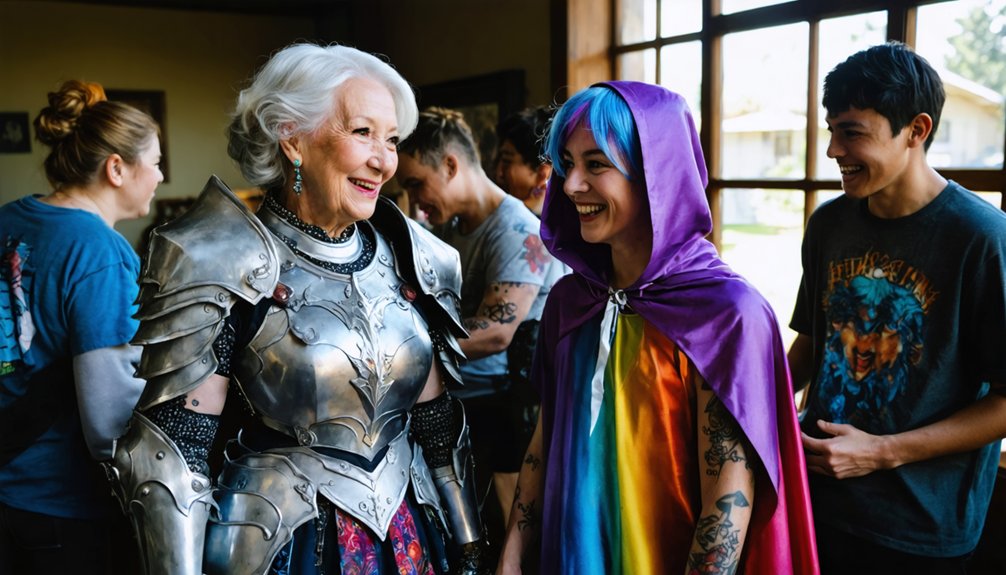
Age-diverse body positivity matters in cosplay because when you welcome creators from fifteen to sixty-five, you naturally expand acceptance of different body types and physical abilities. You’ll find that veteran cosplayers bring technical mastery while younger creators offer fresh perspectives, and together they develop innovative solutions like mobility-aid integration and adaptive costume techniques. This intergenerational collaboration doesn’t just strengthen individual builds—it revolutionizes how your community approaches accessibility, gender expression, and character interpretation. Discover how conventions and makers are transforming this vision into reality.
Key Takeaways
- Age diversity naturally expands body type acceptance as different life stages bring varied physical forms and experiences to character interpretation.
- Accepting cosplayers across ages combats restrictive beauty standards that currently dominate, particularly hypersexualized characters with exaggerated curves.
- Multigenerational collaboration enables adaptive innovations, such as integrating mobility aids seamlessly into costumes and exploring diverse character embodiments.
- Age-inclusive communities strengthen mentorship pipelines, allowing veterans to share technical mastery while newcomers contribute fresh creative perspectives.
- Breaking age barriers revolutionizes identity play and accessibility, enabling gender-bending concepts and plus-size hero interpretations to flourish.
Breaking Down the Current Demographics of Cosplay Communities
The cosplay community spans multiple generations, though current participation concentrates heavily among people aged 16-35. You’ll find youth under 18 engaging through animated series and gaming fandoms, while adults prioritize intricate costume craftsmanship.
Cosplay thrives across generations, with participants aged 16-35 leading the community through diverse interests from gaming fandoms to elaborate costume artistry.
These dynamic demographic shifts reveal exciting opportunities—kids now enter through family events and school activities, expanding the community’s reach.
Gender representation shows 64% female participation, with women driving trends in magical girls and fantasy heroines while men gravitate toward superheroes and action franchises. However, generational communication gaps persist between youth-focused online spaces and adult convention cultures.
Asia Pacific dominates with 49.6% market share, while North America’s Comic-Con culture and South America’s growing event scene demonstrate global expansion. Understanding these demographics helps you build more inclusive, age-diverse spaces where every cosplayer feels valued.
How Ageism Manifests in Modern Cosplay Culture
Ageism cuts through modern cosplay culture both online and at conventions, creating barriers that weaken the community’s collaborative spirit. You’ll encounter gatekeeping comments questioning whether older cosplayers “truly understand” the hobby, while younger creators face dismissal that denies them mentorship opportunities.
This age-based elitism thrives particularly on platforms like TikTok, where generational friction intensifies through comment sections and echo chambers.
At conventions, you’ll notice physical segregation as Millennial, Gen X, and Gen Z cosplayers cluster within their age groups rather than forming mixed communities. This separation blocks intergenerational collaboration and prevents knowledge transfer from experienced creators who develop tutorials and patterns.
When you exclude based on age, you’re undermining the mentorship pipelines that strengthen costume-making techniques and community wisdom across generations.
The Unspoken Divide Between Generational Groups at Conventions
You’ve likely noticed how age groups cluster separately at conventions—younger cosplayers gather in their circles while experienced makers stay in theirs, rarely bridging that gap. This invisible barrier costs everyone: newcomers miss out on valuable mentorship from seasoned creators, while veterans lose opportunities to share knowledge and stay connected to evolving community trends.
When generations don’t mix, assumptions and stereotypes fill the space where meaningful relationships and skill-sharing could flourish.
Segregated Social Circles Form
Walk into any major convention hall and you’ll notice an invisible pattern emerging: cosplayers naturally gravitate toward their own age groups, creating distinct generational clusters throughout the venue. These segregated social circles aren’t just coincidental—they’re reinforced by generational attitudes that shape who gets welcomed into creative spaces.
Older organizers often overlook younger cosplayers for leadership roles, while Gen Z creators face unfair generalizations based on isolated incidents. This age-based hierarchy creates barriers where none should exist, especially in a community built on creativity and self-expression. Convention policies further cement these divides through minor curfews and ID-checked panels.
While mixed-age friend groups do exist, they remain surprisingly rare. The result? You’re missing valuable cross-generational mentorship opportunities and limiting the innovative perspectives that diverse age collaboration brings.
Missed Mentorship Opportunities Arise
The cosplay community holds decades of collective wisdom that’s simply not reaching those who need it most. When 25% of makers possess over a decade of experience but younger cosplayers face exclusion from leadership roles, critical knowledge transfer breaks down.
You’ll find 60% of makers aged 23-39 dominating convention spaces, yet generational rifts prevent them from guiding newcomers lacking confidence in their craft.
This separation creates tangible consequences for body positivity. Without veteran mentors who’ve navigated diverse body types across years of costume construction, younger makers struggle with reduced self-acceptance.
They’re pushed away by age-based stereotypes instead of learning techniques that work for all bodies. Meanwhile, experienced cosplayers overlook opportunities to share inclusive practices, perpetuating cycles where beginners must reinvent solutions that already exist within unreachable networks.
Stereotypes Replace Genuine Connection
When convention halls fill with cosplayers spanning teens to middle-aged fans, assumptions about who “belongs” often overshadow genuine connection. Despite 60% of cosplay makers aged 23-39 bringing decades of experience, age-related stereotypes prevent meaningful interactions that could strengthen community bonds. You’ll notice cosplayers perceive personality differences at conventions versus online, revealing how preconceptions shape our encounters.
These barriers manifest through:
- Pluralistic ignorance: believing others are less welcoming than they actually are
- Age-segregated socializing: under-30 attendees clustering separately from older fans despite shared interests
- Missed collaborations: experienced makers and newcomers rarely connecting across generational lines
When stereotypes replace authentic engagement, everyone loses opportunities for mentorship, skill-sharing, and developing positive self-image regardless of age or experience level.
Challenges Facing Younger Cosplayers in an Age-Biased Environment
When you’re a younger cosplayer entering the community, you’ll often find yourself traversing, maneuvering, or exploring spaces where experienced creators hesitate to share their knowledge, leaving you to learn complex techniques in isolation.
The assumption that you’re only chasing social media clout rather than genuinely passionate about the craft creates barriers before you’ve even had a chance to prove your dedication.
Without access to mentors who can guide your growth, you’re forced to overcome both skill gaps and age-based prejudice simultaneously.
Limited Mentorship and Guidance
Despite cosplay’s reputation as a welcoming community, younger creators face significant barriers in accessing the mentorship they need to develop their craft. With 60% of makers aged 23-39 and 25% cosplaying over a decade, there’s concentrated expertise among veterans—yet ageist attitudes prevent inclusive learning experiences from forming.
You’ll find:
- Structural gaps: Convention leadership primarily consists of Gen X and millennial organizers who overlook Gen Z candidates for guidance roles
- Negative stereotyping: Older peers dismiss younger cosplayers based on a problematic minority’s behavior, blocking multi generational knowledge sharing
- Bidirectional bias: Younger creators sometimes adopt superiority mindsets that isolate them from experienced makers
This environment particularly impacts emerging PSLE-age cosplayers who lack access to safety guidance and technical skill development from seasoned professionals.
Stereotyped as Fame-Seeking
The mentorship barriers younger cosplayers encounter stem partly from a pervasive stereotype that positions Gen Z participants as shallow fame-seekers rather than dedicated artists. These community biases overlook your documented craft skills—73.3% proficiency in sewing, 45.9% in makeup application—and dismiss your legitimate passion for character representation.
Convention organizers often exclude you from leadership roles, reinforcing stereotype perpetuation through gatekeeping that prevents you from shaping community standards. While social media integration has amplified perceptions of validation-seeking behavior, your motivations mirror older generations: genuine fandom and creative expression. This dismissal ignores your equivalent experience levels and serious craft investment.
Breaking these assumptions requires challenging age-based prejudices that position you as peripheral rather than recognizing your essential contributions to cosplay’s evolving creative landscape.
Barriers Experienced by Veteran Cosplayers in Today’s Scene
Over fifteen years of evolution in cosplay culture has created unexpected obstacles for those who’ve been crafting costumes since the community’s earlier days. You’re now traversing a landscape where competitions funnel you exclusively into Artisan or Expert tiers, demanding exceptional builds while discouraging sponsorship opportunities for mid-level veterans.
The physical limitations of aging compound these challenges as duties require extended endurance and all-ages panel restrictions limit your creative expression.
Consider these escalating barriers:
- Resource escalation: Advanced techniques like 3D modeling, foam sculpting, and LED integration weren’t prerequisites when you started—now they’re baseline expectations
- Economic pressure: Prize pools favor top-tier entries while your material costs continue rising
- Visibility erosion: Interviews and panels chiefly feature newer cosplayers, marginalizing your decade-plus experience
Your veteran perspective deserves celebration, not systematic exclusion.
The Connection Between Age Diversity and Body Representation
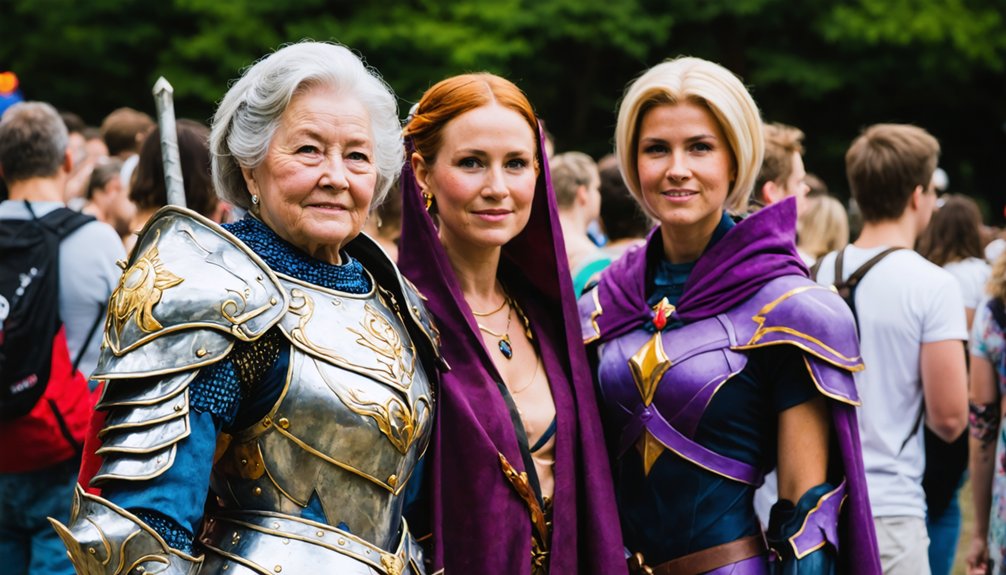
When you examine cosplay’s demographic patterns, you’ll notice how age and body representation intertwine to shape who feels welcome in the community. The 60% concentration of makers aged 23-39 reveals how narrow age bands correlate with restrictive beauty standards—hypersexualized characters with exaggerated curves dominate, creating barriers for bodies that don’t fit these ideals.
You’ll find that inclusive community engagement suffers when generational divides emerge, with younger cosplayers dismissing older participants as “cringey.” Yet the data shows potential: cosplayers ranging up to 50 years demonstrate that overcoming beauty ideals requires embracing age diversity. When your community accepts different life stages, it naturally expands body type acceptance—older cosplayers bring varied physiques and challenge the notion that only youthful bodies deserve representation.
Why Mixed-Age Collaboration Strengthens the Craft
- Technical mastery meets fresh perspectives – Experienced sewers share couture techniques while younger collaborators introduce 3D-printing solutions
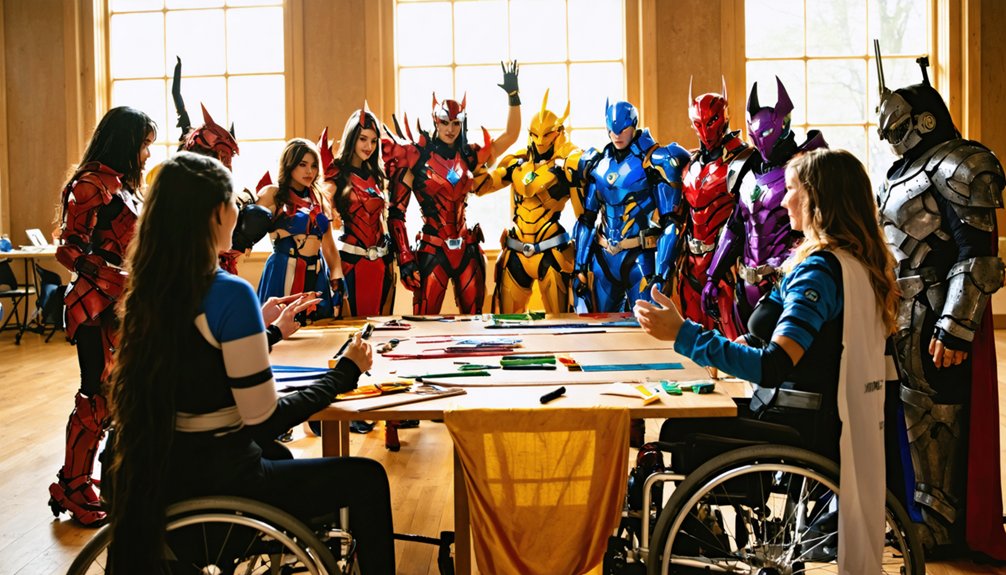
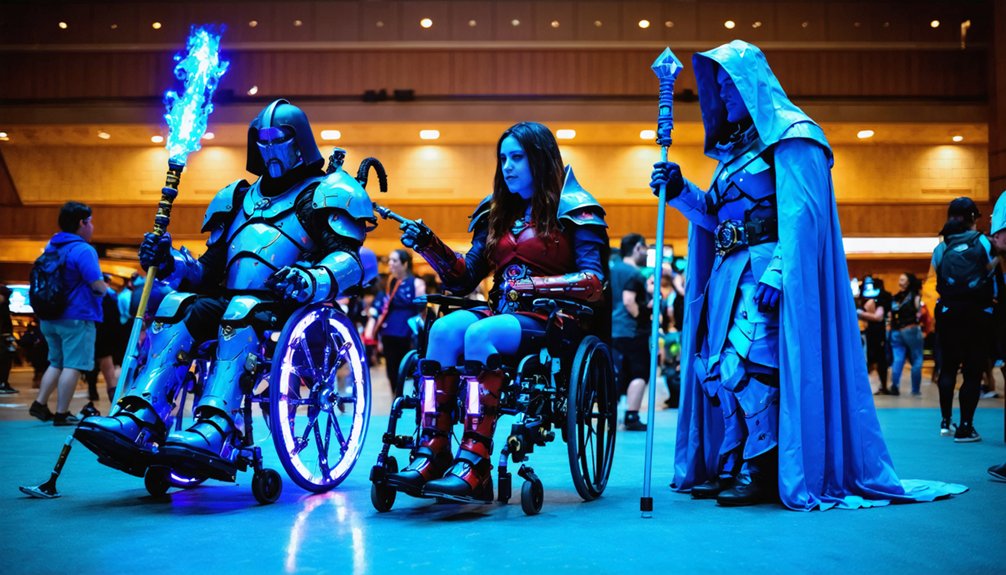
- Adaptive design breakthroughs – Collective problem-solving integrates mobility aids seamlessly into character aesthetics
- Expanded narrative interpretation – Varied life experiences generate gender-bending concepts and character embodiments that single-age groups overlook
You’ll discover these collaborations don’t just strengthen individual costumes—they revolutionize how communities approach identity play, accessibility, and artistic expression across all body types and abilities.
Creating Mentorship Opportunities Across Generational Lines
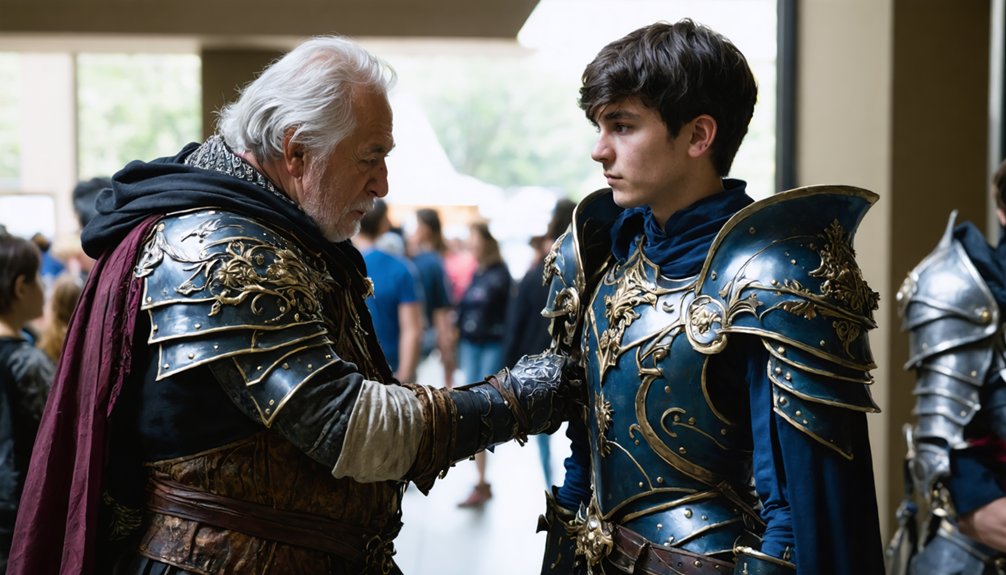
The magic of cosplay mentorship happens in unexpected moments****—a veteran builder demonstrating weathering techniques to a teenager at a hotel crafting table, a Gen Z TikToker teaching a 45-year-old the latest foam-shaping hack, or a retired seamstress guiding college students through corsetry fundamentals.
You’ll find intergenerational skill sharing thrives when conventions intentionally create spaces for knowledge exchange. With 64% of makers attending 3+ events yearly, you’ve got repeated opportunities to connect novices with the 25% who’ve crafted for over a decade.
Multi age event hosting transforms passive attendance into active learning—organize panel discussions pairing emerging and veteran makers, establish mentorship matching programs, and designate crafting zones where skill levels intermingle naturally.
These structured touchpoints combat the age rifts that currently prevent essential knowledge transfer, ensuring that craftsmanship evolves rather than fragments across generational divides.
Building a More Inclusive Future for Cosplayers of All Ages
Mentorship connections plant seeds that grow into systemic change when cosplay communities actively dismantle age-related barriers. You’re witnessing intergenerational cosplay communities reshape industry standards through collective action.
Conventions now implement inclusive design considerations that serve creators from youth under 18 to adults 39+, while e-commerce platforms expand unisex offerings beyond their current 42.3% market share.
Your participation accelerates three critical shifts:
- Accessible creation spaces where 25% of makers producing 5+ costumes yearly share techniques across age groups
- Body-positive competitions that celebrate diverse interpretations from plus-size heroes to adaptive costume innovations
- Multigenerational events leveraging the 64% convention attendance rate to normalize age-inclusive representation
This ecosystem projects USD 15.9 billion market growth by 2035, proving inclusivity drives both cultural impact and sustainable engagement.
Frequently Asked Questions
What Age Range Is Considered Too Old to Start Cosplaying?
Like the Phoenix rising from ashes, you’re never too old to start cosplaying. There’s no appropriate age range or cosplay retirement age—you’ll find vibrant community members beginning their creative journeys at every life stage imaginable.
How Do I Find Cosplay Friends Outside My Age Group?
Attend all-ages cosplay meetups at conventions and online forums where diverse communities gather. Reach out to local cosplay groups through social media platforms—they’ll welcome your enthusiasm regardless of age, creating meaningful connections across generations through shared creativity.
Are Certain Characters Inappropriate to Cosplay at My Age?
No character’s inappropriate for your age! Age appropriate character selection means choosing what resonates with you personally. Cosplay thrives on diverse age representation—your passion and craftsmanship matter most, not arbitrary age limitations. Express yourself authentically!
Do Judges Prefer Younger or Older Cosplayers in Competitions?
You’ll be thrilled to know there’s zero evidence of judge preferences based on age! Age discrimination concerns aren’t supported by data—judges focus on craftsmanship and creativity. Your skills matter most, making competitions welcoming for our entire diverse community.
Should Parents Cosplay Alongside Their Teenage Children at Conventions?
Yes, you’ll strengthen family bonding and intergenerational relationships by cosplaying together. You’ll create shared experiences, model body positivity across ages, and demonstrate that creativity has no generational boundaries while building lasting memories within the welcoming cosplay community.