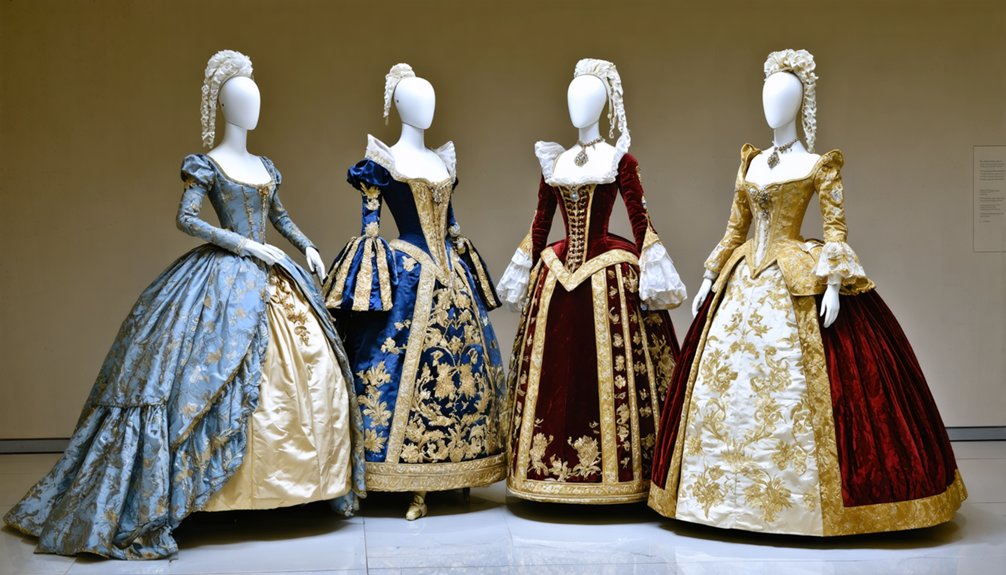
You’ll find historical authenticity in five distinct 18th-century French royal costumes: the Grand Robe de Cour with its boned bodice and separate train (1680s), the Robe à la Française featuring Watteau pleats and panniers reaching 2.5 meters (1750s), full court ensembles with layered understructures (1774-93), nobleman’s coats displaying gold embroidery and jeweled buttons, and Marie Antoinette’s shift/change in style chemise à la reine that rejected rigid stays. Each costume represents specific structural engineering principles that transformed bodies into architectural statements, with construction techniques documented in surviving garments and period sources.
Key Takeaways
- Grand Robe De Cour features boned bodice, low oval neckline, elbow-length sleeves with lace flounces, and dramatic train from waist or shoulders.
- Robe À La Française showcases Watteau pleats, square neckline, decorative stomacher with bows, and paniers extending up to 2.5-meter widths.
- Nobleman’s coat displays gold-threaded velvet, sable lining, diamond-embroidered buttonholes, and jeweled buttons demonstrating aristocratic wealth.
- Marie Antoinette’s chemise à la reine offers simplified silhouette with flowing white cotton, rejecting structured panniers and rigid stays.
- Full court ensemble layers shift, boned stays, petticoats, and silk brocade overdress, creating geometric silhouette through engineered construction.
The Grand Robe De Cour With Elaborate Train and Boned Bodice
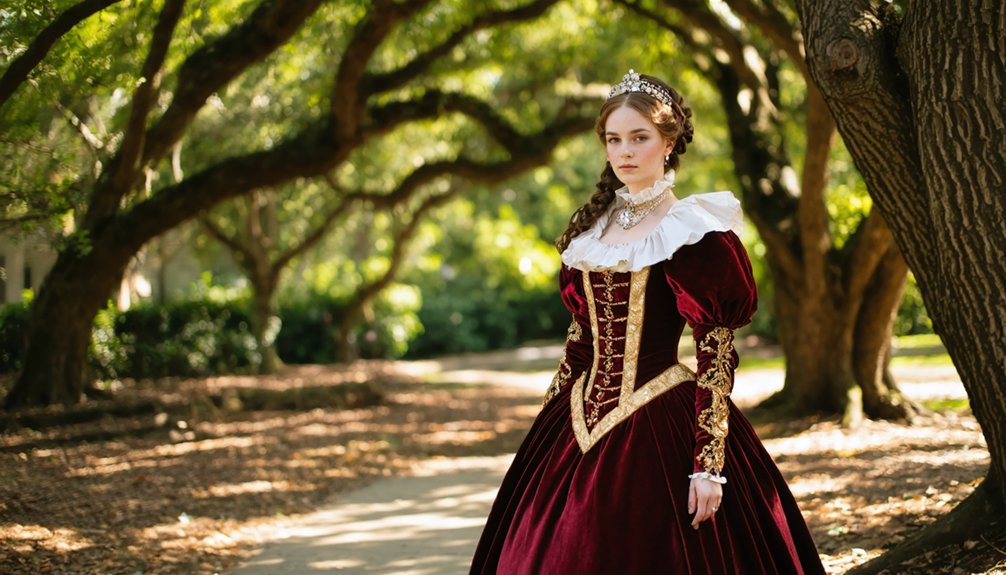
The grand robe de cour emerged in the 1680s as Louis XIV’s calculated response to the informal mantua dresses that had begun infiltrating French court life. You’ll find this garment’s construction mirrors stay-making techniques—a fully boned bodice laced at the back creates its distinctive rigid silhouette. The low oval neckline deliberately exposes shoulders, while elbow-length sleeves feature detachable lace flounces as intricate sleeve embellishments.
What’s revolutionary is the separate train attachment, extending from waist or shoulders to create dramatic visual impact alongside ornate headpieces. Royal decree mandated this costume at formal occasions throughout the 18th century, with specific color requirements: black-and-white for presentations, colored versions afterward. Though Marie Antoinette influenced its 1770s obsolescence, the grand robe remained obligatory for presentations until century’s end.
Robe À La Française Featuring Signature Watteau Pleats
Emerging from the informal domestic sphere in the 1730s, the robe à la française transformed French court fashion through its distinctive construction centered on continuous back pleats flowing unbroken from shoulder to hem. Named after painter Antoine Watteau, these structural elements created Watteau pleat silhouette variations that ranged from softly cascading to architecturally precise forms.
Continuous back pleats flowing from shoulder to hem defined the robe à la française’s revolutionary transformation of eighteenth-century court dress.
Essential Construction Elements:
- Two concealed whalebone stays beneath pleats maintained structural integrity
- Square neckline bodice with decorative stomacher featuring bows and silk fly fringes
- Paniers expanding to 2.5-meter widths during 1750s court presentations
- Rich silk brocades displaying vertical garland patterns from Lyon manufactories (1755-1765)
Cost considerations for Watteau pleats included reinforcement materials—occasionally rolled playing cards—plus elaborate lace engageantes and contrasting underskirts that demonstrated material abundance while achieving the signature bell-shaped silhouette.
Full Court Ensemble With Pocket Hoops and Layered Underpinnings
Beyond surface ornamentation, French court dress demanded complex structural engineering that began with the body’s innermost layers and extended outward through calculated geometric expansion. You’ll discover this architectural approach commenced with the shift, progressed through boned stays constricting your torso into conical form, then layered multiple petticoats before positioning panniers—those fabric-covered hoops enabling Versailles’ characteristic rectangular silhouette.
Your fabric choice of silk damasks, brocades, and embroidered satins wasn’t merely aesthetic but structural, supporting the overdress that opened frontally to reveal the stomacher and underskirt beneath. Accessory elements from marchands des modes—ribbons, lace insertions, silk flowers—completed ensembles that transformed the body into living geometry, each component calibrated for court presentation between 1774–93.
Richly Embellished Nobleman’s Coat With Gold Embroidery and Diamonds
While women’s court dress achieved its monumental silhouette through architectural understructures, male courtiers at Versailles proclaimed their status through surface magnificence concentrated upon the habit habillé—that large coat whose gold embroidery and diamond-set buttons transformed cloth into portable treasury. Your understanding of these garments requires examining their material investment:
- Gold threaded intricacies covered colored velvets, with the Marquis de Stainville’s silver cloth coat featuring sable lining at £1,000
- Diamond encrusted embroidery appeared on button-holes, particularly the Ducs de Chartres and de Penthièvre’s examples
- Buttons incorporated precious stones, mother-of-pearl, or painted miniatures reflecting wearer’s initials
- The accompanying waistcoat displayed diamond buttons and buckles beneath
This textile extravagance—worn with flowing unpowdered wigs—demonstrated wealth through wearable artistry rather than structural engineering.
Marie Antoinette-Era Transitional Gown With Relaxed Formality
Marie Antoinette’s ascent to the French throne in 1774 catalyzed a sartorial revolution that dismantled the very principles governing male courtly magnificence. You’ll find her chemise à la reine construction rejected panniers and structured stays entirely, employing sheer muslin gathered at the waist with simple sashes. This relaxed salon dress components system represented radical departure from Lyon silks and metallic brocades.
The robe en chemise worn at Petit Trianon substituted flowing cotton for rigid undergarments, while the robe à l’anglaise introduced fitted backs with separate bodice-skirt configurations by the 1780s. Your reproduction demands attention to zone-front design details, ruched sabots replacing elaborate engageantes, and the emerging higher waistline that presaged Empire silhouettes. White cotton authenticity supersedes decorative excess in these metamorphic forms.
Frequently Asked Questions
What Were the Documented Penalties for Not Wearing Mandatory Court Dress in 1704?
Documented court etiquette from 1704 reveals no specific penalties for noncompliance with mandatory dress codes. You’d face social erasure—being “not seen” by the king—effectively ending your court access and favor, which proved more devastating than legal punishment.
How Did Ribbon and Lace Choker Styles Specifically Differ During the 1760S?
During the 1760s, you’ll find ribbon styles featured broad, puffed colliers worn tight to the neck, while lace choker variations appeared as blonde silk-edged fichus and engageantes creating softer, layered neckline effects rather than structured bands.
Which Caps À La Henri IV Design Elements Made Them Fashionable Novelties?
You’ll find decorative feather accents and slashed sleeve designs distinguished caps à la Henri IV as fashionable novelties, deliberately evoking sixteenth-century Renaissance aesthetics while offering lighter alternatives to towering eighteenth-century head-dresses through historically-informed reinterpretation.
What Caused Headdress Heights to Diminish Throughout the 18TH Century?
You’ll find headdress heights diminished due to royal condemnation, satirical pressure, and changing social norms that rejected excess. Shifting textile availability and Marie Antoinette’s adoption of simpler styles hastened the metamorphosis toward modest, practical coiffures by 1780.
How Did Split Petticoat Designs Allow Practical Access to Pocket Hoops?
Split petticoats juxtaposed structural elegance with utilitarian function: you’d step through 12-inch side openings to access pocket hoops beneath, ensuring ease of mobility while comfort considerations preserved the era’s dramatic silhouette without requiring complete undressing for practical needs.