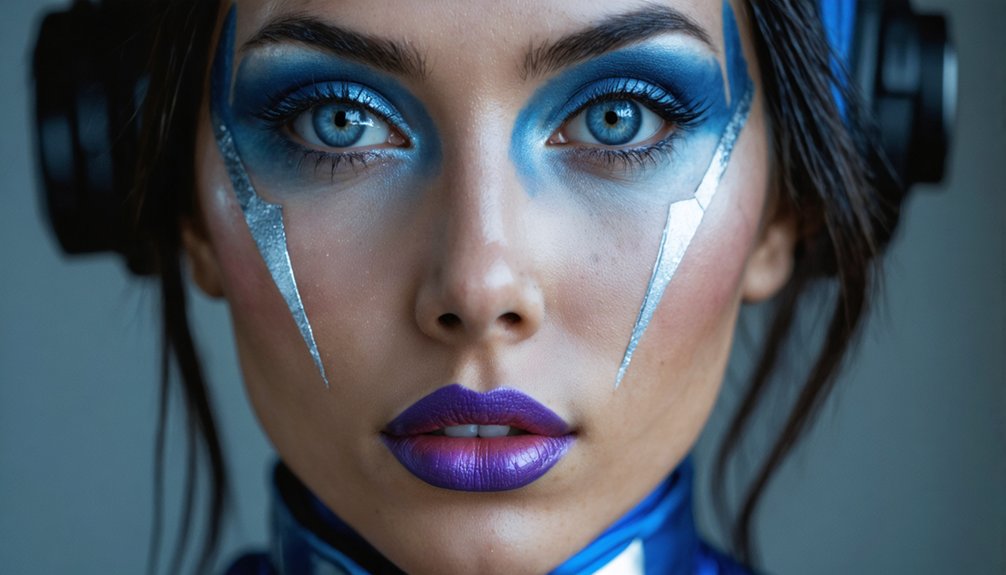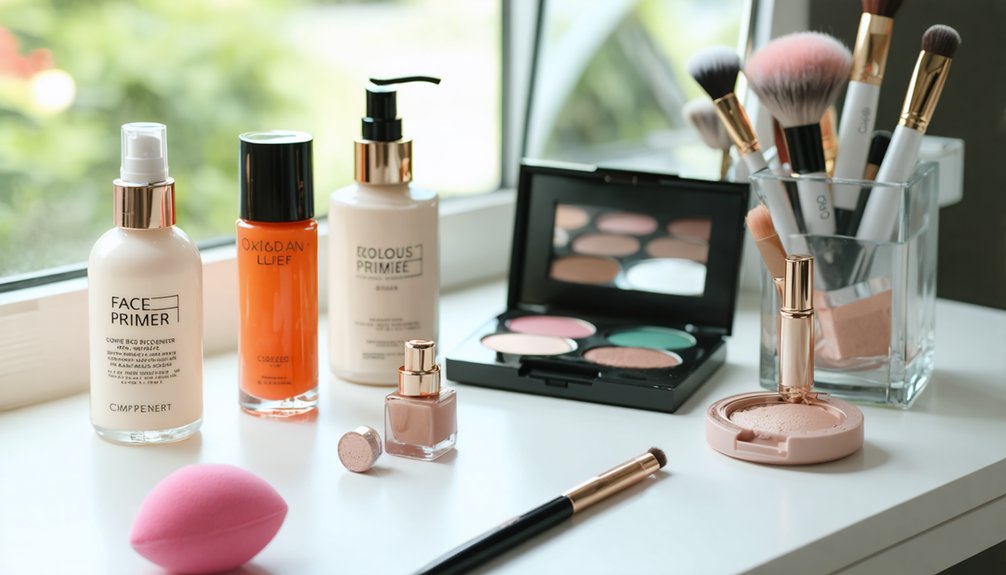
Master these five cosplay makeup essentials: First, you’ll need to prep skin with a primer that matches your foundation base for pore-sealing adhesion. Second, identify your undertone by examining wrist veins, then test foundation on your jawline rather than your hand. Third, apply dark contour diagonally along the jawline and blend upward into metallic highlighters. Fourth, prime your eyelids with adhesive formulas and layer white eyeshadow at inner corners. Fifth, set everything with powder bronzers and spray sealant before donning wigs. The techniques below break down each step’s product specifications and application methods.
Key Takeaways
- Prepare skin with cleanser and moisturizer, then apply primer to create a smooth base and extend makeup wear time.
- Match foundation to your undertone by testing on your jawline, blending with damp sponges for natural coverage.
- Use dark contour along the jawline and highlighter on cheekbones to sculpt facial features for dimensional character accuracy.
- Prime eyelids before applying eyeshadow, and use white liner to reshape eyes for larger, more anime-inspired looks.
- Set makeup with translucent powder and finishing spray to prevent smudging under wigs and during long convention days.
Start With Proper Skin Preparation and Priming
The foundation of any successful cosplay makeup application begins with a meticulously prepared canvas. Start with skin type analysis to determine ideal cleansing protocols—utilize mild cleansers like First Aid Beauty for sensitive conditions or wet wipes for convention settings. Execute exfoliation using mechanical scrubs such as Mizon Honey Black Sugar or chemical peels to eliminate surface irregularities that compromise coverage.
Product selection strategies should align with your dermal profile: gel-based moisturizers for sebaceous skin, cream formulations for xerotic conditions. Allow five-minute absorption intervals between applications. Incorporate toners and targeted serums post-exfoliation for enhanced penetration.
Deploy primer technology to create a barrier against oxidation while extending wear time—select variants offering oil control, adhesion enhancement, or pore-blurring properties. This systematic approach guarantees flawless makeup adherence throughout extended wear periods.
Master Foundation Matching and Application Techniques
Once your skin preparation is complete, foundation matching becomes the critical determinant of believable character transformation. Master undertone identification techniques by examining wrist veins: blue-purple indicates cool, green signals warm, and blue-green reveals neutral undertones.
Foundation matching transcends cosmetics—it’s the cornerstone of authentic transformation, beginning with mastering the subtle science of undertone identification.
Deploy accurate shade matching methods by testing products on your face’s lateral area rather than hands, guaranteeing seamless blending between facial and neck regions.
Select liquid formulations for superior coverage and skin integration, while crème foundations deliver maximum opacity for dramatic character shifts. Apply using synthetic brushes for precise distribution, then blend with dampened sponges using patting motions to prevent streaking.
Combat oxidation by pairing silicon primers with silicon-based foundations or water-based systems accordingly. This strategic approach certifies your foundation performs as a transformative canvas rather than a superficial mask.
Learn Contouring and Highlighting for Character Features
Strategic contouring and highlighting transform facial architecture into character-specific features by manipulating light perception through pigment placement. For powder-based methods, apply dark foundation with neutral undertones diagonally along the jawline, creating authentic shadow effects that photograph exceptionally well. Customized contouring shapes require blending upward into metallic highlighters for dimensional sculpting.
Target photogenic highlighting placement on your T-zone, under-eye triangles, cheekbones, nose tip, cupid’s bow, and chin using padding brush motions for extended wear. Alternatively, dual-ended cream sticks like Wet n Wild’s formula offer superior blending through squishier textures—apply highlight before contour for seamless integration.
Powder formulations prove essential for cake makeup compatibility during extended photoshoots. Fan brushes distribute highlighter evenly across facial high points, while diagonal jawline contouring mimics wig shadowing for cohesive character embodiment.
Perfect Your Eye Makeup and Brow Transformation
Before applying any eyeshadow, prime your lids with eye-specific formulas that create adhesive barriers between skin oils and pigments, preventing creasing during extended wear sessions.
Layer white eyeshadow at inner corners, extending darker shades like matte browns outward to reshape eye geometry. Utilize liquid white liner on lower lash lines to redraw orbital shapes, then tightline waterlines with white pencil for dramatic enlargement effects.
Apply waterproof black liner along upper lashes, blending into smoky wings using targeted shadow placement. Highlight over liner with metallic beige formulas for dimensional contrast.
For brows, deploy fine-tip pens like NYX Lift & Snatch to construct character-accurate shapes before finalizing color coordinated eye accessories. Complete with customized eyelash application that complements your transformation’s intensity requirements.
Set and Seal Your Makeup for All-Day Wear
After perfecting your eye and brow work, you’ll need strategic anchoring methods to maintain that artistry through hours of convention activity. Begin with primer matched to your foundation base—silicone pairs with silicone, water-based with water-based—creating pore-sealing adhesion that withstands stage lighting.
Master powder layering techniques by dusting translucent formulas like e.l.f. High Definition over cream products, building light coats to prevent shifting without caking. Set cream contours with corresponding powder bronzers using angled brushes for seamless blending at your jawline.
Complete with spray setting application using fixing sprays like L’Oréal Infallible, misting your entire face, neck, and jawline after powder application. This flexible seal locks everything beneath wigs and costume pieces, providing essential durability against convention heat and perspiration while maintaining makeup integrity.
Frequently Asked Questions
How Do I Remove Cosplay Makeup Without Damaging My Skin?
You’ll liberate your complexion from theatrical pigments by implementing a proper cleansing routine with gentle makeup removers like micellar water, oil-based solutions, or Cetaphil. Press—don’t drag—using cotton pads in circular motions to prevent epidermal stress.
What’s the Best Way to Store Opened Makeup Products Between Conventions?
Store opened makeup products in separate sealed bags within three-drawer organizers at room temperature. You’ll maintain proper storage conditions by keeping them in climate-controlled bedrooms—not hot attics—and implementing a frequent cleaning schedule to prevent contamination between conventions.
Can I Use Regular Makeup Brushes or Do I Need Special Ones?
You can start with regular brushes using professional application techniques like stippling and layering. However, inexpensive alternatives with denser synthetic bristles offer superior pigment deposit and longevity under heavy-coverage cosplay conditions, especially over prosthetics.
How Do I Prevent Makeup From Transferring Onto My Cosplay Costume?
Ironically, your biggest enemy isn’t stage lights—it’s fabric contact. You’ll need to use setting powders liberally and invest in transfer-resistant cosmetics with film-forming polymers. Apply primer, build coverage gradually, then lock everything with professional-grade fixing spray for complete costume protection.
What Should I Do if I Have an Allergic Reaction During an Event?
Remove the offending product immediately with hypoallergenic remover, apply cold compresses, and take oral antihistamines. Monitor for worsening symptoms like angioedema or respiratory distress, and seek medical attention promptly if reactions escalate or persist beyond initial intervention.