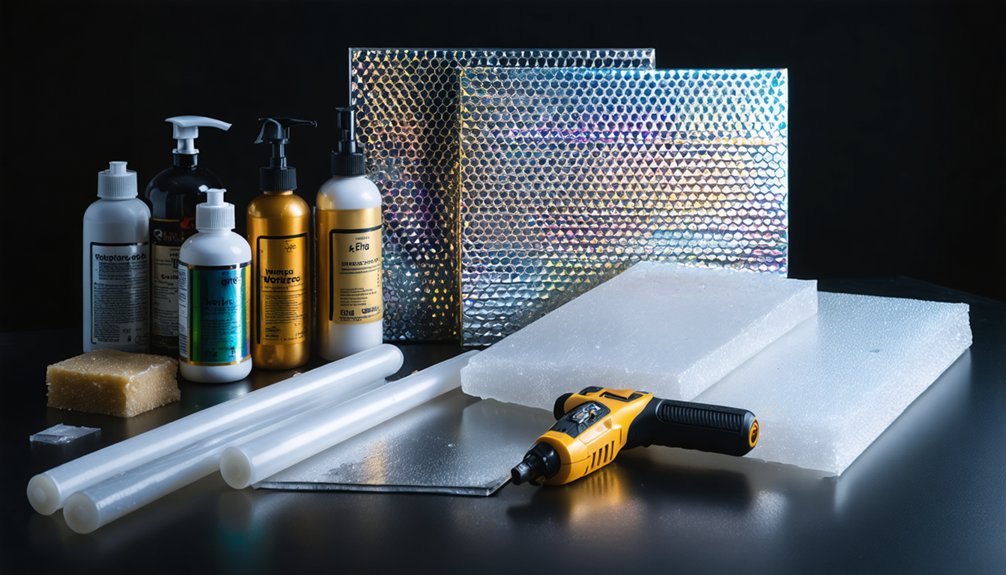
You’ll want EVA foam as your primary material—it’s lightweight, heat-moldable, and maintains structural integrity through extended wear. High-density variants in 2mm-10mm thicknesses let you create detailed armor pieces that won’t fatigue you at conventions. Combine thermoplastics like Worbla for intricate surface details and edge finishing, while foam pool noodles excel for large cylindrical props. Cardboard works perfectly for angular constructions and templates. Layer these materials strategically to optimize your weight distribution while achieving the dimensional depth your build demands.
Key Takeaways
- EVA foam offers superior lightweight construction that prevents fatigue while resisting dents, tears, and deformation during extended wear.
- High-density EVA foam maintains detailed shapes and provides structural integrity in 2mm, 5mm, and 10mm thicknesses.
- Thermoplastics like Worbla layered over foam bases add precision details while maintaining the lightweight core structure.
- Polyethylene foam pool noodles create lightweight foundations for large cylindrical props when reinforced with PVC pipe cores.
- Craft foam and chipboard provide flexible, lightweight options for templates, curved pieces, and angular armor constructions.
EVA Foam: The Cosplayer’s Foundation Material
EVA foam stands as the material of choice for cosplay armor construction due to its unique combination of properties that address both fabrication requirements and wearer comfort. You’ll find high-density variants deliver superior structural integrity with minimal air pockets, maintaining detailed shapes and precise seams throughout extended convention wear. The material’s lightweight construction prevents fatigue while resisting dents, tears, and deformation.
Molding EVA foam via heat transforms flat sheets into compound curves that conform to your body’s contours. You can layer multiple thicknesses to achieve dimensional depth, then refine surfaces using rotary tools for beveled edges and engravings. Cushioning EVA foam layers at contact points enhances wearability without compromising the armor’s professional appearance. Available in 2mm, 5mm, and 10mm thicknesses at accessible retail locations, it provides cost-effective solutions for both props and full-body builds.
Worbla and Thermoplastics for Detailed Armor Pieces
When you need precision detailing beyond EVA foam’s capabilities, thermoplastics like Worbla Black activate at temperatures between 120-180°F, becoming moldable for intricate armor components.
You’ll apply heat activation techniques to create complex curves and structural elements, then layer thin sheets over foam bases to add raised surface details, rivets, and decorative elements.
This combination method leverages foam’s lightweight core with thermoplastic’s superior edge finishing and self-adhesive properties for seamless joints.
Heat Activation and Shaping
Thermoplastic materials like Worbla revolutionize armor construction by offering unlimited reshaping cycles through heat activation. You’ll position your heat gun five inches away, using the lowest setting for even thermal forming processes. The material signals readiness when it darkens and achieves clay-like malleability. You can reshape repeatedly without degrading structural integrity.
For assembly, cut sheets slightly larger than foam patterns, then sandwich or fold around edges. Press heated surfaces together firmly, employing pinning techniques to eliminate trapped air bubbles. Roll scraps into thin noodles for borders and detail work—they’ll adhere tackily without adhesives.
Post-assembly modifications remain possible: reheat to etch textures, cut adjustments, or add dimensional elements. This thermoplastic’s self-adhesive property and infinite reworkability make it ideal for innovation-driven armor fabrication requiring both precision and adaptability.
Layering for Fine Details
Building dimensional armor requires strategic layering that transforms flat thermoplastic sheets into sculptural forms with pronounced depth. You’ll achieve precision details through the sandwich method—craft foam between two Worbla sheets creates stable foundations for customizable embossing. Transfer patterns with 1-2 inch margins, press heated Worbla around foam designs using pointed wooden tools, then seal with a second layer.
Advanced Layering Techniques:
- Stack multiple foam layers before Worbla covering to build pronounced three-dimensional elements
- Work one quadrant at a time to manage rapid cooling during embossing procedures
- Apply heated Worbla scraps like moldable clay for hand-sculpted ornamentation without adhesives
- Reinforce curved sections with fabric-backed layers to prevent structural buckling
Finish with 2-3 coats of wood glue or filler primer, sanded smooth for paintable surfaces that maintain crisp detail definition.
Combining With EVA Foam
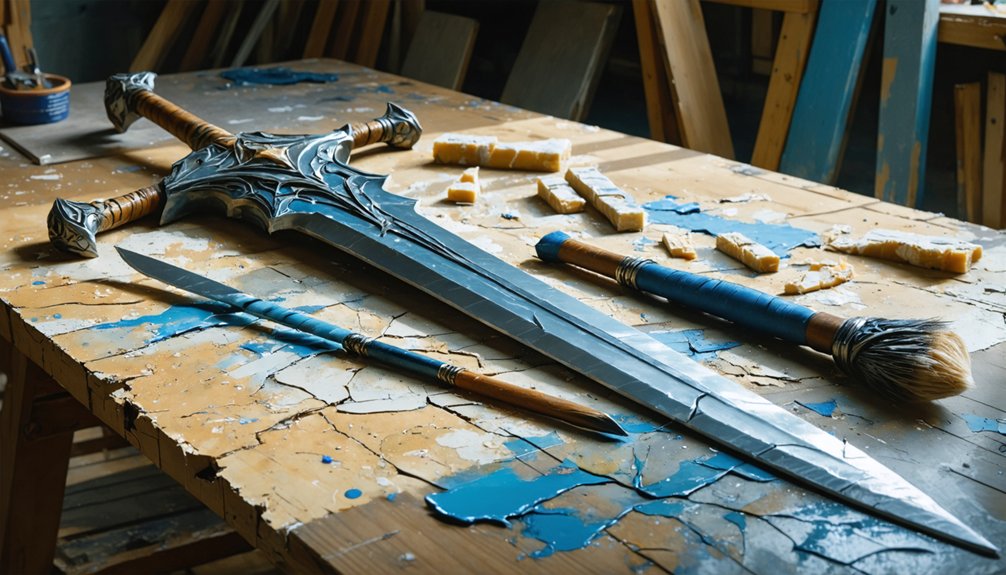
Two materials create stronger armor than either component alone—EVA foam provides lightweight structure while thermoplastic shells deliver impact resistance and surface refinement. You’ll achieve ideal results through molding over shaped foam, heating Worbla to fruit-leather consistency before draping it over carved EVA details. Black Art excels here—its texture mimics foam grain for wood finishes, though you must carve generously to prevent tearing during stretches.
The “Worbla sandwich” technique embeds 2mm foam between thermoplastic layers, creating rigid boot covers and props without bulk. Self-adhesive properties eliminate separate bonding agents, while bonding with other materials extends to cross-brand compatibility—ThermoArt bonds directly with Worbla under heat application. You’ll reinforce protruding pauldrons and chest plates cost-effectively, maintaining durability through convention wear, mock combat, and transport without internal armatures.
Foam Noodles for Large Cylindrical Props
When constructing large cylindrical props for cosplay armor, pool noodles made from polyethylene foam provide an exceptional foundation that balances structural integrity with minimal weight. You’ll achieve professional results by molding fluid textures through circumferential slicing—typically four cuts per tube—then applying heat to refine contours. Leveraging heat activated bonding eliminates mechanical fasteners while creating seamless joints between sections.
Essential techniques for cylindrical prop construction:
- Insert PVC pipe cores before heating to prevent exposed hard edges while maintaining blade rigidity
- Clamp your heat gun for consistent temperature distribution across fusion points
- Apply brown paint gradients over melted seams to simulate wood grain or metallic patinas
- Utilize hot wire cutters for rapid custom shaping beyond standard cylindrical forms
Complete full-scale props in under an hour while maintaining durability for repeated convention use.
Cardboard and Craft Foam for Templates and Layering
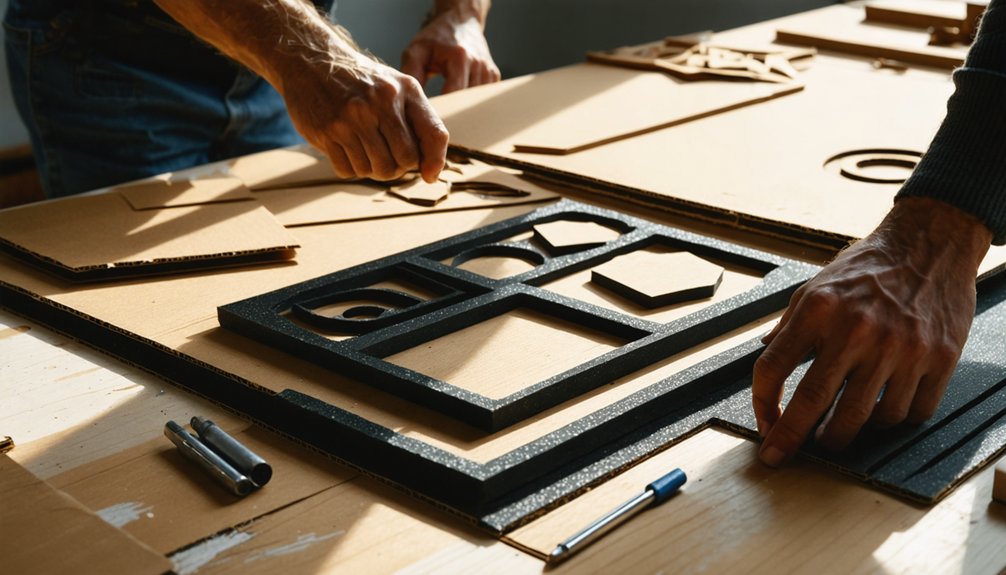
Pool noodles excel at creating smooth cylindrical forms, but geometric armor components demand materials that accommodate sharp angles and precise templating. Cardboard’s material properties make it ideal for 8-bit designs and angular constructions. You’ll find chipboard provides flexibility for curved helmet pieces, while shipping box cardboard delivers rigidity for shields and chest plates.
Master dart construction by cutting lower layers completely through and upper layers partially, then peel to create bendable flaps. Hot glue bonds sections effectively while maintaining structural integrity. Apply reinforcement techniques through layering—multiple cardboard sheets add dimensional depth and prevent separation during wear.
Use cardboard as your base template for EVA foam overlays, creating scale details and mosaic accents. This combined approach optimizes weight distribution while maintaining structural stability throughout extended convention wear.
Combining Materials to Optimize Weight Distribution
Strategic material combinations transform single-layer foam pieces into engineered armor systems that distribute weight across your body’s natural load-bearing points. You’ll achieve ideal density distribution by pairing high-density EVA foam cores with low-density exterior layers, creating structural integrity without bulk. Thermoplastics like Black Worbla reinforce stress points sparingly—shoulder joints, chest plate edges—while maintaining weight optimization throughout the build.
Layer high-density foam cores with lightweight exteriors to engineer armor that distributes weight efficiently across natural load-bearing points.
Advanced layering techniques for balanced armor:
- EVA-thermoplastic hybrids: Apply Worbla selectively to 8mm foam bases for edge definition and hardness where impact resistance matters most
- Resin-coated foam segments: Use Smooth-Cast or Epsilon Pro on high-wear areas while leaving flexible sections uncoated
- Fabric-foam composites: Cover 2mm EVA with metallic Lycra for movement-intensive pieces requiring breathability
- Density-stratified construction: Layer thin high-density foam against body contact points, shifting to lightweight materials externally
PVC Pipe and Wooden Dowels for Structural Support
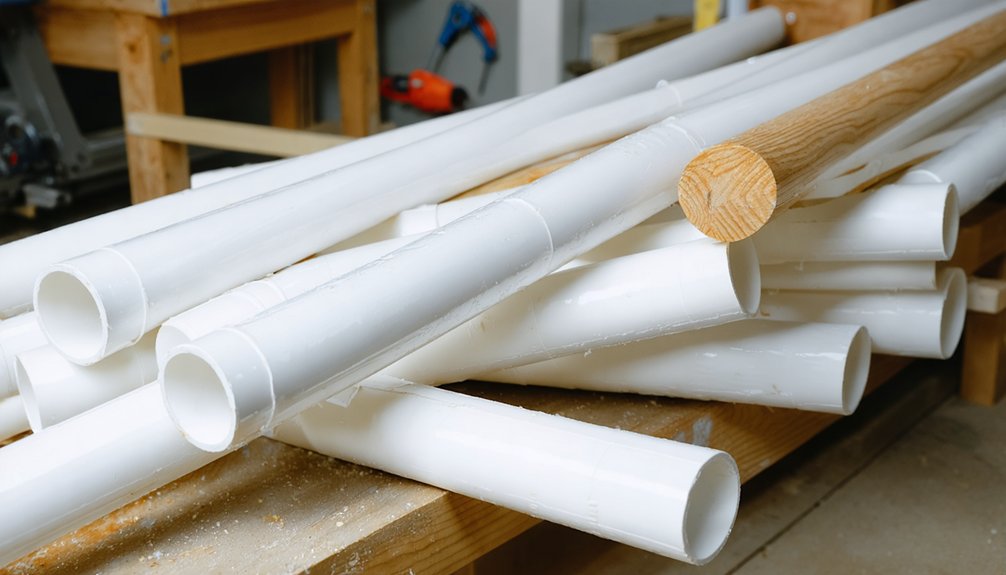
While foam dominates lightweight cosplay construction, rigid structural elements solve critical engineering challenges that flexible materials can’t address—plate curvature retention, load-bearing connections, and three-dimensional shaping that maintains form under stress.
Four-inch diameter drain pipe (thinner-walled than pressure variants) provides optimal material economy. You’ll heat-flatten 10-foot sections into workable sheets using propane burners, then thermoform curved breastplates and articulated vambraces.
Half-inch wooden dowels integrate as internal supports, cementing into PVC connectors for hybrid frameworks requiring additional rigidity without mass penalties.
Connection methodologies employ Chicago screws, embedded machine screws with fender washers, or thick wire loops for load distribution. Perform strength testing on heated joints before final assembly. Critical consideration: guarantee adequate ventilation during thermoforming, as PVC releases chlorine compounds. Moisture management remains negligible given materials’ inherent water resistance.
Fast Mache as a Lightweight Alternative to Traditional Fillers
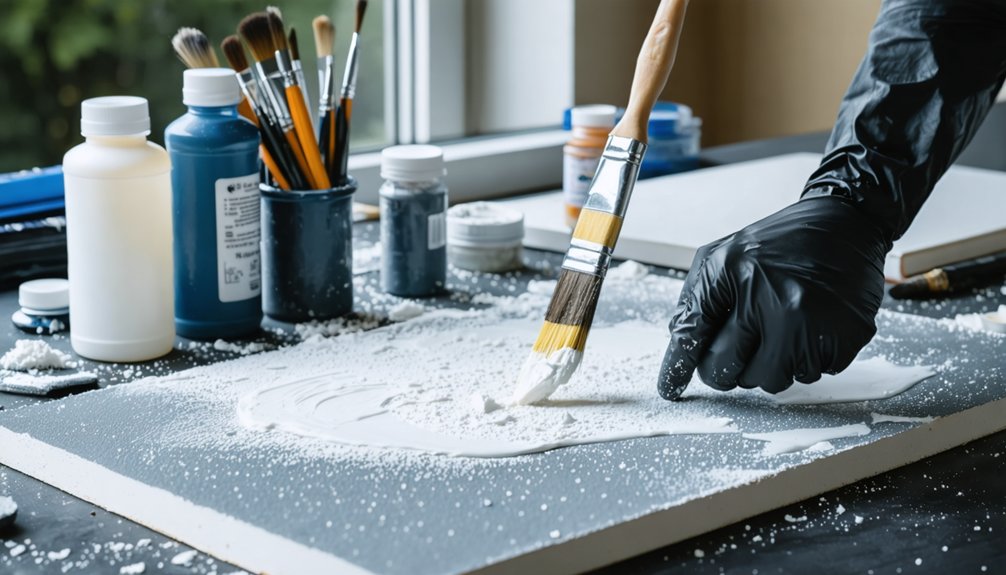
Fast mache—a rapid-drying paperclay variant—offers cosplayers a minimal-mass filler that bonds paper pulp with adhesive for quick application over armor bases.
You’ll apply it directly to tagboard, cardboard, or masking tape structures to smooth imperfections and create paintable surfaces within hours. The material dries to a firm yet slightly spongy texture that accepts paint, sands moderately well, and requires sealing with products like Mod Podge for con-ready durability.
What Is Fast Mache
Activa Fast Mache provides cosplayers with a pre-mixed, air-dry material that serves as a lightweight alternative to traditional heavy fillers like Bondo. This paste requires no mixing and applies directly over foam or cardboard bases, eliminating the complexities of traditional flour-water recipes that produce noodle-like lumps.
Key Material Properties:
- Drying Properties: Achieves partial tack in 30-45 minutes for smoothing, reaching full hardness in 1-2 days
- Application Method: Functions ideally as thin coating rather than primary sculpting material
- Weight Optimization: Lower density than Bondo reduces overall prop weight while maintaining durability
- Adhesion Challenges: Requires regular mache underlayer on foam substrates for proper bonding
You’ll achieve best results by shaping your base form precisely before application and supporting pieces during cure to prevent warping.
Sanding and Finishing Properties
How effectively can you sand Fast Mache to achieve professional-grade armor surfaces? You’ll obtain completely smooth, professional finishes through sufficient sanding investment, though ideal timing for sanding occurs within one day post-application—before full hardening increases difficulty exponentially. Apply thin coats rather than thick layers to prevent flat appearances while maintaining structural integrity. Extended sanding sessions yield flat surfaces that rival commercial-grade armor finishes.
For maximizing material efficiency, use regular papier-mâché as your base layer to cover foam imperfections, reserving Fast Mache exclusively for finishing coats. This strategic approach preserves your premium material while maintaining superior surface quality. Multiple thin applications outperform single thick coats in both durability and weight management. One box covers substantial pieces like complete helmets when applied strategically as a finishing compound rather than structural filler.
Application Techniques for Armor
Strategic application of Fast Mache transforms foam and pepakura bases into durable armor without the weight penalties of traditional resin systems. You’ll achieve ideal results by shaping your base geometry as close to final specifications as possible, then applying Fast Mache in thin, controlled coats. This technique prevents the flat appearance common with excessive buildup while maintaining structural integrity.
Critical application protocols:
- Smooth partially-dried Fast Mache with dampened hands after 30-45 minutes to eliminate surface irregularities
- Support armor components on mannequins during curing methods to prevent dimensional warping
- Layer systematically—minimum three coats inside and outside—with accelerated drying between applications
- Seal completed assemblies with Mod Podge for moisture resistance during storage considerations
One Fast Mache container efficiently covers helmet and arm assemblies, making it exceptionally cost-effective for innovative armor fabrication.
Metallic Lycra for Flexible Armor Coverage
When constructing flexible armor coverage for cosplay, metallic lycra delivers the ideal balance between visual impact and unrestricted movement. The 90% polyester, 10% spandex composition integrates metallic foil finishes through specialized coating processes, producing light-reflective surfaces that simulate metal plating without weight penalties. High stretch capabilities—specifically 4-way stretch configurations—enable your armor to conform dynamically to body contours during performance sequences.
You’ll achieve perfect results using nylon-spandex tricot variants for base layer applications, while black spandex foil lamé provides enhanced structural support for articulated armor segments. The 60-inch width accommodates pattern layouts efficiently, reducing seam counts. Material specifications include 14 oz per yard density, moisture-wicking properties for extended wear comfort, and UV-resistant polyester metallic lycra that maintains colorfastness under stage lighting conditions. Machine wash cold, air dry protocols preserve metallic integrity.
Specialty Foams for Advanced Lightweight Builds
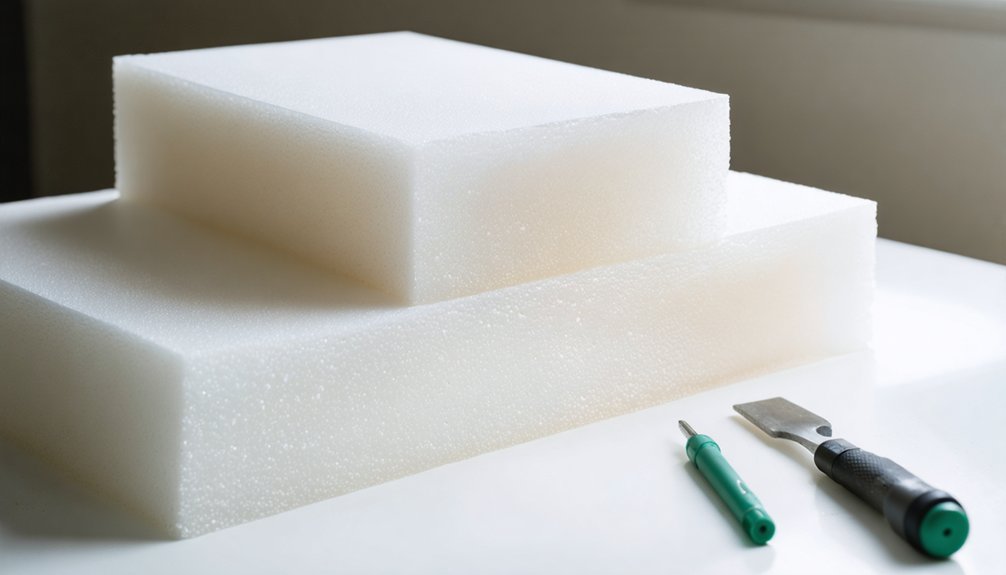
Selecting the appropriate foam density fundamentally determines your armor’s structural integrity and performance longevity. EVA 60’s rigidity eliminates internal frameworks for swords and reinforced plates, while 85 kg/m³ high-density EVA delivers superior heat-moldable retention for curved components. Plastazote’s semi-transparent structure revolutionizes illuminated builds through effective LED diffusion, though you’ll need strategic reinforcement with denser substrates.
Advanced foam applications demand precise execution:
- Layering techniques combine high-density bases with low-density accents for dimensional complexity
- Heat guns enable permanent shape memory in 85 kg/m³ formulations for helmets and shoulders
- Belt sanders create sharp bevels and edges in EVA 60’s dense matrix
- Adhesive application methods require contact cement for load-bearing joints, complemented by Plastidip priming
Your material selection directly impacts workshop efficiency and convention durability outcomes.
Frequently Asked Questions
How Do You Seal and Paint Foam Armor to Look Realistic?
You’ll seal foam with Plasti-Dip and Flexbond, then prime with automotive products. Apply metallic base coats using surface finishing techniques, followed by weathering and distressing effects through dry brushing, washes, and Rub n Buff for authentic dimensional realism.
What’s the Best Adhesive for Attaching Different Cosplay Materials Together?
You’ll achieve professional-grade bonds using flexible epoxy resins for dissimilar substrates requiring structural integrity, while cyanoacrylate adhesives excel at quick-tack applications. However, contact cement dominates foam-to-fabric interfaces, and E-6000 provides unmatched versatility across multi-material assemblies.
Can Lightweight Armor Withstand Convention Wear and Multiple Events?
Yes, you’ll achieve multi-event durability with proper material selection and reinforcement techniques. High-density EVA foam and thermoplastics withstand convention wear when sealed correctly. Consider storage requirements—flat packing prevents warping, while climate-controlled environments maintain structural integrity between events.
How Do You Size Armor Pieces for Proper Fit and Mobility?
Take precise measurements of arm/leg circumference at widest points, then fabricate test pieces. Evaluate range of motion through full movement cycles—bending, reaching, sitting. You’ll achieve ideal fit by iterating designs until mobility matches performance requirements.
What Safety Precautions Are Needed When Heat-Forming Thermoplastics?
You’ll need appropriate protective equipment—heat-resistant gloves, safety glasses, and respirator—because molten plastic burns aren’t the aesthetic you’re after. Guarantee proper ventilation requirements are met to exhaust toxic fumes, maintaining workspace integrity while thermoforming your armor components.