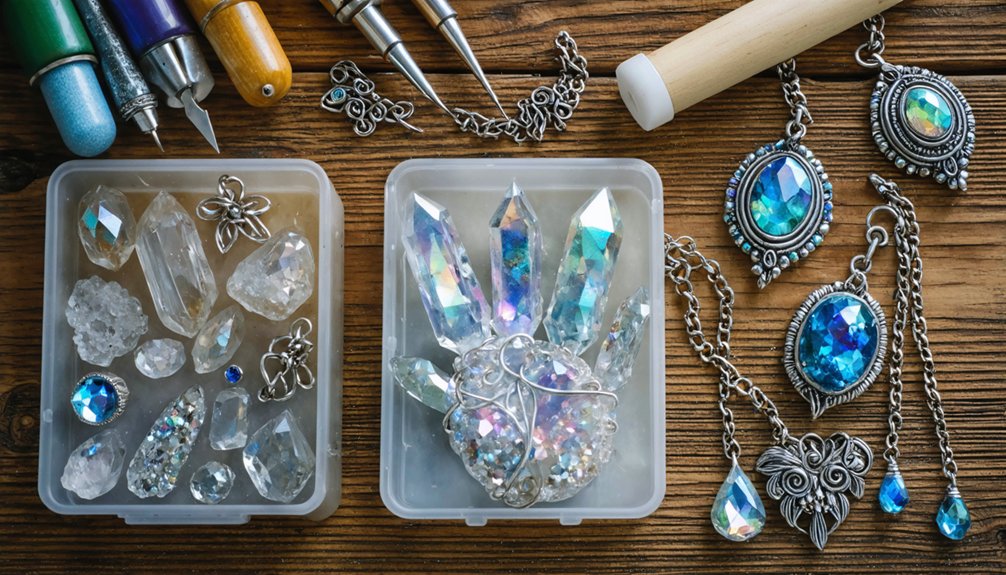
The three best methods for homemade cosplay jewelry are hot glue gems on aluminum foil, resin casting, and EVA foam sculpting. You’ll create glass-like gems by applying crystal clear glue sticks onto foil backing, then smoothing with a heat gun. Resin casting delivers professional dimensional depth through precise mixing and layered applications in silicone molds. EVA foam provides lightweight sculptural pieces through heat manipulation and strategic layering. Each technique offers distinct advantages for different jewelry styles, and mastering their specific protocols will elevate your costume’s authenticity.
Key Takeaways
- Hot glue gems on aluminum foil create glass-like effects using crystal clear sticks, heat smoothing, and colored foil backing.
- Resin casting produces professional clarity through precise mixing, layered pouring, and flexible silicone molds with proper ventilation.
- EVA foam sculpting offers lightweight dimensional pieces using heat manipulation, strategic layering, and carved textures sealed with heat.
- Wire settings with 18-gauge aluminum or metal rings provide secure mounting options for gems and cosplay integration.
- Custom shapes achieve unique effects through silicone molds, marker blending, glitter additions, and clear nail polish sealing.
Hot Glue and Foil Gem Creation
Creating transparent gems with hot glue requires crystal clear glue sticks as your foundation—opaque or colored varieties won’t produce the glass-like effect you’re after. Place dots of glue on aluminum foil backing, working from center outward for ideal adhesion.
Your heat gun smooths imperfections without overheating, which causes clouding. Achieving depth and clarity demands shallow layering—thick applications fog the gem’s interior. Once cooled, cut closely around each piece and fold excess foil backward.
Designing custom shapes becomes possible through silicone molds or freehand application. Color your foil backing with permanent markers or nail polish before applying glue, enabling galaxy effects through strategic marker blending. Decorative glitter or sequins can be sprinkled into the glue while still warm to add dimensional sparkle. Seal finished gems with clear nail polish for enhanced luminosity and protection.
Wire settings using 18-gauge aluminum provide professional mounting options for cosplay integration. Metal rings serve as ready-made settings when filled directly with hot glue for an instant gem mounting solution.
Resin Casting for Professional-Looking Pieces
Resin casting elevates your cosplay jewelry from craft-level to convention-worthy through its glass-like clarity and dimensional depth. Master these essential techniques for professional results:
Transform ordinary costume accessories into premium convention pieces with resin’s crystal-clear finish and professional-grade depth that commands attention.
- Precision Mixing Protocol: Measure hardener first, then resin according to manufacturer ratios (typically 2:1). Stir slowly for several minutes to guarantee bubble reduction techniques while maintaining proper ventilation.
- Mold Selection Strategy: Use flexible silicone molds or prepare plastic variants with thin vaseline coatings. Custom molds from Sculpey prototypes accommodate unique design specifications.
- Mixed Resin Layering: Pour initial clear base, allow partial cure, then add colored or glitter-infused layers. Complete with transparent dome coating for enhanced brilliance.
- Demolding Execution: Flex silicone edges gradually after full cure to release castings without surface distortion. Target casting 8 gems simultaneously to maximize production efficiency while working on other costume elements. Reusable molds enable multiple batches for matching jewelry sets or backup pieces.
Apply backing finishes using nail polish or painted tagboard for enhanced visual impact.
EVA Foam Sculpting and Shaping
Lightweight EVA foam transforms into dimensional cosplay jewelry through strategic layering, heat manipulation, and precise edge refinement. Begin with 5mm sheets for basic pieces, upgrading to 10mm for structural earrings or 30mm dowels for volumetric fangs. Trace paper patterns using an awl, then cut shapes with circle cutters or slice dowels to length. Round all edges with a Dremel before heat application.
Wave your heat gun 4 inches from foam for 30 seconds per side, then stretch, bend, or press heated pieces into bowls for bevels. Layered foamtex techniques build complexity from base layers upward. Carve textures with an Exacto knife, seal carved channels with heat, then apply flexible rubber filler to seams. Sand progressively from 60 to 80 grit. Prime finished pieces with 3 coats of Plasti Dip for a smooth paintable surface. Once heat shaping is complete, add backing pieces to necklaces and earrings for structural support and a professional finish. Secure components using glue gun attachment methods for seamless assembly.
Frequently Asked Questions
Can Plastic Bottles Be Transformed Into Realistic Cosplay Gemstones?
Yes, you’ll transform discarded bottles into brilliant gems through upcycling plastic flower-shaped bases. Cut symmetrical petals, embed hot glue crystals creating patterns with colored adhesive, then layer progressively smaller pieces. This technique produces lightweight, translucent gemstones perfect for innovative costume applications.
What’s the Best Way to Attach Metal Findings to Painted Gems?
Apply E6000 or mixed epoxy resin to clean metal findings using a toothpick, then press onto your painted gem. After curing, add sealant application like spray varnish to protect the bond and safeguard durable cosplay wear.
How Do You Prevent Nail Polish From Melting Styrofoam Surfaces?
You can’t—acetone gleefully devours polystyrene like a chemical Pac-Man. Instead, apply Styrofoam sealants like Mod Podge or acrylic coating options (gesso works brilliantly) before painting. These barriers prevent solvent penetration, preserving your foam’s structural integrity completely.
Which Painting Techniques Create the Most Reflective Metallic Shine?
You’ll achieve maximum reflective shine using the Multi-Layer Enamel Process with chrome base, or explore electro plating techniques and foiling application methods. These advanced approaches create mirror-like finishes surpassing standard metallics for innovative cosplay pieces.
Can Foam Clay Be Combined With Wire for Structural Support?
You’ll achieve superior foam clay durability by incorporating wire reinforcement into your armature. Bend your wire framework first, then layer foam clay over it. This technique prevents structural collapse and maintains complex shapes throughout construction and wear.
References
- https://www.youtube.com/watch?v=oYkAWzfzifY
- https://www.youtube.com/watch?v=-bnY4NHD75g
- https://ashweezcosplay.com/2022/04/04/making-my-kena-cosplay-part-ii-necklace-staff/
- https://www.youtube.com/watch?v=oqgaaReBkLo
- https://aliceincosplayland.com/2012/10/cosplay-tutorials-making-gems-and-jewels.html
- https://wanderfulcatcreations.com/tips-and-tricks-for-making-durable-and-long-lasting-costume-jewelry/
- https://www.perlesandco.co.uk/resources/f1941-how-to-create-your-costume-jewellery.html
- https://www.instructables.com/DIY-Faux-Resin-CharmsGems-Using-Hot-Glue/
- https://www.youtube.com/watch?v=LlCF0Me09Cs
- https://www.youtube.com/watch?v=JXkSELR6o1Y