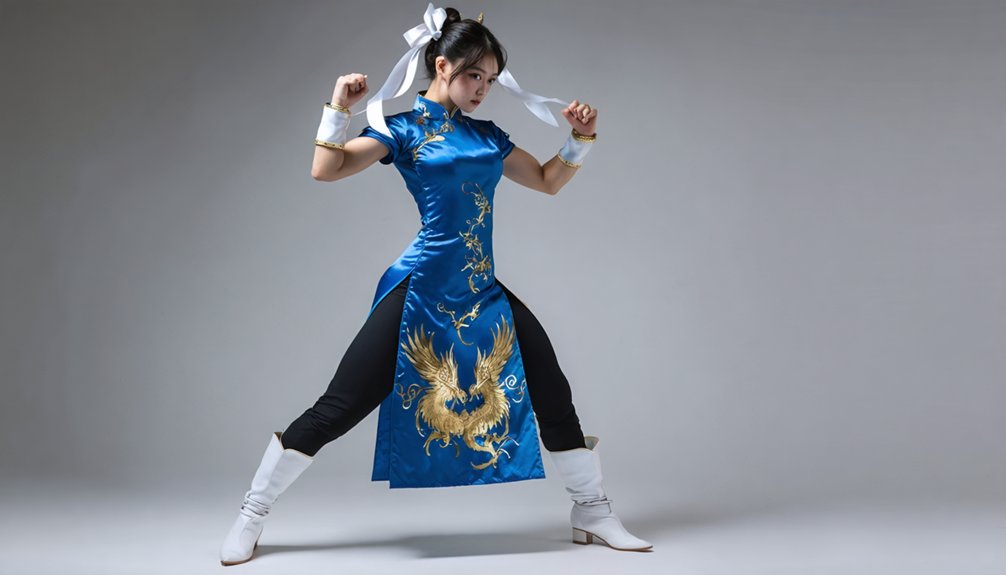
To nail Chun-Li’s signature look, you’ll draft a curve-hugging qipao with mandarin collar and dramatic puffed sleeves by spreading your sleeve pattern outward and gathering edges with zigzag stitching. Install a separating zipper up the center back, sewing directionally from hem to neckline. Complete your transformation with spiked wrist cuffs, white heeled boots, and symmetrical odango buns secured through strategic folding and pinning. Master her Lightning Kick stance by distributing weight through your forearm while extending sweeping arcs, and you’ll discover the construction secrets that separate authentic cosplay from simple costume assembly.
Key Takeaways
- Construct the qipao dress with mandarin collar, scalloped edge details, and puffed sleeves using gathered fabric and supportive interfacing.
- Install a separating back zipper from hem upward, trimming excess tape before attaching the collar for proper alignment.
- Complete accessories with spiked wrist cuffs, jade-gold bracelets, and white heeled boots to achieve authentic warrior aesthetics.
- Style hair into symmetrical double buns using center parting, high ponytails, and strategic bobby pinning for volume.
- Photograph dynamic fighting stances using low angles, weight distribution principles, and foreshortening to showcase powerful leg techniques.
Foundation Qipao Dress Pattern and Fabric Selection
Where do you begin when recreating Chun-Li’s iconic qipao? Start by sourcing qipao patterns through free downloads or commercial vendors designed for costume adaptation. You’ll find pattern pieces separated into bodice and skirt components, typically arranged in 4×4 grids with 16 pieces for standard sizing.
Before committing to your final blue base with gold accents, construct a muslin toile using inexpensive cotton at $1.40 per meter. This test garment reveals necessary pattern modifications for Chun-Li’s distinctive silhouette. Mark your fabric with center lines and height indicators for bust, waist, hip, and length placement.
Consider fabric blends that accommodate movement while maintaining structure. Test gold fabric paint on your chosen material first, ensuring compatibility with your base fabric’s composition before full application.
Mandarin Collar Construction With Scalloped Edge Details
You’ll draft Chun-Li’s signature mandarin collar by measuring 1.5 inches up from your qipao neckline and cutting the pattern with 3/8-inch seam allowances around all edges. The scalloped edge detail requires careful marking and stitching along curved sections, trimming seams to 1/4 inch and notching rounded corners before turning right side out.
Since Chun-Li’s dress features a back closure, you’ll separate the collar stand at center back to accommodate a zipper installation rather than drafting it on the fold.
Collar Pattern Design Steps
Before tackling the mandarin collar’s distinctive silhouette, drape muslin on your dress form to create a base fitted sheath with front and back darts that’ll serve as your foundation pattern.
Fold your collar pattern in half, cut it, then add 1/2″ on back edges for zipper insertion. Position tracing paper over your pattern for paper pattern transfer, drawing the gold scalloped details with 1/8″-1/4″ seam allowance.
The back pointed shape must align with center back zipper placement. Cut four collar pieces total—two pairs that’ll separate at the zipper—and duplicate outer pieces for scalloped edge application.
Mark high side slits and back slit height from the hem using ruler and chalk, then cut shapes from satin for decorative fabric finishes that’ll enhance Chun-Li’s iconic aesthetic.
Scalloped Edge Finishing Techniques
With your collar pieces cut and marked, the scalloped edge demands precision work that’ll define Chun-Li’s signature gold trim. Since standard mandarin collar techniques don’t address scalloped finishing, you’ll need to develop innovative seam finishings tailored to this decorative collar element.
Start by creating a scallop template using flexible curve rulers, ensuring uniform spacing and depth across the entire edge. Stabilize the fabric with fusible interfacing before cutting to prevent stretching.
For clean curves, clip into seam allowances at regular intervals without cutting through stitching lines. Consider bias binding or Hong Kong finishes to encase raw edges professionally. Test your chosen method on scrap fabric first, as decorative collar elements require flawless execution.
The gold piping you’ll add later depends entirely on achieving smooth, consistent scallops now.
Back Zipper Separation Method
Since Chun-Li’s dress requires full back access for dressing, installing a separating zipper into the center back seam creates the foundation for your mandarin collar attachment. Mark vertical alignment lines on your fabric’s wrong side using tailor’s chalk, then position each zipper tape piece with wrong sides up against the right side of your fabric.
This full length zipper requires precise seam matching—baste one side first, zip it closed, then mark critical points like the collar neckline on the opposite tape before stitching. Sew directionally from hem upward to prevent misalignment during separating zipper construction. Topstitch at 1/8″ from the seamline, lifting your presser foot to navigate the slider.
Trim excess tape flush with your neckline edge before integrating the mandarin collar.
Creating Chun-Li’s Iconic Puffed Sleeves
You’ll achieve Chun-Li’s signature sleeve volume by spreading your sleeve pattern into diamond sections and gathering both the cap and hem edges. Start with a basic fitted sleeve block, then cut and fan the pattern pieces to create the necessary fullness before cutting from white fabric with extra seam allowance.
Control the final silhouette through strategic pinning—concentrate more fabric at the sleeve cap center—and use wide zigzag stitching along edges to pull gathering threads for precise ruching.
Pattern Spreading and Gathering
Chun-Li’s signature puffed sleeves require two fundamental techniques: spreading the pattern to create volume and gathering fabric to control fullness. Begin by spreading your basic sleeve pattern outward to generate the dramatic puff silhouette. Measure your armhole length post-adjustment, then create diamond shapes that sum to your sleeve hem measurement—this guarantees proper pocket implementation within the structure.
For gathering, fold your muslin cutout into a sausage shape, aligning shoulder and bottom curves precisely. Start stitching 3-4 fingers from each sharp curve turn, weaving loosely without knotting. Push fabric along the thread to form bunches. Use separate needles for top and bottom curves to maintain control. Adjust gathers by pulling thread or loosening from the knot side. Pin your gathered edge to the inner sleeve arrangement, sew permanently, then remove temporary stitches.
Ruching Through Wide Stitching
Wide stitching transforms flat fabric into the dimensional puffs that define Chun-Li’s sleeves. You’ll create this signature volume through strategic ruching—a technique that offers puff variation techniques depending on your fabric considerations for ruching.
Execute this method after sewing your sleeve sides to the high hip area:
- Thread preparation: Use wide stitches along both top and bottom curves without knotting
- Gather creation: Pull thread to compress fabric into controlled ruching
- Volume enhancement: Add interfacing for extra support or line with tulle for maximum puff
- Edge finishing: Hem raw edges with wide bias trims
Your muslin sleeve pattern should start higher and wider than standard sleeves, with added curve along the bottom. This guarantees sufficient fabric bunches into Chun-Li’s distinctive silhouette while maintaining comfort.
Volume and Silhouette Control
The foundation of authentic puffed sleeves lies in pattern modification that extends beyond simple gathering. You’ll need to spread your basic sleeve pattern considerably, increasing height at the top while preserving armhole measurements. The lower curves create that distinctive poof silhouette—calculate your diamond hem pieces based on gathered proportions.
Strategic gathering requires dual stitch lines: one along the shoulder curve, another on the lower edge. Leave threads unknotted for adjustment, pushing bunches toward your needle until volume distributes evenly. Critical: keep gathers away from armpit areas.
Interfacing application maintains structural integrity throughout wear, while tulle lining options offer amplified volume for dramatic effect. Choose support materials before assembly, ensuring your sleeves retain their signature shape without restricting shoulder mobility or collapsing during movement.
Essential Combat Accessories and White Boot Selection
Bringing together Chun-Li’s combat accessories requires attention to three distinct hardware elements: spiked wrist cuffs, a skirted belt overlay, and accent bracelets. The spiked wrist cuffs aesthetic appears in official Leg Avenue four-piece packages ($59.99), paired directly with bodysuit and belt components for visual cohesion. Jade or gold bracelets enhancement adds warrior elegance through cascade blue designs or gold swirl print accents.
Hardware trinity—spiked cuffs, skirted overlay, accent bracelets—delivers warrior authenticity through Leg Avenue packages and jade-gold enhancement elements for visual cohesion.
White boot selection demands strategic criteria alignment:
- Color Harmony: Iconic white heels create visual balance with long gloves in ranked designs
- Silhouette Integration: Match shimmer bodysuit’s curve-hugging style for unified presentation
- Functional Accuracy: Prioritize classic white over clawed-toe alternatives for authentic character representation
- Investment Range: Etsy custom options span $20-$130, balancing budget with construction quality
These elements support leg-focused kicking poses essential for combat authenticity.
Crafting the Signature Double Bun Hairstyle
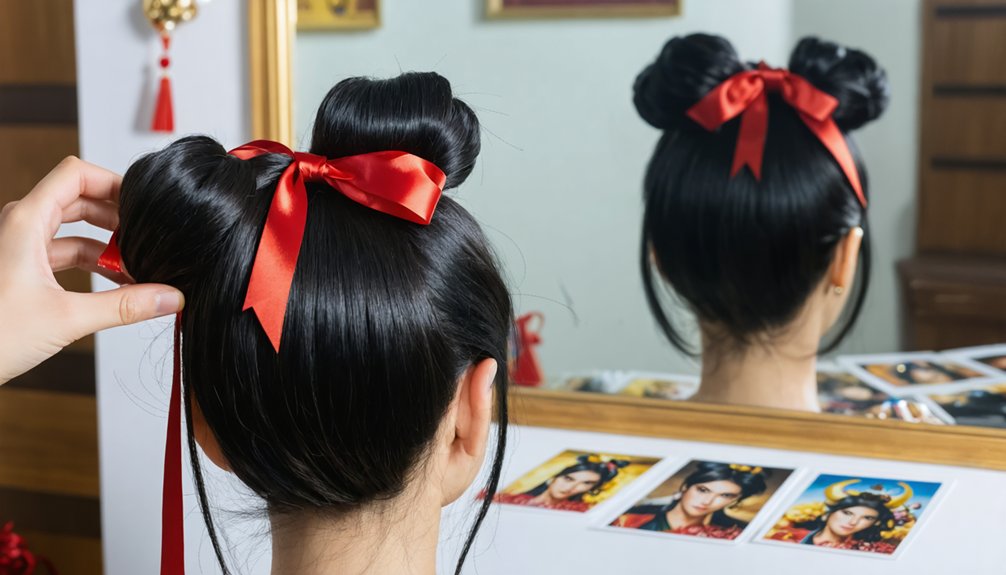
Mastering Chun-Li’s iconic double bun hairstyle breaks down into five sequential construction phases that transform any hair length or texture into symmetrical odango buns. Begin with precise center parting, using water to control flyaways while establishing your crown bun structure development foundation. Secure matching high ponytails at your desired placement points, wrapping elastics multiple times for stability.
Execute the folding technique by wrapping hair around three-to-four fingers, creating air-filled volume against your scalp. Insert bobby pins through the base at angles, bending outward to maximize roundness. Explore diverse bun texturing ideas—tease strands for dramatic volume on fine hair or embrace natural poof for curly textures.
Lock everything with strategic pinning, then refine edges and baby hairs for that authentic Street Fighter aesthetic.
Pink Eyeshadow and Anime-Inspired Makeup Application
- Apply silvery highlight to inner corners and T-zone for that characteristic reflective quality
- Tightline your upper lash line with gel pencil, then add strategic black liner to enlarge eye appearance
- Smudge mixed red shades beneath your lower lid, extending slightly outward in a subtle wing
- Finish with minimal false lashes (Ardell Naturals 120 Demi) to maintain character authenticity without excessive drama
Curl lashes before mascara application, ensuring each technique maintains Chun-Li’s balanced aesthetic.
Dynamic Fighting Stance Photography Techniques
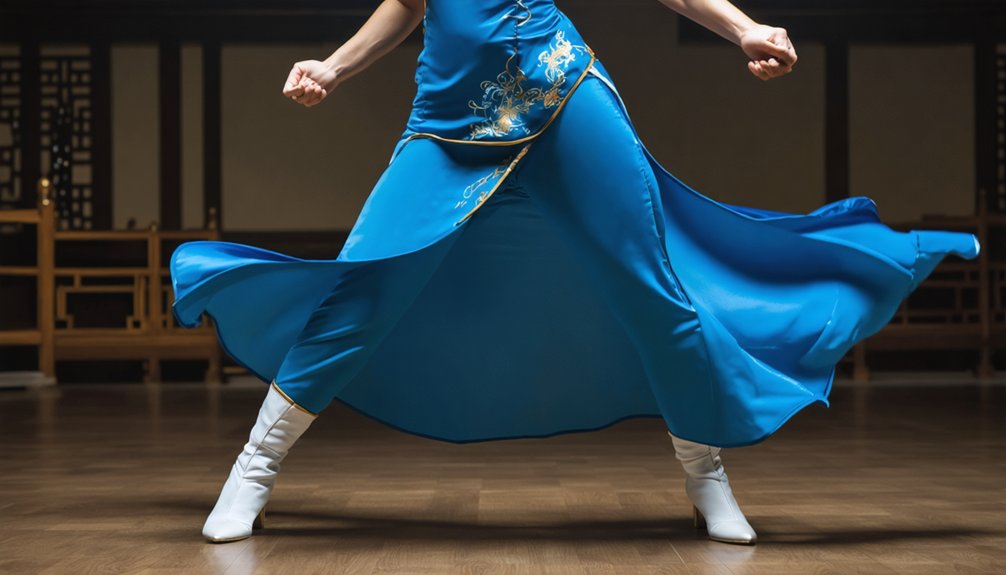
Your makeup captures Chun-Li’s iconic look, but the character’s power comes alive through her legendary fighting stances. Apply weight distribution principles by positioning your forearm to bear load during signature moves—your biceps and triceps control vertical motion while establishing authentic martial arts tension.
Create intentional arcs through sweeping kicks, extending motion lines from limbs through hair flow for maximum impact.
Foreshortening amplifies perspective drama when you pull away from the camera at extreme angles, making kicks and strikes pop dimensionally. Position dynamic lighting effects to emphasize anatomical stress points and costume details during balletic leaps.
Capture low-angle shots showcasing Chun-Li’s powerful leg techniques, adjusting camera position to reference authentic stances. These technical approaches transform static cosplay into action-packed photography that honors the character’s fighting legacy.
Embodying Chun-Li’s Fierce Elegance at Conventions
While conventions pulse with energy and competing visual spectacles, Chun-Li’s fierce elegance demands a calculated balance between combat readiness and graceful presence. Your portrayal transcends costume accuracy through deliberate authenticity techniques that merge martial arts precision with refined aesthetics.
Master convention dynamics through these structured approaches:
- Pre-event rehearsal: Practice Lightning Kicks and signature stances to guarantee fluid execution in crowded spaces
- Strategic positioning: Identify prime photo zones with adequate room for dynamic movement sequences
- Community engagement loops: Connect with Street Fighter enthusiasts to exchange performance insights and technical refinements
- Energy modulation: Alternate between intense combat poses and elegant resting positions to maintain character consistency
Local cosplay groups provide invaluable feedback for calibrating your fierce-yet-graceful balance. These connections transform solo practice into collaborative excellence, elevating your Chun-Li portrayal beyond surface-level replication.
Frequently Asked Questions
What Is the Best Way to Keep the Qipao Dress From Riding Up?
You’ll prevent riding by securing overlapped panels with topstitching, ensuring proper undergarment fit beneath the dress, and maintaining fabric tension through movement. Stretch periodically, wear high heels for stability, and tightly finish slit hems for ideal control.
How Do You Prevent the Puffed Sleeves From Deflating During Wear?
You’ll prevent deflation by maintaining sleeve structure through strategic padding between inner and outer layers. Use fiberfill or tulle for lightweight support, then add interfacing inside the lining. Pinch and reposition the fabric outward after any compression to restore volume.
Can I Wear a Wig Instead of Styling My Natural Hair?
Like choosing between custom fabric and ready-made patterns, you’ll find natural hair alternatives more cost-effective when your texture matches Chun-Li’s style. However, premium human hair wigs offer superior blending if you’re willing to invest in proper wig maintenance routines.
What Undergarments Work Best With the Tight-Fitting Qipao Silhouette?
You’ll want seamless, skin-tone matching underwear in breathable fabrics like silk blends or moisture-wicking nylon. Choose high-waisted briefs to prevent visible lines, ensuring fabric breathability maintains comfort during extended wear beneath your form-fitting qipao.
How Do You Make the Spiked Bracelets Comfortable for All-Day Wear?
You’ll practically forget you’re wearing armor when you add padding between foam layers and adjust clasp tension on elastic bands. This construction-smart approach guarantees your wrist openings flex naturally while maintaining the bracelet’s structured spike pattern throughout marathon convention days.