Creating memorable anime group cosplays starts with choosing a franchise your whole crew loves and can commit to fully. You’ll need to coordinate costumes using shared color palettes, iconic props, and character-accurate accessories to achieve visual cohesion. Set a group budget early, source costumes through shared suppliers, and rehearse poses that tell your story. A well-executed group cosplay commands convention floors in ways solo costumes simply can’t — and there’s much more strategy to master.
Key Takeaways
- Choose an anime theme that balances recognizability with costume complexity, ensuring the group can execute it with their available skills and timeline.
- Assign characters early, coordinate matching props, and rehearse character-accurate poses to sharpen group identity and storytelling impact.
- Use shared color palettes, iconography, and coordinated accessories directly from source material to create a visually cohesive group appearance.
- Set a total group budget beforehand, source costumes from shared suppliers or online marketplaces, and build a 10-15% buffer for unexpected costs.
- Select franchises with strong character dynamics, like Naruto or Demon Slayer, to maximize crowd recognition and overall presentation impact.
Why Anime Group Cosplay Outperforms Solo Every Time
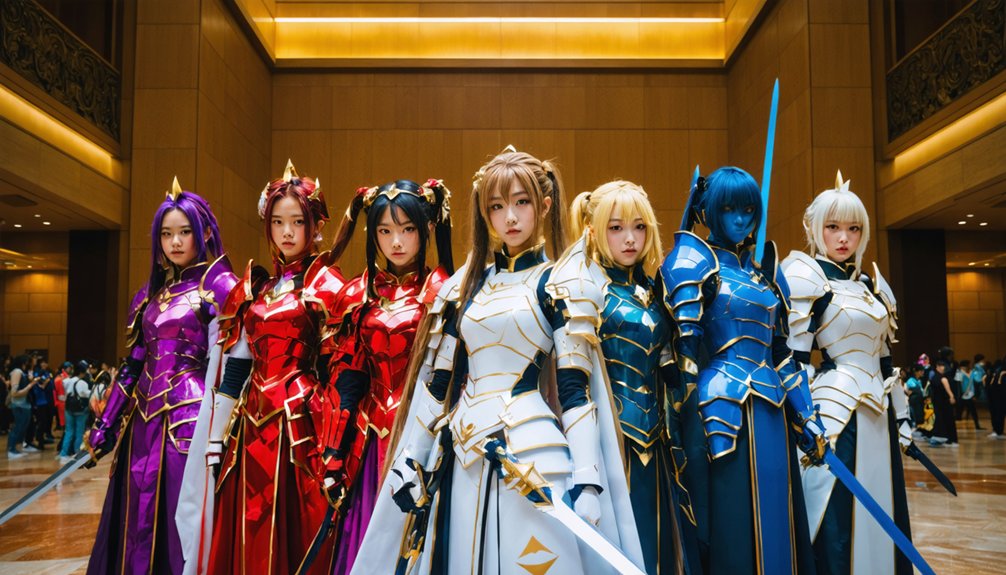
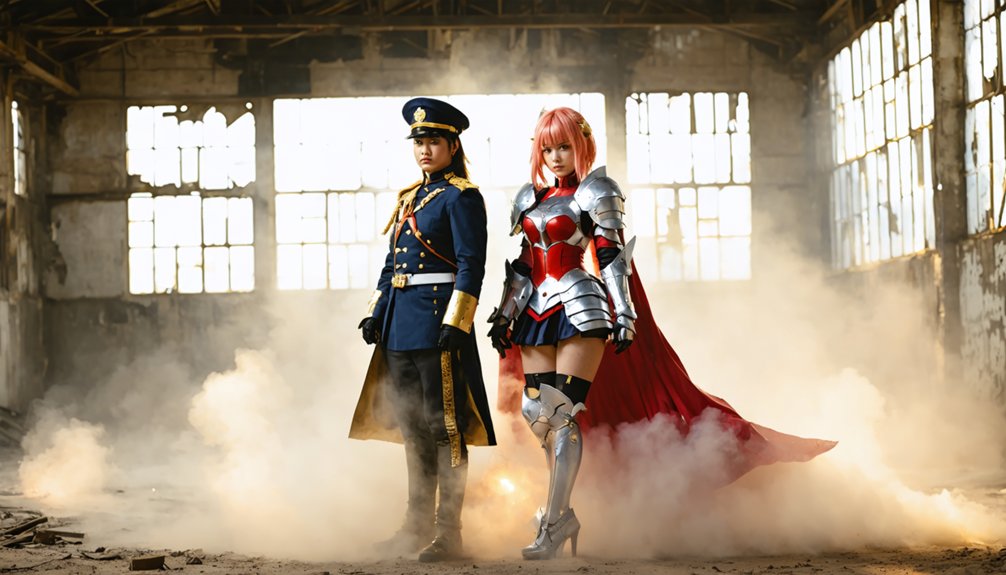
When you walk into a convention hall as a solo cosplayer, you make an impression — but when you arrive as a coordinated group, you command the room. Solo creativity has its place, and individual expressions matter, but group cosplay operates on a fundamentally different level of visual impact.
Solo cosplay makes an impression — group cosplay commands the room.
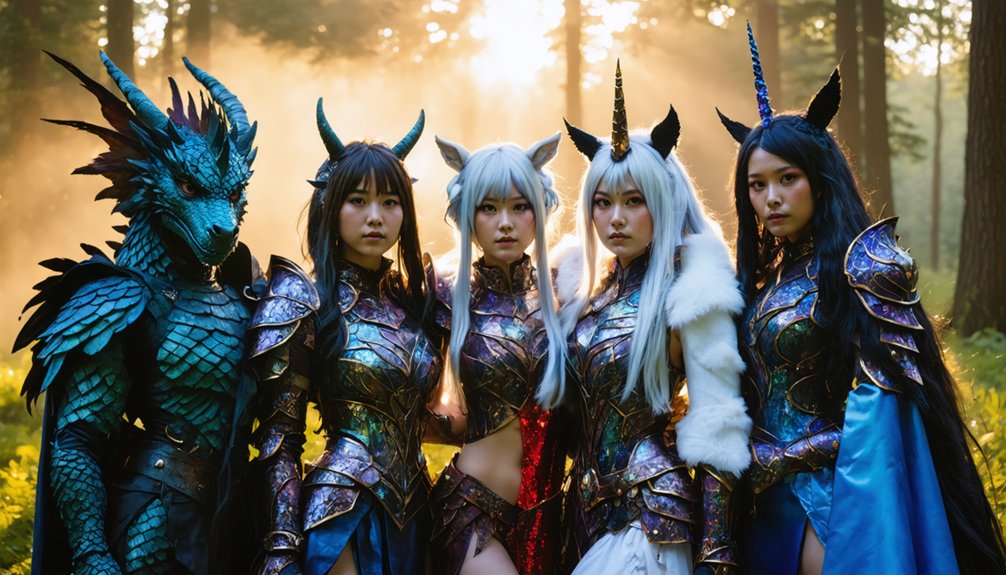
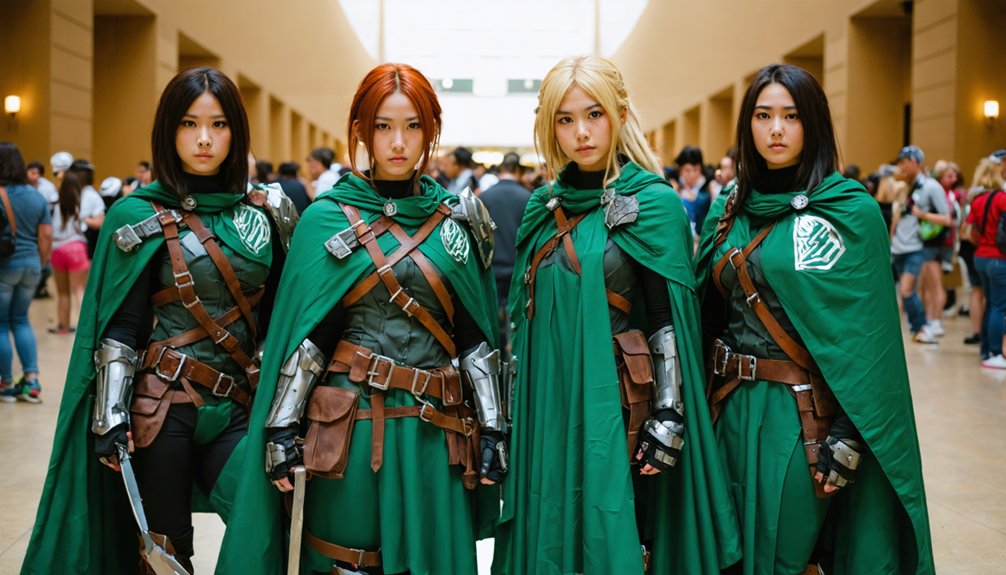
Synchronized color palettes, matched props, and character-consistent body language create a unified spectacle that solo work simply can’t replicate. You’re not just wearing a costume — you’re embodying an entire universe alongside your team.
Judges notice it, photographers prioritize it, and crowds respond to it immediately. The collective energy amplifies every detail, turning coordinated outfits into a living, breathing scene.
Group cosplay doesn’t replace solo artistry — it elevates the entire experience into something unmistakably powerful.
Pick an Anime Theme Your Whole Group Will Commit To
Assess costume complexity honestly before committing. A *Demon Slayer* Hashira lineup demands intricate haori patterns and precise sword props.
While a *Sailor Moon* ensemble balances recognizability with simpler construction. Match the theme’s technical demands to your group’s actual crafting capacity and timeline.
When everyone’s genuinely invested in the source material, that enthusiasm translates directly into sharper execution and stronger on-floor presence.
How Many People Does Each Anime Actually Need?
Group size directly shapes which anime you can realistically pull off, so match your headcount to the franchise before you fall in love with a concept.
*Team 7 from Naruto* locks you into three core members, making it ideal for small groups that want instant recognition without filling out a larger roster.
*Haikyuu!!* scales cleanly from five to twelve players, with each position carrying a distinct role and jersey number that keeps the lineup readable at any size.
*My Hero Academia* and *Dragon Ball Z* give you the most flexibility—you can field four people or fourteen and still build a coherent, recognizable ensemble by pulling from heroes, villains, or support characters.
*Sailor Moon* sits comfortably at five Guardians, though you can extend it to nine with the Outer Senshi without breaking the visual logic.
Prioritize franchises where costume versatility and character dynamics naturally accommodate your exact headcount.
Match Costumes So Your Anime Group Cosplay Looks Unified
Once you’ve locked in your anime and assigned characters, you need to focus on what actually makes a group cosplay *look* like a group—shared colors and iconic props.
Pull your palette directly from the source material, whether that’s the matching haori patterns of Demon Slayer’s Hashira or the orange-and-blue consistency running through a *Naruto* lineup.
Then reinforce that visual unity with character-specific accessories like Nichirin swords, forehead protectors, or volleyballs, because props transform individual costumes into a cohesive squad statement.
Shared Colors And Palettes
Push this further by extending shared accent colors into props, accessories, and even makeup. You don’t need identical outfits — you need a consistent chromatic thread running through every member’s look.
That deliberate repetition signals teamwork, elevates presentation quality, and makes your group photograph with professional impact every single time.
Iconic Props And Accessories
Props and accessories are the visual anchors that lock your group cosplay into instant recognition. When your team carries Nichirin swords, forehead protectors, or sport-specific gear like volleyballs and kneepads, you’re reinforcing anime character dynamics that audiences immediately decode.
Every prop communicates role, rank, and personality without a single word spoken.
Don’t treat accessories as afterthoughts. Coordinate them deliberately across your group so each piece connects to a unified visual language. Shared emblems, matching weapon styles, or color-coded accessories strengthen your lineup’s coherence dramatically.
Props also elevate group choreography by giving each member a physical focal point during poses and stage movement. A well-timed sword raise or synchronized prop gesture transforms a static lineup into a dynamic, story-driven presentation that genuinely commands attention.
Set Your Anime Group Cosplay Budget Before Anyone Shops
Before anyone adds a single item to their cart, you need to pin down the group’s total estimated cost by tallying costumes, wigs, props, and accessories across every member.
Once you’ve got that number, divide expenses strategically — assign higher budgets to the most visually complex characters and offset costs by sharing prop builds or pooling purchases from the same supplier.
From there, hit online marketplaces, rental services, and your own existing wardrobes to source affordable pieces without sacrificing the visual cohesion your group worked hard to plan.
Estimate Total Group Costs
Setting a total group budget before anyone shops is the single most effective way to prevent cost overruns and last-minute dropouts.
Start by calculating per-person costume costs, including wigs, props, and accessories, then multiply across your full roster.
Factor in character dynamics when assigning roles, since complex designs like Hashira haori or hero suits cost significantly more than standard school uniforms.
Distribute higher-cost characters among members with larger individual budgets to maintain costume coordination without straining the group financially.
Build a shared buffer of roughly 10 to 15 percent above your projected total to absorb unexpected expenses like replacement materials or shipping delays.
Track every expenditure in a shared document so the entire team maintains visibility and accountability throughout the purchasing process.
Divide Expenses Strategically
Once your total budget is locked in, splitting those costs fairly across the group determines whether everyone stays on board through to the event. Smart expense division accounts for costume customization complexity and prop coordination demands across every member.
Structure your breakdown using these proven strategies:
- Assign higher individual budgets to characters requiring complex costume customization
- Pool funds for shared prop coordination, including weapons, emblems, and accessories
- Separate labor costs from material costs to track each independently
- Designate one person to manage collective purchases and receipts
- Build a 10–15% reserve fund for last-minute adjustments or replacements
When costs align with each member’s actual costume demands, resentment stays low and commitment stays high. Transparent financial planning transforms a chaotic group effort into a synchronized, high-impact cosplay presentation that delivers results on event day.
Source Affordable Costume Pieces
With your budget locked and expenses divided, sourcing affordable costume pieces becomes your next high-impact opportunity to stretch every dollar without sacrificing visual cohesion. Start by exploring online marketplaces for cosplay fabric, where bulk purchasing cuts costs markedly across your entire group.
Prioritize character accessories — forehead protectors, Nichirin swords, hero emblems — since these details drive instant recognition without requiring expensive custom builds.
Rental services work brilliantly when multiple members need elaborate outfits simultaneously. Mine your existing wardrobes for athletic wear, school uniforms, or basic blacks that align with your chosen anime’s aesthetic.
Coordinate sourcing through shared suppliers to maintain consistent material quality and color accuracy. Smart, centralized purchasing eliminates duplicate spending while keeping every costume visually unified — maximizing collective impact without exhausting your carefully structured budget.
Where to Source Anime Group Cosplay Costumes for Less

Keeping costs low for a group cosplay takes strategy, but the right sourcing approach makes it entirely manageable. Smart sourcing unlocks cosplay customization without draining your budget, while supporting character diversity across your entire lineup.
Smart sourcing transforms group cosplay from a budget nightmare into a customizable, character-diverse experience your whole crew can afford.
Explore these high-value sourcing options:
- Online marketplaces like AliExpress or Etsy offer broad selections at competitive price points
- Costume rental services provide multiple outfits simultaneously for budget-conscious groups
- Existing wardrobe pieces such as athletic wear or school uniforms reduce custom construction costs
- Shared prop building cuts expenses when members need similar weapons or emblems
- Large-franchise mix-and-match options simplify budget management across varied character selections
Combining these strategies lets your group maintain visual cohesion while keeping individual spending minimal. Prioritize consistency, communicate sourcing decisions early, and execute with precision.
Assign Roles, Props, and Poses Before the Event
Sourcing your costumes efficiently sets the foundation, but locking in roles, props, and poses before the event is what transforms a group of dressed-up fans into a coordinated, high-impact cosplay team.
Role delegation sharpens your group’s identity instantly. Assign each member a specific character, then build outward from there. Prop coordination follows naturally once roles are confirmed. Pair Demon Slayer members with their Nichirin swords, hand Haikyuu!! players their volleyballs, and equip Naruto characters with forehead protectors and kunai.
Don’t leave posing to chance. Rehearse character-accurate stances together so your lineup reads clearly in photos and competition settings. Synchronized movement and intentional spacing elevate your presentation from casual to compelling.
Plan early, drill consistently, and your group’s execution will reflect that preparation visibly.
Which Anime Group Cosplay Concepts Make the Biggest Impact?
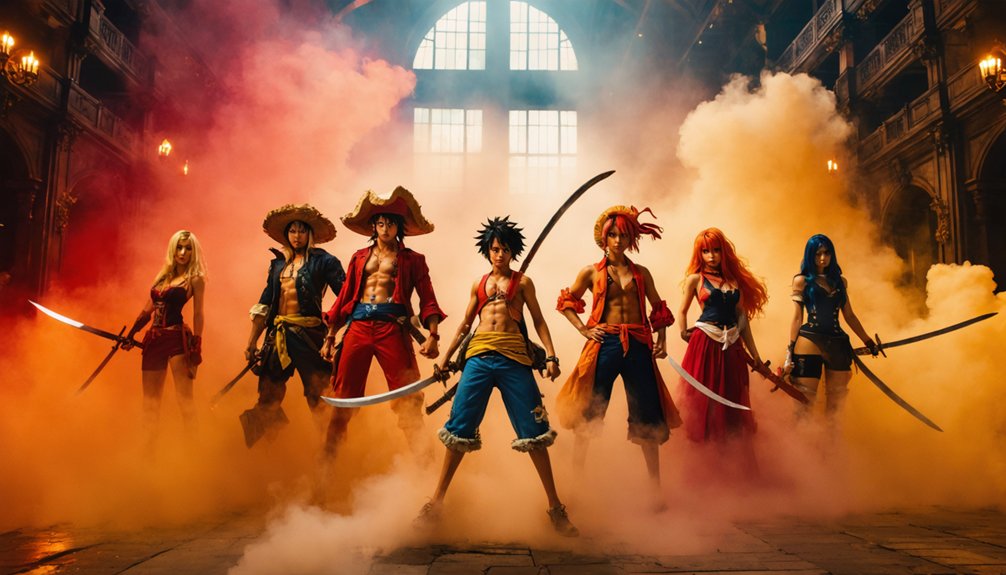
Once you’ve locked in your preparation strategy, choosing the right anime concept becomes the most visible decision your group will make. Strong character dynamics and costume symbolism define whether your lineup reads as intentional or accidental. Pick concepts that reward coordination:
- Team 7 (Naruto): Compact, iconic, instantly readable
- Demon Slayer Hashira squad: Layered patterned haori amplify costume symbolism dramatically
- My Hero Academia hero team: Supports diverse suit designs while maintaining thematic unity
- Dragon Ball Z lineup: Flexible roster accommodates heroes, villains, and fusion characters
- Haikyuu!! volleyball team: Uniform-based structure delivers clean, role-driven character dynamics
Each concept works because visual cohesion reinforces group identity. The franchises above offer built-in recognition, giving your group immediate crowd impact without sacrificing creative depth.
Frequently Asked Questions
Can Anime Group Cosplay Work for Conventions Outside of the United States?
Yes, it absolutely works! Don’t let geography limit you—anime’s universal appeal drives international collaboration across global conventions. You’ll find cultural adaptation enhances your group’s creativity, making your cosplay resonate powerfully with diverse, innovation-hungry audiences worldwide.
How Do You Handle Costume Sizing Differences Within a Diverse Group?
You’ll tackle sizing coordination by sourcing adjustable or custom-made pieces, then making precise costume adjustments like hemming or adding panels. Embrace innovative tailoring techniques to guarantee every member’s outfit fits flawlessly and maintains your group’s visual cohesion!
What Should the Group Do if a Member Drops Out Last Minute?
Like a ninja adapting mid-mission, you’ll pivot fast! Activate your backup plans immediately—reassign their character, merge roles, or embrace solo adjustments that reframe your lineup creatively. Don’t let one absence unravel your team’s entire dynamic!
Is It Acceptable to Mix Characters From Different Anime Series Together?
Yes, you can absolutely mix characters from different anime series! Embrace crossover themes and bold character mashups to craft a uniquely creative ensemble. Prioritize visual cohesion through matching color palettes, shared props, or unified aesthetic concepts that tie your diverse lineup together powerfully.
How Early Should the Group Arrive at the Event for Preparation?
Over 60% of cosplayers report last-minute chaos! You should prioritize group arrival timing at least two hours early. Smart preparation scheduling lets you handle touch-ups, coordinate props, and sync your team’s energy before the excitement peaks!
References
- https://rogersenpai.com/50-cosplay-ideas-for-groups/
- https://starstruckpanda.com/fun-and-creative-anime-cosplay-group-ideas/
- https://theswordstall.co.uk/blogs/news/10-group-cosplay-ideas-for-friends-and-families
- http://jaroukaparade.blogspot.com/2014/09/group-cosplays.html
- https://cosplayadvice.com/group-cosplay-ideas/