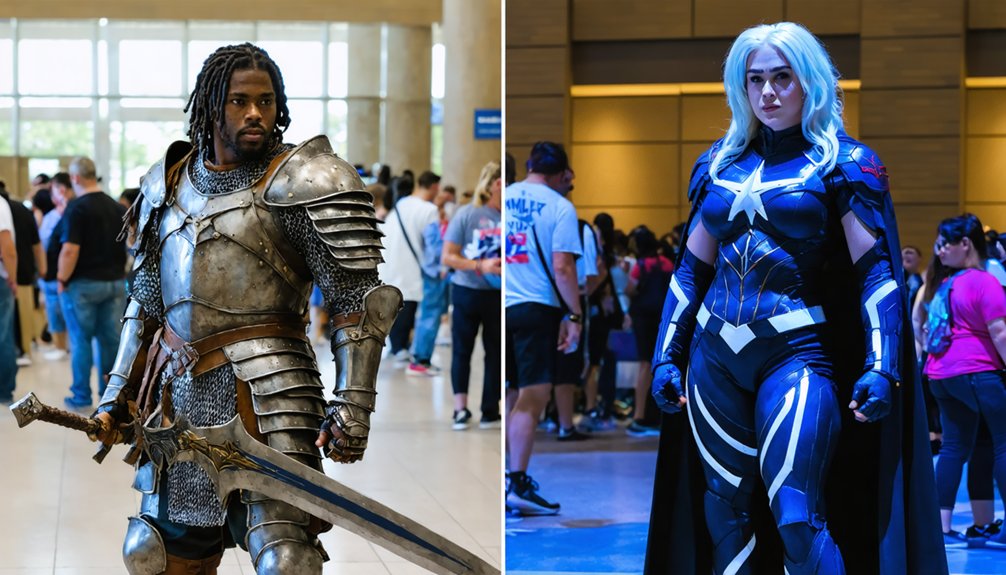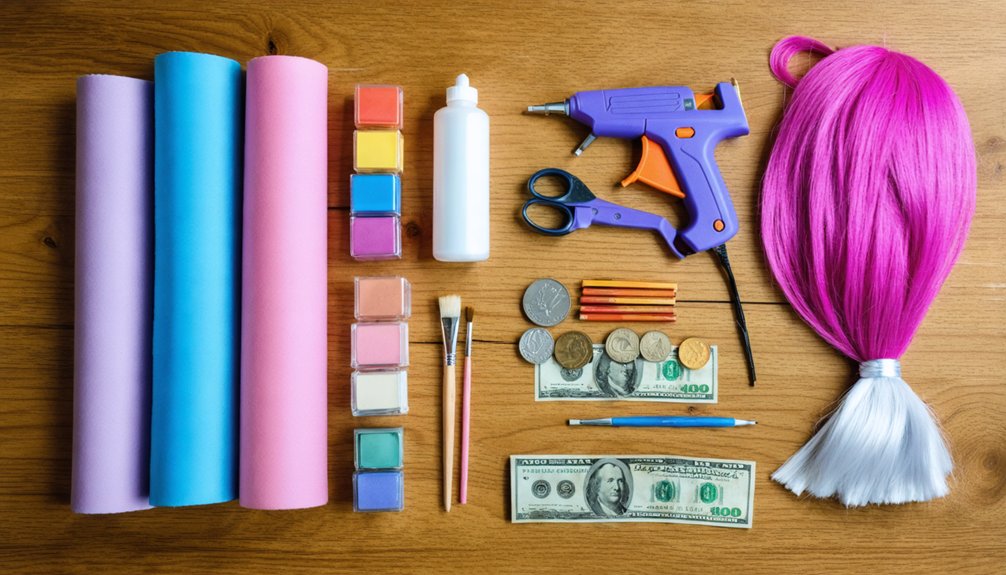
You’ll typically spend $100-$400 on your first cosplay when factoring in both costume creation and convention attendance. About 32% of beginners budget $100-$200 for their initial outfit, while another 28% allocate $201-$400 for more detailed characters. Don’t forget hidden costs like wigs ($20-$60), makeup, props, and convention passes ($52-$150). If you’re attending out of town, expect total expenses reaching $650-$1,000 including travel and lodging. Strategic material choices and knowing when to DIY versus buy can dramatically reduce these baseline costs.
Key Takeaways
- Most beginners spend $100-200 on their first costume, with 32.1% of cosplayers staying within this realistic budget range.
- DIY costumes cost $50-500 upfront while ready-to-wear options range $80-300+, depending on character complexity and material choices.
- Hidden costs include wigs, makeup, contacts, foam for armor, and styling products that add significantly to base expenses.
- Convention attendance adds $200-500 for local attendees, covering weekend passes ($52-150), meals, merchandise, and photo opportunities.
- Seventy percent of cosplayers spend an additional $100+ at conventions beyond their costume budget for merchandise and extras.
Understanding Entry-Level Investment Ranges
Starting your cosplay journey requires a realistic budget of $100-200 for your first costume, placing you among the 32.1% of cosplayers who invest in this entry-level range. When calculating starter costs, you’ll find ready-to-wear options greatly reduce financial barriers compared to custom builds.
Supporting cosplay budgets demands strategic material choices—reusable fabrics and DIY techniques keep expenses manageable while delivering quality results.
You’ll notice 27.7% of cosplayers allocate $201-400 for more detailed creations, but starting lower lets you develop skills without overcommitting. Consider that 70% of makers spend an additional $100+ at conventions, so factor these ancillary costs into your planning.
Rental services and second-hand marketplaces offer temporary access to premium pieces, letting you experiment with different characters before making substantial investments in your craft.
Breaking Down Your First Costume Budget
Before purchasing anything, you’ll need an itemized breakdown that separates fabrics, wigs, accessories, and props with realistic price tags attached. Research online prices and thrift sources before committing, letting personal inspiration sources guide your character selection toward achievable budgets. Set per-component limits—$50 maximum for simple builds, $200-300 for detailed pieces requiring specialty materials.
Account for hidden costs: contacts, makeup, foam for armor, and styling products. Create mockups using cheap fabric to test patterns before cutting expensive materials. Community sourced materials dramatically reduce expenses—borrow equipment like grommet punches, salvage buttons and ribbons from fellow cosplayers, or access library 3D printing services.
Factor your skill level honestly. Commission costs add $300+ quickly, while selecting simpler characters using wardrobe basics keeps totals manageable. Plan months ahead to capture sales and accumulate savings strategically.
DIY Versus Ready-to-Wear: Cost Comparison
Your first costume’s upfront cost differs dramatically between DIY ($50-$500) and ready-to-wear ($80-$300+), but that’s only part of the equation.
When you buy fabric, notions, and tools for one project, you’re building a reusable supply stash that drops the per-costume cost on future builds. The catch is time—developing the skills to construct quality costumes efficiently means your first few DIY attempts will take considerably longer than simply ordering premade, and beginners’ mistakes can push costs above retail prices.
Initial Investment Per Costume
When you’re mapping out your first cosplay budget, the fundamental choice between DIY and ready-to-wear dramatically reshapes your financial commitment. DIY material procurement starts around $50, with budget-conscious creators achieving complete costumes for $20-$60 through strategic sourcing.
Your budget expectations shift considerably with ready-to-wear options, where the baseline jumps to $100+ for quality pieces featuring elaborate stitching and durable construction.
The 32% of cosplayers spending $101-$200 per DIY costume demonstrate how mid-range material investments—particularly higher-density EVA foam—balance quality with affordability. Meanwhile, pre-made costumes in this bracket eliminate material research while guaranteeing consistent durability.
Your character selection fundamentally determines costs: simple attire keeps expenses minimal, while complex designs requiring extensive foam construction push budgets toward the $200-$600 range where 70% of cosplayers operate.
Long-Term Material Reusability
Craftsmanship sustainability considerations extend beyond initial builds. Reusable props and clothing enhance your skill expression while market-driven ready-to-wear pieces (projected to reach $80.85 billion by 2028) prioritize petroleum-derived polyester over biodegradability.
Second-hand options cost half-price, yet DIY reusability ultimately undercuts both online and in-store purchases long-term.
Skill Development Time Costs
Before you commit to scissors and fabric, understand that DIY cosplay demands 20 to 100+ hours depending on complexity—time that translates directly into hidden costs beginners often underestimate. You’ll invest 10-30 hours mastering sewing basics, another 20+ hours learning prop-making techniques like foam crafting or resin casting, and 15-40 hours perfecting character-accurate makeup.
Time management considerations become critical when a mid-range project like Raven consumes four months of intermittent work. Fundamental skill learning through tutorials saves trial-and-error waste, yet first-timers still lose 20-50 hours to avoidable mistakes.
Ready-to-wear eliminates this ramp-up entirely, delivering convention-ready results in 5-10 hours for styling. Calculate your hourly value—if 100 DIY hours at minimum wage exceeds a $350 commission, purchasing accelerates your debut while preserving creative energy for advanced builds later.
Hidden Expenses: Convention Fees and Event Costs

While you’ve calculated fabric and wig costs down to the dollar, convention attendance itself represents a substantial line item that catches many beginners off guard. Weekend passes vary dramatically—from Anime Verse’s budget-friendly $52 to major cons averaging $150. Factor in service fees, typically $2.75 per ticket, which add up rapidly.
Beyond admission, venue capacity constraints drive up accommodation costs, with hotels near popular conventions reaching $120 nightly. Food service availability affects your budget considerably; convention center meals average $45 daily, though nearby budget options like Waffle House run $12 per person. Reserve $150 minimum for vendor merchandise and photo ops ($20-$50 each). Local attendees typically spend $200-$500 total, while travelers beyond 250 miles face $650-$1,000. Book tickets three months ahead—70% of attendees do—to lock competitive rates.
Material Choices and Their Price Impact
Your material selections will make or break your budget, with craft foam and thrifted fabrics keeping costs under $50 while specialty materials can push a single costume past $500. You’ll find that investing in reusable components like quality wigs, armor pieces, and structured props pays dividends across multiple builds rather than buying disposable alternatives for each character.
Smart cosplayers know that basic materials like EVA foam and acrylic paint achieve professional results when you master proper techniques—it’s your skill application, not premium products, that determines the final quality.
Basic Fabric Cost Ranges
Since fabric typically represents 40-60% of your total cosplay budget, understanding material costs upfront prevents overspending on your first costume. Your fabric selection recommendations should prioritize cotton at $3-8 per yard for breathable basics, polyester at $4-10 for versatile synthetics, and cotton poplin under $5 for lightweight pieces. Polycotton blends offer cheaper alternatives while maintaining workability.
Material sourcing strategies expand when you consider fleece at $6-12 per yard for plush characters and twill at $5-10 for structured military uniforms. Linen runs slightly higher at $8-15 but delivers authentic historical appeal. Smart buyers stock up during seasonal sales, securing polyester year-round in multiple colors.
Calculate yardage before shopping—most beginner costumes require 3-6 yards depending on design complexity and your measurements.
Premium Materials Increase Expenses
Premium materials transform budget-friendly projects into significant investments that’ll stretch your wallet considerably beyond basic fabric purchases. Specialty leathers elevate simple suits to $400+ base costs, with professional-grade armor reaching $5,000+ when you’re integrating custom dyeing effects and metalwork.
You’ll find fur additions pushing hobbyist budgets from $300 to $800, while synthetic variants cost 2-3x basic fabrics for texture accuracy. Resin components start at $500+ for advanced armor pieces, demanding specialized casting techniques that total $350-400 for solid props.
LED integrations surpass $500 for illuminated features, with premium setups hitting $1,000. Metal accents drive costs beyond standard thresholds—intricate metalwork adds $200+ instantly. Each premium choice demands extended labor hours, compounding your financial commitment while delivering convention-worthy authenticity.
Reusable Components Save Money
While investing in premium materials delivers stunning results, strategic reuse of components cuts your overall cosplay spending by 40-60% without sacrificing visual impact. Heat-friendly wigs around $80 enable wig sharing across multiple characters—restyle one base for Rogue variations rather than purchasing new pieces.
Master fabric combinations by transforming thrift store sheets into costumes for under $2, or repurpose curtains and blankets as premium-looking materials.
Your prop arsenal becomes infinitely versatile through creative recycling. Cardboard tubes, pool noodles, and plastic containers build impressive accessories at minimal cost. Repaint previous props instead of constructing new ones, and modify thrift store shoes rather than buying specialty footwear.
Store costume components like petticoats, ties, and accessories in organized bins—these transfer seamlessly between projects, maximizing every dollar spent while maintaining professional-quality results.
How Often Should Beginners Plan to Create New Costumes?
As you gain confidence, you’ll naturally accelerate production. However, resisting the urge to rush multiple projects simultaneously prevents costly mistakes and skill gaps.
Quality repetition builds expertise more effectively than quantity—especially when you’re establishing your technical foundation and budget management systems.
Cost-Saving Strategies: Rentals, Second-Hand, and Subscriptions

Renting costumes slashes your initial investment while giving you access to professional-grade pieces you’d otherwise spend months crafting. Single rentals typically cost 15-30% of retail prices, making $300 costumes accessible for $50-90. You’ll find subscription models even more strategic—they generate recurring access to rotating wardrobes without storage headaches.
Second-hand markets expose serious value through thrifting opportunities at convention swap meets and online marketplaces. You’re tapping into donation drives where experienced cosplayers offload retired pieces at fraction costs. These pre-owned finds often include premium materials and construction techniques you can reverse-engineer for future builds.
Combined approaches maximize efficiency: rent your first costume, study its construction, then source similar materials second-hand. You’re building technical knowledge while controlling expenditure—the innovation-focused strategy that transforms beginners into skilled creators without financial strain.
Quality Tiers: What Different Price Points Get You
Understanding cosplay quality tiers helps you make informed purchasing decisions based on your actual needs rather than aspirational wants. Budget materials—typically polyester blends and basic construction—serve beginners perfectly well for convention wear, while premium fabrics like accurate-weight twills and licensed character reproductions justify their higher costs through durability and screen accuracy.
You’ll notice the steepest price jumps occur when costumes include official licensing fees, which can double or triple costs even when the base materials remain similar to unlicensed alternatives.
Budget vs. Premium Materials
The materials you choose will define both your costume’s appearance and your wallet’s health. Understanding foam quality and fabric durability separates functional costumes from festival failures.
Budget craft foam ($15-30) works for first builds but dents easily. Mid-tier EVA foam ($40-80) offers genuine impact resistance and heat-forming capability. Premium Worbla ($100+) provides professional sculpting precision that justifies its cost for competition-grade armor.
Your material decisions create distinct outcomes:
- Thrifted fabrics transform into cloaks at $10, while specialty cosplay fabric runs $25-50 per yard
- Sample foam boxes let you test thermoplastics without buying full sheets
- Grey EVA foam laser-cuts cleaner than black varieties for intricate patterns
- Flexbond primer prevents chipping on flexible pieces where cheaper primers crack
Start economical, upgrade strategically as your technique improves.
Licensing Costs Impact Price
Material choices matter, but they’re only part of your total investment. When selecting characters, you’ll navigate trademark considerations that affect pricing structures. Licensed costume manufacturers pay for rights approval process, passing those costs directly to you—expect 20-40% markups on official merchandise compared to generic alternatives.
You’ll find creative workarounds through independent commissioners who craft “inspired by” designs without infringing copyrights. These commissions ($500-$800) balance quality with legal safety. Complex contemporary characters from properties like Genshin Impact demand 80+ hours of specialized labor, translating to $2,000+ for premium executions.
Smart budgeting means choosing characters strategically. Generic fantasy designs or vintage anime properties offer more affordable commission options ($250-$550) while delivering impressive visual impact without licensing premiums.
Licensing Fees and Commercial Options Explained

Commercial cosplay ventures face a sobering financial reality: licensing negotiations alone can cost more than you’ll ever earn from small-scale operations. Proper licensing negotiations require attorney involvement, with major rights holders demanding quarterly royalty payments based on gross sales percentages.
The path to legitimate commercial activity includes:
- Attorney consultation fees mounting before generating any revenue
- Quarterly royalty payments calculated from your gross sales
- Mandatory revenue reporting to copyright holders
- Cease and desist notices arriving when you skip proper channels
For liability exposure avoidance, consider partnering with established licensed retailers like Cospa.com or authorized talent agencies. Your innovative approach works better through legitimate channels—merchandise sales, commissioned work, and appearance fees all trigger enforcement from companies like Disney. The cost-benefit analysis consistently favors hobby-level operations over commercial ventures.
Building Your Starter Kit Without Breaking the Bank
Entry-level cosplayers can launch their crafting journey for $40-$60 with targeted starter bundles that eliminate wasteful purchasing. These curated kits prevent duplicate tools while providing essential materials, patterns, and instructions for your first foam builds.
You’ll find thorough digital packages offering 48+ armor patterns and beginner books for under $90, delivering immediate workspace access without shipping delays.
Maximize your investment through strategic material sourcing. Bulk buying supplies like EVA foam and hot glue reduces per-project costs considerably.
Sourcing materials locally from art stores and thrift shops provides hands-on selection while keeping expenses manageable—polycotton fabric runs just £3 per meter.
Smart starters choose adaptable base patterns over single-piece purchases. A $46 foam armor pattern kit grants access to 14 leg designs and 14 bracer variations, multiplying your creative possibilities exponentially.
Frequently Asked Questions
Can I Cosplay Characters From Any Franchise Without Legal Concerns?
You can cosplay any character for personal use without licensing restrictions, but selling costumes risks copyright infringement. Create handmade outfits for conventions and social media—you’ll avoid legal issues while mastering budget-friendly techniques that showcase your innovative skills.
How Do I Store Multiple Costumes in a Small Apartment?
Like Victorian steamer trunks, you’ll maximize vertical space with ceiling-height shelving and over-door hangers. Use space saving storage like under-bed bins and Really Useful Boxes. Master costume organization techniques: vacuum-seal fabrics, hang garments, containerize accessories efficiently.
What Insurance Covers Damaged or Stolen Cosplay at Conventions?
Travel insurance with specific cosplay provisions covers your gear during transit, while event insurance coverage protects vendors’ inventory. Unfortunately, convention reimbursement policies don’t cover attendee costumes—you’ll need separate personal property insurance for extensive protection.
Are There Tax Deductions for Cosplay Expenses as a Hobby?
Since 2018’s Tax Cuts eliminated hobby expenses deductions, you can’t claim cosplay tax deductions unless you’re earning profit. Track every expense meticulously—if you’re selling commissions or prints consistently, you’ll access business-level deductions through strategic reclassification.
How Do I Find Local Cosplay Groups for Beginners?
You’ll find cosplay meetup groups through Meetup.com’s 108 dedicated communities and discover local cosplay communities at conventions, makerspaces, and Discord servers. Start with free platforms to connect budget-consciously while learning techniques from experienced crafters nearby.