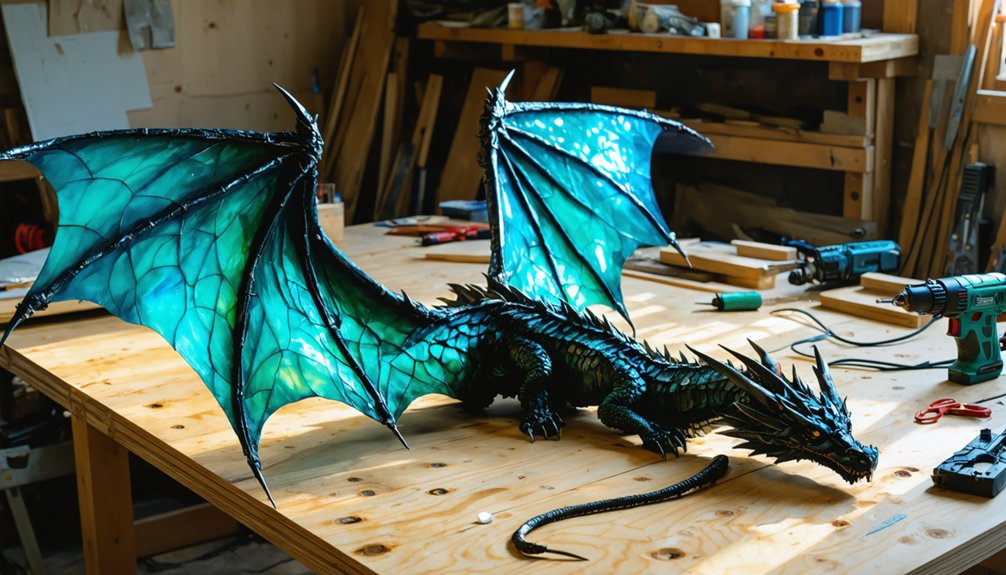
To build dragon wings for fantasy creature cosplay, you’ll start by choosing a style that matches your skill level, from no-sew fleece for beginners to CNC-cut EVA foam for experts. You’ll construct an internal frame using aluminum wire, wooden strips, or Baltic birch plywood for stability. Then you’ll cut, layer, and bond your panels before attaching a comfortable harness system. Every skill level has a tailored approach that makes the process achievable.
Key Takeaways
- Choose materials based on skill level: fleece for beginners, EVA foam or Baltic birch plywood for advanced builders requiring dimensional, professional-grade wings.
- Build a strong internal skeleton using aluminum wire or plywood to maintain wing shape and structural stability throughout wear.
- Layer and bond materials using fusible adhesive or hot glue, sandwiching foam between fabric layers to create rigid, dimensional wing panels.
- Add surface details like felt spikes, sew-on gems, and overlapping fleece colors to achieve authentic reptilian texture and visual depth.
- Distribute weight comfortably using a harness system with D-rings, positioning armholes 8 to 12 inches from the wing center.
Choose Your Dragon Wing Style Before You Build
Before you cut a single piece of fabric or bend any wire, you need to decide what type of dragon wings you’re building, because that choice determines every material and technique you’ll use.
Dragon wing styles range from soft, fabric-based beginner builds using fleece to rigid, articulated systems engineered from Baltic birch plywood and hinged joints. Your wing design inspiration should drive structural decisions early.
Lightweight fleece wings suit quick cosplay builds, while EVA foam and acrylic sheeting create professional-grade membranes with dimensional realism. Advanced designs incorporate folding mechanisms using paracord and binder posts.
Consider your skill level honestly. A no-sew fleece build takes roughly 10 minutes, while an articulated harness system demands multiple days and power tools.
Define your scope before purchasing materials.
Pick the Right Materials for Your Skill Level
Your material choices will make or break your dragon wings, so matching them to your skill level is essential.
If you’re just starting out, fleece fabric is your best option—it’s widely available, comes in multiple colors, and requires no sewing, letting you complete a basic pair in about 10 minutes with just scissors and fusible adhesive.
For advanced builds, you’ll want to work with EVA foam, Baltic birch plywood, and polyester-spandex blends supported by aluminum wire armatures to achieve structured, articulated wings capable of holding complex shapes.
Beginner-Friendly Fabric Options
When starting your first pair of dragon wings, fleece fabric is your best material choice—it’s affordable, widely available, and comes in multiple colors and textures without requiring specialized tools or sewing experience.
Fleece varieties range from standard anti-pill to textured options that mimic scales or membrane surfaces, giving your build an immediate visual advantage.
You can experiment with color combinations by layering contrasting fleece shades to suggest depth, iridescence, or species-specific markings.
Since fleece doesn’t fray when cut, you’ll skip hemming entirely, which accelerates your construction timeline considerably.
For no-sew builds, fusible adhesive bonds multiple fleece layers cleanly and securely.
Plan for approximately two yards depending on your desired wing span, and select colors intentionally before cutting to guarantee your final design reads cohesively from a distance.
Advanced Structural Materials
Once your skills progress beyond simple fleece builds, EVA foam, aluminum wire, and Baltic birch plywood become your primary structural options—each serving a distinct purpose depending on your project’s complexity.
EVA foam techniques using 2mm and 5mm thicknesses deliver professional-grade rigidity while remaining lightweight. Aluminum wire forms internal skeletons, and ¼” Baltic birch plywood enables articulated, poseable wing stabilization methods.
- Use 2mm EVA foam for curved membrane sections requiring flexibility
- Shape aluminum wire into segmented bone frameworks with wire cutters
- Apply ¼” Baltic birch plywood for upper wing support structures
- Connect components using binder posts and screws for folding mechanisms
- Reinforce joints with paracord and hinges to enable realistic dynamic movement
Build a Sturdy Frame for Your Dragon Wings
A strong internal skeleton makes the difference between wings that hold their shape and wings that droop and collapse mid-wear. For reliable frame stability and structural integrity, start with metal hangers or aluminum wire, shaping each segment to match your wing’s silhouette.
Cut and bend wire using wire cutters, then reinforce upper sections with wooden strips for lightweight construction without sacrificing support systems.
For advanced wing articulation, integrate Baltic birch plywood at ¼” thickness, connecting components with binder posts that allow folding movement.
Apply assembly techniques strategically—stitching fabric along bones after covering improves material durability and locks each element in place.
Thoughtful engineering of your frame directly enhances design aesthetics, ensuring your finished wings maintain their dramatic silhouette through extended cosplay wear.
Cut and Shape Your Dragon Wing Panels
With your frame complete, you’re ready to trace and cut the fabric panels that’ll define your wing’s final shape.
Use a salad plate—roughly 7 inches in diameter—as a curved template, then cut your fleece or EVA foam precisely along the traced lines with sharp scissors or a craft knife.
Once your panels are cut, layer them over the frame and bond the pieces together using fusible adhesive or hot glue, pressing firmly to guarantee full adhesion across every surface.
Tracing Wing Panel Shapes
Tracing your wing panel shapes requires just a few household tools and some careful measuring before you cut into your fabric. Use wing shape templates like 7-inch salad plates to trace smooth, consistent curves onto your fleece or foam material.
Apply precise tracing techniques by marking outlines with fabric chalk or washable markers for clean, removable guidelines.
- Position templates symmetrically on folded fabric to cut matching pairs simultaneously.
- Trace membrane sections and spike placements separately for modular construction.
- Use salad plates for rounded leading edges and tapered cuts for pointed tips.
- Mark armhole positions 8 to 12 inches from the wing center before cutting.
- Transfer structural bone pathways onto fabric panels to guide stitching or adhesive placement later.
Cutting Fabric Precisely
Once your wing shapes are fully traced and marked, cutting them precisely makes the difference between panels that align cleanly and those that require frustrating corrections later.
Fabric measuring techniques matter here — double-check seam allowances before committing your scissors to fleece or spandex blends.
For cutting tools comparison, rotary cutters outperform standard scissors on curved membrane sections, delivering smoother arcs through stretch fabrics without distortion.
Sharp fabric scissors handle straight-edged segments and felt spikes effectively, while EVA foam demands a sharp utility knife guided along a metal straightedge.
Cut single layers when accuracy is critical, since stacked fabric shifts and introduces misalignment.
Keep your cutting surface firm and flat, pressing fabric taut without stretching it.
Precise cuts now eliminate fitting problems during frame assembly and attachment stages.
Layering And Bonding Panels
Layering your cut panels transforms flat fabric into dimensional wing structures, and the bonding method you choose determines both durability and flexibility. Multi-layering methods stack fleece, foam, and structural elements into cohesive assemblies. Panel adhesion techniques like Heat’n Bond fusible adhesive eliminate stitching while maintaining clean edges.
- Press fusible adhesive between fleece layers using steady iron heat for complete bonding.
- Sandwich 2mm EVA foam between fabric layers to add structured rigidity.
- Apply hot glue along foam edges to secure dimensional spikes and textured details.
- Stitch along internal wire bones after bonding to reinforce shape retention.
- Layer multiple fleece colors strategically to create depth and species-specific visual contrast.
Each bonded layer compounds structural integrity, giving your wings professional-quality form without compromising wearable flexibility.
Attach the Frame to Your Dragon Wing Fabric
Slide your shaped metal hanger bones or aluminum wire frame onto the cut fleece fabric, positioning each wire segment along the traced wing lines before securing. These frame attachment techniques determine your wing’s final silhouette and structural integrity.
Pin each bone temporarily before committing to permanent fabric bonding methods. Apply fusible adhesive strips directly over the wire segments, then press with an iron to lock both layers together. This sandwiches the frame between fleece panels without stitching.
For reinforcement, stitch directly along each bone using a stretch needle and ½” seam allowance, preventing frame migration during wear.
Hot glue works effectively for securing EVA foam sections to wire endpoints. Once bonded, tug gently along each seam to confirm the frame holds firm under movement stress.
Add Spikes, Gems, and Texture to Your Dragon Wings
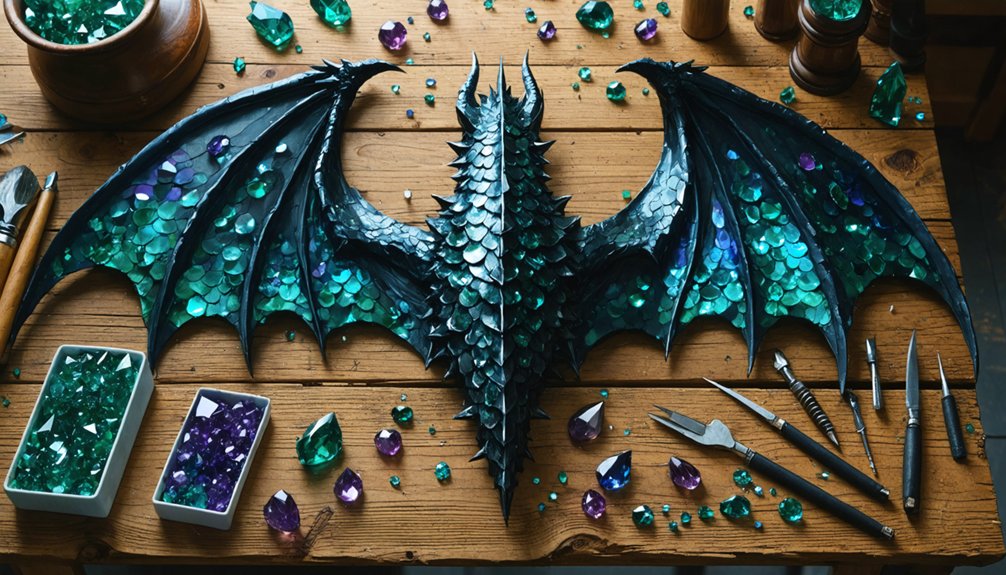
With your frame locked into the fabric, you’re ready to bring your dragon wings to life through surface detailing. Strategic embellishment techniques transform flat fabric into dimensional, creature-accurate designs.
- Spike placement: Layer felt spikes in graduating sizes along wing edges, alternating color combinations for depth.
- Gem positioning: Secure sew-on gems near membrane intersections using hot glue for precise, permanent placement.
- Texture layering: Apply multiple fleece colors in overlapping sections, building visual complexity across wing surfaces.
- Detailing methods: Use hot glue for foam accents and hand-stitching for structural embellishments requiring durability.
- Finishing touches: Reference design inspiration from reptilian anatomy, ensuring color combinations and pattern distribution feel anatomically authentic.
These targeted approaches deliver finishing touches that elevate your wings from craft project to professional cosplay piece.
How Do You Wear Dragon Wings Comfortably All Day?
Wearing dragon wings comfortably through extended events depends on how well you distribute their weight across your torso rather than concentrating it on your shoulders. Car seat harness systems solve this problem by spreading load across your chest and back simultaneously.
Pair these with D-rings and cord locks to create adjustable harness systems that let you fine-tune tension throughout the day.
Position armholes 8 to 12 inches from the wing center so your arms move naturally without pulling the structure off-balance.
For wing comfort techniques, elastic straps measuring approximately 9 inches secure wings without restricting circulation.
Heavier EVA foam or plywood constructions demand backplates that anchor securely to your harness, preventing forward tilt that strains your lower back during prolonged wear.
Scale Your Dragon Wing Build to Your Skill Level
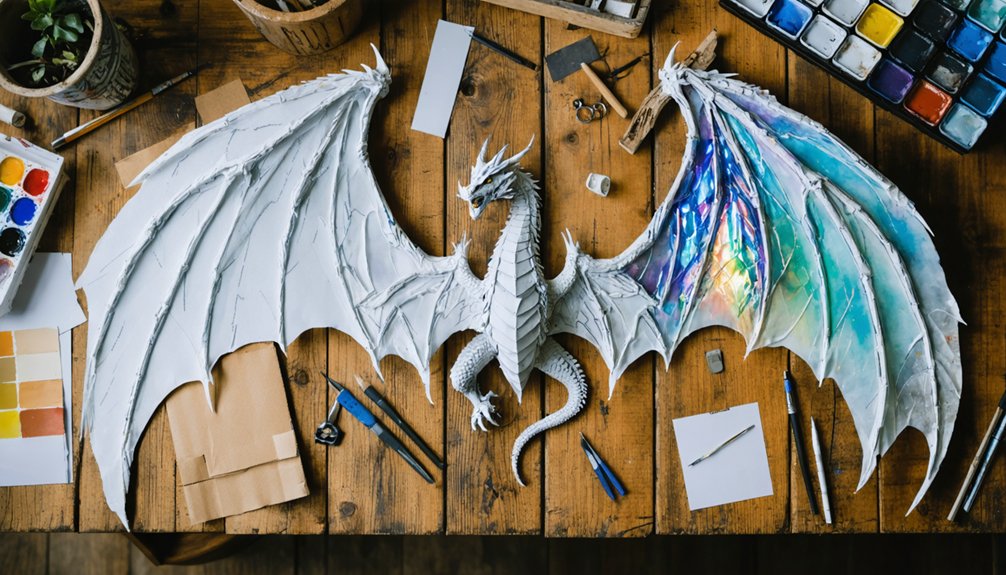
Once you’ve sorted out how your wings will attach and distribute weight, the build complexity itself determines how much time, tooling, and experience you’ll actually need.
Match your design inspiration to your actual skill set before committing to materials.
- Beginner: No-sew fleece wings using scissors and fusible adhesive, completable in 10 minutes
- Intermediate: Basic sewing with metal hanger frames and fusible adhesive bonding for improved structure
- Advanced: Baltic birch plywood systems with binder post hinges enabling full wing articulation
- Expert: CNC-cut EVA foam with paracord mechanisms, D-rings, and engineered folding harness backplates
- All levels: Salad plates and felt spikes add dimensional detail without escalating build complexity
Power tools and metal fabrication require adult supervision regardless of your experience level.
Fix Dragon Wings That Sag, Collapse, or Won’t Stay On
Even well-constructed dragon wings fail at a handful of predictable points—sagging membranes, collapsing frames, and slipping attachment points each signal a specific structural fix rather than a full rebuild.
For sagging issues, reinforce membrane sections with additional 2mm EVA foam strips bonded using hot glue along stress lines.
Collapsing frames need stiffer aluminum wire or Baltic birch plywood inserts added to the upper wing sections.
For attachment solutions, replace basic elastic straps with D-rings connected to a car seat harness system, distributing weight across your torso instead of single anchor points.
Balance adjustments require repositioning armholes closer to or farther from the wing center—target the 8-to-12-inch range—until the structure sits level without pulling backward or drooping forward during movement.
Frequently Asked Questions
Can Dragon Wings Be Safely Packed and Transported to Cosplay Events?
Yes, you can safely transport your wings using smart transport methods tailored to your wing materials. Foam and fleece wings disassemble easily, while articulated plywood systems need padded cases to prevent structural damage during transit.
How Do You Clean and Store Dragon Wings After Wearing Them?
Spot-clean your fleece wings using mild soap and cool water, applying targeted cleaning techniques for stains. For storage solutions, disassemble structural components, wrap foam sections in acid-free tissue, and store flat in a climate-controlled container.
Are Dragon Wings Appropriate for Outdoor Festivals in Windy Conditions?
Dragon wings can work outdoors, but you’ll need to prioritize wind resistance and festival safety. Secure your EVA foam or fleece wings with a car seat harness system and D-rings to prevent dangerous movement in gusty conditions.
Can Children Safely Wear Dragon Wings Without Adult Supervision Nearby?
Like a kite needs a steady hand, children wearing dragon wings need adult supervision nearby. You’ll want to follow safety guidelines, as wing materials like metal frames and hot glue present real hazards.
How Long Do Finished Dragon Wings Typically Last Before Needing Repairs?
Your dragon wings’ lifespan depends on material durability—fleece wears out faster than EVA foam or polyester-spandex blends. You’ll extend longevity considerably by applying proactive repair techniques like regluing seams, reinforcing stitching, and replacing stressed elastic components regularly.
References
- https://swoodsonsays.com/dragon-wings-costume-diy-tutorial/
- https://feelincrafty.wordpress.com/2010/10/19/dragon-wings-tutorial/
- https://brendid.com/how-to-train-your-dragon-diy-no-sew-dragon-wings/
- https://www.instructables.com/Dragon-Wings-1/
- https://www.youtube.com/watch?v=ghHwspvkADw
- https://www.youtube.com/watch?v=qf3DYnNLf1w