To commission a custom cosplay costume, you’ll need to research commissioners’ portfolios for technical capabilities, then provide detailed character specifications, accurate ISO 8559-1 measurements, and your event date. Budget $200-$2,000+ depending on complexity, and allow 3-8 months for production. Contact commissioners through their preferred channels with reference images, material preferences (cotton poplin, thermoplastics, stretch fabrics), and budget constraints. Establish clear communication expectations regarding progress updates, fitting appointments, and payment structures. Guaranteeing these fundamentals confirms your commissioned piece meets both technical specifications and deadline requirements.
Key Takeaways
- Research commissioners by reviewing their portfolios, technical skills, material expertise, and client feedback to ensure quality alignment.
- Provide accurate measurements following standard methods, character references, and sizing requirements through the commissioner’s preferred contact channel.
- Allow 3-6 months minimum lead time; complex costumes with armor or electronics require several months for completion.
- Discuss material preferences, budget constraints, payment terms, and progress update schedules upfront to establish clear expectations.
- Participate in approval stages including digital prototypes and fittings to ensure accurate construction before final delivery.
Finding the Right Commissioner for Your Project
Finding a qualified commissioner requires systematic evaluation of their technical capabilities and project portfolio. Examine their completed commissions to assess construction quality, craftsmanship consistency, and portfolio diversity across different character types. Verify they’ve worked with specialized materials your design demands—armor fabrication, wig styling, or wing construction require distinct skill sets.
Confirm material limitations upfront, as not all craftspeople work with identical fabrics or supplies. Some commissioners offer alternative materials to accommodate tighter budgets, though this may affect final aesthetics. Review their commission policies regarding custom requests, as certain creators only accept projects matching their specialization.
Present your event date immediately—commissioners need three months minimum for quality execution. They’ll decline if timelines compromise craftsmanship standards. Provide your budget range early to filter incompatible pricing structures and prevent wasted communication cycles.
Preparing Your Initial Contact Information
Once you’ve identified potential commissioners, compile your project specifications before making contact. Document your character name, costume size requirements, and specific component inclusions or exclusions.
Before contacting commissioners, thoroughly document your character specifications, sizing requirements, and desired costume components to streamline the commission process.
Include your preferred nickname and verified email address—you’ll need this twice for confirmation protocols. Research each commissioner’s commission acceptance criteria beforehand, as processing timelines vary from under one month to three months depending on queue capacity.
Prepare measurement data using their provided instructions; you’ll need assistance for accuracy. Verify their payment processing methods align with your budget constraints, particularly since refunds aren’t typically offered post-confirmation.
Utilize their preferred contact channel—whether email, platform-specific messaging systems like Etsy, social media DMs, or online quote forms—to guarantee your inquiry enters their tracking system efficiently.
Setting Clear Communication Expectations
Successful costume commissions depend on establishing concrete communication protocols from your first interaction. You’ll need to specify minimum three-month advance notice, though six-to-eight-month timelines reduce rush fees and provide essential buffer periods. Timely communication about material requirements—whether traditional fabrication or specialized techniques like 3D printing—prevents wasted consultations with unsuitable commissioners.
Document your design expectations thoroughly, encouraging open dialogue about potential deviations from source material. Request the commissioner’s reasoning for modifications before implementation, maintaining collaborative control throughout production. Establish transparent expectations regarding progress updates through social media documentation or scheduled photo reviews. Define payment structures, delivery logistics, and final inspection protocols within formal contracts. Specify communication frequency preferences upfront—whether weekly updates or milestone-based check-ins—ensuring alignment between your monitoring needs and the commissioner’s workflow capabilities.
Providing Accurate Measurements and Size References
Your measurements determine the garment’s construction specifications, so inaccuracies directly impact material costs and remake fees. Standard sizing charts provide baseline references, but custom commissions require precise body measurements to achieve proper fit without expensive alterations.
Request preliminary pattern sketches or muslins to verify dimensions before your costumer cuts into final fabrics, as catching sizing errors early prevents wasted materials and labor charges.
Measurement Accuracy Is Critical
When commissioning a custom cosplay costume, measurement accuracy directly impacts whether you’ll receive a garment that fits or one that requires costly alterations. Follow ISO 8559-1:2017 standards for chest, waist, hip, and height measurements to guarantee material consistency across your order. Use flexible tailoring tape—never carpenter’s tape—keeping it snug but not tight while checking alignment with a mirror.
Critical measurements include chest at fullest point, waist at natural narrowest, and hips at widest circumference. Costuming proportion depends on accurate shoulder width, inseam, and arm length measurements. Measure over minimal clothing with legs together for consistent readings.
If any measurement falls at a size range’s upper limit, size up to avoid compression issues. Account for fabric stretch properties—typically 5cm flexibility in bodysuits—and always verify your tape measure’s precision against a ruler before recording dimensions.
Standard Sizing vs. Custom
Most cosplay commissioners face a fundamental decision: selecting standard sizing or requesting custom measurements. Standard sizing leverages pre-defined dimensions (2XS-3XL) with built-in ease, optimizing production cycles when your chest, waist, and hip measurements align within one size bracket.
Custom sizing requires precise body parameters—bust, waist, hips, height, torso length—and becomes non-returnable due to specialized fabric selection and construction methods.
Cost considerations remain identical between options:
- Both standard and custom pricing match exactly
- Production timelines don’t vary between sizing methods
- Custom orders allow complimentary design adjustments like enhanced chest detailing
Choose custom when measurements span multiple standard sizes or when character proportions demand non-standard fitting. Standard sizing works best for products marked “Standard Size Only” or when measurements consistently fall within one size range, particularly for budget-conscious commissioners prioritizing alteration flexibility.
Verification Through Initial Sketches
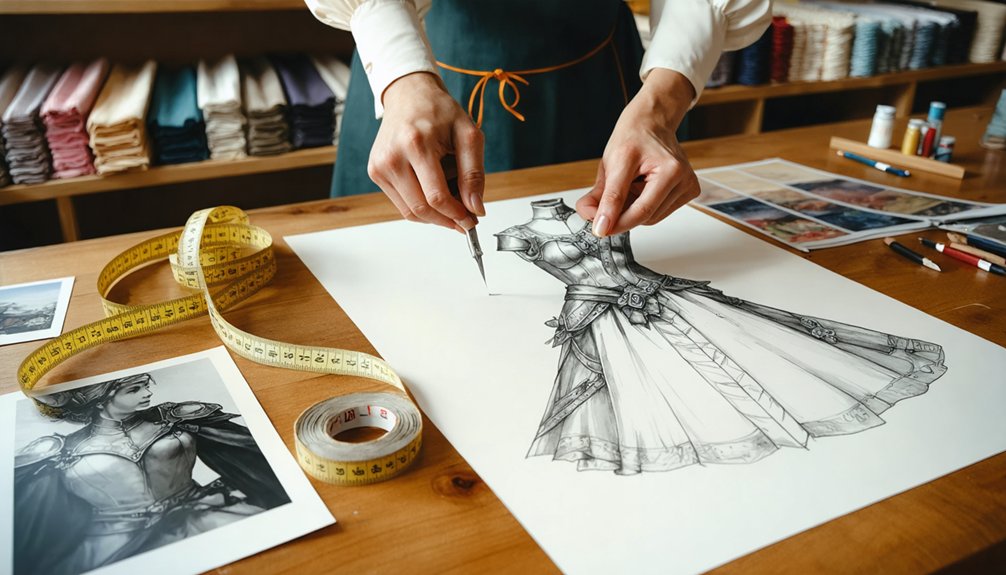
Before fabric cutting begins, initial sketches translate character references into dimensional blueprints that guarantee material waste and construction errors are avoided. You’ll provide front, side, and back reference images alongside chest, waist, length, and shoulder measurements—then commission artists incorporate these specs directly onto component breakdowns for clothing, armor, and accessories. This sketch quality control confirms rigid elements match your proportions before pattern drafting.
Add 1-2 inches seam allowance when artists convert sketches to paper patterns, which you’ll test against your body before final material purchases. For layered costume assembly, request overlapping allowances between components—base garments, mid-layers, and outer armor pieces. Mark adjustment points during mockup fittings, then refine sketches accordingly. Finalized drawings become traceable templates for alterations or duplicate builds, maximizing your commission investment through reusable construction documentation.
Understanding the Production Timeline and Process
You’ll need to account for a multi-month production cycle when commissioning custom cosplay work, as the process involves distinct stages from concept approval through final delivery. Understanding each production phase—consultation, pattern development, material sourcing, assembly, and quality control—helps you identify where delays might occur and where costs accumulate.
Set your timeline expectations based on costume complexity: simple designs may complete within weeks, while elaborate mirror-work pieces requiring CLO software patterning and extensive hand-decoration typically demand several months from initial contact to shipment.
Realistic Timeline Expectations
When commissioning a custom cosplay costume, understanding production timelines protects your budget and prevents costly rush fees. Timeline transparency directly correlates with cost transparency—artists who clearly communicate their process help you avoid expensive last-minute modifications.
Production duration varies considerably based on design complexity:
- Simple commissions: 3 days for basic designs with minimal detail work
- Moderate complexity: 2-4 weeks for mid-tier costumes requiring custom patterns and specialized materials
- Elaborate builds: Several months for intricate armor, electronics integration, or extensive embellishment
You’ll need to account for pre-production phases including measurements submission, reference collection, and material sourcing. Build buffer time into your event deadline—unexpected challenges like fabric availability or shipping delays commonly extend timelines. Starting early enables parallel workflows, such as simultaneous painting and sewing, optimizing your project’s cost-efficiency.
Production Stages Breakdown
Understanding project milestones helps you monitor progress and identify potential cost overruns before they compound. Your commissioned costume progresses through five distinct phases: planning considerations encompass character selection, reference compilation, and technical research to establish feasibility parameters.
During preparation, your maker sources materials strategically—balancing online wholesale pricing against local availability while repurposing household items to respect budget constraints.
The modeling stage delivers 3D renderings for approval, calculating exact material quantities and breaking down construction pathways.
Assembly integrates specialized techniques: heat-forming thermoplastics, precision-cutting reflective materials, and engineering garment structures.
Finishing applies surface treatments—priming, weathering, protective coatings—before final client fittings. Each phase requires specific expertise and timeframes; understanding this workflow enables you to anticipate cost variables and communicate effectively with your fabricator throughout production.
Material Selection and Technical Requirements
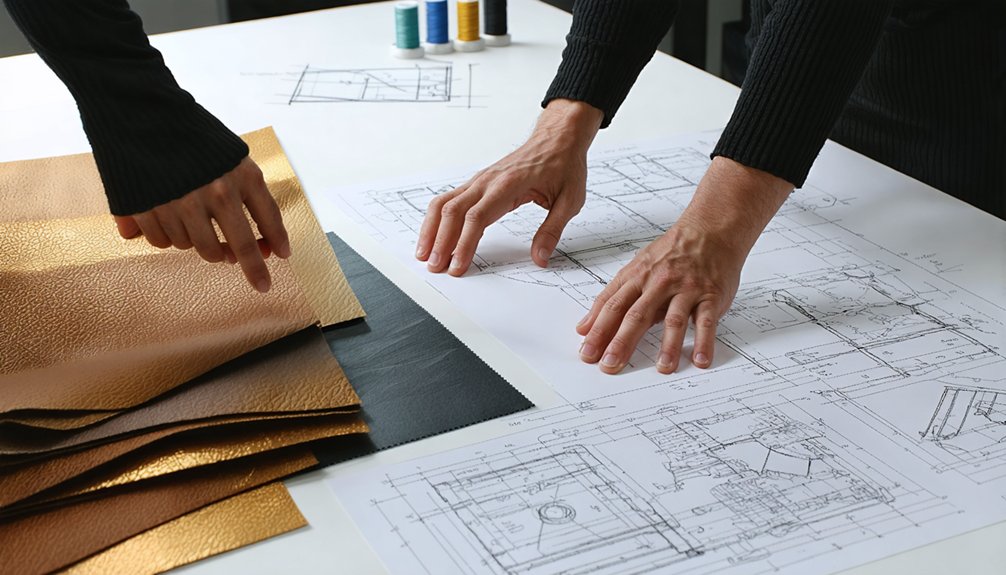
Selecting appropriate materials can make or break your cosplay commission, directly impacting both authenticity and your bottom line. Understanding fabric properties helps you communicate realistic expectations with your fabricator. Cotton poplin works for base garments at $3-8/yard, while gabardine delivers structure for $12-15/yard. Silk’s premium aesthetic commands $20-40/yard.
Material limitations determine your costume’s durability and functionality:
- Thermoplastics like Worbla ($25/sheet) require heat guns for armor fabrication
- Stretch fabrics (Spandex, Florence Net) need specialized needle sizes and tension settings
- Synthetic materials resist weather but complicate dyeing processes
Budget-conscious commissioners should specify preferred materials upfront. Thermoplastic alternatives and foam core construction reduce costs without sacrificing visual impact. Request material swatches before validating—duchess satin and gala lining validate color accuracy while maintaining professional finishing standards.
The Approval and Fitting Process
Material decisions lock in once you’ve navigated the approval and fitting process—a structured workflow that protects your investment through staged verification points. Your costumer will submit a 3D CLO model based on your body avatar parameters, allowing you to review feedback collaboration opportunities before pattern production begins. This digital prototype demonstrates preliminary appearance and fit accuracy.
Following 3D approval, patterns translate to biflex base garments for initial fitting tests. You’ll finalize approval criteria during this stage, ensuring dimensional accuracy before decorative elements attach. Mirrors and acrylic embellishments follow predesigned placement patterns post-base construction.
The final fitting confirms all specifications through high-resolution documentation—minimum 1080×1920 images against neutral backgrounds. Custom designs undergo case-by-case assessment with construction summaries, materials lists, and technique documentation ensuring screen-accurate results.
Final Delivery and Post-Commission Considerations
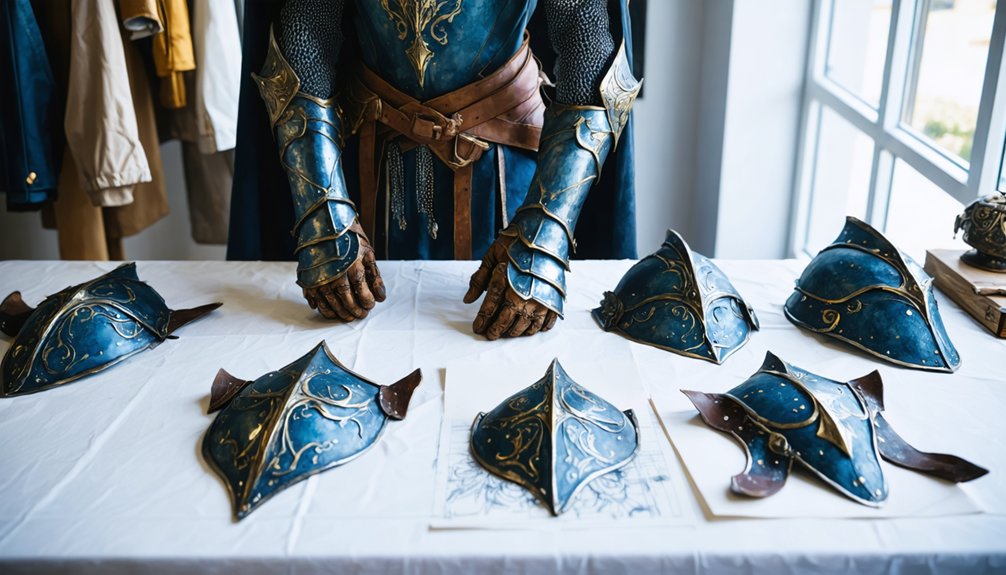
Once your costume clears final approval, you’ll encounter delivery timelines spanning 18-45 working days for standard custom commissions—a critical budget consideration when planning convention attendance. Tracking shipment status becomes essential through automated email notifications containing carrier information from FedEx, DHL, UPS, or EMS services.
Plan convention costumes with 18-45 day delivery windows in mind—tracking notifications through major carriers keep shipment visibility throughout the fulfillment process.
Strategic shipping selection profoundly impacts both cost and timeline:
- Standard shipping (25-30 days): Most economical option for non-urgent commissions
- Fast shipping (20-25 days): Requires specifying delivery dates for improved planning
- International air (7-15 days): Premium expedited service reducing production-to-delivery cycles
Managing customs delays requires buffer time, particularly for international orders where inspections extend timelines. PO Box and APO/FPO addresses incur remote surcharges and additional processing days. Holiday periods—Halloween and Christmas—necessitate earlier commission placement to certify convention-ready delivery.
Frequently Asked Questions
What Happens if I Gain or Lose Weight During the Commission Process?
Your dream costume could become a nightmare—notify your commissioner immediately about weight fluctuations during construction. You’ll cover costume alterations after delivery if measurements change. Request progress fittings, adjust timelines, and budget extra for potential rework to salvage your investment.
Can I Resell or Modify the Costume After Receiving It?
You can’t resell without permission due to commercial rights restrictions and copyright ownership issues. Personal modifications are allowed, but unauthorized commercial alterations or resale violate contract terms, potentially triggering legal action and financial penalties from creators or IP holders.
Are Deposits Refundable if I Need to Cancel My Commission?
No, deposits aren’t refundable under standard contract terms. You’ll forfeit your initial payment if you cancel, as payment policies classify deposits as non-refundable reservation fees. However, you might receive up to 60% back on completed work.
Who Owns the Design Rights to Custom Original Character Costumes?
You’ll typically retain design element ownership for original character costumes unless you’ve signed a work-for-hire agreement. However, intellectual property concerns arise if your design incorporates licensed characters, requiring careful contract negotiation before commissioning.
Should I Tip My Commissioner for Exceptional Work or Fast Turnaround?
Picture yourself unboxing that flawless armor piece—yes, you can tip 10–15% for exceptional work. However, appropriate communication and clear expectations about timelines belong in your contract upfront, not incentivized afterward. Tips express gratitude, never obligation.