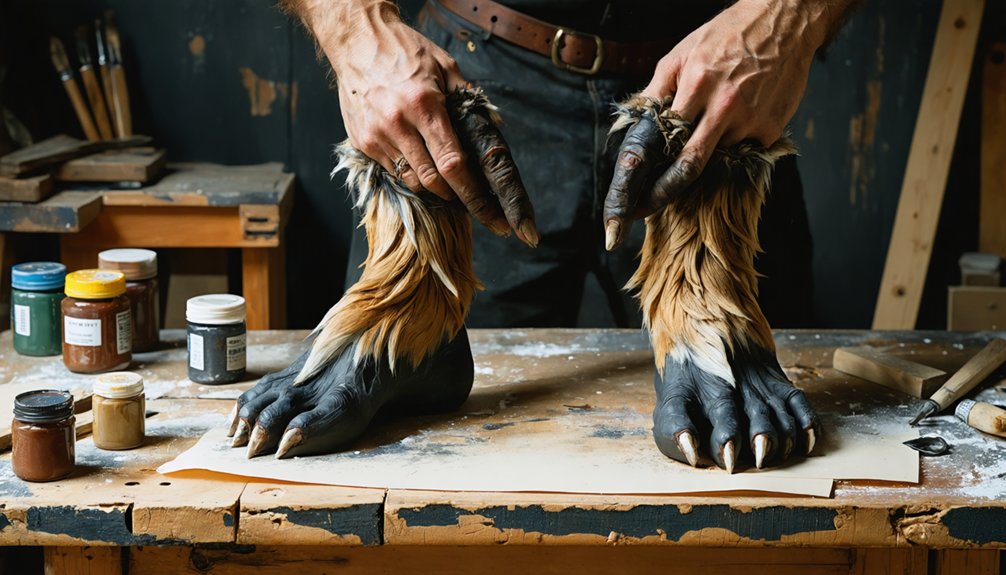
To cosplay a hydra with multi-head props, you’ll construct a wearable armature using PVC pipes or aluminum tubing that distributes weight across your shoulders and torso through harness brackets. Craft each serpentine head from lightweight EVA foam or papier-mâché over cardboard bases, then attach them to the framework using removable mounting systems. Paint with layered acrylics to achieve reptilian scale textures, and incorporate strategic disassembly points for transportation. The following sections break down each construction phase with detailed material specifications and engineering solutions for balance and mobility.
Key Takeaways
- Design 3-9 heads based on mythology, considering weight distribution across shoulder harnesses and torso-mounted brackets for comfortable wear.
- Use lightweight materials like EVA foam or papier-mâché for head construction to minimize strain during extended wear.
- Build a PVC pipe or aluminum tubing armature that follows natural body contours and distributes weight evenly.
- Create modular, removable heads with breakaway mechanisms to enable transportation, storage, and mythologically-accurate regeneration effects.
- Layer scales using EVA foam techniques, then paint with weathering effects to achieve realistic reptilian skin texture.
Understanding the Mythology Behind Your Hydra Design
Before you start fabricating headpieces and assembling armatures, you need to nail down which mythological interpretation you’re building. The Hydra’s head count varies dramatically across sources—nine heads per Alcaeus, though accounts range from three to one hundred. Your design decision impacts material load, weight distribution, and structural engineering.
Consider the creature’s godlike parentage from Typhon and Echidna when selecting scale and menacing aesthetics. The underworld connection offers atmospheric design opportunities: incorporate swamp textures, poisonous gas effects through LED-lit fog systems, or serpentine elements rather than draconic features.
Remember the regenerative mechanic—you might integrate breakaway heads with hidden duplicates. The central immortal head deserves distinct treatment: enhanced detailing, contrasting materials, or elevated positioning.
Choose your source canon strategically; it’ll dictate your entire construction methodology.
Planning Your Multi-Head Configuration and Layout
Your mythological framework established, you’ll now translate that conceptual design into engineering specifications. Head placement considerations begin with anatomical accuracy—position heads along curved body contours that mirror serpentine movement patterns. Supporting multiple heads demands strategic weight distribution through your helmet mount and pylon architecture.
Strategic head placement follows serpentine anatomy while optimizing weight distribution across helmet mounts and structural pylons for balanced multi-head support.
You’ll need foam strips heated into tubular supports that follow natural curves while concealing assembly connections.
Configuration Planning Essentials:
- Scale models to human proportions for puppeteering functionality rather than mythological giant sizes
- Design removable head mechanisms enabling modular adjustments from three to nine heads
- Position heavier heads centrally with lighter variants at extremities for balance optimization
- Cut assembly parts along body contours to hide connectors within organic changes
- Print structural connectors at 100% infill for rigid static joints supporting distributed loads
Selecting Materials for Lightweight Head Construction
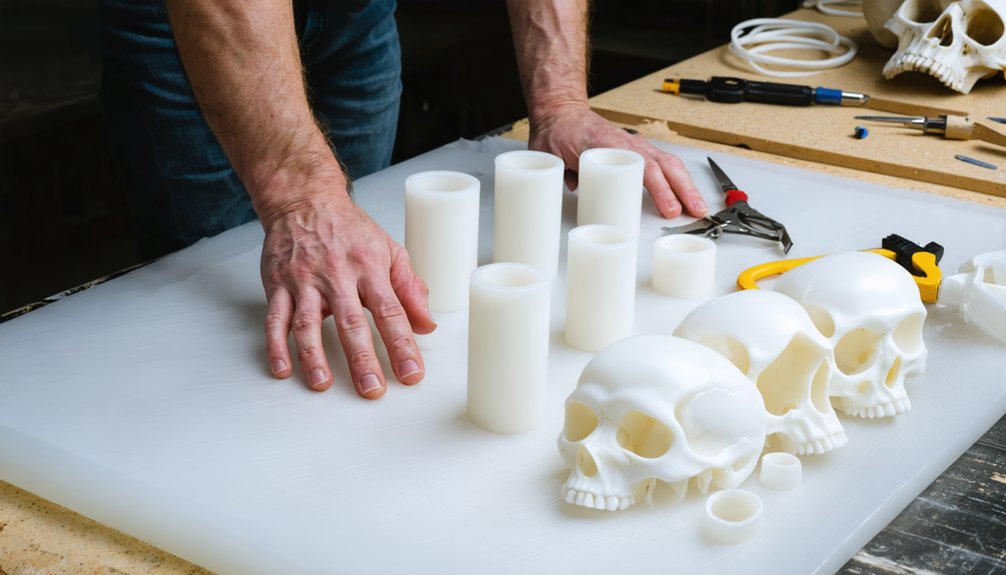
When building multiple hydra heads, you’ll need materials that balance structural integrity with minimal weight since you’re multiplying every ounce across several heads. Foam options like EVA sheets or high-quality foam sponge bases deliver breathability and flexibility at roughly 0.5 lbs per head, while papier-mâché offers an ultra-lightweight alternative that requires more sealing work.
Your material choice directly affects how weight distributes across your shoulders and back—lighter individual heads allow for more heads total, but each material handles reinforcement and mounting hardware differently.
Foam vs. Papier-Mâché Options
Two primary material approaches dominate lightweight hydra head construction: papier-mâché systems and foam-based methods. Cost comparison reveals papier-mâché’s advantage—household newspaper and 1:1 glue-water mixtures minimize expenses, while EVA foam and foam board require craft store purchases.
Weight characteristics differ substantially: foam maintains inherent lightness essential for multi-head props, whereas papier-mâché layers add mass unless applied minimally over aluminum foil bases.
Material Selection Framework:
- Papier-mâché excels for budget-conscious builders using cardboard bases, achieving sturdiness after 12-hour cures
- EVA foam provides superior flexibility for armor-like applications, resisting distortion under stress
- Spray foam detailing ($4.96/can bulk) reduces papier-mâché requirements while maintaining lightweight profiles
- Fast mache over foam accelerates construction timelines compared to traditional layering methods
- Tissue paper-reinforced EVA (5 PVA glue layers) delivers seamless, crack-resistant surfaces
Weight Distribution Considerations
Because hydra builds require multiple heads mounted simultaneously, material density directly impacts cervical strain and cosplay endurance. Varaform under-structures at 1 lb 12 oz per head enable manageable total loads when multiplied across three to five heads.
You’ll optimize head movement patterns by centering foam sponge bases (230g each) over shoulder-mounted harnesses rather than neck attachments. Air-dry clays like Hearty or Paperclay add minimal mass while preserving detail on cardboard frameworks.
Weight transfer techniques improve when you distribute Styrofoam bucks across backpack rigs instead of relying on head-mounting alone. Avoid fiberglass layers that introduce epoxy mass; Varaform’s breathable pore-infused structure maintains airflow without resin weight. Position heavier heads at lower mounting points to reduce leverage forces during extended wear sessions.
Building the Base Framework and Support Structure
You’ll need to select materials that balance rigidity with weight for your hydra’s multi-head support system. Start with PVC pipes or aluminum tubing for the main armature, positioning heavier structural elements close to your body’s center of gravity.
Distribute the weight of each head across shoulder harnesses and torso-mounted brackets, ensuring the framework transfers load through your core rather than straining your neck or arms.
Choosing Structural Materials
Material selection forms the foundation of any multi-head hydra prop, where structural integrity must balance against wearability constraints. When choosing long lasting materials, prioritize wood for high-stress contact points like feet and treads—its durability withstands repeated wear.
For selecting budget friendly alternatives, EVA foam offers exceptional versatility at minimal cost, layering to 2 inches for body construction while maintaining flexibility. Cardboard provides lightweight segmentation, enabling articulated joints without excessive bulk.
Essential Material Considerations:
- Wood foundations: Scrap wood creates durable bases for weight-bearing components and attachment points
- EVA foam layering: Combine 3mm and 4mm sheets for detailed segmentation with structural depth
- Cardboard flexibility: Dividing body segments allows natural movement while reducing overall mass
- Reinforcement integration: Brass tubes through foam create rivet-like strengthening without added weight
- Protective barriers: PVC sheets shield vulnerable edges from abrasion and floor damage
Weight Distribution Techniques
Three critical zones define successful weight distribution in multi-head hydra props: the base framework, internal support channels, and counterweight positioning. You’ll achieve stability through strategic positioning by drilling insertion points into your prop base for weighted blocks—wood filled with pre-melted solder works effectively.
Thread unraveled solder spools directly into hollow barrel sections, lowering the center of gravity in top-heavy configurations. For helmet-mounted designs, balance the entire assembly on a bike helmet before final bonding to prevent forward tipping.
Counterbalancing weight loads requires threading solder filament into hollow 3D-printed components at temperatures below your filament’s melting point. Position concentrated weights at the base to offset multiple head attachments.
Test each sectional assembly independently, using clamps during epoxy curing to maintain ideal weight alignment throughout construction.
Crafting Individual Hydra Heads With Foam and Clay
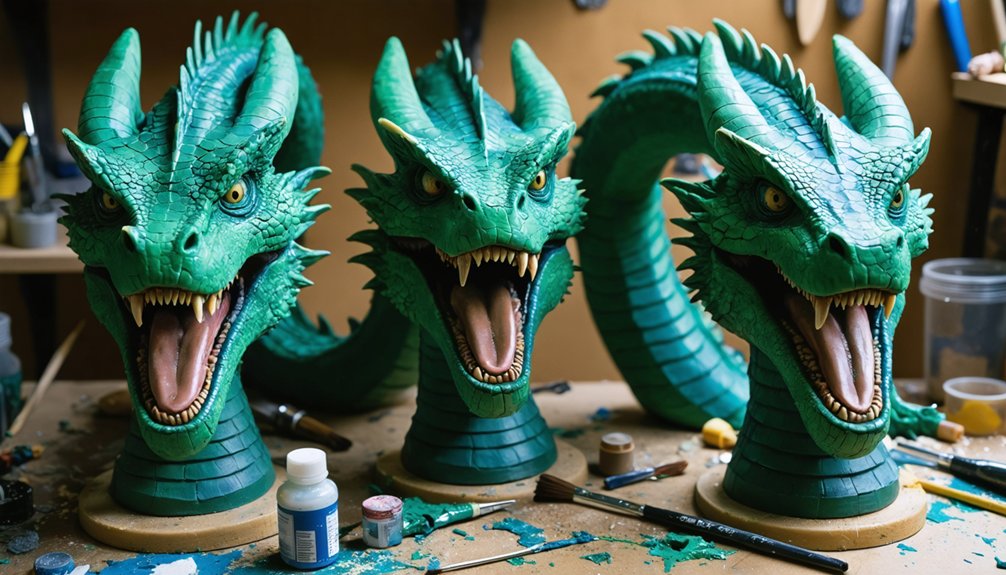
Building each hydra head starts with selecting 10mm EVA foam as your primary structural material, which provides the ideal balance between rigidity and workability for cranium-sized proportions. Trace skull templates onto foam sheets, then cut using a scroll saw for precision curves.
Heat-form the cranial pieces to create organic curvature before applying contact cement to seams. Layer 4mm foam strips for jaw definition and facial structure, incorporating foam texturing techniques with acrylic applied via palette knife.
Stack multiple foam layers for snout thickness, reinforcing joints with strategic adhesive placement. Add 15mm HD foam for protruding features like eye ridges or horn bases, achieving realistic facial expressions through careful segment assembly.
Essential Construction Steps:
- Heat-form 10mm foam sections for three-dimensional skull structure
- Layer 4mm detail strips for muscular definition
- Sand edges smooth for seamless joint integration
- Embed 15mm foam for pronounced anatomical features
- Apply acrylic texturing before final assembly
Creating Realistic Scales and Texture Details
You’ll need to select appropriate scale materials—either 2mm EVA foam, craft foam, or resin 3D-printed pieces—before beginning your texture work.
The layering process requires specific application techniques, starting with a black base coat foundation and working from top to bottom to prevent scales from bonding together.
Once your scales are properly attached with hot glue or contact cement, you’ll apply iridescent paints and weathering effects to create depth and realistic coloration across the hydra’s body.
Material Selection for Scales
When selecting scale materials for your hydra cosplay, you’ll need to balance visual impact against practical construction requirements. Selecting breathable fabric backings guarantees comfort during extended wear, while incorporating stretch and flexibility allows natural movement across multiple heads and necks.
Material Options by Application:
- 3D Printed PLA scales (21.545mm × 36.104mm × 21.959mm) on mesh fabric provide rigid structure with sewable attachment points
- Acrylic sheets (12×19 inches, 3mm thickness) in hydra-specific fiery tones offer lightweight durability at $8.00-$20.00
- Holographic stretch fabrics enable body-contouring effects with light-refracting properties for dynamic visual impact
- Resin-printed scales (55mm length) with riveting holes allow flexible leather backing integration
- Cotton eco-print fabrics (150cm width, $5.17/yard) deliver breathable base layers for scale attachment
Layering and Application Techniques
Creating dimensionality across your hydra’s multiple necks requires systematic scale layering that progresses from foundational patterns to organic texture variations. Begin with 1mm craft foam cutouts traced centrally, then expand outward row by row until surface curvature demands adaptation. Heat your foam post-marking to push tool edges deep into pattern lines, creating cuts that reach near-foam thickness. This establishes realistic scale shapes with genuine depth and movement.
For non uniform scale placement, vary sizes strategically after initial tracing, then cut beneath edges from multiple angles to mobilize individual pieces. Insert pre-cut foam fragments between traced lines for authentic texture breaks. Heat again post-cutting to deepen separation further. This multi-stage approach transforms flat foam into dimensional skin that flexes naturally across your hydra’s articulated necks.
Painting and Weathering Effects
How do you transform flat foam scales into convincing reptilian skin that photographs like the real thing? Start with two progressive basecoats—dilute first, then pigment-rich—scrubbing paint into textured crevices. Pigment layering techniques build dimensional depth through targeted accumulation in recesses and selective drybrushing on raised surfaces.
Create stencils from masking tape for precise scale patterns, then enhance edges with focused highlights. Airbrush weathering applications deliver gradient changes impossible with brushwork alone, while misting creates subtle texture shifts. Apply weathering effects strategically: concentrate darker pigments in crevices simulating dirt accumulation, brighten peaks for worn authenticity. Seal everything with clear finish to lock layers and boost saturation. Multiple thin applications preserve intricate details better than heavy coats.
Essential Scale Painting Workflow:
- Prime surfaces before basecoats for ideal paint adhesion
- Build depth through 3+ thin layers versus single heavy application
- Position final highlights for photographic lighting conditions
- Use hairdryer between layers for workflow efficiency
- Maintain brushes throughout multi-layer construction
Painting and Finishing Techniques for Dragon-Like Heads
Multiple layers of paint transform raw foam and clay surfaces into convincing reptilian textures for hydra head props. Begin with ultra flat camouflage green spray paint, dusting lightly around mouths and horns. Test all application techniques on scrap material first.
Layer Liquitex sap green washes over exposed skin areas, then add selective cadmium yellow on darker scales for dimensional contrast. Apply graphite powder with shop towels, buffing for metallic finishing effects. Dry brush highlights using raw sienna, unbleached titanium, and cadmium yellow mixtures to feather edges naturally.
Create battle damage with rotary tools before painting begins. Seal completed work with hand-applied Mod Podge or polyacrylic varnish—avoid aerosol sealers on polymer clay surfaces. Execute final touch-ups before applying your sealing layer for professional results.
Attachment Methods for Multiple Heads to Your Costume
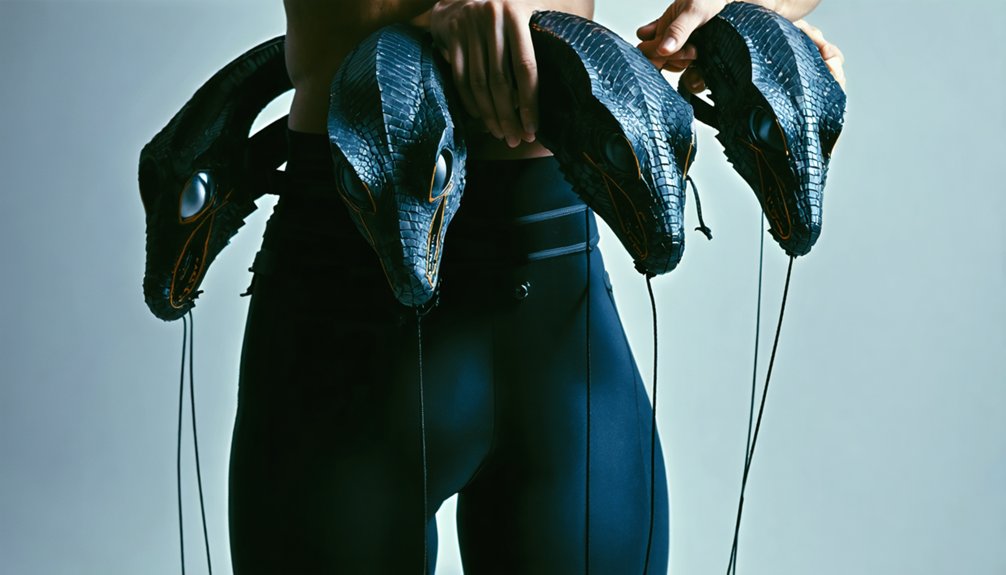
When attaching multiple hydra heads to your costume base, you’ll need mechanical fastening systems that balance security with reusability. Magnet-based methods create sandwich structures between wig fabric and prop pieces, enabling non-permanent attachment durability. Position one magnet under the wig to connect with headpiece magnets, adding extras for stronger holds.
Alternatively, implement screw-and-nut systems by drilling three holes into each headpiece, gluing screws into props, then pushing them through wig fabric and securing with hex nuts. For structural bonding, super glue bonds 2mm to 18mm EVA foam layers after sealing. Fold foam at designated lines, gluing back ends while leaving fronts open for flexibility. These reversible methods guarantee repeated wig attachment without permanent alterations.
Key Implementation Strategies:
- Test multiple attachment configurations before finalizing placement
- Layer magnets strategically for distributed weight support
- Pre-seal foam before adhesive application
- Maintain partial openings for movement articulation
- Prioritize reversible fastening for component longevity
Ensuring Mobility and Balance While Wearing Your Prop
The success of any multi-head hydra costume depends on maintaining unrestricted movement while supporting distributed weight across your frame. Flexible shoulder attachments require EVA foam density under 100 kg/m³, reinforced sparingly with Worbla thermoplastics at core stress points.
Form foam tubes for neck armatures, keeping material volume minimal while achieving structural integrity. Head articulation methods employ string-pulling tendons with rings positioned at joint bases, allowing individual or simultaneous operation without motion restriction.
Mark joint placements proportionally on patterns, then heat-shape creases for invisible hinge lines. Apply 2mm foam sheets over articulated sections, bonding seams with contact cement for tight, flexible joins. Test thread tension pre-assembly—taut enough for control, loose enough to prevent binding.
Scale patterns slightly larger than anatomical proportions, distributing weight evenly across reinforced shoulder zones while preserving full mobility.
Transportation and Storage Solutions for Large Props

Large multi-head hydra props demand strategic disassembly planning before you ever attend a convention. Your multi-component system requires wheeled travel cases from manufacturers like Rubbermaid for bulky head assemblies, while utility carts accommodate smaller segmented pieces.
Climate controlled storage prevents material degradation—avoid outdoor sheds where heat and moisture compromise foam integrity. Implement pest prevention strategies through sealed containers with proper ventilation in temperature-stable environments.
Essential Transportation Components:
- Clear labeled stackable bins organize neck articulation mechanisms and mounting hardware separately
- Folding utility carts consolidate multiple costume changes without requiring additional trips
- Compartmentalized systems reduce convention setup time through pre-organized component groups
- Hard-sided wheeled bags protect delicate painted surfaces and sculpted details during transit
- Specialized hanging storage maintains shape integrity for fabric-based costume elements between events
Frequently Asked Questions
How Do I Make the Heads Move or Animate During Performance?
You’ll control head movement patterns through PathDeform modifiers or scripted sequences that adjust articulation techniques. Use morph targets for mouth animation, while mult() and blend() functions create dynamic motion synchronization across your multi-head prop assembly during performance.
What’s the Best Way to Add LED Lights to the Eyes?
Like tiny beacons in darkness, embed coin cell LEDs behind translucent resin eye pieces for ideal lighting placement. You’ll want battery pack power source options hidden in the neck mechanisms, using thin gauge wiring for seamless integration throughout your multi-head assembly.
Can I Make This Cosplay Convention-Safe With Sharp Teeth and Claws?
Yes, you’ll achieve convention-appropriate materials and realistic appearance enhancement by using soft, flexible dental-grade thermoplastic for teeth and filing claw edges smooth. These innovations maintain dramatic effects while meeting safety standards for extended wear.
How Much Does a Full Multi-Head Hydra Cosplay Typically Cost?
Picture foam, wire, and fabric transforming into serpentine heads—you’ll spend $150-$500 depending on your prop construction methods and material cost choices. Advanced mechanisms and premium materials push budgets higher, while budget-friendly techniques keep expenses low.
What Undergarments Work Best Beneath the Costume for Long Wear?
You’ll need moisture-wicking base layers in breathable fabrics like merino wool or technical synthetics for thermal control. Seamless compression shorts prevent chafing, while athletic supporters eliminate bulk under bodysuit constructions during extended convention wear.