Start with heat-resistant Futura fiber (340°F tolerance) in 24-36 inch lengths to accommodate styling shrinkage. Secure your natural hair flat with cornrows, then anchor the wig using bobby pins at center seams and ear tabs. Style sections for 10 seconds maximum with your heat tool, allowing complete cooling between passes. Kanekalon works best for natural-looking fantasy textures, while Futura maintains flowing styles through multiple convention days. Master these foundational techniques before advancing to complex layering and color-blending methods.
Key Takeaways
- Start with 24-36 inches minimum length to compensate for styling loss from curling and layering cuts.
- Choose Futura fiber for heat styling up to 340°F or Kanekalon for natural-looking curl retention.
- Select heavy-density construction with tight weft spacing to achieve voluminous fantasy character styles.
- Apply heat tools for maximum 10 seconds per section, allowing complete cooling between passes.
- Secure the wig foundation by braiding natural hair flat and pinning at center seams and ear tabs.
Selecting the Right Length and Color for Your Character
When you begin selecting a wig for fantasy cosplay, character reference artwork determines every critical dimension of your purchase. Analyze lighting conditions in source material to identify color undertone matching—highlights, lowlights, and base tones that shift under convention hall illumination. Always start with longer lengths since you can’t restore trimmed fiber. For flowing styles, purchase 24-36 inches minimum, accounting for curling loss and layering reduction.
Wig density considerations prove equally critical for authentic fantasy recreation. Voluminous character designs demand heavy-density construction with tighter weft spacing to achieve proper weight and dramatic presence. Dense wefts provide adequate material for cascading layers while maintaining fullness throughout styled sections. Coordinate chosen colors with your skin tone for cohesive appearance, or utilize specialized synthetic dyes when exact shades aren’t commercially available.
Understanding Synthetic Fiber Materials and Heat Resistance
You’ll work with three primary synthetic fibers in fantasy cosplay wigs: Futura (heat-safe to 340°F), Henlon (up to 300°F), and Kanekalon for curl-retention styling. These temperature thresholds determine which heat tools you can safely apply—flat irons, steamers, or boiling water—without melting or damaging the fibers.
Premium synthetic materials like high temperature fiber and microfiber blends maintain their structure through multiple convention days, resisting tangling and frizzing under stage lights and prolonged wear.
Premium Synthetic Fiber Types
Understanding the fiber composition of your wig determines both its styling capabilities and longevity. When evaluating wig fiber quality, prioritize Kanekalon for its realistic texture and reduced sheen—it’s your foundational material for natural-looking fantasy styles.
For heat-intensive styling, Futura withstands temperatures up to 340°F, allowing you to create waves and curls without fiber damage. Japanese Futura variants extend this threshold to 410°F for advanced techniques.
Synthetic fiber characteristics vary considerably: Toyokalon‘s high-gloss finish creates unwanted shine in photography, while Henlon delivers smooth texture with 150%-180% density for voluminous cascading styles. Heat-safe variants enable curl pattern modifications, whereas standard synthetics maintain permanent pre-set styles.
Premium acrylics and polyesters offer flame-retardant properties essential for convention safety compliance while reducing costs compared to human hair alternatives.
Heat-Resistant Temperature Thresholds
How hot can your styling tools go before destroying your fantasy wig investment? Heat-resistant synthetic fibers tolerate specific thresholds: modacrylic handles up to 300°F, treated polyester reaches 270°F to 350°F, and hi-heat fibers max out at 260°F to 280°F. Proper heat application starts at lower temperatures, increasing gradually while monitoring fiber response. Use digital temperature displays for precision control—never exceed manufacturer limits, as single passes beyond thresholds cause irreversible melting, frizz, and stiffness.
Heat duration limits prove equally critical. Restrict contact to 10 seconds per section, allowing complete cooling between passes. For Ellen Wille heat-friendly fibers, style while wet within the 260°F to 280°F range. Always verify heat tolerance through label specifications and strand testing on hidden sections before committing to visible areas.
Durability Under Event Conditions
While heat thresholds protect fibers during styling, convention floors present distinct durability challenges that test your wig’s construction limits. Direct sunlight exposure threatens lower-grade synthetics above 300°F, risking fiber melting during outdoor photo shoots.
Complex fantasy textures—layered curls, crimped sections, or backcombed volume—increase event durability vulnerabilities in crowded spaces where friction accelerates breakdown.
Lace front caps offer strategic ventilation advantages, minimizing sweat-induced friction that degrades wefts during extended wear. Your material vulnerabilities multiply when intricate styling meets high-traffic environments; Kanekalon’s 212°F steam tolerance becomes critical knowledge for emergency smoothing between panels.
For multi-day events, Futura’s 410°F resistance preserves long flowing styles better than standard fibers. Plan detangling sessions using fabric softener between wear cycles to combat the accelerated matting that complex cosplay builds experience under convention conditions.
Preparing Your Natural Hair With Caps and Pinning Techniques
Before placing your fantasy wig, you’ll need to create a flat foundation by braiding your natural hair close to the scalp—typically 7-8 cornrows for thick 4C textures or wrapped sections for straightened hair. Secure each braid with bobby pins placed flat against your head, testing stability with a gentle shake to prevent bulges that’ll distort the wig’s flow.
Position your wig cap by stretching it from your forehead backward, pulling it taut over the pinned braids and smoothing the edges until you’ve eliminated all lumps and gaps.
Braiding and Pinning Hair
When preparing your natural hair for a long fantasy wig, you’ll need to create a flat foundation that prevents lumps and maintains the wig’s intended silhouette. Begin by braiding your natural hair into tight sections or buns, then apply hair spray to guarantee shape. Secure these braids flat against your scalp using bobby pins, focusing particularly on the nape area where layering wig caps will occur.
Once flattened, attach your braided bun directly to the cap base using hot glue for permanent stability. This braiding technique safeguards minimal bulk under your wig. Pin the teased, sprayed sections firmly against the cap, distributing pins strategically at center seams and ear tabs—always securing into elastic portions rather than delicate lace to prevent damage.
Positioning the Wig Cap
After securing your braided natural hair flat against your scalp, you’ll select the appropriate wig cap type based on your specific needs. Pantyhose caps smooth flyaways for realistic silhouettes, while fishnet varieties offer maximum grip. For thick hair, layer multiple caps to achieve a flatter foundation.
Stretch the cap open and pull it over your prepared hair, starting at the nape and drawing forward to your hairline. For lacefront applications, position the edge half an inch back on your forehead.
Securing wig cap tightly requires strategic bobby pin placement: insert one pin at the base, then two on each side in an X-formation with open ends facing the crown. Pins must penetrate both cap and natural hair for ideal hold, ensuring no strands escape during performance.
Positioning and Securing the Wig on Your Head
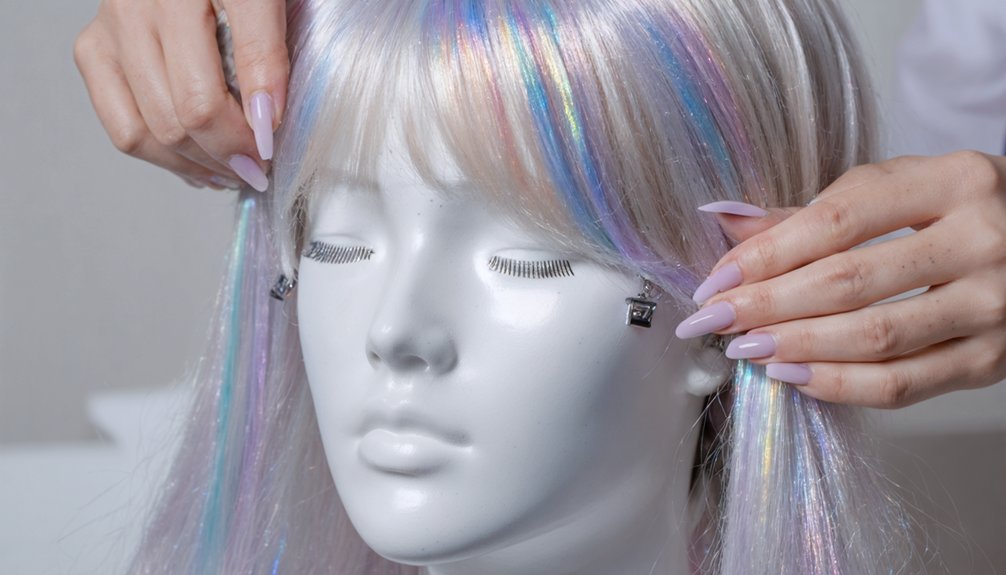
Once your hair sits flat beneath the wig cap, grab the wig at its front edge with both hands using your index fingers positioned inside the cap opening. Bend forward and align the wig’s hairline with your natural one before flipping it onto your head in one smooth motion.
Alternatively, position the wig from back to front for better coverage control.
Adjust the part placement at your head’s center, then pull any trapped natural hair free from the sides. For blending hairline seamlessly, guarantee no wig cap or natural hair shows along the edges. Raise or lower the wig until internal combs reach ideal scalp positions.
For securing wig firmly to head, slide small combs through the cap into your natural hair, tighten the adjustable back strap, and add bobby pins at strategic points for stability.
Detangling Methods for Different Wig Textures
Long flowing fantasy wigs require texture-specific detangling methods to maintain their dramatic appearance without causing fiber damage. You’ll apply different techniques based on whether you’re working with straight synthetic fibers that respond to brush strokes, curly textures that need finger separation to preserve their pattern, or wavy styles that benefit from wide-tooth comb applications.
Matching your tool selection and hand movements to the wig’s texture prevents shedding while achieving the smooth, cascading effect essential for fantasy cosplay characters.
Straight Wig Brush Techniques
Before you begin detangling your straight fantasy wig, secure it on a wig head or canvas block to create a stable working surface. These wig stabilization techniques prevent fiber stress during manipulation.
Apply detangling solution application to 1.5-inch sections, ensuring adequate lubrication before tool contact.
Execute the following brushing sequence:
- Initial Pass: Use your wig brush with light pressure, starting at fiber ends and progressing upward in short strokes
- Heat Assistance: Hold hair taut while directing warm blow dryer air from above to relax synthetic fibers
- Precision Smoothing: Section strands and employ a wide-tooth comb from tips to roots, finishing with swift flat iron passes
Avoid contact with lace cap areas to preserve construction integrity. Work methodically through each section, maintaining consistent tension without pulling.
Curly Wig Hand Separation
Curly fantasy wigs demand a gentler approach than their straight counterparts due to the spiral structure’s tendency to interlock and form persistent tangles. Hand separation techniques prove essential for minimizing wig damage while preserving curl definition.
Begin by spritzing small, finger-thick sections with water until damp—never soaked. Your fingers become precision tools: gently separate moistened curls from tips upward, methodically working through each lock. Once a section releases freely, twist it around your finger to reform the curl’s natural shape.
This tactile method allows you to detect resistance before fiber breakage occurs, unlike brushes that can shear delicate synthetic strands. Progress systematically from back to front, securing detangled sections with clips. Only move to wide-tooth combs after initial hand-work eliminates major knots.
Wide-Tooth Comb Applications
After releasing major knots through manual separation, you’ll reach for a wide-tooth comb to confirm the detangling process. This tool’s flexible two-tiered teeth design maximizes detangling effectiveness across synthetic and human hair fibers without compromising strand integrity.
Apply these texture-specific techniques:
- Curly/Textured Wigs (3C-4C): Spritz conditioning spray, then work from tips upward using the rounded-tooth side to preserve curl definition and prevent fiber breakage.
- Straight Synthetic Fibers: Focus on the nape area where tangles concentrate, holding sections higher up to minimize root stress during combing passes.
- Heat-Friendly Materials: Draw the comb through after styling product application to distribute formulas evenly and smooth fiber appearance.
For maintenance and storage, the comb’s compact design guarantees portability while its durable plastic construction withstands repeated styling sessions throughout your cosplay build.
Styling Techniques Without Heat Tools
Why struggle with heat damage when fabric strips and manual techniques achieve identical flowing results on synthetic fibers? Wrap scrap fabric around sections, securing tightly at the top to create temperature controlled sculpting through prolonged setting. This fabric manipulation method preserves fiber integrity while establishing dramatic waves.
Expose your wig to direct sunlight for natural fiber training, or wear it under a toque while walking to flatten roots using body heat. Secure shapes with alligator clips and T-pins on your wig stand, finishing with freeze spray to lock your no-heat style permanently.
Generate warmth through rapid hand friction, then pat from roots downward—never rake—to smooth and train synthetic strands. Focus on small sections for realistic blending without compromising curl definition.
Washing and Conditioning Your Cosplay Wig

Your cosplay wig’s longevity depends on proper washing technique, starting with water temperature selection. Use lukewarm water for synthetic fibers, shifting to cool water for your final rinse on pre-styled pieces. This temperature control prevents fiber degradation while maintaining your carefully crafted curls and waves.
Essential Washing Protocol:
- Shampoo Phase – Add mild or baby shampoo to create light suds, then submerge your wig and work out styling products gently. Avoid vigorous agitation that compromises fiber integrity.
- Conditioning Treatment – Dissolve one capful of conditioner in room temperature water before immersion. Focus application on product-heavy sections while keeping solution away from roots and cap adjustments.
- Rinsing Cycle – Execute three complete rinses until bubbles disappear, enabling effective wig deodorizing and complete product removal.
Pat dry with towels; never brush while wet.
Drying Your Wig Safely After Cleaning
Three primary methods exist for drying your freshly washed cosplay wig, each suited to different fiber types and time constraints.
For synthetic fibers, follow air drying guidelines: rinse with cold water, suspend on a wig hanger overnight in ventilated space, and never brush while wet to preserve curl patterns.
Human hair wigs benefit from towel drying alternatives—sandwich the wig between two towels on a flat surface, creating a moisture-wicking cocoon that reduces drying time to 25-30 minutes.
For accelerated results, insert your dryer nozzle inside the cap at medium heat and low speed, repositioning every 10-15 minutes. Avoid machine dryers entirely and verify complete dryness through visual inspection before styling.
Packing Long Wigs for Travel and Events
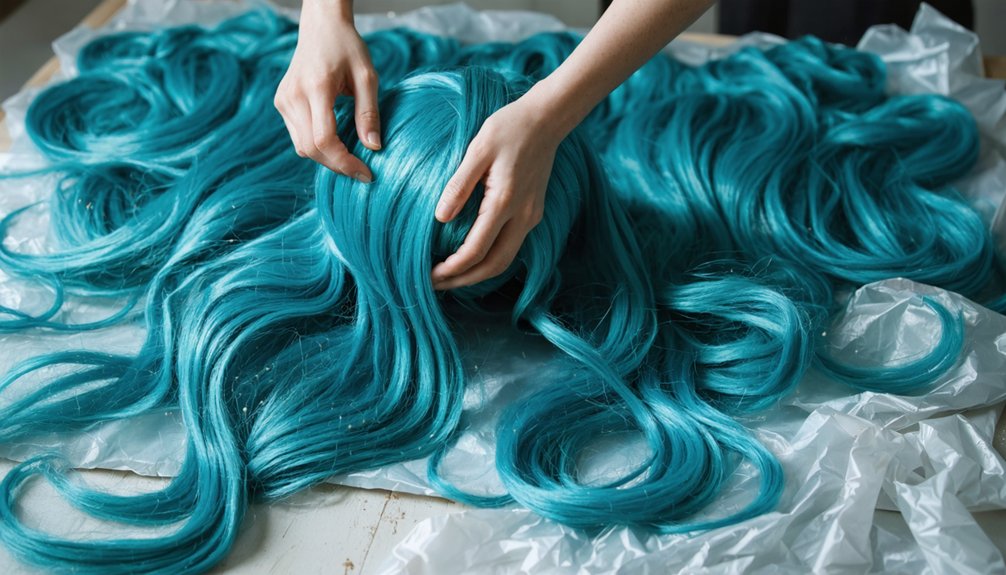
When transporting elaborate cosplay wigs to conventions or photoshoots, proper packing prevents style collapse, fiber damage, and hours of on-site repairs. Long flowing wigs require specialized storage solutions that protect delicate styling while maximizing portability.
Essential Transportation Precautions:
- Braid and coil your wig’s length, securing ends with rubber bands before placing in a silk-wrapped bag to prevent friction-induced frizz
- Mount styled wigs on foam heads with straight pins, then anchor the base to cardboard cut precisely to your box dimensions for zero movement
- Layer protection using multiple hairnets over heavy hairspray application, then pack in snug-fitting containers with air pillow cushioning
Always pack wigs in carry-on luggage rather than checked bags. Select boxes with handles or collapsible containers that accommodate your wig’s volume without compression.
Maintaining Your Wig Between Cosplay Appearances
Between convention appearances, synthetic and human hair wigs deteriorate rapidly without systematic maintenance protocols. Implement regular wear storage by positioning your wig on a stand immediately after removal, preventing fiber compression and tangling.
Wig longevity depends on immediate post-wear protocols—always use a stand to prevent fiber damage and preserve your investment between conventions.
Inspect wig cap condition maintenance through biweekly examinations of elastic bands, combs, and netting integrity—replace compromised components before events.
Execute washing cycles every 10-15 wears using diluted wig-specific shampoo, followed by conditioner application to lock moisture into fibers. Air dry exclusively on stands to maintain structural shape.
For long wigs, create loose braids before storage in original netting and bags, shielding from direct sunlight exposure.
Between uses, finger comb sections gently and apply wig-specific detanglers to guarantee your fantasy cosplay piece remains performance-ready across multiple conventions.
Frequently Asked Questions
Can I Dye a Synthetic Cosplay Wig to Match My Character Better?
Yes, you can darken synthetic wigs using specialized wig dyeing methods like heat-activated Rit DyeMore or FW Ink spray techniques. These synthetic wig coloring techniques require testing samples first, as you’ll only achieve darker shades—bleaching won’t work.
How Do I Fix Matted Tangles in an Old Cosplay Wig?
Soak your wig overnight in water mixed with fabric softener to soften the fibers. Then, section the hair and finger-detangle from tips upward before you brush gently with a wide-tooth comb or tangle teezer.
What’s the Best Way to Add Volume to Flat Synthetic Wigs?
Transform your lifeless wig into cloud-like drama by backcombing sections at the roots, then adding volume using wig safe hairspray to lock lift. Alternatively, you’re utilizing wig volume powders applied directly to roots for instant theatrical dimension.
Can I Trim or Cut My Long Cosplay Wig Myself Safely?
You can safely trim your cosplay wig using proper wig styling techniques—cut only elastic, lace, or netting connection points, never fibers directly. Work in small sections at 45° angles, and guarantee you’re selecting appropriate wig adhesives for secure positioning.
How Long Do Synthetic Cosplay Wigs Typically Last With Regular Use?
Your synthetic cosplay wig’ll last 4-6 months with regular wear. Extend its lifespan to 10-12 months through cost effective wig maintenance—washing every 20 wears and implementing proper wig storage methods away from heat and direct sunlight.