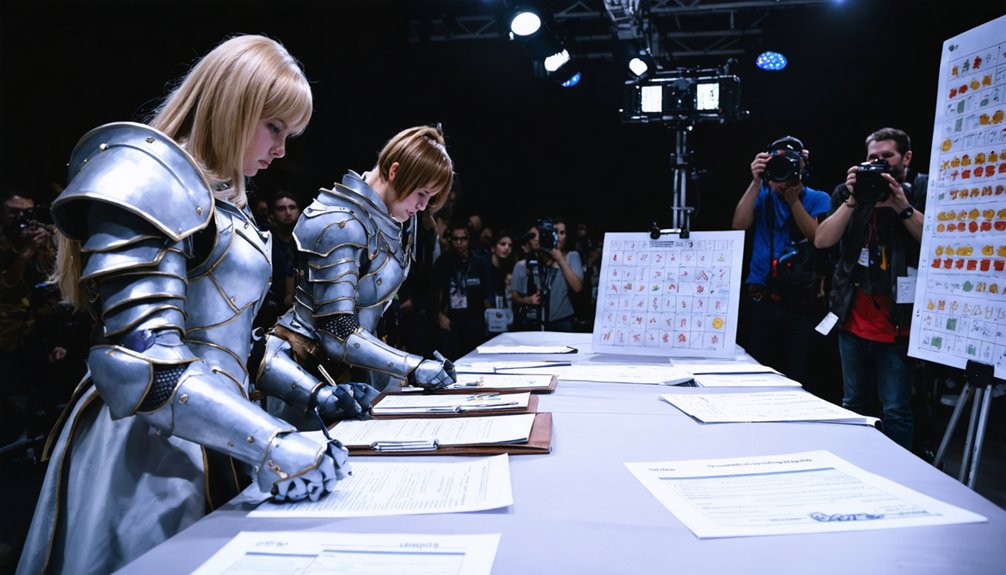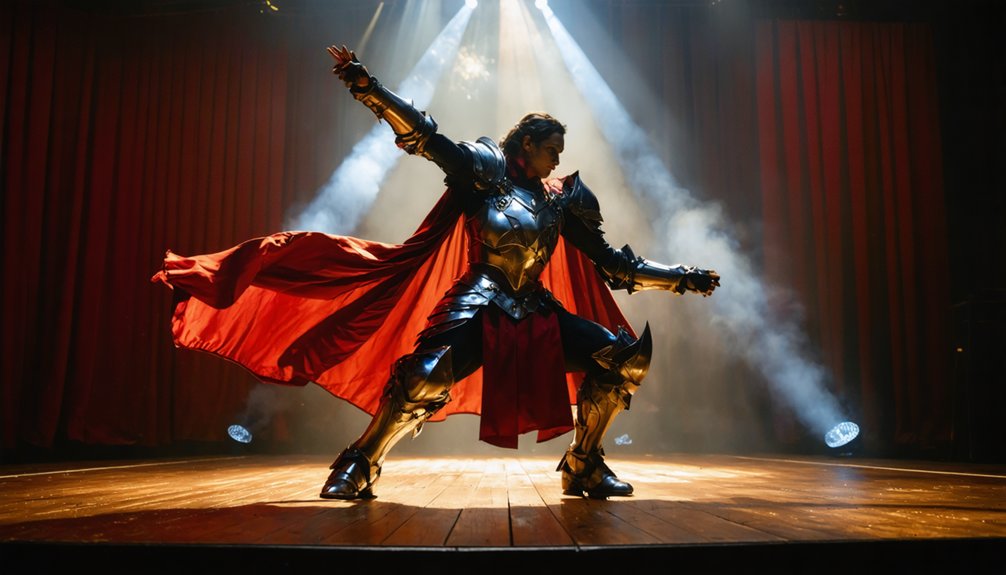
Transform your cosplay stage presentation by mastering spatial awareness through full-stage movement and practicing in convention-sized spaces. You’ll build confidence using progressive exposure—start with mirror practice, then perform for trusted friends before tackling larger audiences. Coordinate exaggerated, full-body gestures with your soundtrack’s rhythm while keeping performances under two minutes for technical precision. Focus on amplifying your character’s signature traits rather than complex storytelling, as judges value confident execution within time constraints. The following strategies will elevate your performance from nervous debut to commanding presence.
Key Takeaways
- Use the entire stage with expansive movements scaled up for back-row visibility and to showcase your costume’s silhouette.
- Practice progressively with mirrors, recordings, and growing audiences to build muscle memory and performance confidence.
- Synchronize full-body movements with your soundtrack’s rhythm while keeping performances under two minutes for technical precision.
- Amplify character traits through signature gestures, poses, and movements that create instant audience recognition.
- Prioritize confident execution of iconic character elements over complex storytelling within venue time constraints.
Master the Art of Dynamic Stage Movement
When you step onto a cosplay stage, your performance space becomes a canvas that demands your full physical commitment. Break free from stationary TikTok-style filming habits by traversing the entire stage—walk to corners, move between positions, and cover maximum territory like a rock performer commanding their venue.
Utilize full body motions rather than just upper-body gestures; your costume’s movement and silhouette need visibility from every seat. Scale up your actions dramatically: wider stances, grander arm sweeps, and exaggerated poses that translate across convention hall distances.
Practice in spaces matching actual stage dimensions to build spatial awareness. Elevate energy levels by maintaining constant character-appropriate movement—whether that’s the Hulk’s direct, powerful paths or Black Widow’s calculated, indirect approach.
Film rehearsals to assess audience perspective and refine your physical storytelling.
Build Confidence Through Progressive Practice Methods
Your confidence grows exponentially when you start with mirror practice sessions at home, allowing you to refine poses and expressions without performance pressure.
Once you’ve mastered your movements in private, systematically increase your audience size—begin with one trusted friend, then expand to small groups of 3-5 people, and finally progress to local meetups.
This graduated exposure method builds genuine stage-ready confidence because you’re developing muscle memory and emotional resilience simultaneously through controlled, incremental challenges.
Mirror Practice Builds Foundation
Mirror practice transforms nervous beginners into confident performers through systematic repetition and self-observation. You’ll develop essential muscle memory by rehearsing character poses daily, allowing your body to internalize movement patterns before facing an audience. Recording yourself provides objective feedback that reveals blind spots your eyes can’t catch in real-time reflection.
Start with basic character stances, then progress to complex gesture sequences. Your self assessment adjustments during these sessions create iterative improvements that compound over time. Experiment with camera angle experiments to identify which poses photograph effectively and which need refinement.
This foundation-building method reduces performance anxiety through familiarity. When you’ve executed a pose hundreds of times privately, stage execution becomes automatic rather than conscious. Progressive rehearsal transforms uncertainty into reliable stage presence through deliberate, measured skill development.
Scale Audience Size Gradually
Private rehearsal mastery prepares you for the next critical phase: strategic audience exposure. Begin with intimate local gatherings where supportive cosplay communities provide community based feedback in low-pressure environments. These controlled settings let you refine stage mechanics while documenting measurable improvements.
Progress methodically through targeted venue selection—start with casual meetups, advance to small conventions, then scale to larger events as your confidence compounds. Each performance tier builds essential resilience; fewer attendees initially reduce intimidation factors while positive reinforcement creates sustainable momentum.
Complement live appearances with recorded performances uploaded to niche online groups. This digital-physical hybrid approach accelerates skill development through diverse feedback channels. Document your progression metrics—audience size, venue complexity, performance duration—to validate readiness for increasingly challenging stages. Incremental exposure transforms anxiety into commanding presence.
Command Attention With Strategic Body Language and Pacing
Your stage presence hinges on how deliberately you move through space and time—every gesture must convey character while commanding the judges’ attention from their seats. You’ll transform static poses into compelling performance by coordinating full-body movements with your soundtrack’s rhythm, ensuring your legs, arms, and facial expressions work together across the entire stage.
Master this technical precision by anticipating audio delays, keeping your performance under two minutes, and using expansive motions that remain visible even to back-row observers.
Master Dynamic Stage Movement
Your body initiates performativity through costume interaction. Lightweight chiffon crafts flowing presence, while spandex blends enable form-fitting flexibility.
Balance breathable moisture-wicking properties with theatrical impact, positioning yourself as co-creator alongside your costume’s responsive technology.
Control Timing and Tempo
Every second on stage carries intentional weight when commanding audience attention through calculated pacing. You’ll maximize stage time usage by keeping skits under two minutes while delivering complete narratives. Practice your entrance, poses, movements, and exit until the flow feels instinctive—this rehearsal efficiency enhancement prevents uncertainty from reading as poor performance.
Vary your tempo strategically: hold dramatic tableaux for three-count pauses at designated stage points, then shift fluidly. Scale movements for back-row visibility while maintaining dynamic energy shifts throughout your routine. Position yourself downstage center for critical moments, utilizing full stage space like professional performers.
Pre-record dialogue to eliminate pacing disruptions from live delivery complications. Your body language commands attention when you’ve rehearsed blocking until it’s second nature, transforming technical precision into engaging stage presence.
Express Character Through Gestures
Precise movements transform costume accuracy into engrossing performance when you anchor every gesture in your character’s core personality. Your expressive limb movements should amplify defining traits—soft, graceful motions near your face suit elegant characters, while purposeful, space-commanding arms convey power.
You’ll convey emotions through posture by coordinating your entire body: plant your feet firmly with strong spine alignment for dominant personalities, or shift weight forward during dynamic mid-attack poses. Don’t limit yourself to upper-body gestures alone. Instead, incorporate bent knees for innocence, full-body spins for energy, and grand sweeping movements that reach the back row.
Match your physical expression to character psychology—slumped shoulders communicate defeat, while upright positioning projects confidence. Complete embodiment overcomes nerves and captivates audiences.
Optimize Your Performance Within Time Constraints
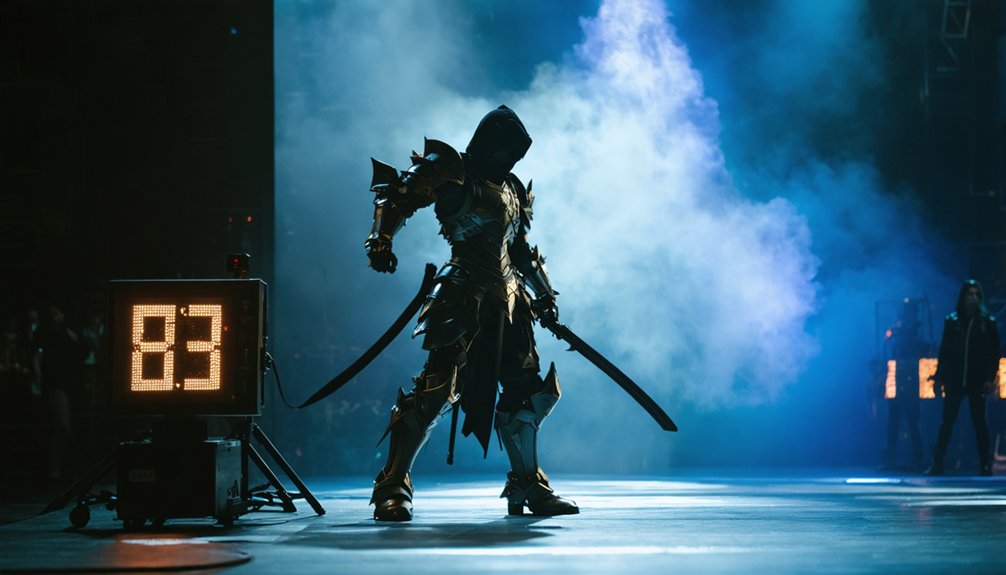
Time limits transform cosplay stage presentations into precision exercises where every second counts. You’ll maximize cosplay presentation impact by strategically editing audio files and streamlining choreography to fit automatic cutoff times. Before finalizing your performance, verify venue-specific rules regarding music permissions and royalty-free requirements to avoid disqualification.
To incorporate theatrical performance elements effectively, prioritize signature character traits over complex narratives. Deploy catchphrases or iconic movements that trigger instant audience recognition within your 1-2 minute window. Practice repeatedly with friends to identify which gestures communicate character identity fastest while maintaining authenticity.
Design original choreography that showcases your costume’s best features without sacrificing timing precision. Remember: conventions value confident execution within constraints over elaborate sequences that risk running over. Strategic preparation transforms limitations into opportunities for focused, memorable performances.
Balance Audio Elements for Maximum Impact
Audio cue synchronization creates immersive experiences when sound effects match your physical actions—lightning strikes, weapon draws, or magical transformations. Wire sound modules like Adafruit Audio FX directly into your costume, triggering effects via buttons, motion sensors, or Bluetooth.
Conceal speakers strategically and adjust volume based on your character and venue size. Sync these elements with visual cues to create sensory synchronicity that emotionally engages your audience beyond simple dialogue delivery.
Present Your Costume From Head to Toe
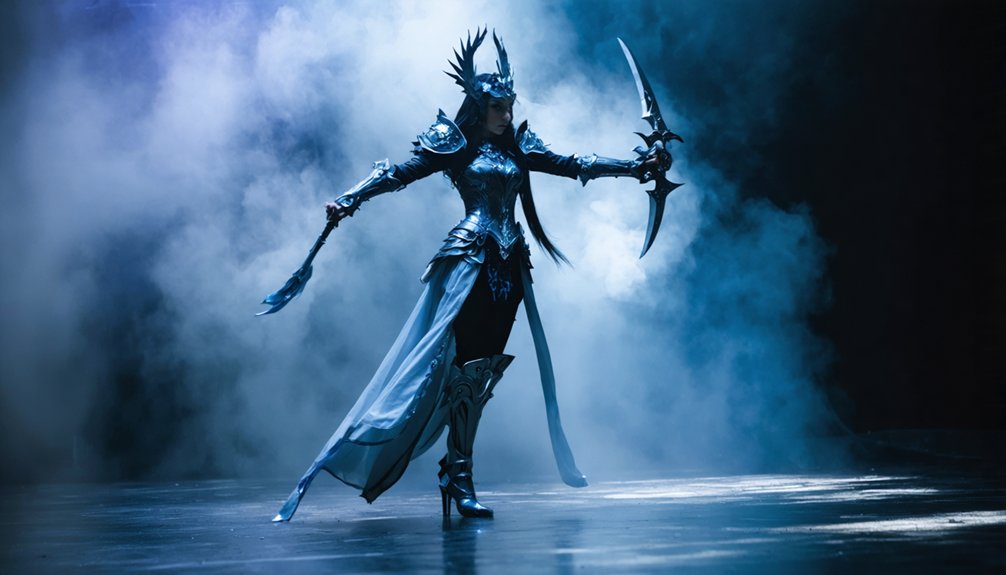
Your stage presentation succeeds or fails in those critical 60 seconds when judges and audiences assess your costume’s craftsmanship from every angle. Execute a strategic triangle path—center back stop, front right pose, front left pose, center back departure—to showcase every detail.
Your pose variety should emphasize features you’re proudest of, whether innovative techniques or intricate embellishments.
Move deliberately to convey movement while maintaining visibility:
- Stop at distinct points for calculated poses that reveal costume construction
- Slow your shifts so observers can appreciate texture, armor mechanics, and fabric work
- Practice your complete presentation with a timer in open space
Ensure your wig sits convincingly with proper securing, makeup reads from distance, and props enhance without distracting. Never criticize your workmanship—own your presence completely and highlight achievements confidently.
Embody Your Character Through Roleplay Techniques
When you step onto that stage in full costume, authentic character embodiment separates memorable performances from mere costume displays. You’ll leverage character motivation by studying source material intensively—analyze personality traits, speech patterns, and emotional responses that define your character’s core.
Embrace a methodical approach through mirror training: rehearse expressions, gestures, and postures until they’re recognizable without costume elements. Practice distinctive mannerisms like head tilts or specific walking styles repeatedly until muscle memory takes over.
Build character playlists from show music to trigger the right mindset before performances. Combine theatrical techniques with LARP-style immersion, ensuring your physicality matches your character’s personality.
Layer these behavioral details with your visual presentation to achieve cohesive transformation. Consistent rehearsal transforms surface-level mimicry into seamless, innovative character portrayal that captivates judges and audiences alike.
Understand Competition Judging Standards and Scoring

Most cosplay competitions evaluate your performance through structured scoring systems that divide points between costume craftsmanship and stage execution—typically allocating 40-50% to performance elements and 50-60% to construction quality.
To comprehend judging criteria effectively, analyze scoring breakdown across these key assessment areas:
- Performance Quality (50 points): Story execution, prop integration, entertainment value, and source material respect during your 2:30-minute showcase
- Construction Precision (40 points): Accuracy to original designs, clean assembly techniques, and proper material selection
- Technical Craftsmanship (40 points): Sewing quality, finishing details, painting techniques, and structural complexity
Advanced construction methods—transformation mechanisms, special effects, structural innovations—score higher than basic techniques.
Your costume accuracy receives maximum points when precisely matching source material, while original interpretations require maintaining character essence through faithful design choices and color palettes.
Showcase Craftsmanship While Maintaining Positive Energy
Understanding judging standards provides the foundation, but translating that knowledge into stage execution requires balancing two competing demands: displaying your construction expertise while projecting compelling character energy.
Present your reference materials to judges first, proactively explaining key construction points before questions arise. Identify specific craftsmanship details during limited judging windows—technical challenges you’ve overcome, innovative material choices, and completion milestones. This illustrates polished stage presence through preparation.
Simultaneously, maintain character immersion through full-body language that reflects emotional states. Execute huge, dramatic facial expressions visible to the back row. Use hand gestures and movements consistent with your character’s personality, never breaking to neutral between lines.
Rehearse this dual focus until it becomes natural. Strong character integration shouldn’t diminish craftsmanship visibility—instead, your performance becomes the dynamic framework showcasing your technical achievements.
Frequently Asked Questions
What Should I Do if My Prop Breaks During My Performance?
Stay calm and improvise your choreography to minimize the prop’s role while you assess damage. Use your emergency repairs kit for quick fixes, or adapt your performance through costume improvisation. Your composure and creativity will shine through any technical setback.
How Do I Handle Stage Fright When Performing in Front of Large Crowds?
Practice consistently and use breathing exercises for managing anxiety levels before performing. You’ll develop confidence through exposure training and realistic goal-setting. Remember, 90% of successful performers overcame severe stage fright—you can too with dedicated preparation.
Can I Compete in Multiple Categories at the Same Convention?
No, you can’t compete in multiple categories. Competition regulations strictly limit you to one entry per convention, ensuring costume compatibility with a single division. Focus your creative energy on perfecting one standout performance instead.
What’s the Best Way to Transition Between Character and Myself Backstage?
Practice smooth costume changes with pre-staged pieces and dresser assistance while mentally shifting between personas. You’ll achieve seamless persona metamorphoses by establishing clear physical rituals—like removing a signature prop—that signal your return to yourself backstage.
Should I Prioritize Costume Accuracy or Stage Mobility When Planning My Design?
Perfect accuracy means nothing if you’re tripping onstage! Balance costume details with performance quality—your audience remembers dynamic movement over screen-accurate seams. Modify restrictive elements strategically, ensuring you’ll captivate through mobility while maintaining recognizable character essence.