To measure yourself for a cosplay costume, you’ll need a soft measuring tape and a way to record results. Wear form-fitting clothing, then take five core measurements: bust/chest, waist, hips, height, and shoulder width. Keep the tape level and snug without pulling tight. Measure each point twice and average the results. Cross-reference your numbers against vendor size charts before ordering. There’s much more to getting a perfect fit than these basics cover.
Key Takeaways
- Use a soft, flexible measuring tape and wear slim-fitting clothing or undergarments to ensure accurate, distortion-free measurements.
- Focus on five core measurements: bust/chest, waist, hips, height, and shoulder width for accurate costume fitting.
- Stand naturally with relaxed posture, keeping the tape level and snug without pulling it too tight around your body.
- Measure each point at least twice, calculate the average, and record results in both inches and centimeters.
- Match measurements against vendor size charts, choosing the larger size when between two sizes, and note any special fitting requirements.
Gather These Tools and Clothing Before You Start
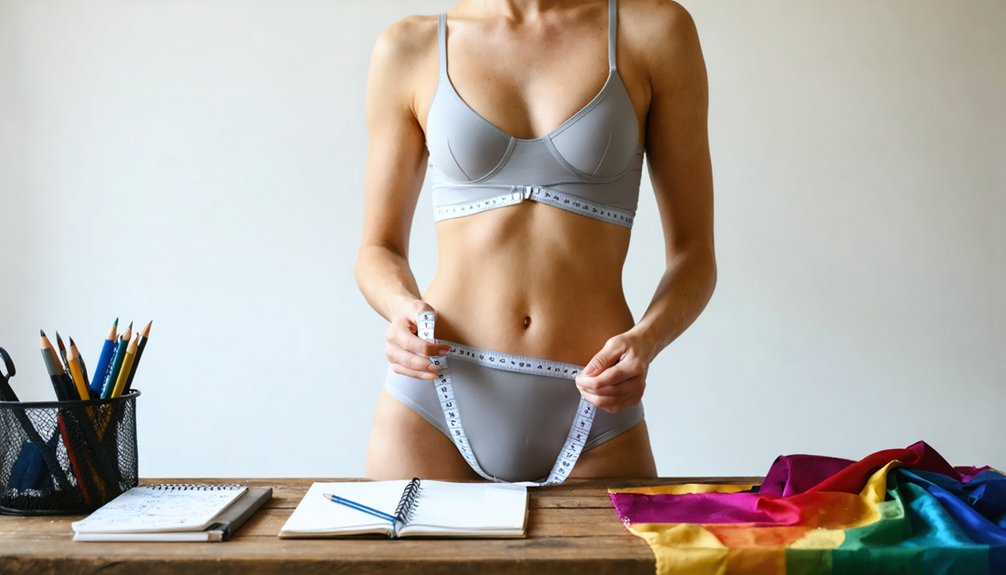
Before you start measuring, you’ll need two essential tools: a soft, flexible measuring tape and something to record your measurements with. A rigid ruler won’t conform to your body’s contours, so flexibility in your measuring tools is non-negotiable.
Next, select your fitting clothing carefully. Wear slim-fitting garments like leggings and a tank top, or measure in your undergarments for maximum precision. Avoid bulky layers that add artificial volume to your measurements.
Slim-fitting clothes or undergarments only — bulky layers distort measurements and compromise the accuracy of your final costume fit.
If your costume includes armor pieces, wear your padding during measurement to guarantee the finished piece fits correctly over protective gear.
Finally, create or download a measurement chart before you begin. Record everything in both inches and centimeters to stay compatible with vendors using different unit standards.
The 5 Essential Cosplay Measurements to Take First
Your five essential measurements are bust or chest, waist, hips, height, and shoulder width—each one anchoring the fit of your costume to your actual body proportions.
Measure your height from the top of your head to the floor while standing straight, and capture your shoulder width across your back from one shoulder joint to the other.
These two structural measurements, combined with your three core circumferences, give costume vendors the complete data they need to size your build accurately.
Core Body Measurements
Whether you’re ordering a pre-made costume or commissioning a custom piece, five core measurements form the foundation of any accurate cosplay fit: bust or chest, waist, hips, shoulder width, and height.
These measurements establish your body’s framework, enabling precise bust measurements, waist adjustments, and hip proportions across any design.
Key measurement points to prioritize:
- Bust/Chest: Measure around the fullest point for accurate panel sizing
- Waist: Identify your natural waistline to anchor torso length calculations
- Hips: Capture the fullest circumference to balance hip proportions correctly
Height determines overall scaling, while shoulder width governs structural fit.
As you progress to advanced customization, you’ll build on these foundations to refine arm lengths, calf sizes, and full torso length for complex costume builds.
Height And Shoulder Width
Height and shoulder width round out the five essential cosplay measurements, and both require careful technique to get right.
For height, stand barefoot on a flat surface, shoulders relaxed, and measure from the floor straight to the top of your head. Height variations between vendors mean you’ll want this number precise, since size charts often differ by two-inch increments.
For shoulder width, measure across your upper back from one shoulder joint to the other. Proper shoulder alignment matters here — keep your posture natural rather than rolled forward or pulled back.
Have a partner take this measurement while you stand relaxed, since self-measuring often skews results. Record both figures in inches and centimeters before cross-referencing them against your vendor’s size chart.
How to Measure Yourself Accurately for a Cosplay Costume
Before you take any measurements, put on slim-fitting clothes like leggings and a tank top, or strip down to your undergarments for the most accurate results. Precise measurement techniques guarantee your costume and cosplay accessories fit correctly without costly adjustments later.
Wear slim-fitting clothes or undergarments before measuring to ensure your costume fits perfectly without expensive adjustments later.
Follow these core practices:
- Stand naturally with relaxed posture, breathing normally without manipulating your stomach.
- Keep the tape level and snug — not tight — around each measurement point to avoid distorted readings.
- Measure twice or three times and calculate the average to confirm accuracy.
Having a second person assist remarkably improves reliability. Record every measurement in both inches and centimeters to stay compatible with multiple vendors.
Before submitting your order, double-check all figures, as retailers won’t accept responsibility for incorrect measurements you provide.
Common Measuring Mistakes That Ruin the Fit
Even small measuring errors can throw off your entire costume fit, so you’ll want to watch for the three most common mistakes: inconsistent tape tension, stomach manipulation, and skipping verification steps.
Keep your tape level, snug but not tight, and never twist it around your body, as uneven tension produces measurements that don’t reflect your actual size.
Don’t suck in or push out your stomach during measurement, and always measure at least twice to confirm accuracy, since a single reading is too unreliable to trust for a final order.
Inconsistent Tape Tension Issues
One of the most common mistakes that ruins a costume’s fit is inconsistent tape tension during measurement. When your tape is too tight, it compresses the body, producing smaller numbers. Too loose, and you’ll order a costume that’s oversized.
To maintain proper tape tension and maximize measurement accuracy, follow these rules:
- Keep the tape level: It must sit parallel to the floor all the way around, never twisted or angled.
- Snug, not tight: You should fit one finger underneath the tape comfortably.
- Check for gaps: Confirm no sagging occurs at the back, sides, or front.
Repeat each measurement two to three times and average the results. Consistent tape tension is non-negotiable for achieving a costume that fits precisely.
Stomach Manipulation Errors
Stomach manipulation during measurement distorts your natural body shape and produces inaccurate numbers that lead to poor costume fit.
Whether you’re sucking in or pushing out, altering your stomach positioning creates a false baseline that throws off every circumference calculation. Your finished costume will either compress uncomfortably or hang loosely because it’s built around a shape you don’t actually maintain.
Correct body posture requires you to stand naturally, breathe normally, and let your abdomen rest without interference.
Before measuring, take a slow breath, exhale completely, and relax. That’s your accurate baseline. Your measurements should capture your true resting form, not an idealized or exaggerated version.
Capturing honest data guarantees your costume accommodates real movement, not just a momentary pose.
Skipping Verification Steps
Skipping the verification step turns a small measurement error into a guaranteed fitting problem. Single measurements aren’t reliable enough for custom costume ordering. You need repeated confirmation to achieve real measurement accuracy.
Follow this verification protocol before submitting any order:
- Measure twice minimum: Take each measurement two to three times and calculate the average value.
- Cross-reference your numbers: Compare results against the vendor’s size chart, flagging any suspicious outliers immediately.
- Document everything: Record verified measurements in both inches and centimeters to eliminate unit-conversion errors.
Verification importance can’t be overstated—retailers explicitly disclaim responsibility for incorrect measurements you provide.
One skipped confirmation step costs you money, time, and a wearable costume. Build verification into your standard process without exception.
Extra Measurements Custom Cosplay Orders Require
While standard measurements cover the basics, custom cosplay orders often require additional data points to ascertain a precise fit. Understanding measurement importance guarantees your costume achieves accurate custom fitting across every component.
Measure your arm length from the shoulder joint to the wrist with a slight bend at the elbow. Record your bicep circumference around the relaxed upper arm’s fullest point.
For bodysuits or pants, capture your inseam from the crotch down to just below the ankle bone. Measure your torso length from neck to waist, and record your calf circumference at its widest point, using the larger leg’s value.
Document everything in both inches and centimeters, and if your costume includes armor, wear your padding during measurement for the most accurate results.
How to Read Cosplay Size Charts and Place Your Order

Once you’ve recorded all your measurements, reading cosplay size charts correctly determines whether your costume fits or frustrates.
Size chart interpretation requires matching your measurements against the chart’s finished garment dimensions, not just labeled sizes.
Matching your measurements to finished garment dimensions—not just labeled sizes—ensures your costume actually fits.
Follow these ordering tips for accuracy:
- Choose the larger size when your measurements fall between two sizes to guarantee comfortable fit.
- Check tolerance ranges since most retailers allow 1–3 inches variance for custom-made costumes due to manual measurement differences.
- Note special requirements in the custom instructions field to communicate unique fitting needs directly to vendors.
Always verify your measurements before submitting, because retailers won’t accept responsibility for incorrect data you provide.
Record both inches and centimeters to stay compatible with international vendors using ISO 8559-1:2017 standardized sizing conventions.
Frequently Asked Questions
What International Standards Govern How Cosplay Measurements Should Be Taken?
Two standards govern your cosplay accuracy: ISO 8559-1:2017 defines chest, waist, hip, and height measurements, while ASTM D5219 standardizes apparel terminology. Use proper measurement tools and follow both to guarantee precise, consistent fitting results.
How Much Size Tolerance Do Retailers Allow for Custom-Made Cosplay Costumes?
When exploring custom sizing options, you’ll find that retailer policies typically allow 1–3 inches of tolerance for custom-made cosplay costumes. Always verify your measurements twice to minimize discrepancies and guarantee the best possible fit.
Should I Wear Padding Clothing When Measuring for Cosplay Armor Pieces?
Yes, you should wear padding clothing when measuring for cosplay armor pieces. This guarantees your padding techniques account for accurate armor fit, preventing gaps or tightness once you’ve layered protective gear beneath your costume components.
Should I Record My Measurements in Inches, Centimeters, or Both?
Even if one system feels intuitive, you’ll want to record your measurements in both inches and centimeters using your measurement tools, ensuring seamless compatibility across global size charts from diverse vendors.
What Should I Do When My Measurements Fall Between Two Cosplay Sizes?
When your measurements fall between two sizes, you’ll want to choose the larger size. This size adjustment technique minimizes fitting alterations later, ensuring you’ve got sufficient fabric for comfortable, precise modifications without compromising the costume’s structural integrity.
References
- https://angel-secret.com/blog/how-to-measure-yourself-correctly-for-cosplay-costumes
- https://www.ezcosplay.com/measurement-guide
- https://www.unibuyplus.com/blog/detail/how-to-measure-your-body-for-cosplay-costumes
- https://www.youtube.com/watch?v=dNy3N4Sn-gY
- https://www.youtube.com/shorts/cfzAz472Wr4
- https://armstreet.com/mens_measurement.html
- http://kiltedkatana.com/blog/2015/8/16/measuring-yourself