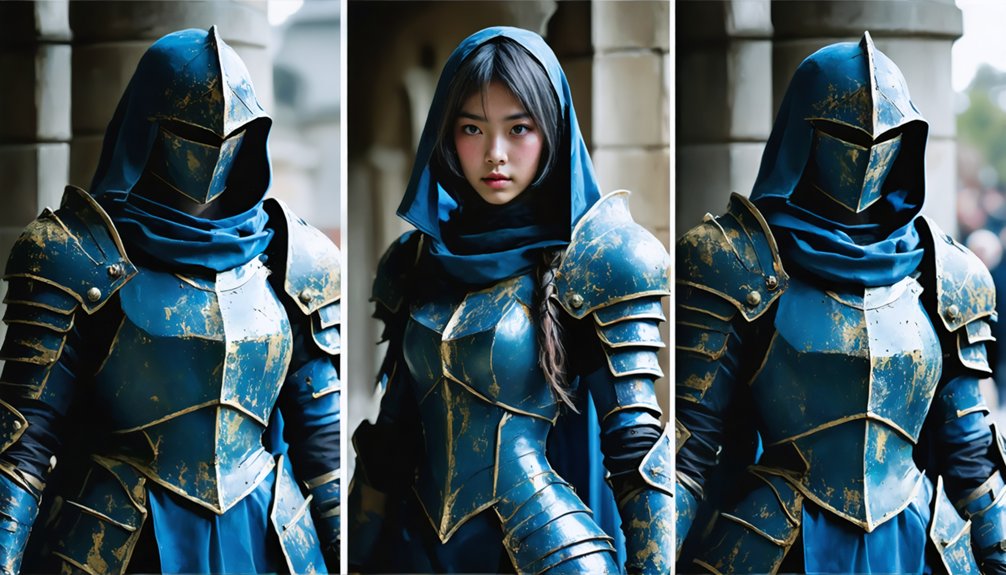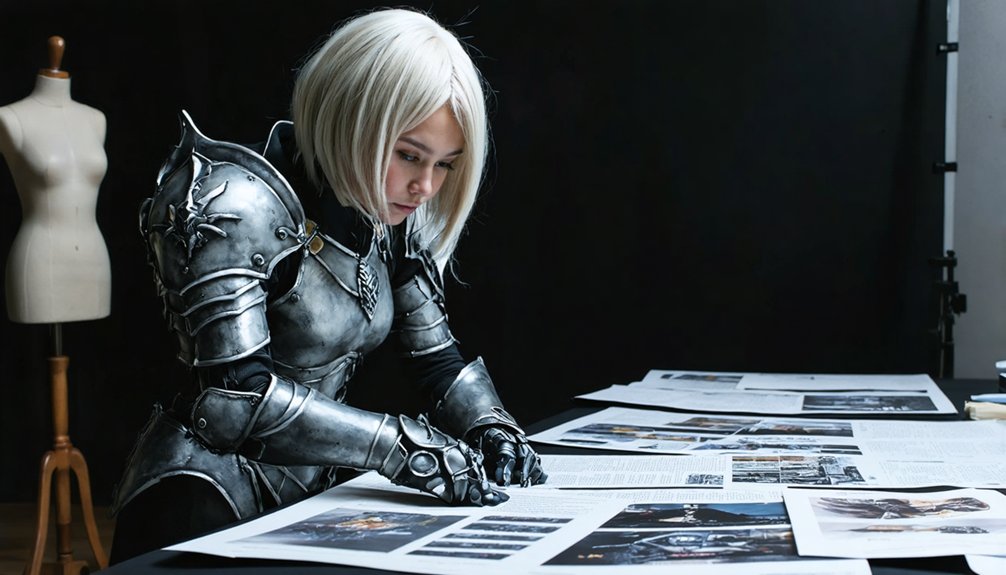
Start by collecting detailed visual references from multiple platforms, organizing them with annotated sheets that highlight construction details and color accuracy. Build your costume using industrial adhesives and structural reinforcements like fiberglass rods, ensuring mobility through pre-event testing. Transform your appearance with strategic makeup techniques—brow blocking, precision contouring, and body paint application. Study your character’s movement patterns through reference GIFs and method acting, testing poses in full costume. The community-driven techniques that follow will refine these fundamentals into performance mastery.
Key Takeaways
- Gather comprehensive references from multiple sources including 360-degree views, close-ups, and annotated construction sheets for accurate character details.
- Build costumes with industrial adhesives, fiberglass rods, and nylon webbing for durability and screen-accurate structural integrity.
- Transform your appearance using contouring, brow blocking, strategic highlighting, and full-coverage foundation for character facial features.
- Study character movement patterns, practice poses with reference GIFs, and test costume mobility to embody authentic mannerisms.
- Engage with cosplay communities for feedback, technique sharing, and real-time peer review to refine your performance skills.
Building Your Vision Through Research And Reference Gathering
Before you cut your first piece of fabric or mix your first batch of Worbla, you’ll need an extensive reference library that captures your character from every conceivable angle. Start with photograph selection across Pinterest, Instagram, and DeviantArt—prioritizing front, back, and 360-degree views alongside close-ups of essential elements like footwear and accessories.
Efficient reference organization separates successful cosplayers from frustrated ones: create dedicated pin boards per character, maintain digital folders on your device, and print physical copies for workshop access without screen dependency. Compare multiple sources to identify color discrepancies from photo editing and distinguish canonical details from artistic interpretation.
Compile annotated reference sheets with arrows highlighting specific construction techniques, then assess whether the project matches your current skill level before committing resources to execution.
Crafting Authentic Costumes With Attention To Detail
Technical assembly choices matter: skip hot glue for industrial adhesives that withstand convention stress.
Insert fiberglass rods through precision slits for structural integrity. Engineer attachment systems using nylon webbing and buckles—your costume must perform through extended wear while maintaining character accuracy.
Transforming Your Appearance With Makeup And Styling
Character transformation begins at skin level—your foundation work determines whether audiences see you or your cosplay. Start by hydrating skin texture with pH-neutral moisturizer, then prime with mattifying formulas for ideal adhesion. For dramatic alterations, apply brow glue and concealer to create blank canvases, enabling complete facial restructuring.
Strategic contouring reshapes features using matte bronzers and highlights—practice under convention lighting conditions for excellent results. Eye enhancement demands precision: tightline for subtle definition, apply white waterline liner for enlarged appearances, or layer dramatic falsies when characters require intensity.
Body paint application requires quality liquid formulas for exotic skin tones, while full-coverage foundation delivers flawless, doll-like finishes. Set everything with translucent powder and fixing spray, maintaining visual longevity throughout extended wear periods under harsh photography conditions.
Bringing Characters To Life Through Movement And Expression
Movement paths reveal personality: aggressive characters demand direct approaches, while calculating types employ allusive trajectories. Speed matters—zombie shuffling differs drastically from energetic leaps. Test costume mobility by walking through your house, reinforcing seams where movement concentrates.
Pose improvisation develops through mirror practice with reference GIFs. Master hand positioning and distinctive head tilts that define iconic moments. Integrate facial expressions—smug smiles, brooding glares—with method acting techniques. Create character playlists for mood immersion. Consider Labanotation for scientific movement breakdown, elevating your performance beyond surface-level imitation.
Growing Your Skills Through Community Engagement And Practice
Community engagement accelerates skill development through structured feedback loops and collaborative learning systems. You’ll leverage peer-based environments at conventions and through dedicated SNS platforms like Discord and Instagram to exchange technical knowledge on costume construction.
These scaffolding systems enable you to tackle increasingly complex builds through collective achievement—sharing techniques via retweets and digital photoshoot data standardizes practices while creating advanced challenges.
Higher participation frequency reduces self-monitoring behaviors, allowing authentic self-presentation that strengthens social confidence. You’ll access real-time peer reviewing at events ranging from $20-$45, where community consciousness fosters bonding and knowledge pooling.
This reciprocal learning directly correlates with improved emotional well being, particularly through immersive engagement that research links to reduced depression. Virtual platforms extend these benefits globally, maintaining supportive networks that function as family units.
Frequently Asked Questions
How Do I Choose My First Cosplay Character as a Beginner?
Looking to start your cosplay journey right? Begin by selecting an appropriate character you’re passionate about, then carefully considering costume complexity against your current skills, budget, and comfort level to guarantee an achievable, enjoyable first build.
What Is a Reasonable Budget for Starting Cosplay?
You’ll need $50-$150 for your first costume using affordable materials like thrift finds and craft foam. Effective cosplay budget planning means starting simple—32% of cosplayers spend $101-$200 per build, which you can achieve through strategic DIY techniques.
How Do I Handle Negative Comments About My Cosplay?
Address constructive criticism by evaluating feedback objectively and implementing useful techniques. Respond professionally to trolls by disengaging immediately—don’t feed negativity. Remember movements like “Anyone Can Cosplay” support your authentic expression. Build community connections that’ll shield you from harassment.
Should I Buy or Make My First Costume?
Buy your first costume—70% of cosplayers spend $101-$600 on costume materials when making. You’ll learn costume craftsmanship fundamentals through modification while avoiding costly beginner mistakes. Later, you can innovate with hybrid approaches combining purchased bases with custom elements.
How Long Does It Typically Take to Complete a Cosplay?
You’ll need 44 hours average for standard builds, though complex projects demand 100+ hours. Factor in character research timeline and cosplay development stages—from material sourcing through construction—when planning your three-month minimum preparation window before events.