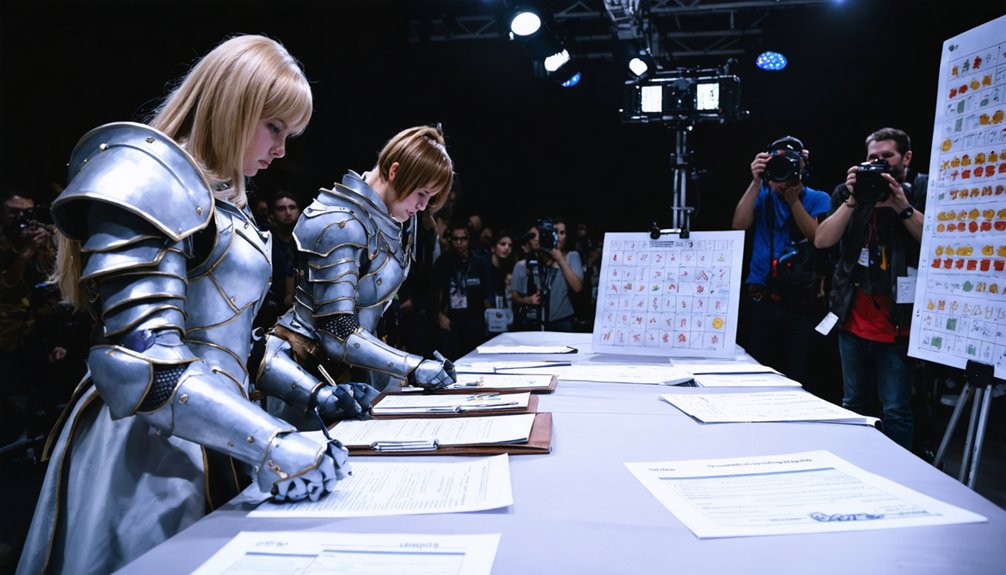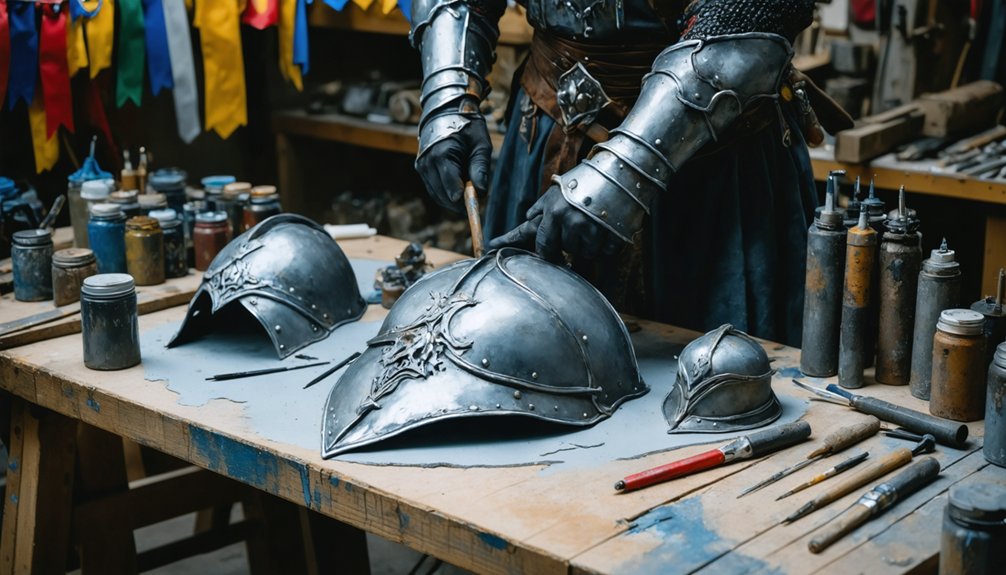
Master competition-grade cosplay armor through three essential techniques: select materials like Coscom Grade A EVA 38 for structural integrity while maintaining mobility, develop precise patterns using duct tape templating with vertical centerlines and registration marks for accurate three-dimensional translation, and apply professional finishes through thin-coat discipline with film-production-standard products like Imperifex. You’ll need proper EVA foam sealing to prevent paint degradation and systematic layering for dimensional depth. The techniques below break down each discipline into competition-ready workflows.
Key Takeaways
- Use EVA foam (2-6mm) or Worbla thermoplastics for lightweight, competition-ready armor with optimal structural integrity and heat retention.
- Create accurate patterns through duct tape templating, establishing centerlines and registration marks before transferring to construction materials.
- Apply specialized fastening solutions that secure components firmly while maintaining mobility and preserving the armor’s aesthetic appearance.
- Seal EVA foam properly before painting to prevent degradation and achieve film-production-standard finishes with products like Imperifex.
- Build durability through thin-coat layering discipline, using multiple refined applications instead of single heavy coats for dimensional depth.
Master Your Materials: Choosing the Right Foundation for Competition-Grade Armor
Building competition-grade armor hinges on selecting materials that balance structural integrity with weight considerations and fabrication complexity. You’ll find EVA foam (2-6mm thickness) provides lightweight bases, though higher-density variants like Coscom Grade A EVA 38 deliver superior firmness for peaked geometries.
Worbla thermoplastics remain the competition standard, offering heat retention capabilities that enable precise molding over foam foundations while maintaining structural rigidity that soft EVA can’t achieve independently. For Gundam-style builds, corrugated plastics and Sintra excel in flat-panel applications, withstanding heavy competition wear.
Advanced fabricators integrate fiberglass and Smooth-On Urecoat for impact resistance, while epoxy putties like Free Form AIR create lightweight armatures. Your material selection must account for specialized fastening solutions that secure components without compromising mobility or adding excessive weight to your build.
Perfect Your Patterning Technique With Duct Tape Templates
Duct tape templating transforms three-dimensional body contours into flat patterns that directly translate to your armor materials with competition-level accuracy. This adhesive application technique requires strategic layering: establish vertical centerlines first, then overlap segments while maintaining natural body position.
Your helper must apply tape without compression distortion—critical for authentic fit.
Execute precision cuts along marked seam lines, incorporating registration marks for reassembly alignment. Strategic dart placement eliminates curve-induced buckling when flattening your shell. This bodysuit fabrication process extends beyond torsos—replicate complex geometry on limbs, helmets, and curved armor sections.
Transfer flattened templates to poster board, adding calculated seam allowances for your chosen material thickness. Pin directly to foam or fabric, preserving pattern integrity. Test-fit against your duct tape dummy before committing to final construction, ensuring competition-ready accuracy.
Achieve Professional Finishes Through Layering and Sealing Methods
Professional results demand thin-coat discipline: multiple refined layers outperform single heavy applications.
Film-production-standard products like Imperifex deliver competition-ready metallics, while proper EVA foam sealing prevents paint incompatibility degradation.
This systematic layering approach creates dimensional depth and extended wearability.
Frequently Asked Questions
How Do I Attach Armor Pieces Securely to My Body During Competitions?
Like puzzle pieces locking together, you’ll achieve superior armor attachment by securing armor with adhesives—combining D-rings with Worbla backing, plus foam padding for preventing armor chafing during wear, creating load-distributed connections through strategic strap placement.
What Strapping Systems Work Best for Different Armor Components?
You’ll achieve ideal results using adjustable buckle systems with parachute clips for heavy pieces, while lightweight metal fasteners like Chicago screws secure belt-mounted components. Combine nylon webbing for limbs with elastic-snap matrices for torso articulation and competition-grade stability.
How Can I Plan Complex Armor Builds From Concept to Completion?
Telegraph your design vision through detailed sketches, then prototype with budget-friendly materials like poster board. You’ll refine templates, considering lightweight design considerations before cutting final foam layers. Test-fit mockups, seal, paint, and integrate strapping systems for competition-ready armor.
What Reference Materials Should I Collect Before Starting My Build?
Collect multi-angle reference images from official sources, including character turnarounds, close-up details, and color specifications. Simultaneously develop your build timeline planning document, mapping construction phases against competition deadlines to guarantee systematic progress tracking.
How Do I Document My Armor Construction Process Effectively?
Maintain detailed photographic logs of each construction phase, capturing material choices, technique applications, and assembly sequences. Provide thorough progress updates documenting weathering patterns, paint applications, and attachment methods. This systematic approach enables process refinement and portfolio development.