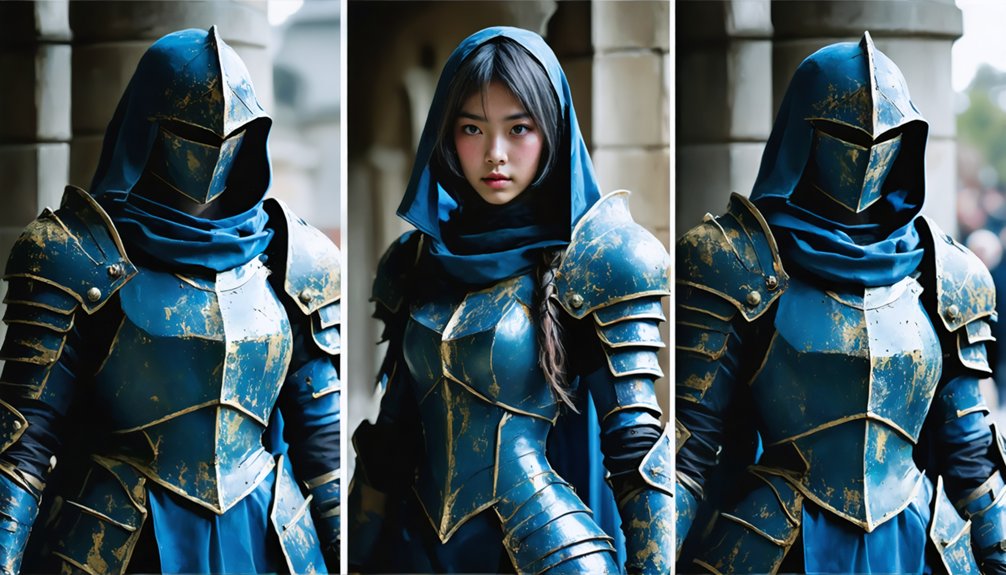
Perfecting character details in cosplay means treating your costume, makeup, movement, and voice as one unified system. You’ll want to lock silhouette accuracy first, then refine fit without sacrificing recognizability. Map your facial contouring to the character’s features, build a mental pose library, and warm up your voice with targeted drills before every event. Each element reinforces the others, and mastering their connection is where the real transformation begins.
Key Takeaways
- Convert your character to a black-and-white silhouette to verify shape accuracy, proportions, and recognizability before adding color or detail.
- Identify non-negotiable visual signature elements and make fit adjustments only to peripheral components like hemlines or sleeve lengths.
- Map facial features carefully, layering shadows, highlights, and texture with matte powders, then seal everything with setting spray.
- Build a mental deck of core poses reflecting distinct emotional registers, exaggerating defining character traits by ten percent for visibility.
- Film rehearsal sessions and debrief analytically, using footage to refine pose clarity, gesture readability, and costume movement restrictions.
Gather Reference Images Before You Touch a Single Material
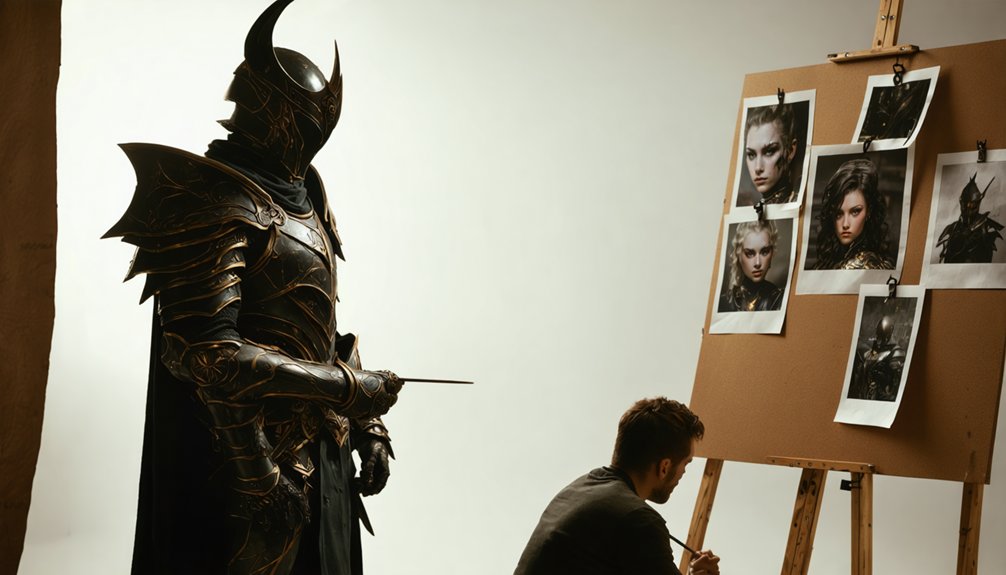
Before you cut a single piece of fabric or pick up a paintbrush, you need a solid visual reference library. Collect images showing your character from every angle — front, back, and profile. These references directly inform your fabric selection by revealing texture, drape, and layering relationships you’d otherwise miss.
Convert your best reference into a black-and-white silhouette to strip away color theory distractions and isolate pure shape first. Once shapes are locked, reintroduce color systematically, matching hues, saturation, and shadow behavior to guide accurate material choices.
Print a reference, cut it out, and reverse it to create a working outline. That outline becomes your technical blueprint, eliminating guesswork before a single stitch happens.
Use Silhouette Analysis to Lock in Your Character’s Core Shapes
Once you’ve gathered your references, picture the character as a pure silhouette — no color, no texture, no detail. Silhouette refinement starts here. Strip everything down to core shapes to expose what actually defines the character’s recognizability.
Before anything else, reduce your character to pure shape — no color, no detail, just silhouette.
Print your reference, cut it out, flip it, and trace the outline. This process forces shape consistency across every costume element you’ll build.
Use this silhouette checkpoint to audit four critical areas:
- Head-to-shoulder ratio — exaggerated or narrow?
- Waist definition — cinched, boxy, or flowing?
- Limb proportion — elongated, compact, or asymmetrical?
- Signature appendages — capes, tails, oversized weapons, or structured accessories?
If the silhouette reads correctly at a distance, your costume will register instantly in crowded convention spaces.
How Do You Modify a Costume Without Losing Accuracy?
Modifying a costume doesn’t mean abandoning accuracy — it means making strategic trade-offs that preserve silhouette integrity while improving wearability. Start by identifying which elements define the character’s visual signature and treat those as non-negotiable.
Peripheral components — hemlines, sleeve lengths, waistlines — offer adjustment flexibility without compromising recognition.
Prioritize fabric durability when substituting materials, ensuring replacements mirror the original’s weight and drape. A lightweight substitute that collapses differently destroys silhouette fidelity faster than a minor color deviation ever would.
Recalibrate accessory placement to maintain proportional balance after structural modifications. If you shorten a skirt, reposition belt pieces or layered details to restore the original visual rhythm.
Every modification should be deliberate — test altered components before the event to confirm accuracy survives the change.
Make Cosplay Fit Work for Your Body Type and Comfort
Costume fit operates as a functional system, and when you align it with your body type, you preserve both comfort and visual accuracy simultaneously. Adjust proportions strategically rather than abandoning character integrity.
Costume fit is a system—align it with your body, and comfort and accuracy follow naturally.
Apply these targeted fit modifications:
- Shorten skirts slightly to elongate leg proportions without compromising silhouette recognition.
- Alter top lengths to match your torso’s natural balance point for unrestricted movement.
- Prioritize fabric durability by selecting materials that stretch, breathe, and withstand extended convention wear.
- Calibrate accessory placement based on your shoulder width and hip ratio to maintain visual symmetry.
Test the full ensemble before the event. Walk, sit, and pose to identify pressure points. Comfort directly affects your ability to embody the character convincingly throughout the day.
Contouring Tricks That Transform Your Face for Cosplay
Fit adjustments carry your costume through the convention floor, but accurate character portrayal doesn’t stop at the neck. Your face requires contour mapping to align your features with the character’s facial symmetry.
Start with a foundation matching your skin tone, blending it evenly to create a neutral base. Then identify your character’s defining facial geometry — sharp jawline, prominent cheekbones, a narrower nose — and map shadow and highlight accordingly. Darker shades recede; lighter shades advance.
Use a wet stipple brush loaded with matte eyeshadow to apply faux freckles, adding textural authenticity without heavy product buildup. Adjust contour intensity based on convention lighting conditions — harsh overhead lighting demands subtler application. Practice each technique beforehand, evaluating results under comparable lighting to guarantee precision when it counts.
Faux Freckles, Shadow Layering, and Texture Techniques for Realistic Skin
Once your contour base sets, layering texture transforms a flat foundation into convincing skin. Use a wet stipple brush loaded with matte eyeshadow to build realistic surface variation.
Layering texture over a set contour base transforms flat foundation into a surface that reads as convincing, dimensional skin.
Optimize your texture application with these four techniques:
- Freckles placement — Concentrate dots along the nose bridge and upper cheekbones, mirroring natural sun exposure patterns.
- Texture blending — Tap, don’t drag, the stipple brush to preserve dimensional depth without smearing existing layers.
- Shadow layering — Build translucent darkness in pores and fine lines using cool-toned powder applied in thin passes.
- Sealing — Lock everything with a fine-mist setting spray to prevent transfer during extended convention wear.
Each layer compounds realism, so work incrementally rather than applying heavy product simultaneously.
How to Move, Pose, and Carry Yourself Like Your Cosplay Character
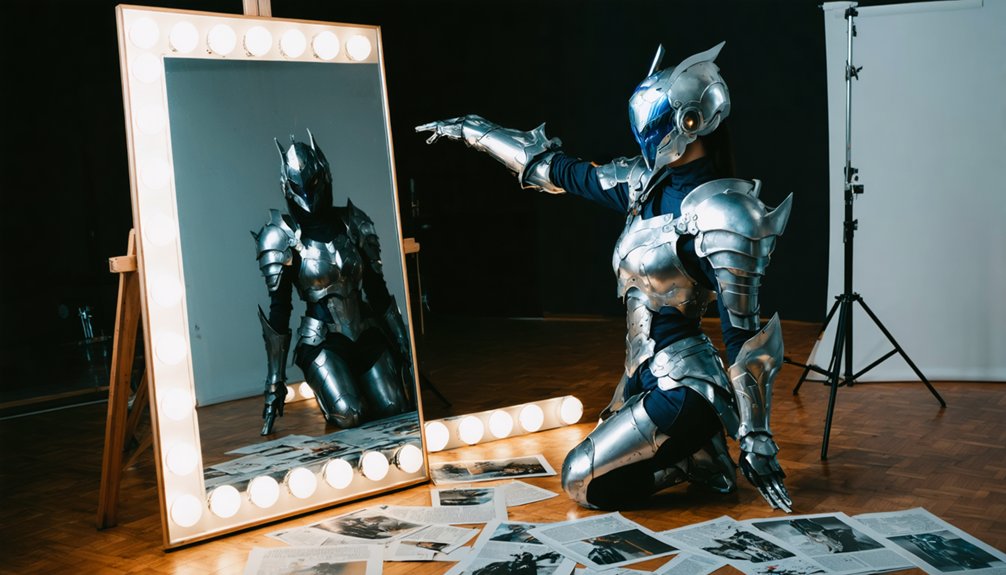
To move like your character, watch their on-screen appearances and identify three defining physical traits — stance, gait, and gesture.
Then exaggerate each by ten percent for visibility in crowded convention spaces.
You’ll want to build a mental deck of five anchor poses drawn directly from canonical scenes, each paired with at least one variant to handle unexpected interaction angles.
Practice mirroring these poses in front of a full-length mirror until muscle memory replaces conscious effort, ensuring your shifts between positions read as natural rather than staged.
Mastering Character Movement Techniques
Embodying a character goes beyond the costume itself — your posture, movement, and gestures signal who you’re portraying before anyone reads your name tag. Study footage closely, isolating stance, gait, and recurring gestures. Even fabric selection and accessory placement influence how naturally you move; restrictive layers or poorly balanced props disrupt authentic motion.
Build your movement system using these four techniques:
- Identify three defining physical traits and exaggerate each by ten percent for crowd readability.
- Watch character footage to isolate walking rhythm, weight distribution, and idle habits.
- Mirror-practice daily, refining emotional expressions and transitional movements between poses.
- Maintain a mental deck of five anchor poses plus five variants for quick, versatile deployment.
Precision in movement transforms a good costume into a compelling portrayal.
Defining Anchor Poses Strategically
Anchor poses function as your physical vocabulary — a curated set of positions you can deploy instantly without breaking character or hesitating mid-interaction. Build a mental deck of five core poses and five variants, each reflecting a distinct emotional register your character expresses.
When selecting poses, consider how your costume’s fabric selection affects movement — structured materials restrict certain angles, while fluid fabrics amplify dynamic stances. Similarly, apply color theory thinking: darker costume panels recede visually, so position your body to spotlight high-contrast zones during photography.
Identify three defining character traits, then exaggerate each by ten percent for legibility in crowded convention spaces. After every event, debrief deliberately — note which poses photographed cleanly, which sparked audience reactions, and which caused physical strain. Refine accordingly, treating each iteration as technical data.
Build a Voice That Matches Your Character’s Personality
Before you speak a single line in character, warm up your voice with pitch glides, lip trills, and resonance drills to build control and flexibility.
Study your character’s speech patterns, isolating their tone, pace, and pitch range so you can replicate them with precision.
Once you’ve locked in the baseline voice, practice modulating emotion by deliberately shifting volume, tempo, and vocal tension to match the character’s shifting moods.
Vocal Warm-Up Techniques
Warming up your voice before an event sharpens your control over tone, pitch, and pacing, which are the three core variables that define how authentically you’ll match your character’s vocal identity. Prioritize breath control and vocal resonance to build a stable, flexible instrument before portraying any character.
Execute this pre-event warm-up sequence:
- Diaphragmatic breathing — Inhale for four counts, hold two, exhale six to establish breath control.
- Humming scales — Activate vocal resonance by humming from your lowest to highest comfortable pitch.
- Lip trills — Loosen articulators and regulate airflow simultaneously across your full range.
- Character phrase repetition — Repeat three signature lines at varied tempos to lock in tonal muscle memory.
Consistency across these drills builds the vocal precision your character demands.
Matching Tone And Pitch
Once your voice is warmed up, matching your character’s tone and pitch requires systematic analysis of three core vocal elements: register, resonance placement, and tonal color. Isolate recordings of your character across varied emotional states, then map pitch ranges using a tuning app for precision.
Chest resonance delivers authority; nasal placement sharpens intensity. You’ll find that tonal color—bright versus dark—distinguishes personalities more than pitch alone.
Think of vocal development like costume durability: both demand repeated stress-testing before the event. Practice sustained dialogue across multiple sessions, tracking consistency.
Accessary integration mirrors this process—each vocal adjustment integrates into a cohesive performance system, not a standalone trick. Adjust volume, cadence, and articulation to reinforce your character’s emotional signature, ensuring every spoken word reads authentically in crowded convention environments.
Modulating Emotion Through Voice
Emotion drives vocal authenticity more than pitch or register alone, so you’ll need to build a deliberate system for modulating your character’s emotional delivery across varied scenarios.
Effective vocal modulation requires mapping each emotional state to specific technical adjustments:
- Adjust pace — slow delivery signals grief or hesitation; rapid speech conveys urgency or excitement.
- Control volume dynamics — drop volume for intimacy, raise it for confrontation.
- Shift breath placement — shallow chest breathing creates tension; deep diaphragmatic breathing projects calm authority.
- Modify articulation — clipped consonants express anger; softened syllables communicate warmth.
Consistent emotional expression across interactions reinforces character recognition. Practice each emotional state in isolation before combining them, ensuring your vocal modulation remains precise under convention pressure.
Mirror Drills, Debriefs, and Dress Rehearsals That Fix Real Problems
Before you ever step into a convention hall, solo rehearsals in front of a mirror expose the gaps between what you think you’re doing and what you’re actually projecting. Lock in five anchor poses and five variants, then cycle through them under different lighting conditions—color theory affects how your fabric selection reads on camera versus in person.
Film each session, then debrief ruthlessly: identify which poses read clearly, which gestures collapse under distance, and which costume elements restrict movement. Dress rehearsals stress-test problem zones before they become convention-floor failures.
Note where seams pinch, where fabric pulls, and where the silhouette breaks character accuracy. Treat every debrief as actionable data, not personal critique, and iterate systematically until your execution matches your original character blueprint precisely.
What the Cosplay Community Teaches That Solo Practice Can’t
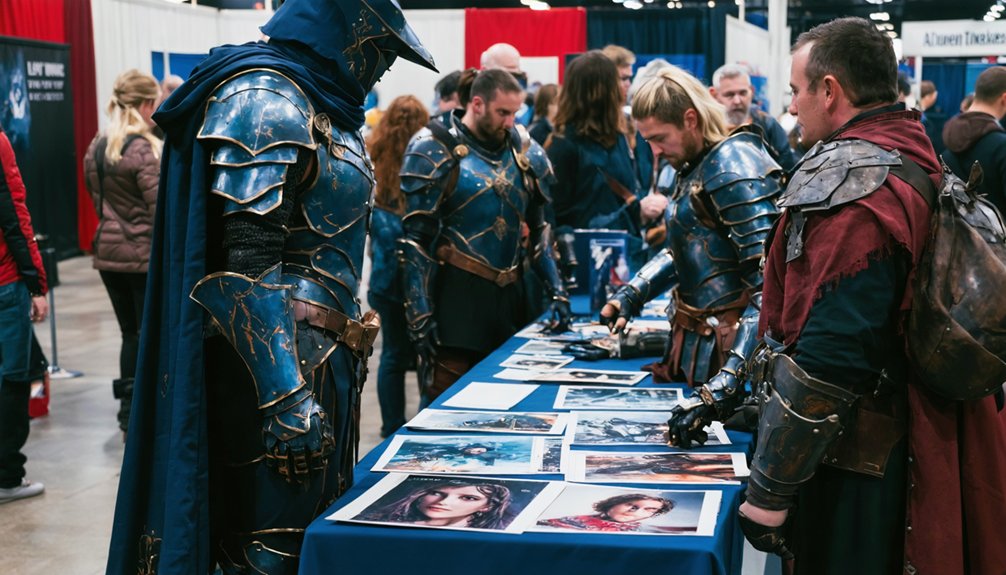
Solo rehearsals sharpen your mechanics, but they can’t replicate the unpredictable feedback loop that a live community provides. Community collaboration exposes blind spots that mirrors never reveal. Shared experiences compress your learning curve dramatically.
Solo practice builds mechanics. Community collaboration exposes the blind spots no mirror ever will.
Engaging with cosplayers at events delivers four critical upgrades:
- Real-time pose calibration — crowds reveal which gestures read clearly at distance and which collapse visually.
- Material intelligence — veterans share fabric failures and construction shortcuts earned through direct trial.
- Spontaneous character pressure — unscripted interactions force authentic, responsive portrayal beyond rehearsed lines.
- Comparative benchmarking — studying others’ builds identifies construction techniques you haven’t yet considered.
You’ll refine faster through one convention weekend than through months of isolated practice. Plug into the community deliberately, debrief obsessively, and let collective knowledge accelerate your precision.
Frequently Asked Questions
How Do You Protect Your Costume From Damage During Long Convention Days?
You’ll protect your costume by reinforcing seams, carrying emergency repair kits, and scheduling cosplay makeup touch-ups throughout the day. Minimize character posing stress on delicate fabrics by practicing controlled, precise movements that reduce unnecessary strain.
What Materials Work Best for Creating Lightweight yet Durable Cosplay Props?
Like a sculptor choosing clay, you’ll find foam crafting delivers featherlight flexibility, while resin casting offers rock-solid durability. Combine both strategically — foam for large pieces, resin for intricate details — and you’ve engineered props that’ll survive marathon convention days effortlessly.
How Do You Manage Cosplay Expenses Without Sacrificing Overall Costume Quality?
You’ll manage cosplay expenses by prioritizing budget planning early and smart material sourcing. Choose two of three: quality, speed, or low cost. You can’t have all three, so strategically allocate funds toward visible, high-impact costume elements first.
What Are the Best Ways to Store and Transport Delicate Cosplay Pieces Safely?
Over 60% of cosplay damage occurs during transit. Prioritize cosplay storage with foam-lined cases to boost prop durability. You’ll want to disassemble larger pieces, wrap fragile parts individually, and label each component for quick, damage-free reassembly.
How Do You Handle Unexpected Costume Malfunctions or Repairs During Events?
Pack an emergency kit with quick repair techniques in mind: carry fabric tape, safety pins, a needle and thread, and a mini glue gun. You’ll fix unexpected costume malfunctions fast, keeping your cosplay convention-ready throughout the event.
References
- https://geekgals.co/2019/02/05/cosplay101-character/
- https://wigs101.com/10-tips-cosplay-beginners
- https://starstruckpanda.com/how-to-match-character-features-for-cosplay-accuracy/
- https://www.pointpress.site/cosplay-confidence-tips-to-bring-characters-to-life-1
- https://starstruckpanda.com/infusing-creativity-into-character-performance/
- https://thecelebportal.com/mastering-character-portrayal-a-guide-to-immersive-cosplay/
- https://www.youtube.com/watch?v=AfKrTUcqxAE