To replicate authentic Qing Dynasty imperial robes, you’ll need to source period-specific fabrics like kesi tapestry-weave silk and understand the rigid color hierarchy—imperial yellow for emperors, royal blue for officials. Master the nine-dragon arrangement with five-clawed “long” motifs, construct the side-fastening chaopao with horsehoof cuffs, and adapt traditional embroidery techniques using metallic threads. Rank-appropriate symbols and construction methods prove essential for historical accuracy. The following sections systematically address each technical component necessary for achieving period-authentic ceremonial garments.
Key Takeaways
- Source authentic fabrics like kesi tapestry-weave and silk damask; substitute with gauze silk for summer or fur-lined silk for winter.
- Match rank-specific colors: bright yellow for emperors, crimson for empresses, royal blue for officials, using historical dye techniques.
- Embroider five-clawed dragons for emperors (nine total) or four-clawed dragons for lower ranks; use metallic thread substitutes for gold.
- Construct side-fastening jacket with horsehoof cuffs, pleated apron skirt, and asymmetrical L-shaped seams using flat-felled techniques.
- Expect significant time investment: traditional imperial robes required years of specialized weaving and embroidery by multiple artisans.
Selecting Authentic Materials and Fabrics for Your Imperial Robe
While authentic Qing dynasty imperial robes demanded extraordinary craftsmanship and rare materials, modern cosplayers can achieve historical accuracy by understanding the dynasty’s sophisticated fabric hierarchies and weaving techniques.
You’ll need to prioritize sourcing authentic fabrics that replicate period-specific weaves: kesi tapestry-weave for dragon motifs, satin-weave for yellow imperial robes, and silk damask for indigo-dyed blue variants. Consider seasonal variations—gauze silk for summer representations and fur-lined heavy silk for winter garments.
When sourcing authentic fabrics, select materials matching rank-specific color standards: bright yellow exclusively for imperial figures, blue for courtiers and princes. Understanding historical dyeing processes, particularly indigo techniques for blue dragon roundels, enhances authenticity. You can substitute metallic embroidery threads for gold-wrapped originals while maintaining visual fidelity to Qing court costume regulations.
Understanding Color Hierarchy and Dyeing Techniques
Beyond fabric selection, mastering Qing dynasty color protocols determines your cosplay’s historical legitimacy, as chromatic restrictions functioned as immediate visual markers of social stratification within the imperial court. Imperial yellow—derived from safflower—remained exclusively reserved for emperors, while empresses accessed bright crimson and select yellows. High-ranking officials employed royal blue (Shíqīng), whereas fifth-through-seventh ranks utilized standard blue tones. You’ll need historical dye recipes replicating these precise hues: safflower for imperial yellow, madder for vermilion reds, and indigo for cobalt blues.
Period appropriate tailoring techniques demand color-coded embroidery—gold dragons on imperial yellow, scarlet phoenixes for empresses. Lower ranks received muted palettes: soft pinks for untitled concubines, earthy tones for commoners. Accurate chromatic execution transforms generic costume into stratified historical representation.
Decoding Dragon Motifs and Imperial Symbols
Nothing distinguishes imperial authority more immediately than dragon iconography, where claw count, directional orientation, and numerical arrangement operate as codified markers of dynastic legitimacy. Dragon symbolism significance extends beyond decoration—it manifests the emperor’s divine authority through precise placement and hierarchical differentiation.
Essential Dragon Specifications:
- Five-clawed “long” dragons exclusively denoted the emperor; “mang” dragons marked princes of first and second rank
- Nine dragons total: eight visible (four forward-facing, four sideways), one concealed beneath the front flap
- Forward-facing orientation indicated superior status; sideways positioning reflected lower rank
- Twelve symbols (shier zhangwen) appeared solely on imperial robes, representing cosmic virtues
- Four-clawed dragons designated lower officials, never totaling nine
You’ll need meticulous attention to these distinctions when engineering historically accurate reproductions.
Mastering Traditional Weaving and Embroidery Methods
The technical complexity of imperial robe production demanded specialized techniques that modern cosplayers must comprehend before attempting historical reconstruction.
Silk weaving techniques like kesi employed whole warp and broken weft methods, requiring 100 horizontal threads per centimeter—a density impossible to replicate with contemporary machinery. Five weavers needed three years minimum to complete one imperial robe using fifteen-foot looms.
Traditional kesi silk weaving achieved 100 threads per centimeter—a precision that remains unattainable for modern industrial looms.
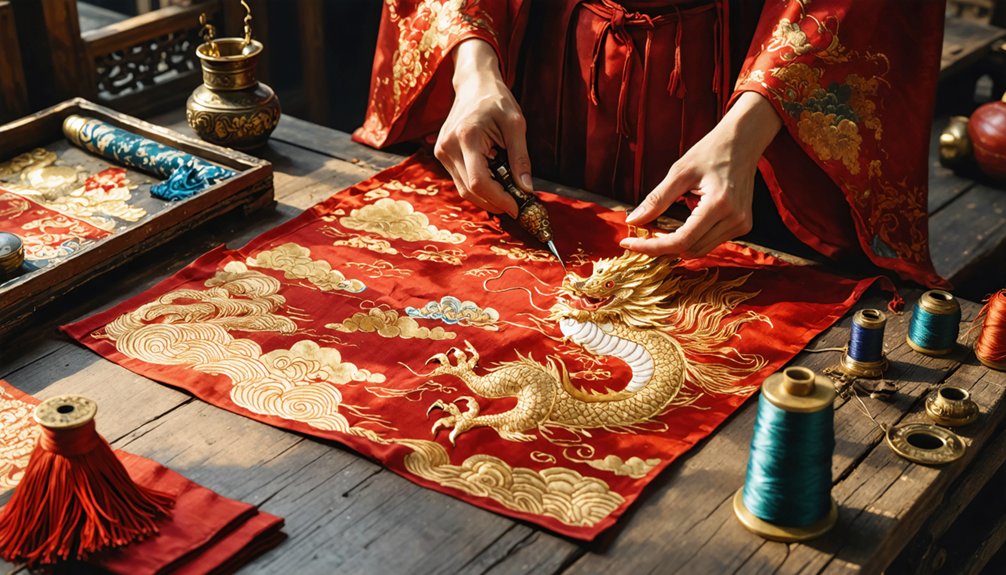
Historical embroidery practices involved wrapping silk cores with 0.1mm gold paper strips, then securing them through gilt couching with tiny stitches. Emperor Qianlong’s robe required 16 months for silk embroidery alone, plus 13 additional months for gold couching.
You’ll need specialized tools including padded cushions for curved stitching and precision instruments for manipulating metallic threads without damaging delicate silk substrates.
Constructing the Chaopao: Pattern and Assembly
Your chaopao construction begins with three primary structural components that distinguish this ceremonial garment from other Qing dynasty robes. The side-fastening jacket forms the foundation through its wraparound bodice secured by buttons beneath the right arm, incorporating the distinctive L-shaped seam that extends from collar to underarm fastenings.
You’ll then attach the horsehoof cuffs to sleeves spanning up to two meters in width, followed by assembling the pleated apron skirt to the narrow waistband that divides upper and lower sections.
Side-Fastening Jacket Construction
Constructing an authentic chaopao begins with understanding its distinctive wraparound closure system, which fundamentally differs from center-front garment construction. Authentic pattern testing reveals the critical L-shaped seam placement between collar and underarm fastenings.
Your precision closure detailing must account for the asymmetrical design:
- Position three buttons at the round mandarin collar to secure the wraparound overlap
- Install two additional buttons under the right arm for structural integrity
- Create the characteristic square flap at the side opening to enclose decorative elements
- Construct the non-functional square patch near the right hip, maintaining historical accuracy
- Calculate overflap measurements to partially obscure waistband and roundel motifs
The side-fastening mechanism requires careful pattern drafting to guarantee proper drape while accommodating the multiple closure points essential to authentic Qing construction methods.
Horsehoof Cuff Attachment
After completing the side-fastening bodice, you’ll move on to drafting the most architecturally distinctive element of Qing court dress: the ma ti xiu (马蹄袖), or horsehoof cuff. Pattern the narrow sleeve to taper from shoulder to wrist, then draft the cuff component broad at top, narrowing to the characteristic hoof base. Incorporating traditional techniques, attach cuffs via flat-felled seams to withstand stress during movement.
Apply heavyweight interfacing or horsehair canvas to maintain structural integrity—historically achieved through fur facing with sable. The tripartite sleeve construction requires precision: the cuff must integrate seamlessly without creating bulk at the wrist joint. Test roll-up functionality, ensuring proper movement for both ceremonial gestures and active poses, replicating the equestrian origins while maintaining the refined silhouette of imperial chaofu.
Apron Skirt Assembly
- Confronting dragon motifs enclosing the side opening
- Square flap detail at closure point
- Decorative non-functional patch near right hip (possibly covering original sword slot)
- Blue and gold brocade edging
- Jade summer gauze or satin fabric choices
The aprons overlay the main pleated skirt, which features eighteen dragon roundels above a confronting dragon band, creating the courtly bulk essential for ceremonial impact.
Creating Horsehoof Cuffs and Authentic Sleeve Details
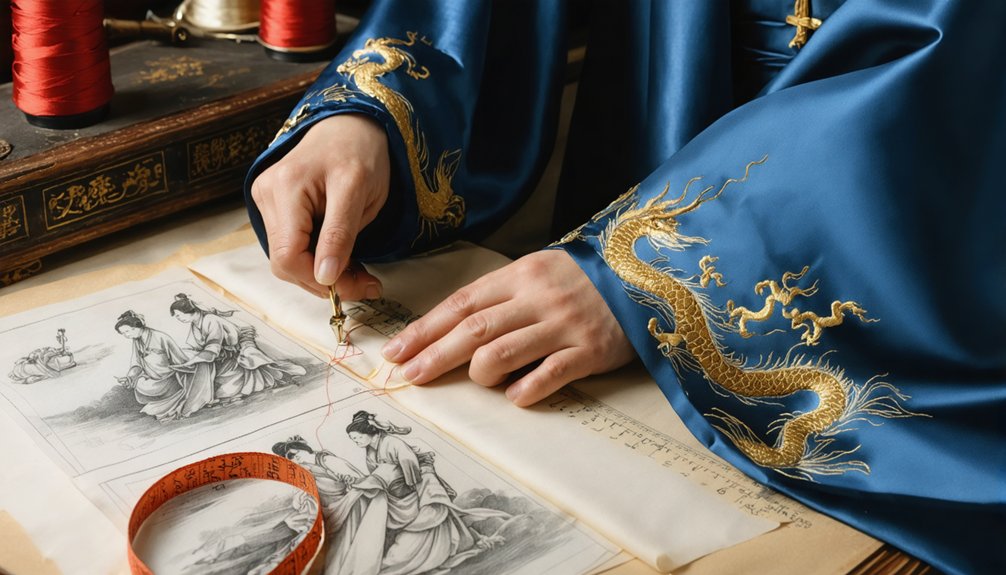
Pattern your cuff angles to create the proper downward semicircle, measuring approximately 8-10 centimeters in depth. Interface the cuff extension with medium-weight fabric to maintain its distinctive drape when flipped down.
Position the attachment seam strategically to allow the cuff’s upward folding capability, replicating the original dual-function design. Coordinate cuff fabric with your garment’s rank-appropriate colors and dragon motifs for ceremonial accuracy.
Adapting Historical Techniques for Modern Cosplay Applications
You can achieve historically accurate Qing imperial aesthetics without the labor-intensive processes required for court production. Modern cosplayers benefit from simplified dyeing protocols using synthetic dyes that approximate the Qianlong Palette’s 42 archeological colors, eliminating the multi-stage mordanting procedures necessary for natural pigments.
Budget-conscious alternatives include substituting gold-wrapped silk threads with metallic embroidery floss and replacing hand-woven kesi silk with digitally printed fabrics featuring cut-silk visual effects.
Simplified Dyeing Methods
The adaptation of Qing Dynasty dyeing methods for contemporary cosplay requires strategic simplification while maintaining historical authenticity. You’ll achieve ideal results by implementing these core techniques:
- Pre-mordant treatment: Immerse silk in alum solution for 30 minutes before dye application to enhance color adhesion
- Temperature control: Maintain dye baths at 60°C during 60-minute simmering cycles
- Repetitive processing: Execute three complete dyeing iterations for sufficient color intensity
- Filtration protocols: Strain all dye solutions post-simmering to remove particulate matter
- Light-sensitive compounds: Store curcumin-based yellows in opaque containers for preservation
Natural dye storage demands careful attention to environmental factors. Dye fixation techniques utilizing plant-based materials like sophora buds and turmeric enable accessible reproduction without specialized laboratory equipment, making historical accuracy achievable for innovation-focused cosplayers.
Budget-Friendly Material Alternatives
How can modern cosplayers authentically replicate Qing Dynasty imperial aesthetics without incurring prohibitive material costs? Polyester satin effectively mimics silk’s characteristic sheen for base chaopao layers, while cotton damask replicates the textured patterns of courtier silk damask. Rayon blends approximate silk’s drape in sleeves and skirts.
For eco-friendly sourcing, thrifted upholstery fabrics substitute for gold-thread brocaded areas in regulated blue-black tones. Viscose gauze provides lightweight breathability comparable to summer court robes.
Budget-friendly construction techniques include machine-sewn Manchu side-fastening with horseshoe cuffs, fusible interfacing for structured silhouettes, and heat-bonded hems eliminating hand-stitching costs. Iron-on transfers depicting five-claw dragons achieve rank-specific authenticity on synthetic fabrics, while stenciled metallics simulate gold-wrapped imperial threads without precious materials.
Frequently Asked Questions
Can I Wear Bright Yellow if I’m Cosplaying a Minor Prince Character?
No, you shouldn’t wear bright yellow when cosplaying a minor prince. Historical accuracy demands respecting Qing color symbolism—bright yellow exclusively signified imperial status. Instead, you’ll achieve authenticity by selecting blue robes, which appropriately represented lower-ranking nobility.
How Do I Care for and Store My Completed Imperial Robe Cosplay?
Seeking preservation excellence? You’ll hand-wash your robe in cold water, air-dry flat, then implement proper storage techniques using acid-free tissue in climate-controlled environments. Consider seasonal display options with UV-protective cases to showcase your historically-accurate recreation innovatively.
What Modern Fabric Alternatives Work if Authentic Silk Is Too Expensive?
You’ll find affordable synthetic fabrics like polyester satin and charmeuse replicate silk’s sheen effectively, while durable cotton blends such as sateen support intricate embroidery techniques. These alternatives maintain historical visual accuracy without compromising structural integrity for cosplay applications.
Are There Copyright Issues When Replicating Museum Pieces for Cosplay Conventions?
You’re traversing clear waters: Qing Dynasty robes lack intellectual property concerns due to public domain status. However, you’ll encounter cultural sensitivity considerations regarding imperial regalia’s ceremonial significance. Museums control physical access through contracts, not copyright protections.
How Much Does It Typically Cost to Create an Accurate Imperial Robe?
Accurate imperial robe production costs you $980-$1,500 through commissioned tailors, reflecting authentic silk procurement, kesi weaving techniques, and hand-embroidery labor expenses. Budget alternatives using polyester range $108-$175, though they’ll sacrifice historical fidelity for affordability.