Revive your synthetic cosplay wig by soaking it overnight in fabric softener solution to loosen tangles, then detangle from ends to roots using a wide-tooth comb before graduating to a Tangle Teezer. Deep clean with synthetic-specific shampoo, air-dry on a wig stand, and use a low-heat flat iron (under 200°F) to reshape fibers. Repair separated wefts with fabric-safe cyanoacrylate adhesive and reinforce elastic bands by sewing replacements to lace seams. This restoration protocol works when damage affects less than 30% of fibers and costs under 40% of replacement value—the following techniques break down each step.
Key Takeaways
- Deep clean with synthetic-specific shampoo, soak in fabric softener overnight, then air-dry suspended to restore fiber texture and manageability.
- Detangle matted fibers gradually using wide-tooth combs first, then straighten with flat irons before reshaping curls with rollers and steam.
- Refresh faded colors using alcohol-based fabric dyes, testing on interior wefts first and applying progressively to control vibrancy.
- Repair separated wefts with bonding glue or cyanoacrylate, and replace elastic bands by sewing directly to lace closure seam edges.
- Restore mid-range or premium wigs costing $40+ when damage affects under 30% of fibers and repair costs stay below 40% of replacement.
Understanding Synthetic Cosplay Wig Degradation Patterns
When you return from a convention, your synthetic cosplay wig‘s condition reveals specific degradation patterns that directly impact its revival potential. Long wigs develop concentrated tangles at the ends where friction and static accumulate most intensely.
Post-convention synthetic wigs display predictable damage zones, with friction-induced tangles clustering at fiber ends where static electricity reaches peak concentration.
You’ll notice low-quality non-heat-resistant fibers exhibit severe dryness, while outer layers show frizzy texture from teasing and environmental exposure. The fiber properties of polyester-based synthetics make them vulnerable to heat damage when you exceed manufacturer specifications during styling.
Interior sections contain volume-holding frizz pockets created by teasing, requiring strategic blending techniques to restore smooth external appearance. Static buildup compounds these issues, particularly after extended wear without proper sectioning.
Understanding these specific degradation mechanisms lets you target each problem zone with appropriate restoration methods.
Essential Tools and Products for Wig Restoration
Before you begin restoration work, assemble the correct brush types to address synthetic fiber manipulation without causing additional damage. You’ll need wide-tooth combs for initial detangling and wire-bristled wig brushes that prevent snagging during hair wefting maintenance. Paddle brushes with ventilation holes enable sectioned styling, while Sporet teasing brushes deliver targeted volume restoration.
Essential conditioning arsenal includes:
- Fabric softener solution (1:3 ratio with water) for frizz elimination and alternative wig preparation methods
- Synthetic-specific shampoo dissolved in lukewarm water to preserve fiber integrity
- Hot air brush or Envy’s 3-n-1 Airstyler for heat styling without thermal degradation
Secure your wig on canvas heads or mannequin stands—this provides manipulation stability and visibility access. Continuous spray bottles guarantee even solvent distribution, while metal-bristled paddle brushes achieve professional brush-out results.
Deep Cleaning Methods to Remove Buildup and Refresh Fibers
How extensively has product residue compromised your wig’s fiber structure? Target buildup with precision soaking techniques: submerge your wig in lukewarm water with wig-friendly shampoo, maintaining ideal fiber pH balance. Allow 30-minute immersion to dissolve stubborn hairspray and wax accumulation. Gently massage concentrated areas without aggressive scrubbing—synthetic fibers demand strategic handling for detangling troubleshooting.
Execute thorough rinsing by repeatedly squeezing strands under clean water until soap elimination’s complete. Apply conditioner to restore fiber moisture and combat static. Pat dry with absorbent toweling, avoiding twisting motions that compromise strand alignment. Suspend your wig for overnight air-drying, anticipating temporary color darkening during moisture evaporation. This methodical approach penetrates deep into fiber matrices, extracting embedded residue while preserving structural integrity for performance-ready restoration.
Detangling Techniques for Matted and Damaged Synthetic Hair
Although finger detangling demands patience, it’s your primary defense against fiber breakage in severely matted synthetic wigs. Understanding fiber quality differences determines your heat tolerance range—always perform strand tests at 70–85°C before applying tools.
Execute this strategic workflow for minimizing breakage during detangling:
- Isolate and soften: Soak wig overnight with fabric softener, then section small strands using clips
- Manual extraction: Hook fingers through knots, pull downward from tips upward—never force larger chunks
- Tool changeover: Deploy wide-tooth combs or Tangle Teezers only after finger work, combing outer layers first
Post-detangling, apply silicone spray bottom-up to seal fibers. For severe matting, straighten the entire piece first using flat irons, then reshape curls individually with plastic rollers and steam.
Restoring Color Vibrancy in Faded Cosplay Wigs
You’ll notice color fade primarily along the wig’s part line, hairline edges, and areas exposed to friction from costume contacts—these high-stress zones bleach faster than protected interior layers.
To counteract this degradation, you can refresh synthetic fibers using alcohol-based fabric dyes like Rit DyeMore applied with targeted spray techniques, or employ professional wig colorists who use heat-activated formulations with pH-balanced conditioners.
Before attempting any dye refresh, test your product on a small weft section from the wig’s interior to verify colorfastness and fiber compatibility.
Identifying Color Fade Patterns
When synthetic cosplay wigs lose their original vibrancy, the fading rarely occurs uniformly across all fibers. You’ll notice distinct zones where color saturation levels diminish at varying rates, creating unintended visual discontinuities. Heat-exposed root areas typically show accelerated pigment loss compared to mid-shaft sections, while fiber density reduction becomes apparent in heavily styled regions.
Critical fade indicators to monitor:
- Gradient disruption – Ombre and dip-dyed sections develop pronounced demarcation lines as darker zones retain pigment while lighter changes wash out
- Undertone emergence – Blue wigs shift toward greenish casts when yellow base fibers dominate fading pigmentation
- Multi-tonal separation – Highlight and lowlight sections fade independently, destroying intended color blends
Document progression through consistent natural-light photography, comparing fresh versus worn sections to determine restoration viability before proceeding with re-dyeing protocols.
Dye Refreshing Techniques
How effectively can you restore pigment intensity to a faded synthetic wig without replacing it entirely? Alternative dye techniques offer precision solutions.
For heat-resistant fibers (up to 320°F), Rit DyeMore provides permanent saturation—heat 3 gallons water to 180-200°F, submerge sectioned wig portions, and agitate continuously. This method eliminates bleeding from sweat or humidity entirely.
On Teflon-finished synthetics like Clover, acrylic ink spray (8:1 ratio of 70% alcohol to FW ink) penetrates smooth surfaces strand-by-strand. Apply multiple coats, drying between layers for controlled vibrancy.
Both techniques demand cold-water rinsing until clear, preventing bleed through during wear. Pre-test small sections to confirm adhesion before full application. Multiple dips or sprays progressively intensify color, allowing targeted restoration of specific faded areas for cosplay-ready results.
Repairing Common Structural Issues: Wefts, Caps, and Elasticity
Your cosplay wig’s structural foundation—wefts, cap bands, and construction points—determines whether it survives multiple conventions or falls apart mid-photoshoot. Loose wefts create visible gaps in coverage, stretched elastic bands compromise fit and comfort, and weakened stress points at temples and nape areas lead to catastrophic cap failure.
You’ll need fabric glue, replacement elastic bands, needle and thread, and precise hand-sewing techniques to reinforce these critical structural components before they progress from minor damage to irreparable breaks.
Securing Loose Wig Wefts
Loose wefts compromise your cosplay wig’s structural integrity the moment strands begin separating from the cap base—a condition accelerated by friction from repeated styling, heat tool exposure, or adhesive breakdown along seam lines. Identifying gaps between wefts and excessive shedding at seams requires immediate intervention to prevent hair fallout during conventions.
Securing Protocol:
- Adhesive Application – Apply synthetic wig bonding glue sparingly to detachment points, pressing wefts for 60 seconds. Alternative adhesive options include fabric-safe cyanoacrylate for permanent bonds or temporary theatrical adhesives for adjustable repairs.
- Heat Bonding – Use low-heat flat iron (under 200°F) with protectant spray to melt fibers into cap edges post-adhesive application.
- Maintenance Schedule – Implement proper post care techniques: brush bottom-to-top after drying, store on stands, and reapply every 2-3 weeks for high-wear pieces.
Restoring Cap Elastic Bands
Stretched elastic bands transform a once-secure cosplay wig into a constantly shifting headpiece that slides backward during photoshoots or lifts at the temples mid-convention. You’ll restore cap tension by sewing replacement elastic bands directly to the lace closure’s seam edges—position them one inch from cap ends to prevent temple pressure.
Turn the base inside-out on a styrofoam head, securing perimeters with T-pins while maintaining flat surfaces. For torn cap areas, flatten damaged zones with 3M Transpore medical tape, then apply acetone to remove oils before sealing with liquid polyurethane.
This approach addresses customizing elasticity requirements for different head sizes while maximizing longevity through reinforced stitching. Avoid stretching bands during attachment to preserve natural cap form and prevent premature elastic degradation.
Reinforcing High-Stress Construction Points
When synthetic wefts separate at the crown or nape regions, you’ll find these high-stress zones reveal the accumulated damage from convention wear and repeated styling sessions. Reinforcing loose weft connections requires strategic intervention at friction points where fibers endure maximum strain.
Targeted reinforcement protocol:
- Curved needle technique – Stitch separated wefts using curved needles with bent tips to conceal thread ends within the cap structure
- Adhesive edge restoration – Strengthen compromised areas by reapplying adhesive cap edges with sewn-in fabric points for enhanced glue retention
- Pre-repair conditioning – Soak affected sections in fabric softener solution for 6 hours, softening fibers to facilitate secure reattachment
Pin reinforced sections to foam heads during drying cycles. This maintains structural integrity while preventing warping at repair sites, ensuring your cosplay wig withstands future convention stress.
Heat Styling Strategies for Reshaping and Restyling
Heat-friendly synthetic fibers require precise temperature control to reshape without compromising their structure. Futura fibers withstand up to 410°F, but you’ll achieve ideal results maintaining styling tools between 280-340°F. Set curling irons to 270-280°F (132.2-137.7°C) for heat controlled curling that preserves fiber integrity.
Secure your wig onto a canvas head form using T-pins before beginning strand by strand application. Section hair into 1/2 to 1-1/2 inch segments, applying heat protector to each. Wrap sections around your curling iron, then slide into your palm and secure with clips for five minutes. The key principle: treat fibers like thermoplastic—heat reshapes, cooling locks the structure. Pass flat irons once per section; avoid repeated passes. Blast cold air for 30 seconds post-styling to crystallize the new shape permanently.
Managing Frizz and Restoring Smoothness to Synthetic Fibers
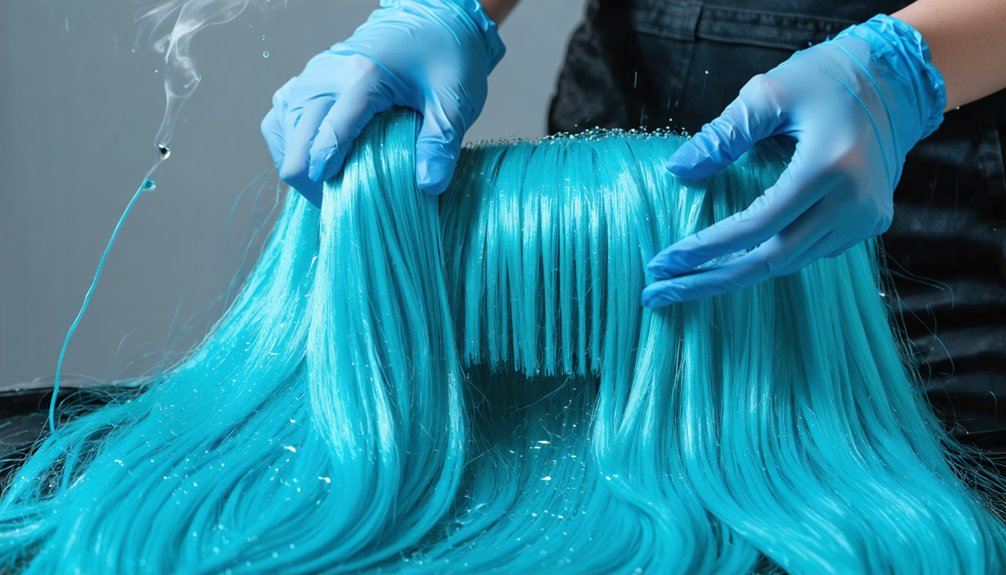
Synthetic fibers develop frizz through a predictable mechanism: friction from clothing contact, environmental static, and repeated manipulation create microscopic surface roughness that catches light irregularly and causes strands to separate from their original formation. Implementing strategic wig conditioning regimes reverses this degradation:
- Detangling Protocol: Work wide-tooth combs from ends upward on nape areas where body contact occurs, preventing fiber tension that amplifies frizz formation.
- Conditioning Treatment Cycle: Apply silicone-based detangling sprays before manipulation, then restore smoothness through cold-water washing every 7-10 days with leave-in conditioner barriers.
- Thermal Protection Strategies: Deploy handheld steamers for non-heat-friendly synthetics, achieving frizz reduction within five minutes without structural damage.
For immediate correction, fabric softener sheets neutralize static electricity in thirty seconds, while strategic conditioning mist application provides two-minute smoothness restoration between thorough treatments.
Storage Solutions to Prevent Future Damage Between Events
Proper storage architecture determines whether your cosplay wig maintains its original styling or deteriorates into a tangled mass requiring complete restoration. Implementing proper wig storage techniques requires adjustable-height, dome-shaped stands with velvet-covered bases that prevent slippage while mimicking natural head curvature—avoid cone-shaped alternatives that distort fiber patterns.
For maximizing wig shelf life between conventions, position stands in cool, low-humidity locations away from direct sunlight and harsh chemicals. Breathable mesh bags permit essential airflow during off-season storage without compression damage. Label each stand using removable archival tape noting character name, fiber type, and last wear date for efficient rotation management.
During transport, secure wigs upright in cake boxes with glued foam heads, ensuring zero hair contact with container walls. Never hang wigs by cap bands—this causes irreversible front hairline sagging within two weeks.
When to Revive Versus Replace Your Cosplay Wig
Before attempting revival, inspect your wig’s fiber structure by running a wide-tooth comb through a test section—if fibers snap rather than flex, or if permanent curl loss affects more than 30% of the piece, replacement becomes more economical than restoration.
Calculate your time investment against the wig’s original cost: non-heat resistant wigs under $25 rarely justify the 3-4 hours needed for fabric softener soaking and hook-and-pull detangling.
Heat-resistant Futura fiber wigs showing isolated frizz zones and intact curl patterns respond well to flat iron smoothing and foam curler re-styling, making them prime candidates for revival over replacement.
Assessing Structural Damage Severity
When examining a cosplay wig for potential revival, you’ll need to distinguish between surface-level wear and structural compromise that renders the piece unsalvageable. Begin by identifying cap foundation types—lace, monofilament, or nylon mesh—as each material exhibits different failure patterns. Check for holes requiring mending versus catastrophic tears from physical forces like twisting or pulling on weakened foundations.
Critical damage indicators include:
- Foundation integrity: Evaluate visible holes, tears, or mesh deterioration where determining thinning crown severity becomes essential for determining patch viability
- Fiber attachment security: Examine knotting stability; single knots indicate higher failure risk than double-knotted construction
- Heat damage threshold: Inspect for melted sections above 160°C/320°F—permanent damage that patching can’t reverse
Document these findings systematically to determine your revival strategy.
Cost-Benefit Analysis Considerations
Your decision to revive or replace a cosplay wig hinges on three quantifiable factors: initial investment versus repair costs, remaining structural lifespan, and character reuse probability.
Budget synthetic wigs ($15–$30) rarely justify restoration beyond basic detangling—replacement proves more cost-effective. Mid-range heat-resistant pieces ($40–$70) warrant revival when damage affects less than 30% of fibers, particularly for recurring maintenance schedules across multiple conventions. Premium custom-grade synthetics ($80–$150+) demand cost effective restoration alternatives since their 10+ con-day lifespan makes repair financially sensible.
Calculate your break-even threshold: if restoration supplies exceed 40% of replacement cost, invest in a new wig. For repeat characters, premium wigs amortize to $30–$75 annually versus budget synthetics requiring $90–$150 in yearly replacements—making strategic revival economically superior for active cosplayers.
Frequently Asked Questions
Can I Use Regular Shampoo on Synthetic Cosplay Wigs?
You can use regular shampoo, but shampoo alternatives like baby shampoo or dish soap often work better. For proper wig cleaning, wig-specific formulas excel at preserving synthetic fibers’ integrity while removing cosplay makeup and styling product buildup effectively.
How Do I Prevent My Wig From Tangling During Convention Wear?
Use proper wig brushing techniques—finger-combing between photos and detangling with wide-tooth combs during breaks. Apply regular conditioning treatments with silicone spray to lubricate fibers, preventing snapping and maintaining smooth, professional-grade appearance throughout extended convention wear.
Are Expensive Cosplay Wigs Worth the Investment Over Budget Options?
You’ll get what you pay for—premium wigs deliver superior wig quality differences through heat-resistant fibers and camera-ready sheen. Wig durability considerations matter: budget synthetics degrade within months, while $80–$120 investments withstand multiple conventions and styling sessions.
Can I Dye a Synthetic Wig to Match My Character Better?
Yes, you can dye synthetic wigs darker using Rit DyeMore or ink-alcohol methods with heat-controlled dyeing techniques for synthetic wigs. Test swatches first, then apply wig heat styling methods like low-heat flat ironing to restore fiber texture post-dyeing.
How Many Times Can I Revive the Same Cosplay Wig?
You’ll achieve 2-3 wig lifespan extensions through strategic revival techniques. Proper wig storage techniques—using breathable bags and wig stands—preserve fiber integrity between cons. Master detangling, steaming, and fiber conditioning to maximize your costume investment’s performance potential.