Enhancing wig accuracy in cosplay starts with precise color matching using physical swatches rather than trusting your monitor. You’ll need to choose the right hairline style—lace fronts for exposed foreheads, bangs for concealment. Secure your wig with double-sided tape, bobby pins, and strong-hold lacquer made for synthetic fibers. Cut incrementally with professional shears, and layer multiple wigs for complex looks. Every technical decision compounds into something far more convincing than you’d expect.
Key Takeaways
- Precise color matching using physical samples ensures accurate hue, saturation, and brightness that naturally integrates with your skin tone.
- Choosing the correct hairline style, such as lace fronts for exposed foreheads, significantly improves cosplay believability and authenticity.
- Small, incremental cuts using professional shears on a properly sized wig head ensure accurate, character-faithful styling results.
- A low-setting heat gun permanently reshapes synthetic fibers, while strong-hold lacquer maintains structure without breaking down wig fibers.
- Layering multiple wigs by cross-locking bobby pins and blending fiber densities creates realistic volume, color depth, and structural integrity.
Why Color Matching Makes or Breaks Cosplay Wig Accuracy
Color matching is one of the most critical skills you’ll develop as a cosplayer, and getting it wrong can undermine even the most meticulously crafted costume. Applying color theory starts with identifying your character’s precise hue variations on the color wheel, then calibrating saturation levels and brightness for accuracy.
Nail color matching by pinpointing your character’s exact hue, then fine-tuning saturation and brightness for a flawless costume.
Don’t rely solely on your monitor — purchase physical color samples to verify your selection, since screen rendering deceives even experienced cosplayers.
Beyond matching your character, consider natural integration by aligning hair color with your skin tone, creating seamless shifts that elevate cosplay realism.
Wig thickness matters too — thinner wigs work better for everyday styles, lending authenticity without appearing theatrical. Prioritizing these technical details transforms a passable wig into an accurate, character-defining element that withstands scrutiny at any convention.
How to Pick the Right Hairline Style for Your Cosplay Wig
Your hairline choice directly shapes how believable your cosplay reads at close range, so matching the style to your character’s design is non-negotiable.
If your character sports bangs, you can skip complex edge work entirely and let the fringe mask a standard wig’s factory hairline.
But if the character shows their forehead, you’ll need a lace front that you trim and glue for a skin-realistic edge.
For a widow’s peak or a precision center split, you can build the shape using lace fronts, hair wefts, or fiber application, giving you full directional control over how the hairline sits and flows.
Bangs Versus Lace Fronts
When choosing a hairline style for your cosplay wig, the decision between bangs and lace fronts fundamentally shapes how believable your character’s look will be.
Wig bangs offer immediate bangs versatility, concealing standard hairlines without adhesives or trimming expertise. Their cosplay bangs customization potential lets you sculpt, layer, or angle coverage precisely matching your character’s reference art.
Lace fronts, however, elevate realism dramatically. Following current lace front trends, you’ll trim the sheer lace panel to mirror your natural hairline, then secure it using wig glue or tape.
These lace front benefits become essential when your character’s hairstyle is pulled back or parted, exposing the forehead. Bang styles suit simpler builds, while lace fronts demand technical precision but deliver unmatched authenticity for competition-level cosplay accuracy.
Creating Realistic Widow’s Peaks
Among the most distinctive hairline features in character design, widow’s peaks demand precise replication to avoid breaking your cosplay’s visual accuracy. You’ve got three primary construction methods: hair wefts, lace fronts, and loose fibers, each offering distinct advantages depending on your skill level.
For lace fronts, you’ll trim the lace edge into a deliberate V-shape before securing it with wig glue or liquid latex. Wig fiber selection matters greatly here — thinner, less dense fibers create believable point definition without bulk.
Loose fibers layered strategically allow sharper geometric angles for stylized characters.
Hairline customization extends beyond simple trimming. You can build the peak’s depth by layering wefts in graduated lengths, reinforcing the V-shape’s intensity.
Always reference your character’s design closely, measuring proportions against your natural forehead before committing to permanent cuts.
Versatile Hairline Splitting Options
Everything about your cosplay’s authenticity hinges on one deceptively simple decision: which direction does the part run? With modern hairline techniques, you’re not locked into a single configuration. Split options let you run parts left, right, center, or diagonally — matching your character’s exact reference images with surgical precision.
Start by analyzing your character’s hairline from multiple angles. Screenshots and high-resolution artwork reveal subtle directional cues that casual observation misses. Once you’ve identified the correct parting direction, use a rattail comb to establish clean, defined separations across the wig’s fiber density.
Lace fronts offer maximum flexibility here, allowing repositioning before adhesive sets permanently. For quicker transformations, pre-parted synthetic wigs eliminate preparation time entirely.
Your split direction ultimately communicates character identity before audiences register any other costume detail.
How to Glue and Tape Your Cosplay Wig for a Skin-Like Hairline
For tape application, cut thin strips of double-sided wig tape, pressing them precisely along your natural hairline before securing the lace front.
Smooth outward from the center, eliminating air bubbles that disrupt realism. Apply got2b Glued hairspray over lace edges, pressing firmly until transparent.
Blend the hairline by dabbing foundation matching your skin tone directly onto the adhesive zone, erasing any visible wig edges for a flawless, photorealistic finish.
Securing Your Cosplay Wig So It Stays Put All Day
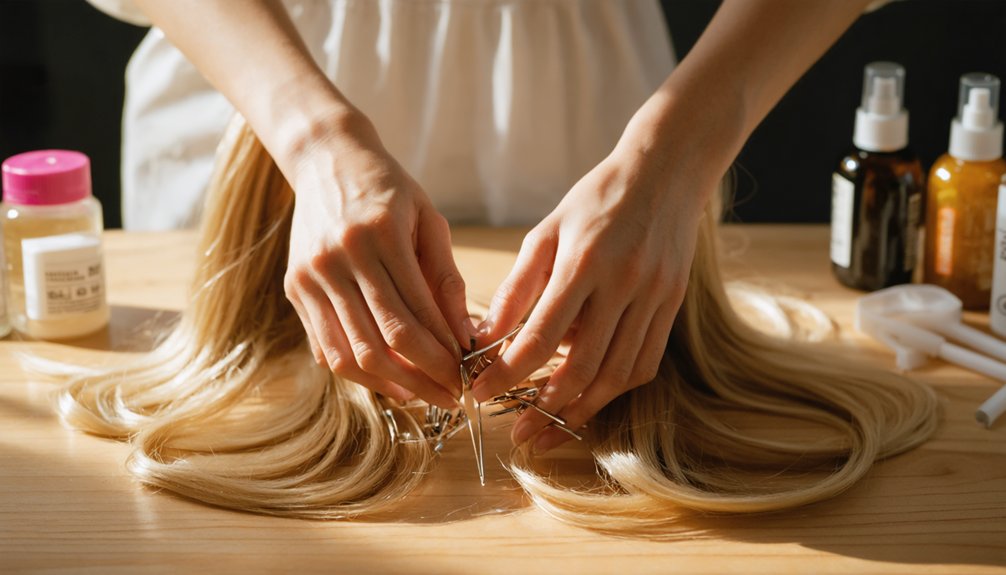
Once your hairline adhesive has set, locking your wig in place for a full convention day requires layering multiple securing methods strategically.
Start with a color-matched wig cap that flattens your natural hair while creating friction against the wig’s interior. Then activate the wig’s internal adjustable bands for a custom fit.
Prioritize these three reinforcement techniques:
- Insert bobby pins diagonally through the wig’s weft and into your wig cap at the nape and temples.
- Apply strong-hold hairspray like got2b Glued to anchor flyaways without compromising fiber integrity.
- Maintain wig hygiene by keeping sweat-absorbing wig caps fresh, since moisture weakens adhesive bonds over extended wear.
Combining mechanical and chemical securing creates redundancy, ensuring zero slippage regardless of movement intensity throughout your event.
The Exact Tools You Need to Cut and Style Cosplay Wigs
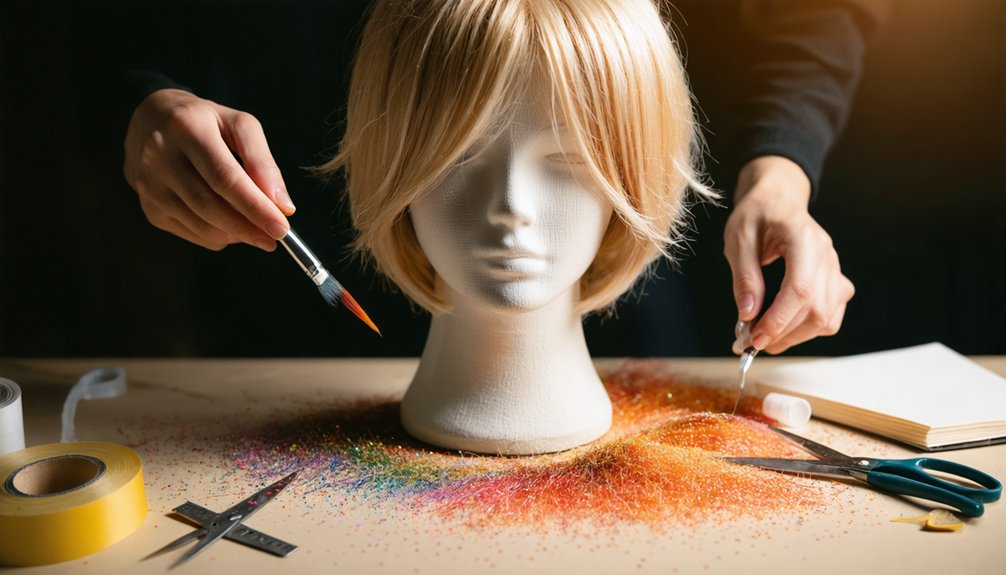
To cut and style cosplay wigs with precision, you’ll need a styrofoam or canvas wig head sized to your measurements, professional shears (never fabric scissors), a teasing brush, and a curling brush.
When cutting, you make small, gradual snips—constantly checking your progress—and aim for clean triangle shapes in any spikes to achieve a realistic, character-accurate silhouette.
Lock your final style in place with a strong-hold product like got2b Glued hairspray or hair lacquer, and use a low-setting heat gun sparingly on synthetic fibers to set the shape without causing damage.
Essential Wig Styling Tools
Whether you’re shaping dramatic anime spikes or trimming a sleek bob, having the right tools transforms a frustrating styling session into a precise, controlled process. Your styling techniques depend entirely on your toolkit’s quality and specificity.
Essential tools for wig maintenance and precision work include:
- Wig head — Use a styrofoam, mannequin, or canvas head sized to your measurements for ideal angle access during cutting.
- Heat gun on low settings — Shapes synthetic fibers without melting them, unlike conventional blow dryers.
- Professional shears — Sharp crafting scissors create clean cuts; fabric scissors crush fiber ends, destroying accuracy.
Complement these with a teasing brush, curling brush, and strong-hold hairspray like got2b Glued.
Never apply real hair products onto synthetic fibers — fiber integrity deteriorates rapidly.
Precision Cutting Techniques
Precision cutting separates polished cosplay wigs from amateur attempts, and three core principles govern every clean result: cut small, check often, and use the right blade.
Never reach for fabric scissors — professional shears deliver the clean, sharp lines that wig texture variations demand. Mount your wig on a properly sized wig head to free both hands and access every angle confidently.
When styling for realism, target deliberate triangle shapes when crafting spikes, since irregular geometry reads as authentic movement under stage lighting.
Make micro-cuts, then step back and assess before continuing — over-trimming is irreversible. Synthetic fibers behave differently than human hair, so adjust your technique accordingly.
Respecting these material differences transforms a basic cut into a character-accurate silhouette that holds its structure throughout extended wear.
Heat And Hold Products
Once your cuts are locked in, heat and hold products determine whether that silhouette survives the convention floor or collapses by noon.
Heat application reshapes synthetic fibers permanently when you use a low-setting heat gun, while strong-hold sprays like got2b Glued lock structure post-shaping.
Prioritize these three product strategies:
- Heat gun at low settings — sculpts spikes and curves without melting fibers during heat application.
- Hair lacquer over standard hairspray — delivers superior hold duration, resisting humidity and movement across long convention days.
- Avoid real-hair products — natural formulas break down synthetic fibers, destroying your styled architecture entirely.
Layer your heat application first, then seal immediately with lacquer.
That sequence maximizes hold duration without compromising fiber integrity or silhouette definition.
Cutting Techniques That Give Cosplay Wigs a Realistic Shape
Cutting a cosplay wig into a realistic shape demands the right tools, technique, and patience—rush it, and you’ll end up with an uneven, over-trimmed mess that’s difficult to fix.
Always use professional shears, never fabric scissors, since dull blades crush synthetic fibers rather than slicing them cleanly. Work on a properly sized wig head to gain ideal angles and free hand movement.
Make small, incremental cuts, constantly stepping back to assess progress. When crafting spikes, aim for deliberate triangle shapes—this precision transforms wig texture from flat and artificial into something dynamic and character-accurate.
Combine these cutting styling techniques with strategic layering to add dimension and movement. Patience isn’t optional here; it’s the single variable separating a polished cosplay wig from an amateurish one.
How to Blend Cosplay Wigs Seamlessly With Your Natural Hair
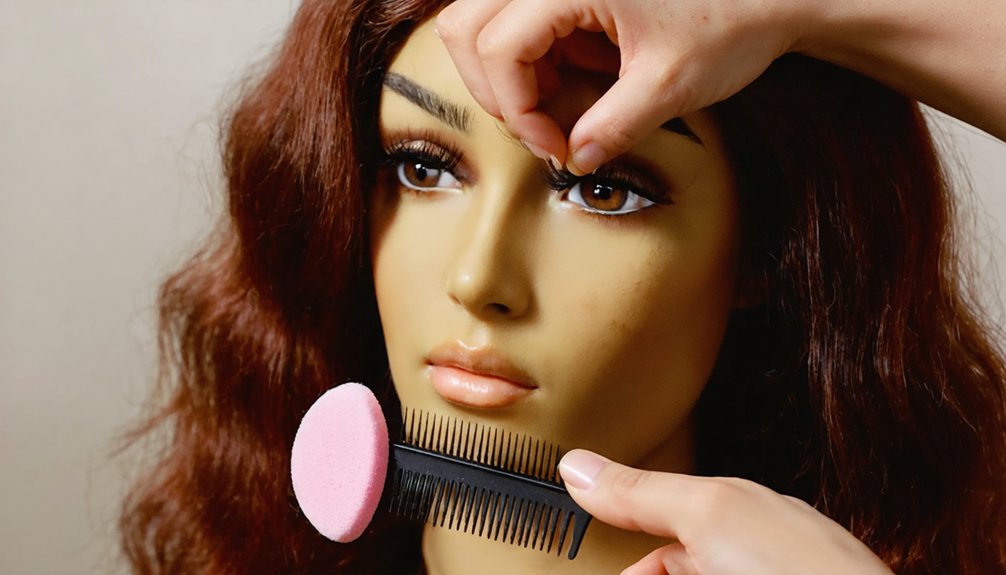
Shaping a wig is only half the battle—even the most precisely cut cosplay wig will betray itself if it doesn’t integrate convincingly with your natural hairline.
Mastering wig blending techniques guarantees a natural shift between synthetic fibers and your own hair.
Apply these critical methods:
- Pin a lace front wig behind your frontal hair, allowing your natural edges to frame the hairline authentically.
- Match fiber density to your hair’s thickness—overly dense wigs create a stark contrast against finer natural hair.
- Use liquid latex or wig tape to secure glued hairlines, eliminating gaps that expose the wig’s edge.
Additionally, wear a wig cap that mirrors your skin tone, preventing unnatural color breaks where the wig meets your scalp.
How to Layer Multiple Cosplay Wigs for Dramatic Character Looks
When a single wig can’t capture the complexity of a character’s layered, multi-tonal, or voluminous hair, combining multiple wigs becomes your most powerful customization tool.
Layering techniques involve stacking wigs strategically — place a shorter base wig first, securing it tightly, then position a longer wig overtop, pinning it at critical anchor points to prevent shifting.
For dramatic styles, blend contrasting colors by positioning the underlayer wig slightly lower, allowing peek-through tones to emerge naturally at the nape or temples. Use thinner fiber density in upper layers to avoid unnatural bulk.
Pin each wig independently with bobby pins, cross-locking them against each other for structural integrity. Apply strong-hold hairspray between layers to lock shapes, ensuring your character’s silhouette remains intact throughout extended wear.
Cosplay Wig Mistakes That Ruin Accuracy: and How to Fix Them
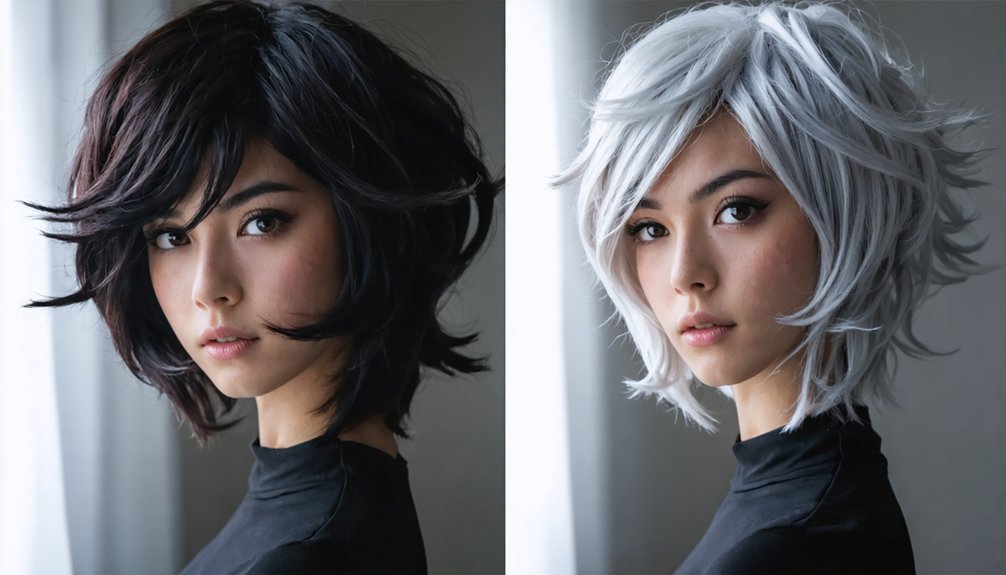
Even the most carefully chosen wig can destroy a cosplay’s accuracy if common styling and fitting mistakes go uncorrected. Referencing character hair references precisely prevents wig color mistakes caused by monitor calibration differences.
Hair texture variations and wig density issues dramatically shift how light interacts with fibers, altering perceived realism.
Fix these critical accuracy errors:
- Hairline alignment tips: Misaligned hairlines immediately signal artificiality—adjust your wig cap choices to match your natural tone, then position the wig against your biological hairline precisely.
- Styling product pitfalls: Never apply real-hair products to synthetic fibers; use got2b Glued instead.
- Wig maintenance secrets: Store wigs on properly sized heads to preserve shape between conventions.
Correcting these mistakes transforms mediocre cosplay into precise character recreation.
Frequently Asked Questions
How Do You Store Cosplay Wigs to Prevent Tangling Between Events?
Store your wigs on mannequin heads to maintain shape, using wig maintenance tips like silk bags for storage solutions. You’ll prevent tangling by brushing fibers before storing and keeping each wig separately in breathable, labeled containers.
Can Synthetic Cosplay Wigs Be Dyed to Match Character Colors?
Over 70% of cosplayers struggle with synthetic wig dyeing techniques. You can’t use standard dye; instead, you’ll apply alcohol-based ink for effective color matching tips, transforming fibers to nail your character’s exact hue accurately.
How Long Do Cosplay Wigs Typically Last With Regular Use?
With proper wig maintenance, your cosplay wig’ll typically last one to three years. Wear frequency directly impacts longevity—store it on a wig head, brush synthetic fibers gently, and avoid excessive heat to maximize durability.
What Wig Brands Are Most Recommended for Beginner Cosplayers?
Over 60% of beginners prefer Arda or Epic Cosplay wigs! You’ll find their heat-resistant wig fiber types ideal for beginner styling tips, offering durability, vibrant colors, and easy customization to elevate your cosplay accuracy creatively.
How Do You Remove Wig Glue Without Damaging Your Skin?
Apply isopropyl alcohol or specialized adhesive remover to dissolve wig adhesive alternatives gently. You’ll want to prioritize skin sensitivity tips—patch-test solutions first, then slowly peel, avoiding aggressive rubbing to protect delicate skin beneath.
References
- https://www.epiccosplay.com/pages/wigs
- https://morojowig.com/blogs/news/mastering-the-art-of-cosplay-wig-styling-your-ultimate-guide
- https://www.youtube.com/watch?v=zBMrFR6e24I
- https://wigs101.com/10-tips-for-wig-noobs
- https://www.youtube.com/watch?v=36PcHGiZd6o
- https://www.youtube.com/watch?v=I3Pn3aOdgtE