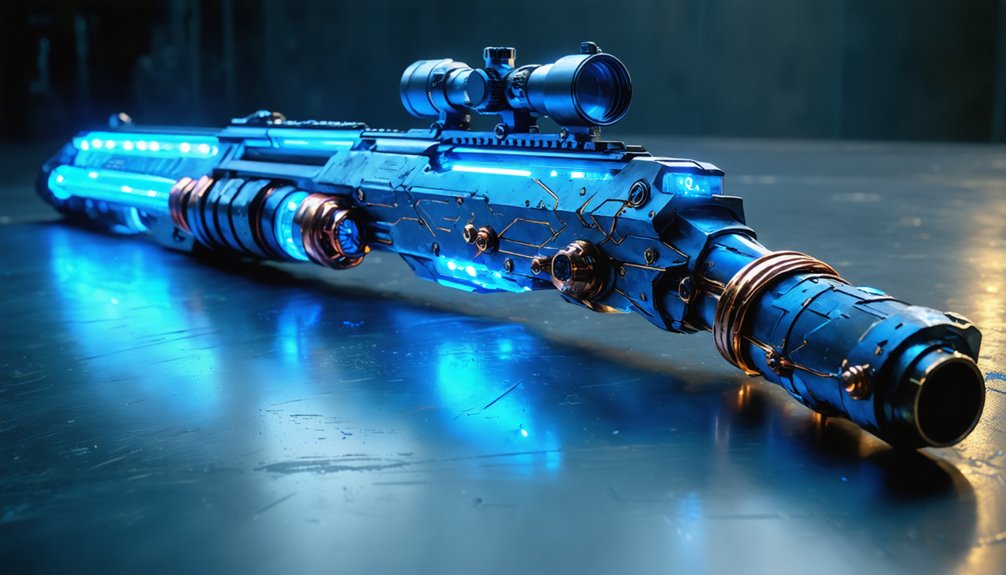
When hunting for futuristic sci-fi cosplay weapon inspiration, you’ll find the richest sources in franchises like Star Wars, Blade Runner, Tron, and Predator—each encoding distinct visual languages through silhouette, paneling, and glowing accents. You’re not just copying a prop; you’re translating speculative engineering into physical form using EVA foam, 3D printing, and LED lighting. Master these design codes, and your builds carry instant cinematic authority—and there’s far more to unpack ahead.
Key Takeaways
- Iconic franchises like Star Wars, Blade Runner, and Tron offer instantly recognizable silhouettes that make compelling cosplay weapon inspiration.
- Clean silhouette clarity, layered paneling, and glowing accents are essential design features for visually striking futuristic props.
- EVA foam and 3D printing are ideal construction materials, offering lightweight durability, clean geometry, and realistic high-tech aesthetics.
- LED lighting along energy channels simulates operational power, enhancing the futuristic appearance of sci-fi cosplay weapons.
- Round sharp edges, use impact-absorbing materials, and carry construction documentation to ensure convention safety compliance.
Most Iconic Sci-Fi Cosplay Weapons From Film and Games
When you’re building a futuristic cosplay weapon, starting with a recognized design gives your prop instant visual authority on the convention floor. Film and game weapons carry decades of historical weapon evolution, each silhouette shaped by cultural influence on design, military aesthetics, and speculative engineering.
Star Wars blasters translate seamlessly into foam builds. The Blade Runner LAPD pistol merges retro hardware with forward-thinking form. Predator’s plasmacaster commands space through dramatic scale and mechanical complexity. Tron’s identity disc delivers geometric precision with high visual impact.
These designs aren’t arbitrary. They encode recognizable visual logic that convention crowds decode instantly. When you anchor your prop in these iconic references, you’re leveraging decades of cinematic design intelligence rather than starting from zero.
Best Franchises for Cosplay Weapon Prop Inspiration
Choosing the right franchise shapes every material and design decision you’ll make from the first foam cut to the final paint layer.
Star Wars delivers compact blasters with immediately readable silhouettes.
Star Wars blasters communicate instantly — bold shapes, compact forms, silhouettes recognizable before details even register.
Star Trek phasers reward minimalist builders who favor clean geometry over complexity.
Blade Runner’s LAPD blaster merges retro-futurist styling with tactical realism, making it ideal for layered panel work.
Predator’s plasmacaster introduces alien technology aesthetics through organic curves and shoulder-mounted drama.
Tron’s identity disc pushes circular design into high-recognition cosplay territory.
Each franchise encodes distinct visual logic.
You’re not just recreating a prop — you’re reverse-engineering a fictional technological culture.
Franchises featuring cybernetic enhancements or alien technology push your builds toward asymmetry, embedded lighting, and non-human proportions, expanding your creative range profoundly.
Design Features That Make Sci-Fi Cosplay Weapons Instantly Recognizable
When you’re designing a sci-fi weapon prop, a clean silhouette is your first communication tool — it lets anyone across a crowded convention floor identify your build in seconds.
You can layer paneling and visible seams over that base form to push a manufactured, high-tech aesthetic that signals craftsmanship and fictional realism.
Add glowing accents along energy channels or power cells, and you’ve transformed a static prop into something that reads as genuinely operational.
Clean Silhouettes Matter
A weapon’s silhouette is the first thing a crowd sees—and in a packed convention hall, that split-second read determines whether your prop lands or disappears into visual noise.
Clean silhouettes work because they communicate function before detail ever registers. You’re designing for recognition at distance, not scrutiny up close.
Strip away clutter and let your prop’s outline do the storytelling. A well-defined barrel, a sculpted ergonomic grip, and deliberate negative space between components create a readable shape that photographs sharply and reads instantly across a crowded floor.
Avoid excessive surface fragmentation that muddies the form.
Matte finishes amplify silhouette strength by eliminating reflective distractions that compete with your prop’s outline. When light doesn’t scatter unpredictably, the shape holds—clean, intentional, and unmistakably futuristic.
Layered Paneling Adds Detail
Layered paneling transforms a flat surface into a manufactured story—your prop stops looking crafted and starts looking engineered. Each visible seam and recessed panel signals internal complexity, telling viewers that components lock together with mechanical purpose.
When you build with layered foam or 3D-printed sections, you’re solving two problems simultaneously: material durability improves because distributed layers resist flex and impact better than single-piece construction, and weight optimization becomes achievable by hollowing internal zones while keeping surface geometry visually dense.
Stack panels at intentional depths—two millimeters of offset reads instantly under convention lighting. Use edge beveling to define boundaries between sections.
Reference sci-fi concept art where manufactured weapons show distinct manufacturing zones. Your layering decisions communicate engineering logic, making the prop feel extracted from a functional universe rather than assembled in a workshop.
Glowing Accents Signal Power
Glowing accents don’t just decorate a prop—they communicate that something inside it’s alive. When you integrate LED strips into energy core designs, you’re not adding decoration; you’re encoding function into form. A pulsing chamber or a lit barrel seam tells viewers your weapon runs on something volatile and controlled.
Neon color schemes amplify this effect dramatically. Blue suggests plasma containment. Red implies thermal overload. Green signals radiation-based tech. Each hue carries its own fictional logic, and your audience reads it instantly.
You’ll achieve the strongest results by layering translucent acrylic over embedded LEDs, diffusing raw light into something that glows rather than blinds. That subtle depth transforms a foam build into a prop that looks genuinely powered—ready to fire on command.
Glowing Accents, Paneling, and Visual Codes That Define Futuristic Props
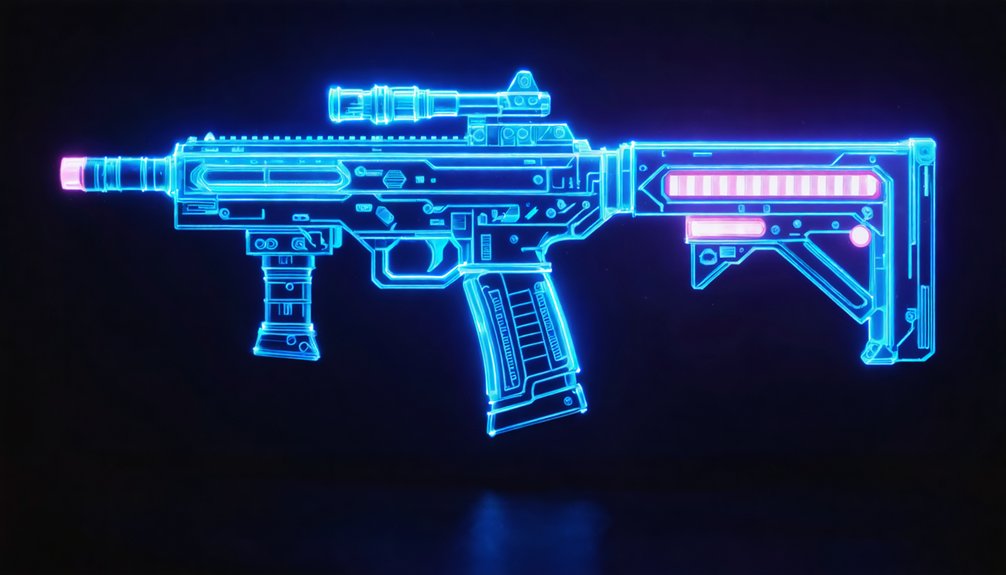
When you add glowing accents to a prop, you’re immediately communicating that it runs on something beyond gunpowder—plasma, energy cells, or technology that doesn’t exist yet.
LED strips tucked behind translucent acrylic panels simulate active power cores and make your weapon read as functional rather than decorative, even across a crowded convention floor.
Panel lines work alongside that glow by breaking the surface into manufactured segments, giving the prop a layered, engineered depth that flat paint alone can’t achieve.
Glow Effects Signal Power
Across nearly every major sci-fi franchise, glowing accents don’t just look dramatic—they communicate function, faction, and power level at a glance. When you integrate LED strips into energy core designs, you’re not decorating a prop—you’re encoding it with readable meaning. Viewers instantly register lit chambers as charged, active, and dangerous. That visual shorthand is exactly what makes glow effects so effective in crowded convention environments.
Your neon color schemes carry narrative weight too. Blue signals controlled precision. Red implies aggression or instability. Green often codes as alien or corrupted. Choose deliberately, because your color choice shapes how people read your weapon before you say a word.
Strategic illumination transforms foam and resin into something that feels genuinely powered.
Panel Lines Add Depth
Panel lines do what glow effects can’t—they build the illusion of internal complexity without a single powered component. When you score deliberate seams across your prop’s surface, you’re communicating manufactured precision: hidden chambers, modular assemblies, mechanical intention. That visual language reads instantly, even across a crowded convention floor.
Pair sharp panel geometry with neon color schemes and you create contrast that forces the eye to trace every edge. Your prop stops looking crafted and starts looking engineered.
Add ergonomic grips with recessed paneling along the handle, and the weapon suggests it was designed for a specific hand—a specific purpose.
Depth isn’t about thickness. It’s about shadow, structure, and the story your surface tells before anyone asks what franchise you’re representing.
How to Build Sci-Fi Cosplay Weapons at Home
Building a futuristic sci-fi weapon at home starts with three core materials: foam, a 3D printer if you have access to one, and LED lighting. Material selection drives everything — EVA foam shapes easily, absorbs impact, and keeps your build convention-safe.
If you’re printing components, design with clean geometry and interlocking panels for that high-tech layered look.
Safety considerations aren’t optional. Sand sharp edges, round every tip, and keep your build lightweight to reduce fatigue during long wear.
Integrate LEDs into recessed channels to simulate energy cores without exposing wiring.
Finish with acrylic paint and metallic dry-brushing to replicate worn polymer casing. You’re not just assembling a prop — you’re engineering a visual identity that reads instantly across a crowded convention floor.
How to Get Your Prop Cleared at Any Convention
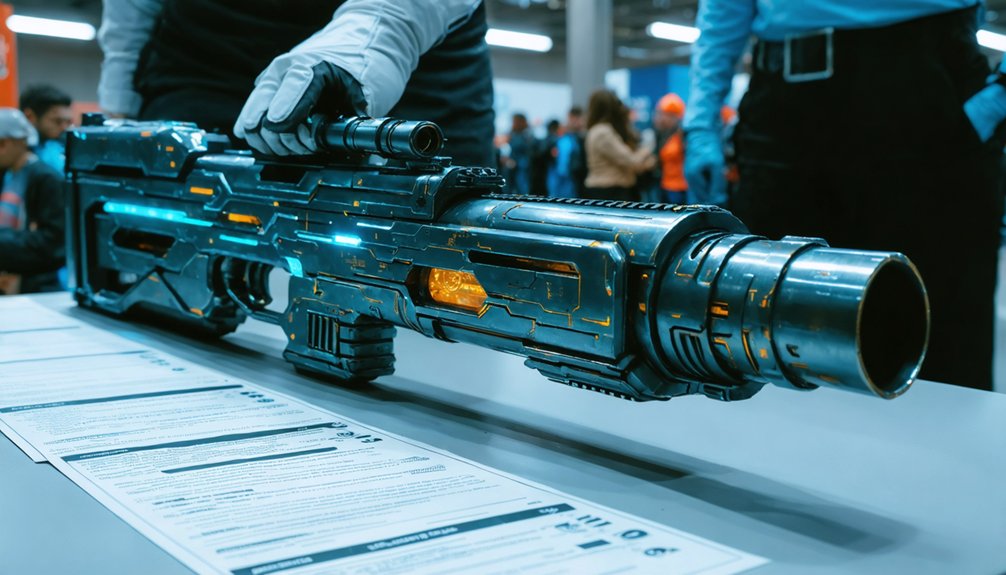
Every convention runs its own prop clearance system, so you need to research event-specific weapon policies before you finalize your build. Prop regulations differ markedly between venues, and what clears one event can get flagged at another.
Build weapon safety into your design from the start. Use lightweight foam or 3D-printed shells, round off any sharp edges, and avoid rigid materials that inspectors typically reject. Brightly colored barrel tips help staff identify your prop immediately as non-functional.
Design safety in from the start—foam, smooth edges, and bright tips make compliance effortless.
Carry printed documentation of your build materials and construction method. Some conventions require pre-registration or badge tagging for props, so contact the event team directly before arrival.
When you engineer compliance into the prop itself rather than scrambling at check-in, clearance becomes a straightforward process instead of a stressful obstacle.
Frequently Asked Questions
What Budget Should Beginners Expect When Starting Their First Cosplay Weapon Build?
You’ll typically spend $20–$50 using budget-friendly materials like foam and acrylic paint. Prioritize cosplay weapon safety by choosing lightweight builds with rounded edges—you’re crafting innovative props without overspending on your first visionary creation.
Can Cosplay Weapons Be Shipped or Carried on Public Transportation Safely?
Better safe than sorry — you’ll want to check public transit regulations before traveling with props. Bag your cosplay weapon safely, guarantee rounded edges, and declare it if asked. Cosplay weapon safety keeps your build convention-ready.
Are There Cosplay Weapon Communities or Forums for Sharing Builds Online?
You’ll find thriving cosplay weapon forums and build sharing communities on Reddit, Discord, and the Replica Prop Forum. There, you can showcase techniques, exchange material specs, and crowdsource innovative solutions with fellow visionary prop engineers.
How Do You Store Large Sci-Fi Props Without Damaging Them Between Conventions?
Like Han Solo’s carbonite preservation, you’ll protect your builds using smart prop storage solutions: wrap pieces in foam, use climate-controlled spaces, and apply damage prevention techniques like padded cases and disassembly for oversized structural components.
Can Children Safely Carry Cosplay Weapon Props at Family-Friendly Conventions?
Yes, children can carry props if you prioritize cosplay safety by choosing lightweight foam builds with rounded edges. Always verify prop regulation policies with each venue, as family-friendly conventions often enforce stricter material, size, and realism guidelines.
References
- https://www.behance.net/search/projects/sci-fi weapon?locale=en_US
- https://www.sffworld.com/2017/10/the-big-guns-top-ten-sci-fi-and-fantasy-weapons-by-gareth-k-pengelly/
- https://www.ranker.com/list/futuristic-looking-weapons/mike-rothschild
- https://www.youtube.com/watch?v=uhLyMdxmw9M
- https://www.reddit.com/r/cosplayprops/comments/1jbgqpt/whats_next/
- https://www.reddit.com/r/scifi/comments/1jlu4r8/ive_done_vehicles_but_now_what_are_your_favorite/
- https://www.facebook.com/groups/2406387646108092/posts/4819149434831889/
- https://www.fun.com/blog/p-1319-50-epic-fictional-weapons.aspx
- https://www.reddit.com/r/rpg/comments/313ll9/scifi_weapons_art/
- https://commons.wikimedia.org/wiki/Category:Fictional_weapons