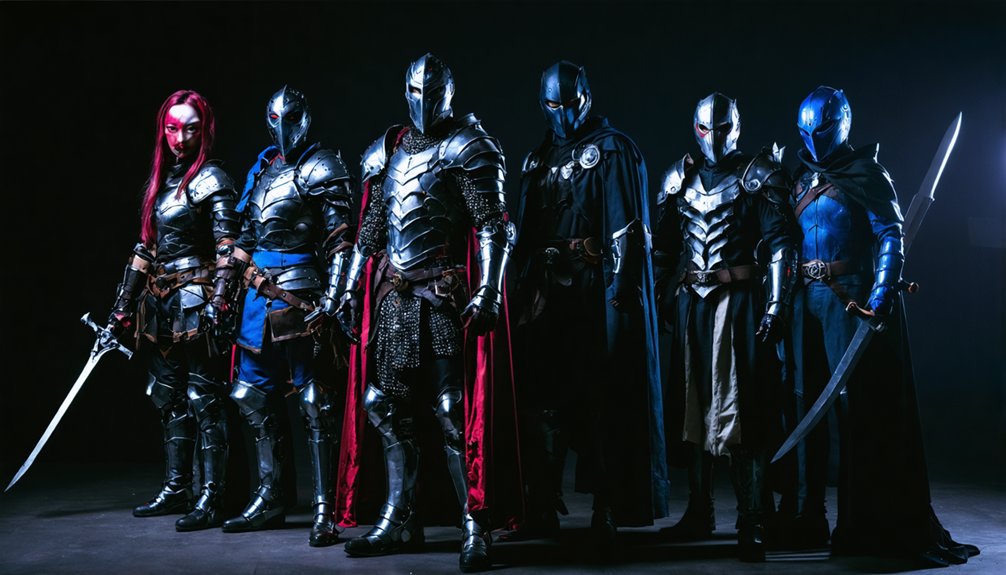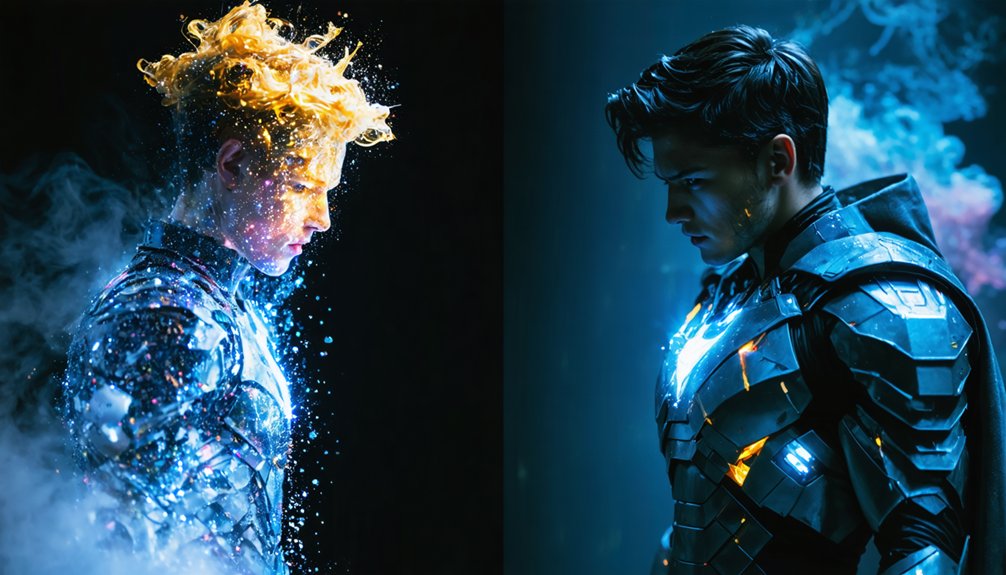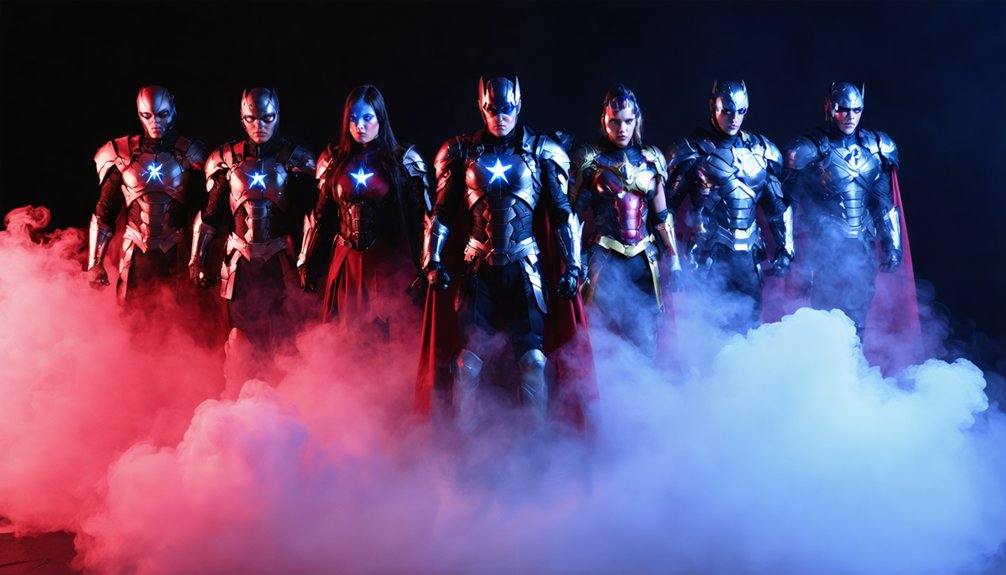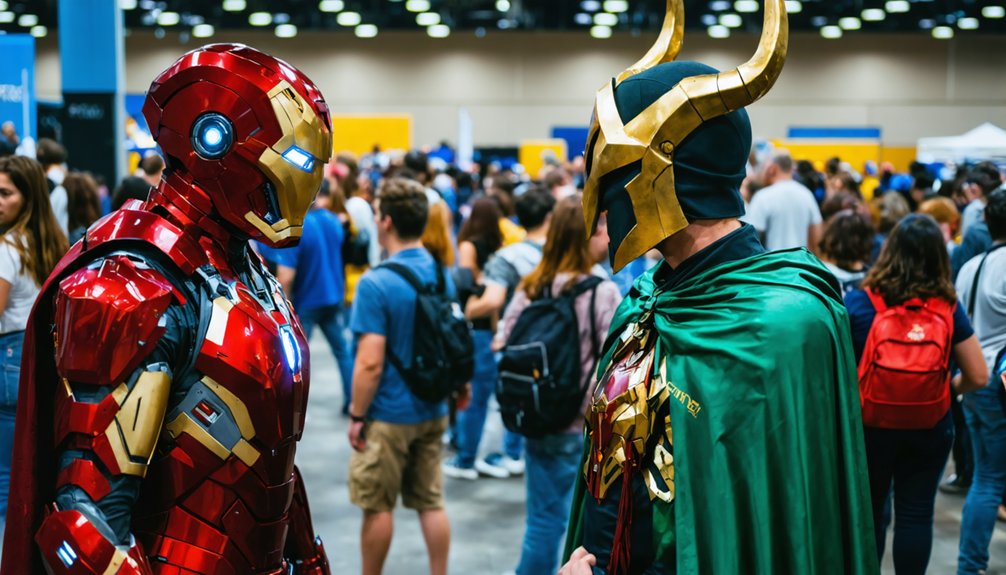
Start your crossover cosplay by selecting characters with complementary visual elements—shared color palettes, similar silhouettes, or thematic connections like Batman/Daredevil’s vigilante aesthetic. You’ll construct the foundation using EVA foam for dimensional armor pieces and four-way stretch spandex for mobility zones. Apply airbrushed gradients where character aesthetics intersect, creating seamless color shifts. Synthesize both personalities through blended physicality—merge their signature stances, gestures, and catchphrases into unified performance vocabulary. Master these technical fundamentals, and you’ll discover advanced methods for achieving convention-stopping hybrid designs.
Key Takeaways
- Select character combinations with strong visual contrast, thematic resonance, and high recognizability to maximize crossover impact and audience engagement.
- Build dimensional base forms using bowling pin shapes and circles, then layer costume elements from both characters for structural accuracy.
- Source character-specific materials including spandex, EVA foam, Worbla thermoplastics, and LED strips to authentically represent both universes.
- Blend costume aesthetics through airbrushed color gradients at seam intersections and layered foam elements beneath modified base garments.
- Synthesize both characters’ physicality by fusing signature movements, speech patterns, and postures into unified performance vocabulary.
Understanding the Art of Character Mashup Design
Every successful character mashup begins with a strategic foundation: establishing your primary character’s action line and basic head shape before layering in secondary elements. You’ll construct dimensional forms using bowling pin shapes for three-dimensional posing accuracy, then build outward with circles and ovals defining hands and feet. Thicken your stick figure framework by drawing lines around the limbs, creating volume without losing proportional integrity.
Your creative experimentation extends through feature integration—mixing ears, facial details, eyebrows, and headwear from multiple sources while avoiding simple head-swaps. Maintain recognizable silhouettes by matching contrasting body types: pair slender frames with muscular builds for maximum visual impact. Position heads along compositional curves, blend skin tones and costume palettes strategically, and incorporate innovative mashup styles through varied line weights and art style combinations that honor both source characters.
Selecting Your Perfect Crossover Character Combination
Your crossover selection demands assessment across five critical compatibility vectors: thematic resonance, visual contrast potential, narrative logic bridges, tonal alignment, and recognizability quotient. Evaluate rogue galleries for seamless integration—Shredder’s Foot Clan naturally complements Batman’s rogues gallery.
Crossover success hinges on five compatibility vectors: thematic resonance, visual contrast, narrative logic, tonal alignment, and recognizability quotient for seamless character integration.
Identify shared artifacts enabling plausible encounters: Necronomicon-based mashups unite supernatural investigators like Hellboy and Ash Williams. Analyze costume design aesthetics for maximum visual impact—sword-wielding warriors like Wonder Woman and Red Sonja create striking silhouettes through complementary armor elements.
Consider character backstory development opportunities: dimensional portals justify Batman/TMNT encounters while maintaining narrative coherence. Prioritize recognizable pairings over obscure combinations—JLA/Avengers and Batman/TMNT dominate fan popularity metrics.
Test tonal consistency: classic Archie accommodates supernatural chaos from The Mask, whereas Archie/Predator creates deliberately jarring juxtaposition. Document your compatibility matrix before finalizing selections.
Sourcing Materials and Essential Tools for Hybrid Costumes
Since crossover costumes merge distinct character aesthetics into unified designs, material procurement requires strategic organization across four supply categories: base textiles, structural reinforcements, fastening systems, and finishing embellishments.
Your fabric selection techniques should prioritize character-specific properties—Spandex for superhero bodysuits, metallic lamé for tech-enhanced heroes, tulle for mystical elements. Source synthetics and natural fibers through craft retailers or Amazon.
Structural components include EVA foam for armor plates, Worbla thermoplastics for curved breastplates, and foam board for lightweight bulk. Grey high-density EVA foam withstands laser cutting for intricate patterns.
Essential tools comprise heat guns for thermoplastic shaping, Dremel attachments for armor refinement, and hot glue guns for assembly troubleshooting. Incorporate LED strips like NeoPixel for character-appropriate lighting effects.
Stock Velcro, elastics, and bias tape for seamless costume integration between contrasting design elements.
Construction Methods for Blending Multiple Character Elements
When constructing your FlashHulk hybrid, you’ll layer foam muscle plates beneath the modified scarlet suit, then apply green airbrushed gradients that shift from Hulk’s gamma-irradiated flesh tones to Flash’s iconic crimson.
Strategic fabric paneling allows you to segment each character’s signature elements—positioning stretchy spandex where speed lines demand flexibility while anchoring rigid EVA foam where Hulk’s mass requires dimensional bulk.
Your color palette must bridge both universes through controlled blending zones, using intermediate hues like olive and burgundy at seam intersections to create visual coherence across the anatomical divide.
Material Fusion and Layering
Before fabric meets foam or paint touches primer, construct your crossover cosplay foundation through systematic base structure layering that merges anatomical elements from both source characters. Start with egg-shaped rib cages and rectangular pelvic boxes, then overlay tracing paper torn to precise dimensions for blending silhouettes seamlessly. Employ colored leads to designate thematic relations between fused elements during your initial sketches.
Your garment integration methods should prioritize practical clothing selections from thrift stores, combining authentic pieces that reflect both characters’ aesthetics. Block basic forms with cylinders and rectangles before adding costume details—this guarantees proper fit over your skeletal framework. Deploy multifabric mixing techniques by researching accessories that match your hybrid’s color palette and era-specific styling. Balance negative space strategically with props, tails, or emblematic elements around your central crossover design for maximum visual impact.
Color Palette Harmony Techniques
Establish your crossover’s chromatic foundation by applying the 60-30-10 Rule directly to character fusion—allocate your primary character’s signature hue (like Wonder Woman’s crimson) to 60% of costume surface area, designating it across chest plates, skirts, or dominant fabric panels. Reserve 30% for your secondary character’s contrasting shade (Batman’s charcoal), implementing it through gauntlets, boots, or cape underlays. Limit accent colors to 10% via metallic webbing or emblematic highlights that bridge both identities.
Conduct color scheme analysis using analogous harmonies (teal-blue-purple) for seamless character blends or triadic arrangements (red-yellow-blue) for energetic multi-hero fusions. Apply digital blending techniques through layered mockups—adjust hue shifts via Curves, introduce complementary shadow tones instead of grays, and test proportional balance before finalizing fabric purchases for ideal crossover recognizability.
Bringing Your Crossover Character to Life Through Performance

Your crossover’s performance demands strategic synthesis of both characters’ physicality—FlashHulk’s aggressive stance merges the Flash’s forward-lean sprint positioning with Hulk’s broad-shouldered rage display.
Map signature movements by isolating each character’s kinetic vocabulary: extract Green Lantern’s ring-charging arm extension and fuse it with Iron Man’s repulsor-blast wrist rotation for Iron Lantern’s construct projection.
Vocal delivery requires layering distinct speech patterns—blend Batman’s gravelly whisper with Wolverine’s growl for Dark Claw, then punctuate dialogue with character-specific catchphrases at alternating intervals.
Embodying Combined Character Traits
When merging two distinct comic book personalities into a single crossover cosplay, you must synthesize their behavioral patterns into a cohesive performance framework that reads as one unified character rather than alternating identities. Develop a dynamic emotional range that draws simultaneously from both source materials—channeling rage-infused determination or speed-enhanced tactical thinking depending on your mashup components.
Your character physicality insights should inform every movement pattern:
- Postural integration combines stance elements (aggressive forward lean with athletic readiness positioning)
- Gestural vocabulary blends signature movements into hybrid actions that reference both characters simultaneously
- Vocal modulation merges speech patterns, creating distinct cadence that honors both personalities without contradiction
Study how each character’s core emotional drivers complement rather than conflict, then embody that synthesis consistently throughout convention interactions.
Signature Poses and Movements
Physical performance transforms your crossover cosplay from a static costume into a living character interpretation. Master character embodiment by synthesizing signature movements—blend Wolverine’s aggressive crouch with Thor’s weapon-raised dominance for a berserker-warrior hybrid. Execute Superman’s elevated hover stance while incorporating Spider-Man’s dynamic torso twist to create aerial acrobatics with godlike confidence.
Prop integration amplifies your performance vocabulary. Position weapons as Thor does: front-held for defensive readiness, overhead for strike anticipation. Deploy Spider-Man’s web-shooting gesture while maintaining Wolverine’s forward-leaning attack posture. Apply dynamic intensity adjustments strategically—downward head tilts heighten combat focus, while exaggerated backward leans during leaps convey superhuman power.
Photograph from below-angles to maximize majestic scale. Your combined movement lexicon should feel biomechanically coherent, not disjointed—each gesture reinforcing your unique character fusion’s narrative logic.
Voice and Mannerism Fusion
How do you vocalize a character who exists nowhere in canon? You’ll need character voice grounding through vocal anchoring—select two distinct traits like pitch variation and rhythm patterns. Chart your fusion’s age, emotional baseline, and accent, then record anchor samples for consistency across performances. Physical storytelling implications demand matching voice placement (chest, nasal, throat) with your crossover’s posture and gestures.
Master seamless shifts between inherited traits:
- Practice dialogue drills that exaggerate then scale back each source character’s cadence
- Experiment with inflection ranges to reflect your fusion’s unique backstory and power dynamics
- Simulate 30-60 minute performance sessions to maintain vocal distinctness under pressure
Your backstory shapes every syllable—let past experiences color inflection, vocabulary choices, and emotional responses for authentic character embodiment.
Showcasing Your Creation at Conventions and Community Events

Bringing your crossover cosplay to life at conventions demands meticulous preparation beyond perfecting seams and weathering techniques. Navigate crossover cosplay challenges by pre-verifying your hybrid character’s compliance with venue-specific regulations. Guarantee costume coverage meets one-piece swimsuit standards while maintaining character integrity.
Your prop arsenal requires orange-tipped weapon modifications and dimensional adherence—2.5m maximum between structural points, with collapsible components excluded. Strategic special event planning involves advance security consultations for hybrid weapons that blur character boundaries. Submit detailed prop photographs pre-convention to expedite check-in procedures.
Master mindful movement protocols for bulky dimensional elements; designate handlers for constructions exceeding standard mobility parameters. Remove masks promptly upon staff request. Document your technical specifications—material composition, construction methodology, safety features—to demonstrate professional craftsmanship during potential compliance reviews. Transform regulatory requirements into innovation opportunities.
Frequently Asked Questions
What Are the Most Popular Comic Book Crossover Mashups at Conventions?
You’ll spot popular character combinations like Deadpool meeting Marvel heroes, Batman alongside Star Wars figures, and anime-infused DC mashups. Unique character mashups blend screen-accurate armor builds with cross-universe pairings—think Mandalorians posed with Sailor Scouts, creating convention photo goldmines.
How Much Does a Typical Crossover Cosplay Costume Cost to Create?
You’ll spend $100-$480 depending on costume materials and crafting techniques you choose. Entry-level fabric builds start lower, while advanced 3D-printed props and multi-character fusion elements push costs higher, rewarding your technical innovation with stunning visual complexity.
Can I Sell Photos or Prints of My Crossover Character Cosplay?
You can’t sell prints without risking infringement claims, as commercial usage rights belong to copyright holders. You’re creating derivative works when monetizing character portrayals, making copyright considerations critical. Non-commercial portfolio display remains your safest creative outlet.
What if My Crossover Combines Characters From Rival Comic Publishers?
You’ll face potential legal implications if selling prints featuring trademarked characters from rival publishers. Instead, create transformative hybrid designs that avoid direct copying—reimagine costume elements into original amalgamations, sidestepping creative limitations in design while showcasing innovation.
How Long Does It Take to Complete a Crossover Cosplay Costume?
Like forging two legendary weapons into one, you’ll need 40-120 hours depending on costume design complexity. Costume construction time varies with your skill level, material availability, and the intricate fusion details required for your innovative crossover vision.