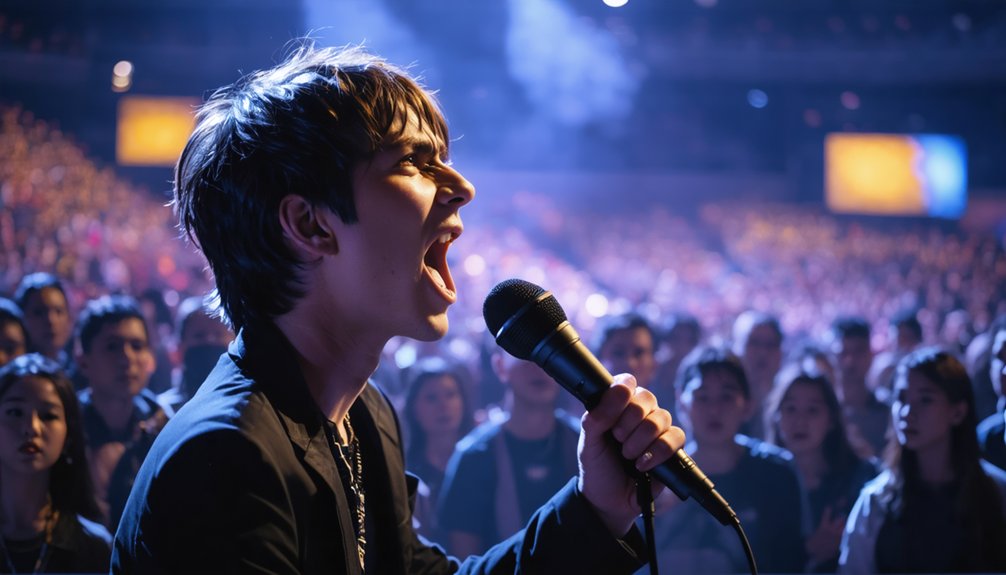
Performing a cosplay character means you’re doing far more than wearing a costume — you’re breathing life into someone else’s soul. Study your character’s movements, gestures, and emotional triggers before stepping into costume. Build muscle memory through mirror practice and recorded rehearsals so instinct drives your performance. Project your voice, own your stage space, and lock eyes with your audience. Keep going, and you’ll discover exactly how deep character immersion can take you.
Key Takeaways
- Study your character’s movement patterns, gestures, and emotional reactions thoroughly before wearing the costume to ensure authentic portrayal.
- Use a full-length mirror and record practice sessions to identify inconsistencies and build muscle memory for natural character expression.
- Project your voice from the diaphragm, slow your pacing, and use deliberate movements to deliver a commanding, authentic performance.
- Lock eyes with audience members for three seconds and react to their responses in character to create genuine engagement.
- Ruthlessly review recordings of your rehearsals to identify and correct every dropped gesture, vocal stumble, and positioning mistake.
The Difference Between Wearing a Costume and Performing a Character
Anyone can wear a replica outfit.
Fewer people commit to character immersion — absorbing a character’s motivations, mannerisms, and emotional core until those qualities radiate outward naturally.
Think of it this way: the costume is the vehicle, but *you* are the engine.
The costume is the shell. You are the soul that breathes life into it.
Without genuine performance driving it forward, even the most flawless costume remains an empty shell.
Your goal isn’t imitation — it’s inhabitation.
Study Your Cosplay Character Before Stepping Into Costume
Before you ever zip up that costume, you need to study your character’s movement patterns, gestures, and interactions with the same intensity an actor brings to a script.
Watch your source material repeatedly, cataloguing every quirk — the way they walk, how they hold their hands, the micro-expressions that define their emotional responses.
These details aren’t decoration; they’re the raw material that transforms your performance from a visual tribute into a living, breathing character.
Analyze Character Movement Patterns
Stepping into a character’s skin starts long before you zip up the costume. You’ll need to dissect every subtle movement with surgical precision, treating gesture significance like sacred performance data.
Study the character’s essence through:
- Observe walking patterns — posture, stride length, and weight distribution reveal personality architecture instantly.
- Catalogue signature gestures — each movement carries costume nuances that audiences subconsciously recognize and validate.
- Analyze emotional reactions — how your character responds physically to conflict, joy, or tension defines authentic portrayal.
Watch source material repeatedly, pausing at critical movement moments. Your body becomes the translation device between fictional world and live performance.
Every quirk you master deepens audience immersion, transforming mere cosplay into compelling theatrical storytelling that resonates long after the curtain drops.
Catalogue Unique Mannerisms
Does your character tilt their head when suspicious? Crack knuckles before confrontation? These distinctive traits transform costume into living character. Document emotional expressions tied to specific situations—anger, surprise, joy—capturing those memorable idiosyncrasies that fans immediately recognize.
Character ticks aren’t accidental; they’re storytelling shortcuts audiences unconsciously decode. That nervous laugh, the unique habits surrounding how your character handles props—these details separate performers from pretenders.
Build your catalogue methodically, then rehearse until these behaviors feel genuinely instinctive rather than mechanically performed.
Study Character Interactions
How your character interacts with others reveals the relational architecture underlying their entire personality. Character dynamics aren’t accidental—they’re deliberate storytelling engines. Study interaction styles, emotional exchanges, and dialogue nuances to reveal authentic performance depth.
- Map relationship development — Identify how your character’s physical proximity and gesture significance shift across different relationships, from allies to adversaries.
- Decode conflict resolution patterns — Notice whether your character confronts tension aggressively, diplomatically, or avoidantly, then embody that behavioral signature consistently.
- Absorb dialogue nuances — Specific word choices, pauses, and vocal rhythms define personality boundaries that separate your character from everyone else.
These aren’t surface details—they’re the connective tissue binding your portrayal together. Master these relational blueprints, and you’ll transform from someone wearing a costume into someone *inhabiting* a character.
Build Muscle Memory Through Focused Mirror Practice
Once you’ve studied your character’s movements, a full-length mirror becomes your most honest rehearsal partner. It reveals every inconsistency, every hesitation, every moment your body betrays the character you’re embodying.
Apply mirror techniques deliberately — watch your posture shift, your hands gesture, your expressions transform. Develop four to five signature poses that showcase distinct costume elements, cycling through each until they feel instinctive rather than constructed.
Mirror work transforms hesitation into instinct — until your poses stop feeling performed and start feeling *inevitable*.
Record your sessions. Playback exposes timing flaws and refinement opportunities invisible during live practice. Repetition isn’t monotony here — it’s architecture. Each session builds muscle memory that transforms conscious movements into unconscious character expression.
When performance day arrives, your body won’t need to remember. It’ll simply *become*.
Master the Body Language Your Cosplay Character Demands

- Isolate signature movement dynamics — identify your character’s defining gestures and own them completely.
- Pursue gesture refinement relentlessly — eliminate vague or generic movements that dilute emotional authenticity on stage.
- Engineer audience connection deliberately — position your body, direct your gaze, and calibrate your energy toward spectators intentionally.
Your character doesn’t just *exist* — they *communicate* through every physical choice you make.
Study source material obsessively, then embody those discoveries with theatrical commitment.
When body language aligns with character truth, audiences don’t watch a costume — they witness a living, breathing presence.
Project Your Voice Clearly in Cosplay Skits and Panels
Whether you’re delivering a character’s battle cry or whispering a villain’s threat, your voice carries the performance just as much as your costume does.
Mastering vocal projection techniques transforms a flat recitation into a living, breathing character moment. Breathe from your diaphragm, not your chest, pushing sound outward without straining your throat.
Speak deliberately. Slow your pacing so every word lands clearly across the venue’s back rows.
Pre-recorded lines demand the same sharp articulation as live delivery — audiences notice the disconnect when they don’t.
Your audience engagement strategies sharpen when your voice commands attention rather than begs for it.
Direct your sound toward the crowd, maintain consistent energy, and let your character’s emotional truth drive every spoken word powerfully forward.
How to Use Stage Space So You Never Look Static

Standing still on stage drains your character’s presence and signals discomfort to every audience member watching.
You own the entire stage, so use deliberate cross-movements, weight shifts, and motivated positioning to keep energy alive between your lines and reactions.
Every step you take should serve your character’s story, turning spatial choices into visual storytelling that holds attention from the front row to the back.
Dynamic Stage Movement Strategies
Rooting yourself in one spot drains the life from your performance — the stage is your world, and you need to claim every inch of it.
Dynamic movement transforms costume versatility into a living showcase, letting each angle reveal new dimensions of your character evolution.
- Diagonal crosses — move corner to corner, creating visual depth and dramatic momentum that static standing destroys.
- Pause with purpose — stillness hits hardest after motion; strategic stops amplify your character’s emotional weight.
- React spatially — let interactions physically push or pull you across the stage, making responses feel organic and unscripted.
Every step you take writes your character’s story for the audience.
Move deliberately, own your shifts, and never let empty space become wasted potential.
Spatial Energy Maintenance Techniques
Let emotional resonance drive your physicality.
Your character doesn’t pause — they exist, continuously, powerfully, and presently.
Connect With Your Audience Through Props and Eye Contact
When you lock eyes with someone in the front row, something electric happens — the invisible wall between performer and spectator dissolves. That’s audience connection at its purest.
Props amplify this power, transforming passive observers into participants within your visual narrative.
Maximize interactive storytelling through these three techniques:
- Extend props toward audience members — prop significance multiplies when spectators feel physically included in your character’s world.
- Hold sustained eye contact for three seconds — brief enough to feel intentional, long enough to create genuine recognition.
- React to audience responses in character — their laughter, gasps, and applause become scene partners you’re actively engaging.
You’re not performing *at* them. You’re pulling them *into* the story.
Cosplay Performance Mistakes Worth Fixing Before Your Next Show
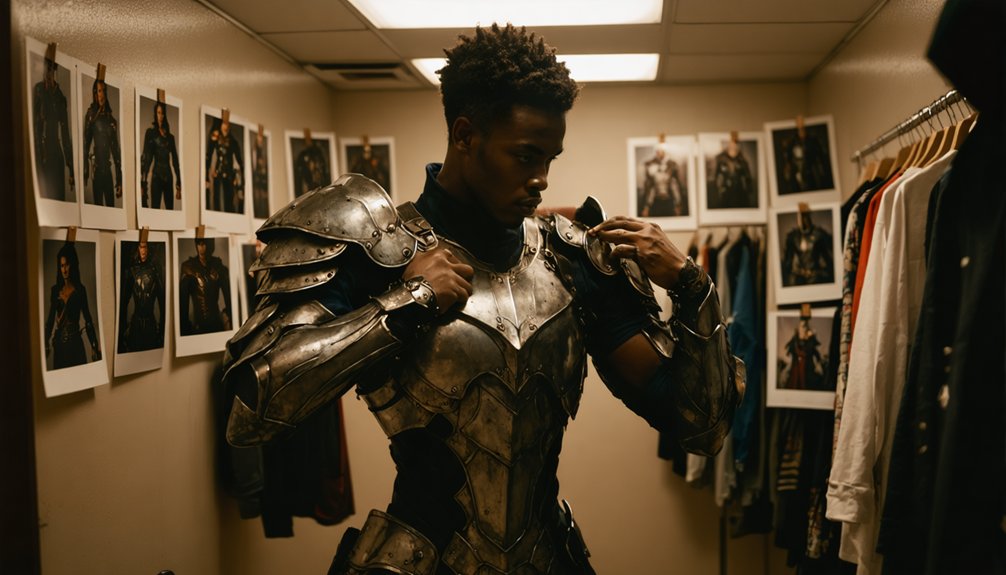
Pulling your audience into the story only works when your performance holds up under scrutiny — and certain habits quietly sabotage that effort before the crowd ever feels the magic.
Mumbling kills performance authenticity faster than a mismatched costume. Project from your diaphragm, not your throat.
Mumbling erodes believability faster than any costume failure — your voice must carry conviction from the core.
Stiff, static positioning signals discomfort — move deliberately across your space. Forgetting character nuances like a signature walk or specific hand gesture strips your portrayal of depth and recognition.
You’re also breaking immersion when your shoulders turn away from the audience during character interactions. Keep them angled forward.
Rushing through dialogue denies your audience processing time.
Record your rehearsals. Watch them ruthlessly. Every flinch, every dropped gesture, every vocal stumble is fixable — but only once you’ve honestly confronted it.
Frequently Asked Questions
How Do I Handle Unexpected Costume Malfunctions During a Live Performance?
When malfunctions strike, you’ve got to transform them into theatrical moments! Improvise boldly, maintain character, and use audience engagement to your advantage while discretely handling costume repairs—turning unexpected chaos into unforgettable, innovation-driven performance magic!
What Mental Preparation Techniques Help Reduce Stage Fright Before Performing?
77% of performers swear by pre-show rituals! You’ll conquer stage fright through visualization techniques—embodying your character fully before stepping out—and breathing exercises that ground your nerves, transforming anxiety into electrifying, authentic performance energy.
How Should I Coordinate Group Cosplay Performances With Multiple Characters Simultaneously?
Sync your character dynamics through shared rehearsal strategies—you’ll assign each performer distinct movement zones, practice ensemble interactions repeatedly, and guarantee everyone’s energy amplifies the group’s collective storytelling, creating an unforgettable, theatrically cohesive performance that electrifies your audience!
Which Competitions Specifically Reward Performance Quality Over Costume Craftsmanship?
Masquerade Hall competitions, WorldCon’s performance divisions, and Dragon Con’s skit categories champion performance criteria above all else. You’ll find their judging standards prioritizing your theatrical delivery, character embodiment, and crowd engagement over mere costume craftsmanship.
How Do Dietary Choices and Physical Fitness Impact Cosplay Performance Endurance?
Your nutritional optimization and fitness routines fuel every dramatic gesture and stage presence. Through hydration strategies and endurance training, you’ll sustain that character’s theatrical energy, commanding the spotlight with innovative physical storytelling that never falters under performance pressure.
References
- https://www.nerdcaliber.com/how-to-be-your-very-best-at-a-masquerade-with-level-up-cosplay/
- https://andsewingishalfthebattle.com/how-to-enter-and-survive-a-cosplay-masquerade/
- https://www.reddit.com/r/CosplayHelp/comments/1kul1di/what_are_the_rules_of_cosplay_contests/
- https://www.youtube.com/watch?v=p-tzOgMMlBc
- https://www.youtube.com/watch?v=RHE8R8rkLDU
- https://www.youtube.com/watch?v=2VlBQasNt2I
- https://www.youtube.com/watch?v=feNkg55tzq0
- https://bigimotikcosplay.com/skit-tutorials/
- https://starstruckpanda.com/unleashing-character-potential-in-cosplay/