Victorian cosplay requires understanding five distinct silhouettes spanning 1837-1901. You’ll master early Victorian’s layered petticoats (1840-1855), the revolutionary cage crinoline’s domed skirt (1856-1869), and the bustle period’s dramatic rear projection (1869-1889). William Perkin’s 1856 synthetic dye discovery transformed color possibilities, making vibrant mauveine and aniline hues accessible beyond expensive natural dyestuffs. Accurate construction demands period-appropriate foundations—whalebone corsets, steel hoops, or wire tournures—paired with era-specific bodice styles. The following sections provide detailed construction techniques for each silhouette’s authentic recreation.
Key Takeaways
- Victorian fashion spanned five distinct silhouettes from 1837-1901, offering cosplayers varied options from crinolines to bustles.
- Cage crinolines (1856-1869) created dramatic domed skirts using collapsible steel hoops, allowing greater mobility than layered petticoats.
- Bustle periods (1869-1889) featured exaggerated rear volume achieved through wire frameworks, pleats, and decorative swags.
- Synthetic aniline dyes after 1856 introduced vibrant, affordable colors like mauveine, transforming Victorian costume palettes beyond natural dyes.
- Authentic construction requires period-appropriate understructures: steel-boned corsets, cage crinolines, or bustle supports depending on chosen era.
Understanding the Three Distinct Victorian Silhouettes for Accurate Cosplay
When constructing Victorian cosplay, you must first recognize that the era’s sixty-three-year span (1837-1901) produced not three but five distinct silhouettes, each dictated by evolving undergarment structures and social conventions.
The crinoline period (1856-1869) prioritized lateral expansion through cage frameworks. Bodice evolution over time shifted dramatically into the first bustle era (1870-1876), redistributing volume rearward.
Cage crinolines expanded skirts laterally until bustles redirected fullness backward, fundamentally transforming the Victorian silhouette within two decades.
The cuirasse phase (1878-1883) eliminated bustles entirely, favoring elongated, armor-like bodices. Second bustle designs (1883-1889) reintroduced exaggerated posterior projection at severe angles.
Finally, the 1890s S-curve demanded nuanced corset construction that thrust the chest forward while pushing hips backward. You’ll achieve authenticity by selecting period-appropriate foundational garments rather than approximating silhouettes through modern shortcuts.
Early Victorian Period: Creating Simple Silhouettes With Printed Cottons (1840-1855)
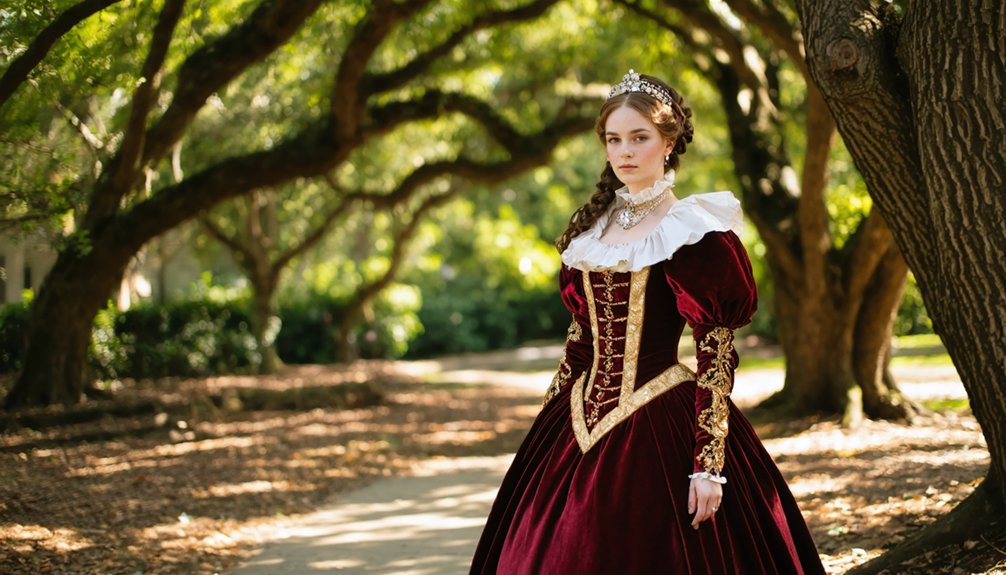
Before the crinoline cage revolutionized skirt construction in 1856, you’ll need to master the deceptively simple early Victorian silhouette through strategic layering of horsehair-stiffened petticoats and printed cotton overskirts. This period’s restraint conceals complex engineering beneath modest surfaces.
Your foundation requires rigid corset shaping techniques: whalebone or steel busks extending from breast to hip, creating the era’s characteristic narrow waistline while preventing torso flexibility. Layer 3-5 petticoats using proven petticoat layering methods—horsehair and cane-stiffened underskirts achieving the bell shape without excessive bulk.
Consider the emotional impact:
- Sloping shoulders and tight sleeves embody demure femininity
- Dark, somber daytime prints contrast dramatically with white evening wear
- V-shaped bretelles and delicate lace flounces add romantic subtlety
Choose printed cottons for authenticity, reserving pre-aniline subdued tones for historical precision.
Hoop Skirt Era: Mastering the Dramatic Domed Skirt Look (1856-1869)
The cage crinoline’s 1856 patent revolutionized Victorian fashion by replacing your foundation of 3-5 horsehair petticoats with R.C. Milliet’s collapsible steel hoops sewn into fabric channels. This innovation’s mass production impact via sewing machines democratized silhouette creation across social class divisions—factory girls and aristocrats alike achieved dramatic volume without weight burden.
You’ll observe the dome evolving: 1850s maintained even hip width, while 1863 shifted fullness backward, flattening fronts by 1865. Pair your crinoline with postillion bodices featuring detailed tails or streamlined princess dresses with gored seams. By 1868, you’re shifting to the crinolette—hoops concentrated at back only.
Despite satirical mockery and pregnancy concealment rumors surrounding Empress Eugénie, feminists praised this structure’s comfort, enabling unprecedented mobility compared to the 1840s’ restrictive layers.
Bustle Period and Natural Form: Crafting the Rear Silhouette (1869-1882)
As elliptical hoops yielded to concentrated rear structures in the late 1860s, you’ll notice the Victorian silhouette underwent its most dramatic spatial transformation—redistributing fabric volume from circumferential expansion to pronounced back projection.
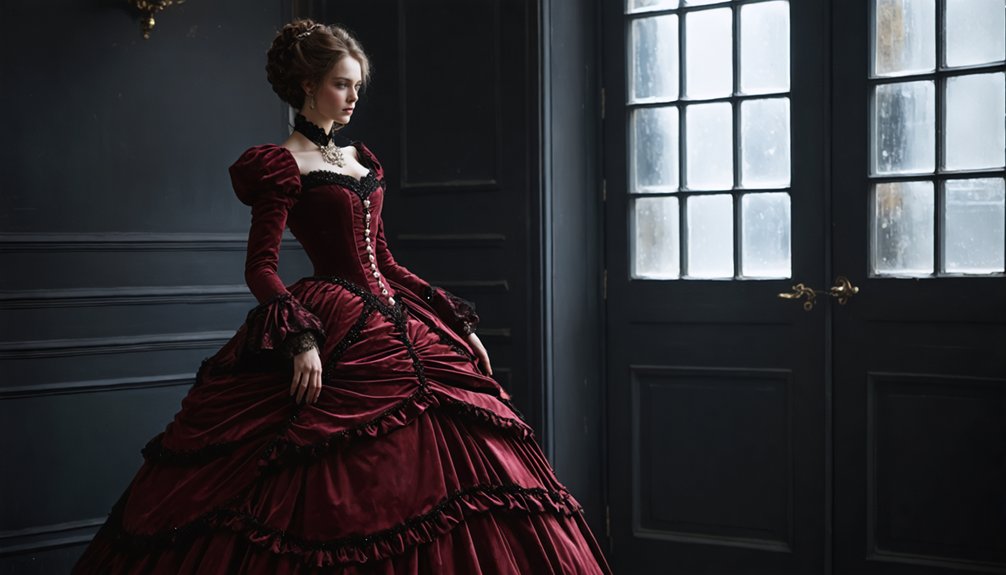
Early bustle structures (1869-1876) created high, soft rear emphasis through crinoline tournures and wire frameworks, while the Natural Form period (1877-1882) refined silhouette proportions with minimal support—stuffed pillows replacing rigid construction. Textile innovations enabled machine-sewn cartridge pleats and elaborate swags impossible in previous decades.
Construction milestones you’ll master:
- Giant tube skirts with back pockets housing bustle supports
- Cartridge pleating techniques pressing width into dramatic rear pouf
- Strategic whipstitching and slipstitching balancing machine efficiency with hand-tailored precision
Patterns like Ageless #1291 and Wingeo #320 provide authentic structural foundations for your rear-focused Victorian transformation.
The Revolutionary Impact of Synthetic Dyes on Victorian Costume Colors
When you recreate Victorian costumes from 1858 onward, you’ll encounter a dramatic chromatic shift that fundamentally altered fashion: William Perkin’s accidental discovery of mauveine in 1856 introduced the first commercially viable synthetic dye derived from coal tar.
This breakthrough launched an immediate fashion revolution, as Queen Victoria herself wore mauveine to her daughter’s wedding in 1858, cementing the color’s status and triggering widespread adoption of synthetically-dyed fabrics.
You must understand that aniline dyes didn’t merely expand the Victorian color palette—they democratized access to intense, vibrant hues previously achievable only through expensive natural dyestuffs like Tyrian purple or cochineal.
Mauveine’s 1858 Fashion Revolution
During Easter vacation 1856, eighteen-year-old William Henry Perkin transformed Victorian fashion forever when he accidentally synthesized mauveine while attempting to produce quinine from coal tar derivatives at his home laboratory in London’s Royal College of Chemistry. His patent filed August 1856 launched commercial production by 1857, creating affordable synthetic palettes that democratized color accessibility.
The fashion revolution accelerated dramatically in 1858:
- Queen Victoria wore mauve velvet to her daughter’s wedding, legitimizing the color across evolving social status boundaries
- Parisian and London high streets experienced “mauve measles” by late 1858, signaling unprecedented demand
- Reluctant dyers capitulated after French success, recognizing synthetic dyes’ commercial viability
This industrial-scale production distinguished mauveine from laboratory curiosities, permanently shifting textiles from unstable natural dyes to reliable synthetics.
Coal Tar Color Innovation
Coal tar’s transformation from industrial waste to fashion catalyst began in cramped laboratory spaces where chemists extracted aniline—a colorless aromatic oil—from the thick, black residue of coke production.
You’ll discover that coal tar chemistry innovations revolutionized Victorian costume possibilities when Perkin accidentally oxidized aniline in 1856, producing mauveine‘s intense purple compound. Synthetic dye affordability democratized vibrant coloration previously reserved for aristocracy; while Tyrian purple required thousands of murex snails, aniline dyes needed minimal quantities to achieve superior intensity.
Essential Accessories to Complete Your Victorian Cosplay Ensemble
Authentic Victorian cosplay demands meticulous attention to accessories, as these finishing touches distinguished social class and occasion in the 19th century. You’ll need to carefully select period-appropriate headwear, gloves, shawls, and parasols that correspond to your character’s gender, time of day, and social standing.
Understanding the specific materials, colors, and styles prescribed for different contexts—from white kid gloves for evening wear to tan leather for riding—will elevate your costume from mere approximation to historically grounded representation.
Period-Appropriate Headwear Styles
While the elaborate gowns and corsets of Victorian fashion rightfully command attention, headwear served as the defining element that marked a woman’s social standing and adherence to propriety. The evolution of bonnet styling from the 1830s’ wide-brimmed modesty coverings to the 1890s’ statement-making cartwheel hats reflects dramatic societal shifts you’ll want to capture authentically.
For your cosplay interpretation, consider these period-specific options:
- Early Era (1830s-1840s): Large bonnets with straw or silk construction, featuring ribbon and floral trimmings that framed the face
- Mid-Century (1860s): High-crowned shapes or sailor hats with straight brims and the proliferation of feather trimmings
- Late Victorian (1880s-1890s): Gibson Girl wide-brims or close-fitting toques adorned with ostrich plumes
Select materials matching seasonal authenticity: straw for summer events, velvet for winter gatherings.
Gloves, Shawls, and Parasols
No Victorian lady would’ve ventured beyond her threshold without gloves adorning her hands—a fundamental requirement that transcended mere fashion and embodied deeply ingrained social propriety. You’ll need kid leather for formal occasions, though suede’s popularity surged during the 1860s before aristocratic censure diminished its cachet.
Evening gloves extended beyond the elbow in finest kid, while daytime versions remained short and pale-hued. Artful glove embellishments like silk threading, metal bobbin lace, and spangles distinguished wealthy patrons from middle-class wearers who favored washable cotton alternatives. Consider undressed kid in blue-gray or olive brown tones that concealed soil effectively.
Modern cosplayers should research glove cleaning preservation techniques specific to historical materials, ensuring authenticity through proper seam construction and button placement that evolved from earlier long-gloved silhouettes favored throughout early Victorian decades.
Necklines and Sleeves: Day Versus Evening Wear Guidelines
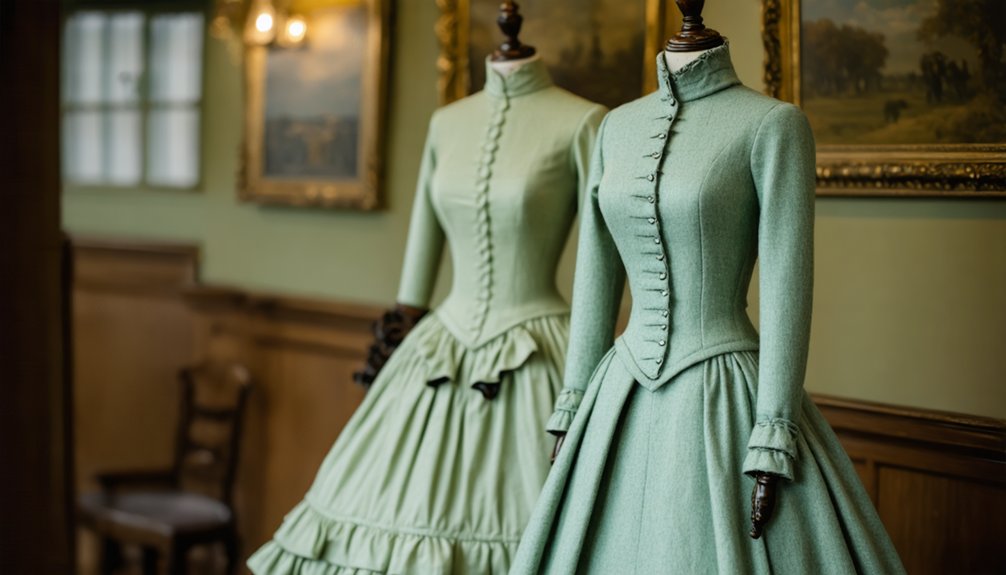
Victorian fashion maintained strict distinctions between day and evening attire, with necklines and sleeves serving as the primary visual indicators of appropriateness for different times and occasions.
For daytime cosplay accuracy, you’ll construct square or V-necklines filled with soft white fabric as daytime layering pieces. Sleeves should remain fitted through the arm with minimal gathering at the armscye, creating practical silhouettes for outdoor activities.
Evening wear demands dramatically different construction:
- Lower squared or scoop necklines left deliberately open without modest infill
- Short puffed sleeves that grew increasingly ornamental through the 1880s
- Three-quarter length options with elbow ruffles for dinner occasions
Consider creating two bodices for single skirts—one modest day version and one featuring decorative evening closures with lavish geometric trims, allowing versatile period-accurate costume transformation.
Indian-Inspired Textiles and Embroidery for Authentic Victorian Details
Through the East India Company’s aggressive trade monopoly, Indian textiles fundamentally transformed Victorian fashion aesthetics and manufacturing practices. You’ll find authentic details in paisley motifs—evolved from elongated leaf designs—and “tree of life” patterns that dominated both clothing and furnishings. Incorporate cashmere shawls, chintz, and calico fabrics that signified imperial status in Victorian society.
For embroidery techniques, consider crewel work’s bold floral patterns with twisting stems, representing fabric hybridization between Indian cottons and Persian influences. Global pattern exchange occurred through designs sent between continents for copying, creating distinctive Anglo-Indian aesthetics. William Morris later drew from these Jacobean-era hybridizations.
You can reference terms like gingham, seersucker, and dungarees—all derived from Indian textile terminology—to demonstrate period-accurate knowledge while constructing your Victorian costume.
Princess Line Construction: Achieving the Body-Conscious Victorian Silhouette
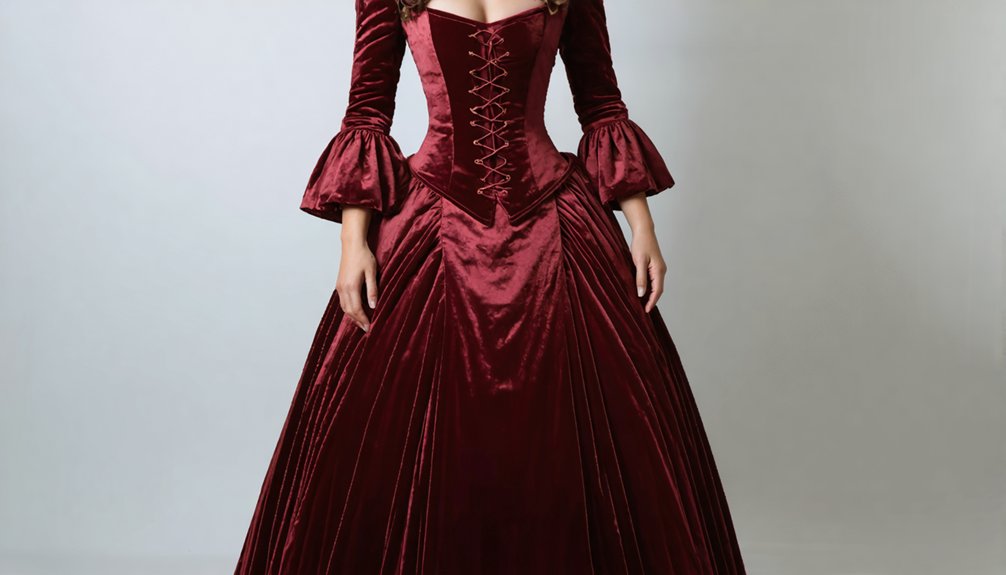
When Princess Alexandra popularized this revolutionary construction technique in the 1860s, she introduced a silhouette that departed radically from previous gored-skirt methods by eliminating the horizontal waist seam entirely. You’ll achieve this body-conscious effect through strategic curved panels that flatline fashion fabric with lightweight lining, creating structural integrity without fabric transparency concerns.
The princess line’s genius lies in vertical seams that sculpt fabric from shoulder to hem without interrupting at the waist.
Critical construction elements include:
- Precise boning placement along vertical seams and darts, transforming two-dimensional fabric into architectural sculpture
- Dual front waist darts per bodice side, engineering the dramatic bust-to-waist shift
- Corset integration beneath, providing essential waist compression and bust support that the princess line reveals rather than conceals
Press seams open meticulously—this technique distributes bulk and maintains the seamless visual flow. Finish edges with bias tape for period accuracy while reinforcing stress points.
Frequently Asked Questions
What Undergarments Are Necessary for Authentic Victorian Cosplay Silhouettes?
Want authentic Victorian silhouettes? You’ll need wearing appropriate corset over combinations, incorporating functional petticoats atop structural supports like crinolines or bustles, plus stockings and drawers. These foundation garments create historically accurate shapes impossible to achieve otherwise.
How Can I Make Victorian Costumes More Comfortable for All-Day Events?
Prioritize breathable fabrics like cotton blends over synthetics, and incorporate adjustable elements such as elastic waistbands and customizable lacing. You’ll achieve period-accurate silhouettes while ensuring moisture management and flexibility for extended wear at cosplay events.
What Budget-Friendly Fabric Alternatives Work Well for Victorian Cosplay?
You’ll find excellent sustainable fabric substitutes in repurposed cotton curtains and poly-taffeta for silks, while affordable lace alternatives include Chinese bridal lace at £12.99 or dyed cotton embroidery, maintaining period-accurate aesthetics without compromising your innovative cosplay vision.
Are There Modern Sewing Patterns Available for Victorian Era Costumes?
You’ll find a treasure trove of modern pattern availability from companies like Truly Victorian, BlackSnail, and Laughing Moon. These historically accurate designs accommodate contemporary sizing, while custom pattern design services adapt period-correct styles for innovative cosplay interpretations.
How Do I Choose Which Victorian Period Suits My Body Type?
Consider your natural proportions when selecting figure flattering silhouettes. Empire waistlines accommodate diverse frames, while bustle-era designs suit modest curves. Analyze proportional design elements like bust-to-waist ratios and bodice lengths to determine which period’s structured garments complement your measurements best.