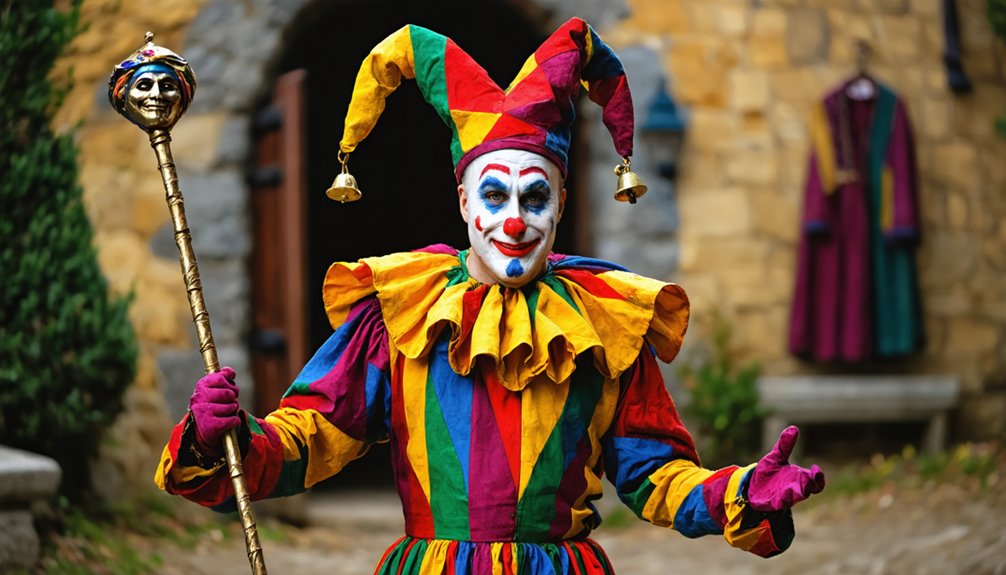
An authentic medieval jester costume requires a cap’n’bells with protruding horns and metal bells, motley fabric in clashing colors like red and blue arranged in two-tone or diamond patterns, and period-accurate wool and linen construction. You’ll need fitted chausses or breeches, with bells sewn at strategic points to announce movement. Historical jesters like Jane the Fool wore these elaborate constructions that symbolized their dual nature as entertainers and truth-tellers. The complete picture involves understanding specific construction techniques and the cultural significance behind each element.
Key Takeaways
- The cap’n’bells features protruding wool and linen horns with extending tails adorned with tiny metal bells for authentic sound and silhouette.
- Motley patterns use clashing colors like reds, blues, yellows, and greens in two-tone or diamond patchwork designs violating courtly conventions.
- Reversible construction allows instant costume transformation, reflecting the jester’s dual role as entertainer and truth-teller in medieval courts.
- Period-correct materials include wool and linen with strategic lining methods, bone folders, and natural threads matching fabric types for authenticity.
- The motley costume symbolizes social immunity, granting jesters exemption from sumptuary laws while enabling audacious political satire and commentary.
The Iconic Cap’n’Bells: Horns, Tails, and Tinkling Sounds
When medieval jesters entered royal courts, the jingling of their cap’n’bells announced their arrival before they could be seen. You’ll find authentic reproductions feature protruding horns crafted from wool and linen, creating fantastical silhouettes that challenged conventional court aesthetics. The tails extending from these double-sided caps carried tiny metal bells sewn at their edges, producing distinctive sounds with every movement.
Reversibility significance became essential in 15th-century designs, allowing jesters to transform their appearance instantly. The shaved head tradition guaranteed caps fit securely during acrobatic performances. Historical figures like Tudor-era Jane the Fool wore these elaborate constructions, which required 4-6 weeks of handcrafting. Today’s Renaissance fair participants prize these details, recognizing how horns evoked animalistic imagery while bells amplified the fool’s satirical presence outside rigid social hierarchies.
Motley Colours: The Signature of Medieval Foolery
When you examine authentic medieval jester costumes, you’ll find that motley’s power resided in its deliberate clash of fiery reds, ocean blues, sunlit yellows, and verdant greens—colours intentionally mismatched rather than coordinated. These contrasting combinations weren’t merely decorative choices but symbolic representations of the jester’s dual nature as both entertainer and truth-teller, a liminal figure existing outside courtly hierarchies.
Historical evidence reveals that early motley featured simple two-tone patterns, with breeches displaying one colour per leg, before evolving into the elaborate patchwork of red, green, and blue diamonds characteristic of later commedia dell’arte traditions.
Contrasting Bright Colour Combinations
From the 14th through 17th centuries, the motley fabric worn by court jesters created one of history’s most recognizable visual identities through its chaotic blend of contrasting colours. You’ll find that authentic motley combined fiery reds with ocean blues, sunlit yellows with verdant greens—deliberate clashes that rejected conventional aesthetic principles.
These contrasted harmonies weren’t random; they served strategic purposes in noisy court settings where jesters needed immediate visual impact. The patchwork diamonds featured bold combinations like red-green and blue-yellow, creating what contemporaries described as “gaudy attire.” This playful coordination extended to tight breeches, where each leg displayed different colours.
The resulting riot of mismatched patterns transformed performers into living art, ensuring they’d command attention while their vibrant appearance symbolized their position outside traditional social hierarchies.
Symbolism of Dual Nature
The jester’s motley costume functioned as a visual passport to immunity, encoding a paradoxical social position that granted lowly entertainers privileges denied to nobles. You’ll find this patchwork attire created a symbolic social disconnect—placing fools outside Elizabethan dress codes and class hierarchies entirely.
Their eccentric designs marked them as non-threats, enabling audacious truth-telling that would’ve earned courtiers execution. This dramatic self perception manifested through the Tarot Fool archetype: walking confidently off cliffs, embodying perversity as divine gift.
Shakespeare’s King Lear exemplified this duality—motley-clad advisers delivered frank counsel through rhymes and mockery, their “childlike madness” providing monarchs with insights no counselor dared voice. The costume’s dual nature balanced entertainment with political satire, transforming lowly status into unprecedented cultural power.
Historical Two-Tone Patterns
Motley emerged as the defining visual language of medieval foolery, transforming simple two-tone fabric into a codified costume that instantly communicated its wearer’s unique social position. Originating between the 14th and 17th centuries, this woollen fabric showcased pioneering color combinations that deliberately violated courtly dress conventions.
You’ll recognize authentic motley through its contrasting hues—typically paired colors that created visual discord rather than harmony. These textile innovations evolved from basic two-color schemes into increasingly complex patterns, eventually inspiring the diamond-patchwork designs of commedia dell’arte’s arlecchino.
The term “motley” itself became synonymous with heterogeneous mixing, though its historical application remained specific to jester attire. This deliberate particolored aesthetic separated fools from polite society’s monochromatic expectations, granting them exemption from sumptuary laws while marking their liminal social status.
Reversible Wool and Linen Construction Techniques
Building upon centuries of medieval tailoring tradition, reversible wool and linen construction creates a fully finished garment without exposed seams on either side. You’ll achieve authenticity through strategic linen lining methods that eliminate visible stitches while maintaining historical accuracy.
Essential construction steps include:
- Sew outer wool pieces along long seams, then align with lining right sides together
- Cut linen lining slightly shorter than exterior on hood points to facilitate turning
- Use bone folders and bamboo needles to push out points and liripipe after turning
- Attach lining with tiny felling stitches after basting wool-covered elements
Your sewing and finishing details matter—trim points to reduce bulk, press seams flat, and employ tailor’s chalk for precise marking. Natural threads matching fabric type guarantee period-correct results.
Chausses and Breeches: Period-Accurate Legwear
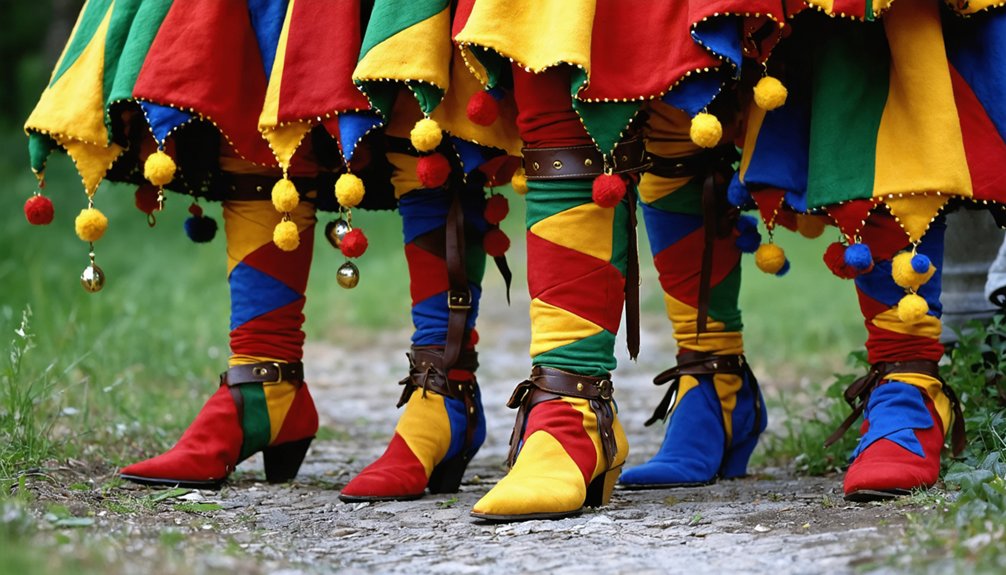
Your jester’s legwear requires careful attention to medieval construction methods, particularly the fitted chausses that extended from foot to hip. You’ll achieve period accuracy through two-tone wool construction, cutting bias-grain fabric pieces and seaming them along the leg’s back and sometimes front.
The garments attach to your doublet or braies through a series of lacing points called “points,” using waxed linen cords threaded through reinforced eyelets to maintain proper fit and prevent sagging during performance.
Two-Tone Wool Construction
Authentic medieval chausses demand careful fabric selection and construction techniques that balance historical accuracy with practical wearability. Two-tone wool construction enables the distinctive visual contrast essential to jester costumes while maintaining period-correct methods. Proportional colour distribution across separate leg sections creates the characteristic parti-colored effect documented in historical sources.
When implementing two-tone designs, you’ll need to ponder:
- Twill weave patterns provide superior durability for dynamic performance movements
- Bias-cutting techniques safeguard figure-hugging fit on both foot and leg portions
- Pink and contrasting wool colors replicate authentic tight-fitting medieval hose examples
- Separate leg construction allows independent color selection while maintaining traditional lacing to braies
- Ass ears on hoods initially represented humble position before evolving into exaggerated points
- Jingling bells warded off gloom while signaling the fool’s protected legal status
- Multi-colored motley patterns contrasted sharply with strict class-based dress codes
- Bauble scepters completed the parody of royal regalia and courtly power
- Duvetyn and velvet fabrics for flexible movement during acrobatic performances
- Multi-colored motley patterns combining at least two vibrant, mismatched hues
- Tight breeches with contrasting leg colors for visual impact
- Specialized performance accessories including baubles with sculpted heads and three-pointed jingling hats
This approach preserves historical integrity while delivering the bold aesthetic innovation modern reenactors demand from their costuming investments.
Lacing and Fit Methods
Fit adjustments involved multiple strategies: wetting the fabric before wearing guaranteed a skin-tight contour as it dried, while points attached directly to your doublet or gambeson distributed weight effectively.
Leather straps around the knees provided additional support, and ankle cuts with leather closures facilitated foot entry in enclosed versions. These period-accurate methods balanced security with flexibility for both mounted and dismounted activities.
Bells, Cockscombs, and Donkey Ears as Satirical Symbols
While the jester’s primary duty was entertainment, every element of his costume carried deeper satirical meaning that medieval audiences instantly recognized. Bells announced his presence while serving as #BellsEtiquette markers—their constant jingling simultaneously captured attention and reminded courts that conventional decorum didn’t apply to licensed fools. The three-pointed cockscomb mirrored royal crowns in mockery, #IndicatingStatus as the one person permitted to satirize authority freely.
These satirical symbols included:
Each element transformed jesters into walking paradoxes—simultaneously lowly and privileged, foolish yet wise.
Historical Court Jesters and Their Documented Attire

Historical records reveal that court jesters’ clothing varied considerably based on their employers’ wealth, regional customs, and individual performance styles. You’ll find documented examples like Jane the Fool, who wore master-specified attire including a distinctive cap paired with shaved heads common among Tudor jesters.
Personal jesters’ wardrobes reflected their patrons’ status—some wore richly decorated motley with fur-edged mantles, while others donned simpler hoods and vertical tunics. Multi-talented jesters performing household duties required practical garments that balanced entertainment value with functionality. Battle accompaniment demanded morale-boosting colourful dress designed for travel.
The symbolic cap and bells served as protective emblems mirroring royal crowns, granting jesters immunity while they delivered satirical commentary. These variations demonstrate how historical context shaped authentic costume elements beyond stereotypical representations.
Crafting Timeline and Material Authenticity Standards
Creating an authentic medieval jester costume requires understanding how these garments evolved from simple entertainers’ wear in the 13th century to the elaborate motley designs that dominated 15th-century courts. The 1400s marked a pivotal transformation in layered textile interplay, with artisans meticulously sewing tunics in color-matched sections—gold thread for gold fabric, purple thread for purple panels.
Medieval jester costumes transformed dramatically through two centuries, with 1400s artisans pioneering color-matched threading techniques that defined authentic motley construction.
Authentic construction prioritized:
Modern reproductions maintain period accuracy through concealed elastic waistbands and hot-dog-style sleeve construction, while decorative patches—stars and moons—replicate the comical embellishments essential to the jester’s distinctive court presence.
Frequently Asked Questions
Did Medieval Jesters Always Shave Their Heads Before Wearing the Cap?
No, you won’t find universal head shaving among medieval jesters. While some adopted tonsured hairstyles or shaved pate styles—like Tudor-era Jane the Fool—most jesters maintained regular hair beneath their cap’n’bells, making shaving tradition-specific rather than standard practice.
Can the Marotte Be Purchased Separately From Costume Sets?
You’ll find marottes sold separately from costume sets—coincidentally, most artisan vendors treat specialized jester costume accessories as modular components. Custom jester cap options and marottes require direct manufacturer contact, with handcrafted pieces typically shipping within 2-4 weeks independently.
Were Female Jesters Like Jane the Fool Dressed Identically to Males?
You’ll find Jane the Fool wore identical attire to male jesters, showing no gender-based variations in costume design. This uniformity reinforced jesters’ unique social status implications, placing entertainment value above conventional gender distinctions in medieval court hierarchy.
What Specific Dye Sources Created Authentic Motley Colours in Medieval Times?
You’ll find historical documentation of motley reveals limited specific dye sources, though natural dye variations included madder for reds, woad for blues, and weld for yellows. Unfortunately, precise medieval jester dyeing practices remain poorly documented in surviving records.
How Were Bells Attached to Prevent Them From Falling off During Performances?
Like anchors securing ships, you’d hand-stitch bells directly through reinforced fabric points using durable thread. Attachment methods varied by bell sizes—smaller bells adorned sleeve fringes, while larger ones crowned hat corners, ensuring nothing detached during acrobatic performances.