Cosplay etiquette requires you to always ask permission before touching costumes or taking photos, respecting both verbal and non-verbal boundaries. You’ll need to maintain good hygiene, pack essential supplies, and stay hydrated throughout the event. Familiarize yourself with prop regulations—conventions ban functional weapons and sharp edges while requiring inspection tags for approved materials. Navigate crowds carefully with large costumes, report harassment immediately to staff, and actively support fellow cosplayers through genuine compliments and shared knowledge. Comprehending these exhaustive guidelines guarantees you’ll contribute to a welcoming, inclusive convention environment.
Key Takeaways
- Always obtain explicit consent before photographing cosplayers or touching their costumes, props, or person.
- Respect personal boundaries by maintaining appropriate distance and avoiding prolonged hovering in crowded convention spaces.
- Practice good hygiene with deodorant, hand sanitizer, and tissues while staying hydrated and taking meal breaks.
- Familiarize yourself with prop regulations, including material restrictions and size limits specific to each convention.
- Support positive community culture by offering genuine compliments, reporting harassment, and mentoring newcomers with helpful tips.
Respecting Personal Boundaries and Physical Space
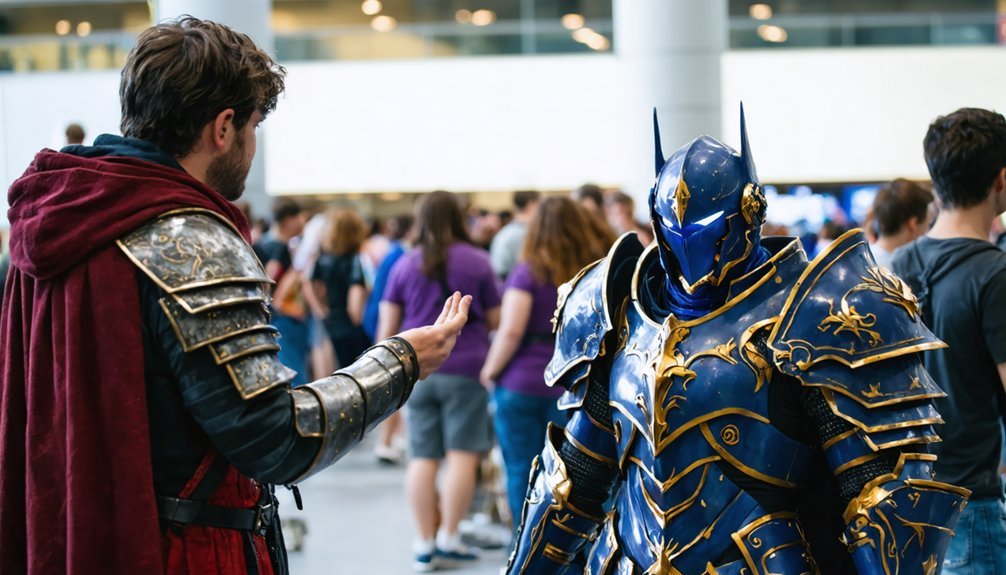
Cosplay conventions operate under a foundational principle: consent precedes all physical contact. You must obtain explicit permission before touching costumes, props, or cosplayers themselves—regardless of how elaborate or inviting the presentation appears.
At cosplay conventions, explicit permission is required before any physical contact with costumes, props, or cosplayers—no matter how elaborate the presentation.
Respecting social cues means maintaining appropriate distance in crowded spaces and avoiding prolonged hovering during interactions.
You’re responsible for managing your belongings to minimize spatial intrusion while honoring individual comfort levels that vary remarkably among attendees. A cosplayer’s online presence doesn’t grant automatic access to their personal space or time.
When uncertainty exists about whether an action crosses boundaries, don’t proceed.
These protocols aren’t restrictive—they’re enabling frameworks that allow everyone to participate authentically. You’ll find that respecting boundaries actually enhances community engagement and creates safer, more innovative convention environments.
Taking Photos the Right Way
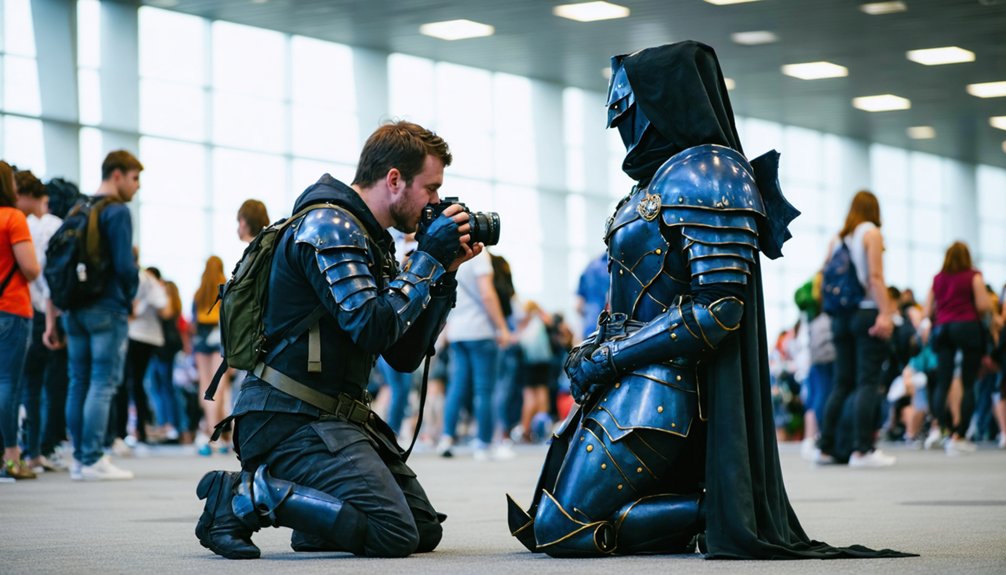
Photography at conventions requires explicit consent before you capture any image of a cosplayer. Always ask permission first, then allow them to pose properly. You’ll respect their creative vision while achieving better creative compositions through collaborative shooting.
Essential photography protocols include:
- Move subjects to less crowded locations that match character themes for ideal shots
- Avoid flash during contests and employ reflectors to counter poor venue lighting
- Photograph entire groups from the same series together before requesting individual shots
- Select flattering angles that prevent discomfort—never shoot upward under costumes
- Keep sessions brief to maintain convention traffic flow
After shooting, exchange contact information for proper tagging on social platforms. These lighting techniques and courteous practices will build lasting relationships within the cosplay community while capturing exceptional imagery.
Maintaining Good Hygiene and Self-Care
While convention excitement often overshadows practical needs, maintaining proper hygiene and self-care directly impacts your safety and enjoyment throughout multi-day events.
Guarantee strategic hydration management by carrying water and scheduling regular meal breaks to prevent medical emergencies. Address feet considerations through pre-broken-in comfortable footwear and portable backup options like foldable flats.
Stay hydrated with portable water and eat regularly—your body can’t run on convention excitement alone, no matter how much you wish it could.
Pack essential supplies: hand sanitizer for crowd navigation, deodorant for reapplication, and tissues for quick cleanups. Adhere to health protocols including properly fitted masks covering nose and mouth, removed only briefly for consumption.
Utilize first aid stations for blister treatment or contact lens issues. Balance your schedule with recharge breaks and less intensive programming.
This systematic approach to personal wellness secures you’ll maintain peak performance while respecting fellow attendees’ comfort throughout the convention experience.
Preventing Harassment and Promoting Inclusivity
Beyond personal wellness, your conduct toward other attendees forms the foundation of convention safety and accessibility. The “Cosplay is Not Consent” movement has demonstrated measurable impact since 2012, reducing harassment incidents while establishing clear consent etiquette standards. Avoiding assumptions about costume choices or character portrayals protects everyone’s experience.
Essential practices include:
- Always ask permission before physical contact or photographs—consent isn’t implied by costume elaborateness
- Respect verbal and non-verbal boundaries without questioning cosplayers’ outfit choices
- Report harassment immediately to convention staff enforcing zero-tolerance policies
- Support vulnerable community members through group attendance and active intervention
- Educate yourself on inclusive practices that welcome women, queer individuals, and all participants
With only 75 of 1,167 conventions meeting full harassment policy criteria, your individual accountability drives cultural transformation toward genuinely inclusive fandom spaces.
Large costumes transform you into a mobile obstacle requiring strategic planning and spatial intelligence. Before convention day, test your costume’s maneuverability through doorways and tight spaces. Clip voluminous fabrics to prevent entanglement with equipment and attendees’ belongings. Coordinate movements deliberately when wearing oversized elements—treat navigation as choreography.
Check convention prop restrictions beforehand to avoid entry denial. Design costumes for disassembly, enabling efficient transport and reassembly on-site. Since most venues lack dedicated storage solutions, prepare to change in parking areas or utilize separate cosplay zones when available.
Measure luggage capacity before constructing large pieces. Include explanatory notes identifying foam or 3D-printed materials. Bring assistants for prop management during activities. Reserve driving-only costumes for local events, prioritizing compact designs for air travel. Your preparation enables both impressive presentation and respectful crowd navigation.
Understanding Prop Regulations and Restrictions
You must familiarize yourself with prop regulations before attending any convention, as violations can result in confiscation or removal from the event.
Each convention establishes specific weapon and prop guidelines that govern permitted sizes, materials, and behaviors—ranging from maximum dimensions to banned substances like metal components and functional projectiles.
Research your specific convention’s policies in advance and construct props using approved lightweight materials such as foam, card, or PLA while ensuring all sharp points are rounded off and edges are safe.
Weapon and Prop Guidelines
Convention organizers enforce strict weapon and prop regulations to maintain attendee safety while allowing creative expression. You’ll need to understand these guidelines for proper prop storage and transportation safety before arriving at the venue.
Prohibited items include:
- Metal blades (swords, axes, knives) and any exposed hard materials in prop weapons
- Functional or realistic firearms, even disabled versions—airsoft, BB guns, and paintball markers are banned
- Projectile weapons capable of firing, including strung bows, crossbows, loaded Nerf guns, and water guns
- Metal components above lightsaber hilts and lightweight aluminum cookware
- Realistic replicas and tasers
Permitted props feature:
- Foam weapons with LARP-style cores
- Lightsabers with metal hilts (excluding glass)
- Unrealistic firearms displaying bright orange caps
- Unstrung bows with blunt-tipped arrows
- Shields under 1m without sharp edges
Convention-Specific Rules Research
Before attending any convention, cosplayers must research venue-specific policies that vary considerably across events. Katsucon restricts props to 6’6″ and 50 pounds, while NYCC and MCM limit shields to 1 metre. LeftField Media requires oversized costume components exceeding 8 feet tall or 3 feet wide to be detachable for doorway navigation.
Storage requirements differ greatly—Katsucon mandates large props remain in hotel rooms or vehicles during Vendors Hall and Main Events access. MCM prohibits wheeled scenic props inside busy halls but permits them outside at security’s discretion. Functional projectile weapons face universal bans across major conventions.
You’ll need assistants with purchased badges for large costumes at LeftField Media. Plan for potential costume repairs, as you’re responsible for damage caused by oversized designs requiring mobility assistance.
Safe Materials and Construction
While convention-specific size limits govern what you can bring, material restrictions determine what you can build. Lightweight construction using innovative materials guarantees your props pass inspection while maintaining visual impact.
Approved materials for durable props include:
- Foam, cardboard, PLA/3D printing, and lightweight wood for structural components
- Foam-core weapons similar to LARP construction techniques
- Lightweight metal shields under 1 metre with no sharp edges
- Blunt wooden staves requiring pre-inspection approval
- Sheathed metal blades that remain permanently secured
Prohibited materials pose safety concerns:
- Metal pans, aluminium cookware, and hard metal props
- Glass components due to shatter risks
- Functional projectile mechanisms including strung bows and compressed air systems
- Metal or hardwood gun replicas
- Any sharp-edged weapons regardless of construction
You’ll need inspection tags demonstrating compliance before entering convention spaces.
Building a Positive Community Culture
You strengthen the convention community by actively celebrating fellow cosplayers’ efforts and sharing the spotlight rather than treating interactions as competitions.
When you encounter problems—harassment, safety concerns, or rule violations—report them directly to convention staff instead of attempting to resolve conflicts yourself.
This dual approach of positive reinforcement and proper escalation channels creates an environment where all attendees can participate safely and enjoyably.
Uplift and Celebrate Others
The cosplay community thrives when members actively celebrate each other’s achievements and foster genuine connections. When you offer genuine compliments on craftsmanship—recognizing the 40-100 hours invested in complex costumes—you validate creators’ dedication and skill. Uplift emerging talents by acknowledging their progress and encouraging their artistic journey.
Foster positive culture through these practices:
- Compliment specific details: Recognize weathering techniques, prop construction, or fabric choices rather than generic praise
- Share others’ work: Amplify cosplayers’ content across your social platforms to expand their reach
- Participate in community activities: Join cosplay parades, trivia contests, and collaborative charity projects
- Create supportive spaces: Contribute to judgment-free environments at panels and social lounges
- Mentor newcomers: Share construction techniques and convention navigation tips with first-time attendees
Your encouragement strengthens community bonds and sustains the welcoming environment that defines modern conventions.
Report Issues Appropriately
Convention spaces maintain their welcoming atmosphere through swift, professional incident reporting. You’ll find staff members in designated shirts ready to address harassment, discrimination, or disruptive behavior immediately. Clear policies identify reportable conduct: slurs, inappropriate touching, hate symbols, or threatening behavior all warrant immediate intervention.
Follow defined processes by alerting competition staff, convention personnel, or hotel security depending on the situation’s nature. When you report issues, staff will address offenders directly, requiring immediate compliance. Non-cooperation results in escalating sanctions—from warnings to event expulsion and future bans.
Your reports strengthen community standards by enabling staff intervention before situations escalate. Management serves as the final adjudicator in disputes, ensuring consistent enforcement. This systematic approach transforms isolated incidents into opportunities for maintaining the innovative, inclusive environment conventions aim to provide.
Frequently Asked Questions
Can I Bring Food and Drinks Into the Convention Hall?
You can’t bring outside food into convention halls due to outside food policies. However, you’ll find food storage accommodations available outside the venue where you can keep meals. Purchase from on-site concessions instead for indoor consumption.
What Should I Do if My Costume Gets Damaged During the Event?
Don’t let a costume malfunction derail your convention experience. Seek immediate repair assistance from convention staff, who’ll guide you through options. Bring a cosplay repair kit with safety pins, fabric glue, and thread for quick fixes on-the-go.
Are There Designated Changing Areas or Storage Lockers Available at Conventions?
Yes, conventions typically offer private dressing rooms in designated buildings with timed access and registration fees. However, secure storage spaces are limited—most cosplayers utilize personal vehicles or hotel rooms for storing props and costume pieces throughout events.
How Do I Handle Situations Where Someone Copies My Original Cosplay Design?
While you can’t formally protect cosplay designs, you should document your creative process publicly. Respect intellectual property discussions politely, avoid confrontation, and celebrate imitation as flattery. Focus on innovation—your next creation will distinguish your evolving artistry further.
What’s the Proper Etiquette for Interacting With Vendors in Artist Alley?
Respect vendor’s space by maintaining distance from tables and avoiding blocking walkways. Keep interactions brief when they’re busy, avoid distracting vendors during transactions, and always ask permission before photographing their setup or work.