You’ll choose elegant steampunk and gothic outfits because they transform you into a living critique of cultural conformity, merging Victorian mourning aesthetics with industrial-age mechanical elements. These garments represent fashion’s most intellectually provocative subcultures, where corsets, brass gears, and dramatic textiles become tools for expressing emotional complexity and nonconformist identity. Rooted in literary traditions from H.G. Wells to Bauhaus’ dark resurrection of gothic music, this wardrobe functions as your strategic arsenal of interchangeable cultural signifiers—versatile enough to shift between cyber goth configurations and steampunk speculation while maintaining aesthetic coherence that continues below.
Key Takeaways
- Blend Victorian romanticism with industrial aesthetics to create distinctive, historically-inspired fashion that stands apart from mainstream trends.
- Express emotional depth and nonconformist identity through dramatic silhouettes, occult jewelry, and carefully curated dark aesthetic elements.
- Build versatile wardrobes with modular pieces that adapt across multiple subcultures, from cyber goth to industrial punk.
- Connect with rich literary and musical heritage spanning H.G. Wells, Bauhaus, and Victorian-era cultural movements.
- Access handcrafted quality through democratized fashion platforms while supporting sustainable, artisan-driven design practices.
Timeless Fusion of Historical Romance and Industrial Innovation
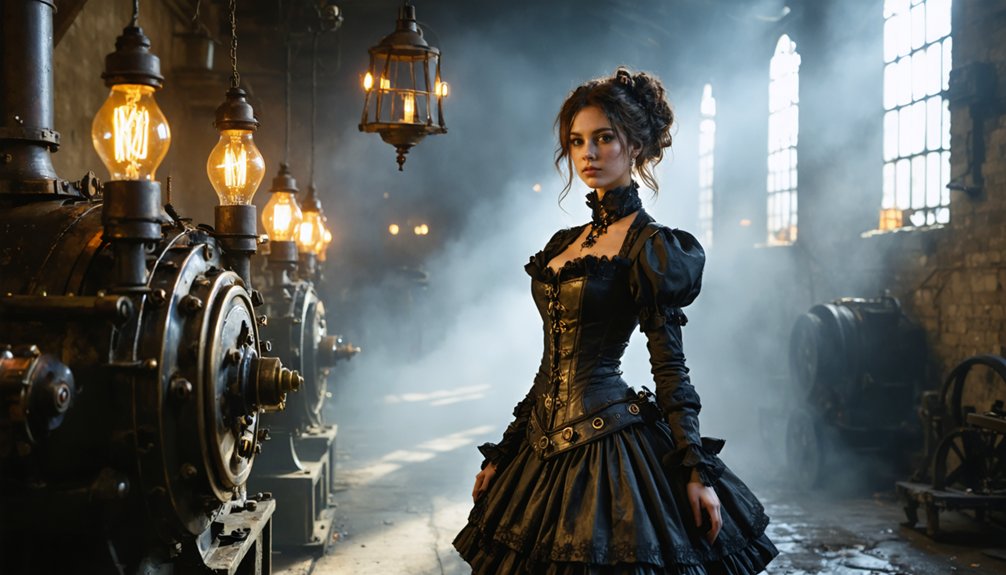
The Victorian era‘s peculiar marriage of romanticism and industrialization birthed an aesthetic paradox that continues to captivate modern fashion sensibilities. You’ll find steampunk and gothic outfits leveraging this cultural tension through deliberate historical re-imagination, transforming 1860s silhouettes and Industrial Revolution machinery into wearable art.
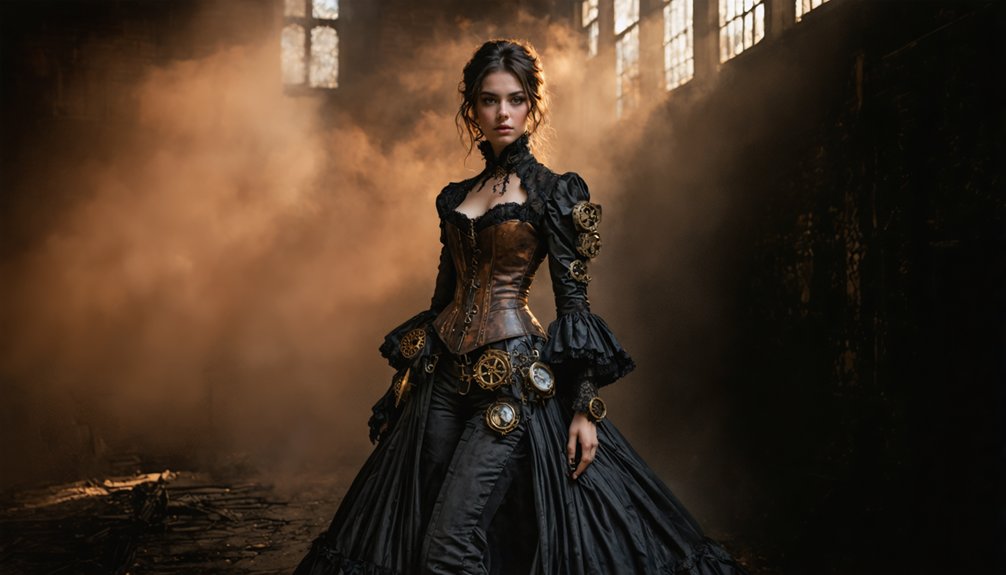
The stylistic adaptability inherent in these genres allows you to merge H.G. Wells-inspired fantasy with authentic Victorian mourning attire, creating ensembles that honor period accuracy while embracing speculative innovation. Corsets, brass gears, and dramatic black textiles become tools for your creative expression—each piece reflecting both gothic literature’s morbid romanticism and steam-powered invention’s mechanical optimism.
This fusion transcends costume, offering you sophisticated fashion that reinterprets 19th-century aesthetics through contemporary design sensibilities.
Express Your Individuality Through Distinctive Dark Aesthetics
While mainstream fashion cycles through seasonal trends dictated by corporate conglomerates, dark aesthetics emerged in late 1970s Britain as punk’s philosophical descendant—a deliberate rejection of disco’s commercial optimism and mass-market conformity.
Dark aesthetics: punk’s brooding heir, born from rebellion against disco’s glitter and the suffocating grip of corporate fashion uniformity.
You’re choosing to articulate emotional complexity through Victorian-influenced imagery of death and decadence, establishing a nonconformist outlook that persists across decades and generations.
Your distinctive expression manifests through:
- Silver occult jewelry contrasting against pale skin and deathly makeup palettes
- Velvet corsets with scarlet accents paired with precarious stilettos for dramatic statements
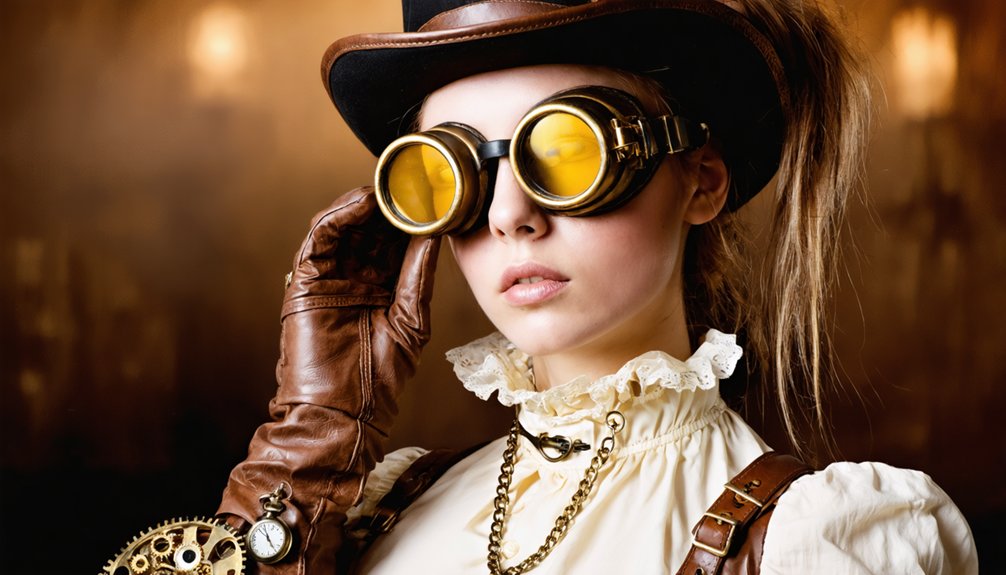
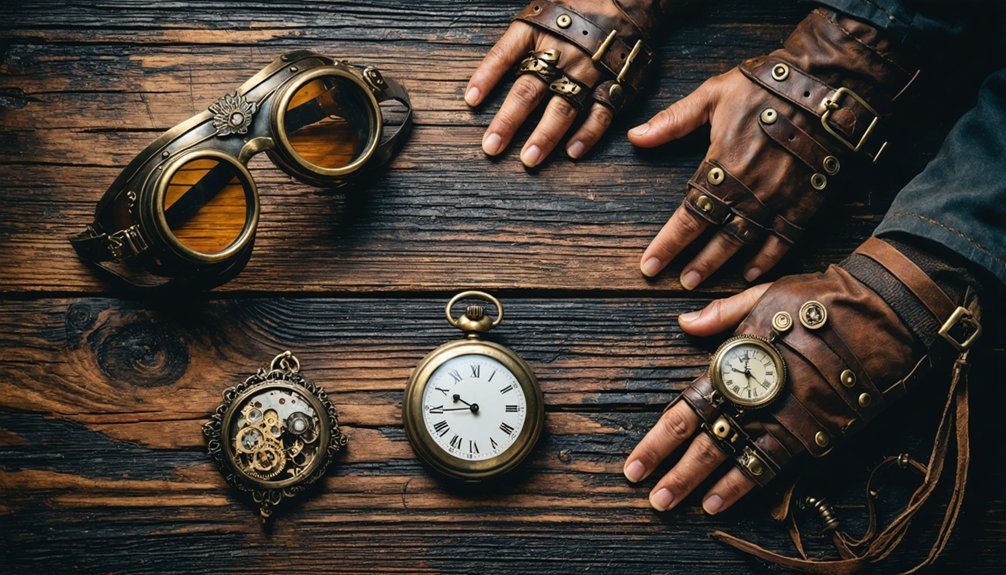
- Steamgoth’s brass goggles and sepia-toned top hats merging historical anachronism
- Flowing lace dresses revealing stockings through garter suspenders
- Aristocrat goth’s romantic elements inspiring designers like McQueen and Westwood
This malleability allows you to absorb progressive influences while maintaining coherent aesthetic identity—passionate, macabre, and resolutely individual.
Versatile Wardrobe Options for Multiple Subculture Styles
Because subcultural dress operates as semiotic resistance rather than superficial decoration, your wardrobe becomes a strategic arsenal of interchangeable signifiers that traverse gothic, steampunk, and cyberpunk territories without compromising ideological coherence.
Versatile layering techniques enable you to merge Victorian corsets with tactical vests, creating hybrid aesthetics that challenge mainstream fashion hegemony. You’ll employ sustainable material choices like repurposed leather, distressed denim, and vintage brocade to construct multi-functional ensembles.
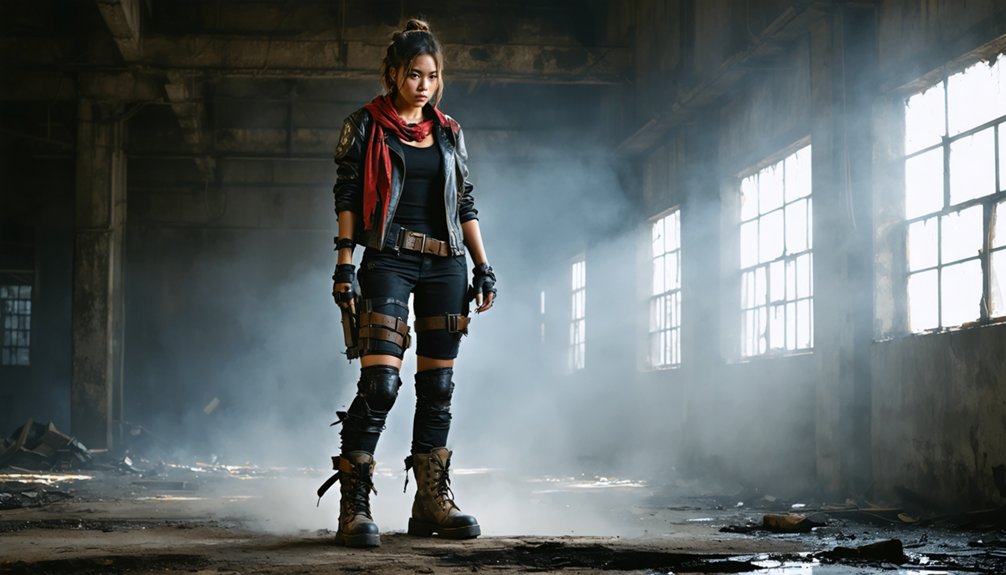
Earth tones shift into neon-accented cyber goth configurations, while brass-detailed accessories code-switch between steampunk romanticism and industrial punk militarism. Your fishnet bodysuits layer beneath reflective fabrics, establishing Nu Goth silhouettes that reference both post-punk rebellion and digital-age innovation.
This modular approach transforms singular garments into adaptable cultural statements, maximizing wardrobe functionality while maintaining subcultural authenticity across evolving aesthetic movements.
Rich Cultural Heritage Rooted in Literature and Music
Beyond material assemblage and aesthetic layering, these subcultural movements derive their philosophical legitimacy from specific literary and musical genealogies that transformed countercultural impulses into codified identity systems. H.G. Wells and Jules Verne established Steampunk’s speculative foundation, while Bauhaus’ “Bela Lugosi’s Dead” initiated Gothic music’s dark resurrection.
These cultural movements’ sociopolitical influences emerged through Joy Division’s melancholic resistance and Cherie Priest’s alternate histories, creating frameworks for subversive self-representation through costume.
Foundational Cultural Touchstones:
- Siouxsie Sioux’s dramatic silhouettes crystallizing post-punk theatrical defiance
- Victorian mourning attire reimagined as anti-establishment armor
- Steam-powered narratives challenging industrial capitalism’s electric future
- Robert Smith’s smeared makeup dissolving gender boundaries
- Artisanal “steamsonas” performing political critique through performative cyborgs
These genealogies legitimize contemporary fashion choices as intellectual inheritances rather than superficial appropriations.
Handcrafted Quality Meets Modern Fashion Accessibility
The democratization of Gothic and Steampunk fashion has upended traditional craft economies, transforming artisan-driven subcultures into hybrid marketplaces where handmade authenticity coexists with mass-market reproduction.
Artisan-driven subcultures now inhabit hybrid marketplaces where handmade authenticity merges seamlessly with mass-market accessibility and reproduction.
You’re witnessing ethical handcrafting scale from Etsy studios to H&M’s 2026 collections, where Victorian-era techniques meet industrial efficiency.
Small batch manufacturing now bridges the $1.4 billion U.S. Gothic sector and the 14.80% CAGR global steampunk market, creating unprecedented accessibility.
Independent designers leverage digital platforms to reach audiences previously confined to subcultural enclaves, while sustainable materials—recycled denim, vegan leather—reinforce craft integrity amid expansion.
This synthesis enables you to access museum-quality corsetry and hand-embellished military details without exclusivity barriers, as Gen Z’s demand for authenticity propels artisan methods into mainstream fashion infrastructure, fundamentally restructuring production hierarchies.
Stand Out With Dramatic Visual Impact and Artistic Expression
When Victorian mourning rituals collided with punk’s defiant aesthetics in late 1970s Britain, they generated a visual vocabulary designed to unsettle bourgeois sensibilities through deliberate corporeal theater. You curate personal narrative through stark eyeliner contrasting pallid complexions, transforming melancholy into wearable philosophy.
Towering backcombed hairstyles with neon extensions evoke powerful moods that reject conventional beauty standards.
Your assembled aesthetic operates as visual rhetoric:
- Lace gloves layered over leather harnesses create temporal dissonance
- Silver skull motifs and cross pendants signal memento mori consciousness
- Top hats affixed with brass goggles suggest mechanical evolution
- Chain jewelry punctuating black velvet invokes decadent mystique
- Colossal platform boots with metallic finishes declare posthuman identity
This malleability absorbs influences—from Blade Runner’s dystopian urbanism to Victorian brocade—into coherent expression that communicates resilience through calculated visual disruption.
Frequently Asked Questions
What Makeup Techniques Best Complement Steampunk and Gothic Outfits?
You’ll master these aesthetics through bold eye makeup featuring heavy kohl liner and smoky shadows, paired with dark lip colors. This Victorian-Gothic fusion creates dramatic contrast, reflecting counter-cultural movements that challenged conventional beauty paradigms through subversive visual expression.
How Do I Care for and Maintain Victorian-Style Corsets and Garments?
Remarkably, Victorian-era preservation parallels modern conservation science. You’ll maintain corsets through proper storage techniques—avoiding humidity and sunlight—while employing fabric preservation methods like gentle hand-washing, strategic spot-cleaning, and controlled air-drying to prevent steel boning deterioration.
Are Steampunk and Gothic Outfits Appropriate for Workplace or Formal Events?
Workplace appropriateness depends on your organization’s cultural evolution toward alternative aesthetics. You’ll find formal event suitability increases when incorporating subtle Victorian elements rather than overt subcultural markers, balancing individual expression with professional expectations strategically.
Where Can I Find Affordable Authentic Steampunk and Gothic Clothing Pieces?
You’ll discover affordable authentic pieces through vintage thrift stores, where Victorian-era garments await repurposing, and local cosplay conventions featuring independent artisans. Online retailers like VampireFreaks and DarkCottage offer ethically-sourced alternatives that honor subcultural aesthetics authentically.
Can I Mix Steampunk and Gothic Styles or Should They Stay Separate?
You’ll unveil infinite possibilities mixing these aesthetics! Steampunk Goth represents a legitimate subcultural hybrid where creative color combinations—bronze meeting obsidian—and experimental accessorizing with gears and lace demonstrate postmodern bricolage. This fusion embodies transgressive sartorial innovation.