Edwardian suffragettes wore protest attire to transform their bodies into walking political billboards that communicated commitment across class and literacy barriers. You’ll find they strategically chose white dresses to symbolize purity and create dramatic visual impact in demonstrations, while purple, white, and green accessories functioned as instantly recognizable movement markers. Their fashionable femininity served as tactical armor against critics who dismissed activists as unfeminine, yet their clothing concealed practical modifications—muffs hid hammers, specially sewn pockets carried stones, and looser silhouettes facilitated militant actions that would reshape women’s political power.
Key Takeaways
- White dresses and color-coded accessories created visual unity and political identity while projecting respectability across class boundaries.
- Strategic fashion choices weaponized femininity to disarm critics and prevent authorities from dismissing activists as unfeminine radicals.
- Hidden pockets and loose garments concealed protest tools like hammers and stones for militant window-smashing campaigns.
- Purple, white, and green uniforms transformed demonstrations into dramatic visual spectacles that photographed powerfully and transcended literacy barriers.
- Historical costumes like Joan of Arc imagery legitimized radical actions by connecting suffragette imprisonment to revered martyrs.
The Strategic Power of White: Purity, Visibility, and Solidarity
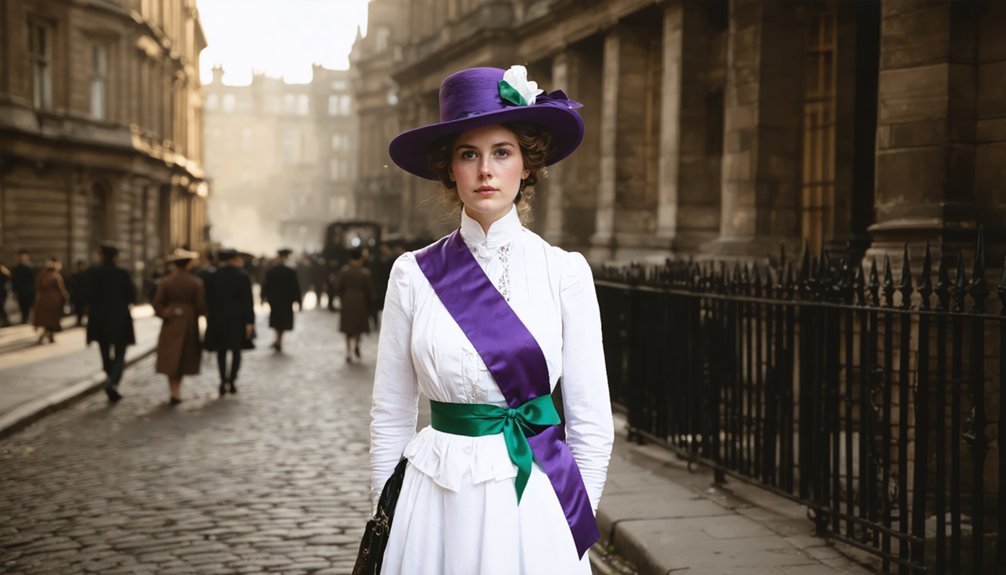
When the Women’s Social and Political Union (WSPU) adopted its tricolor scheme of purple, white, and green in 1908, white emerged as the most tactically significant element of suffragette protest dress.
You’ll find that white served three strategic functions simultaneously. It symbolized purity and virtuous femininity, countering anti-suffragette caricatures depicting activists as unfeminine. During the 1908 Hyde Park demonstration with 250,000 attendees, massed white attire created dramatic visual impact visible from considerable distances.
The color fostered cohesive aesthetics across class boundaries—white Edwardian dresses were popular everyday wear, enabling inclusive fashion participation without financial barriers. This accessibility allowed working-class and upper-class women alike to present unified resistance. White items already inhabited most wardrobes, transforming ordinary blouses into political uniforms that projected respectability while concealing militant intentions.
Color-Coded Commitment: Sashes and Accessories as Political Statements
Beyond the foundational white garments that unified suffragette demonstrations, colored accessories transformed individual participants into walking billboards for the movement’s strategic branded emblem marketing. You’d immediately recognize fellow activists through their striped sashes in purple, white, and green—worn prominently at protests like the 1909 Knightsbridge event where Emmeline Pankhurst led demonstrators.
Colored sashes and accessories transformed suffragettes into walking advertisements, creating instant visual recognition among activists at demonstrations.
These color-coded accessories created uniting through uniform display while generating campaign funds:
- Jewelry featuring movement colors: Amethyst, pearl, and emerald pieces allowed subtle everyday support
- Group-specific badges: NUWSS distinguished itself with ruby, white, and green to signal non-militant tactics
- Extended accessories: Stockings, ribbons, hat pins, and scarves transformed entire outfits into political statements
The WSPU’s 1908 adoption of purple (dignity), white (purity), and green (hope) aligned perfectly with “Give Women Votes”—creating accessible visual shorthand that transcended literacy barriers.
Fashionable Femininity as Tactical Armor Against Critics
The suffragettes’ strategic embrace of Edwardian fashion standards created what historians now recognize as “respectability armor”—a deliberate visual defense against critics who’d dismiss them as unfeminine radicals.
You’ll find they weaponized sophisticated femininity during window-breaking campaigns and picketing, deliberately pairing militant tactics with conventional glamour. When Leonora Cohen attended the Leeds Arts Club Ball in her turquoise rayon dress adorned with WSPU shields, she embodied this tactical contradiction.
Movement leaders encouraged wearing their “smartest clothes” to marches, prioritizing high-fashion spending over affordability to safeguard the cause’s credibility.
White Edwardian Tea Dresses—ironically adopted for their less restrictive fit—became accessible uniforms that signaled political commitment while maintaining mainstream acceptability. This calculated conformity guaranteed authorities and media couldn’t easily dismiss suffragettes as societal outcasts.
Hidden in Plain Sight: Practical Adaptations for Militant Action
How did suffragettes transform everyday Edwardian fashion into practical tools for militant action? You’ll find their genius lay in concealment features embedded within respectable attire. Muffs hid hammers for window-smashing campaigns, while specially sewn pockets inside skirts carried stones undetected. Long cloth ulsters provided cover for protest tools without suspicious bags.
Mobility enhancement proved equally critical:
- Looser 1910s silhouettes abandoned restrictive corsets, enabling fluid movement during demonstrations
- Shorter sleeves and practical hemlines facilitated radical physical actions at events
- Tea dresses with freeing fits allowed elegant appearances while maintaining freedom for militant tactics
White blouses offered plausible deniability—you could assemble protest uniforms instantly. Subtle jewelry and accessories in suffragette colors created universal signals without immediate detection, proving that strategic fashion design enabled both stealth and solidarity.
Pageantry and Parades: Mass Demonstrations Through Coordinated Dress
While individual suffragettes concealed their militant tools beneath respectable clothing, collective action demanded visibility, not stealth. The WSPU’s June 1908 Hyde Park pageant drew 250,000 spectators, with women’s white dresses creating dramatic visual unity against black-and-grey photography. You’d see Emmeline Pethick-Lawrence herself wearing white to model this spectacle.
The movement treated parade participants as “units in a great whole, marching eyes front like soldiers”—civilian soldiery advancing a political cause. Seven hundred purple, white, and green banners required matching dress colours for maximum impact. *Votes for Women* urged white or cream tussore with purple or green accents, while hand-embroidered stockings displayed suffragette mottos at ankle height.
This coordinated pageantry transformed demonstrations into unforgettable visual statements that subverted critics’ claims about unwomanly activists.
From Prison Garb to Medieval Costumes: Symbolic and Militant Fashion Choices
You’ll find suffragettes transformed their imprisonment from shame into visual propaganda by photographing themselves in coarse prison garb marked with broad arrows—the British criminal identifier—outside Holloway’s walls where cameras were banned inside.
Upon release, they wore the Holloway Prison brooch and hunger-strike medals as military decorations, converting the symbols of their persecution into badges of political valor. This deliberate inversion of criminal stigma reached its height when women donned replica prison costumes at public events and medieval-inspired dress featuring imprisoned figures, claiming martyrdom through costume that positioned their cause within centuries of resistance against tyranny.
Prison Uniforms as Protest
From 1909 onward, incarcerated suffragettes transformed their coarse prison uniforms—marked with the government’s broad arrow—into powerful protest symbols that extended far beyond Holloway’s walls. This uniform reclamation strategy deliberately showcased the contrast between refined elite women and degrading convict dress, forcing public confrontation with state violence.
You’d witness protest attire transformation through multiple channels:
- Released prisoners parading through streets in open carriages, wearing actual prison garb to advertise upcoming meetings
- Non-imprisoned members donning replica uniforms at by-elections and bazaars, creating visual solidarity with incarcerated comrades
- Embroidered panels stitched covertly in cells using smuggled purple and green silk, documenting wing numbers and sentences as textile evidence
The WSPU commissioned prison-themed dolls, brooches, and badges from 1909, converting criminalized imagery into fundraising propaganda that visually demonstrated disenfranchisement’s brutal reality.
Medieval Imagery and Martyrdom
Beyond the stark reality of prison uniforms, suffragettes drew inspiration from centuries past, adopting medieval imagery that recast their struggle as epic historical drama. Joan of Arc became your movement’s most potent symbol—her image appeared on banners, pins, and procession costumes, creating symbolic resonance between her fifteenth-century martyrdom and suffragette sacrifice.
When Emily Wilding Davison died at the 1913 Epsom Derby, Elsie Howey rode in full Joan of Arc costume at her funeral, while thousands formed an honor guard. This historical appropriation wasn’t mere pageantry; you deliberately connected contemporary militancy to celebrated medieval heroism. Banners stitched with Joan’s words “I was a prisoner” paralleled your own imprisonment, transforming suffragette resistance into legendary narrative that legitimized radical action through revered historical precedent.
Frequently Asked Questions
How Did Working-Class Suffragettes Afford White Clothing for Protests?
You’d find white blouses already hanging in your wardrobe, as they were everyday wear. Working-class suffragettes accessed affordable fabric sources like cotton voile, second-hand clothing options, and community support networks that customized existing garments for protests.
Did Suffragettes Face Legal Consequences for Their Clothing Choices?
You’ll find no legal punishments for suffragettes’ clothing choices themselves. Arrests stemmed from militant actions—window smashing, stone throwing—not attire. However, authorities imposed clothing restrictions through forced prison uniforms, which suffragettes later wore publicly to expose institutional abuse.
What Happened to Suffrage Clothing After the Movement Succeeded?
Fashionable freedom followed victory: You’ll find donated clothing reused through secondhand clothing markets, while preserved pieces like Cohen’s turquoise dress became museum artifacts. Symbolic colors persisted in protests, and practical styles—bloomers, loose silhouettes—transitioned into mainstream everyday wear.
How Did Male Supporters Participate in Suffragette Dress Codes?
You’ll find male allies demonstrated sartorial solidarity by wearing suffragette colors—purple, white, green—through sashes and badges at protests. They maintained respectable dark suits while incorporating WSPU branding, creating visual unity without adopting feminine dress codes.
Were There Regional Differences in Suffragette Fashion Across Countries?
You’ll find distinctive sartorial statements varied greatly: Welsh suffragettes wore traditional costume in 1911 processions, while American groups incorporated regional fashion trends like Kansas’s gold sunflower symbolism, demonstrating how local contexts shaped protest dress strategies.