Contest-winning video game cosplayers excel by mastering standardized judging systems that allocate 40 points to costume quality, 40 to source accuracy, 20 to technical complexity, and 50 to performance execution. You’ll need meticulous fabric sourcing, precision prop construction, and choreographed stage presence that authentically captures your character’s essence. Winners strategically select recognizable franchises like League of Legends or Overwatch, showcase advanced fabrication techniques including 3D printing and weathering, and document their craftsmanship processes throughout competition circuits to maximize scores across all evaluation categories.
Key Takeaways
- Winning cosplayers achieve screen-accurate recreations through meticulous fabric sourcing, precise prop construction, and attention to authentic material weights and textures.
- Competition scoring allocates 40 points each to costume quality and accuracy, with 20 points for technique complexity and 50 for performance.
- Selecting recognizable characters from mainstream franchises like League of Legends or Overwatch ensures instant audience connection and judge familiarity.
- Technical mastery of advanced fabrication methods including EVA foam manipulation, 3D printing, electronics integration, and multi-layered painting demonstrates superior craftsmanship.
- Successful competitors strategically match their strengths to competition formats, choosing craftsmanship-only or performance categories based on their specialized skills.
Mastering the Art of Costume Accuracy and Detail
When judges evaluate cosplay competitions, they examine screen accuracy as the foundational criterion—a one-to-one recreation that matches the exact source material down to specific colors, fabric types, and recognizable elements that fans immediately identify. You’ll need meticulous fabric sourcing to replicate authentic material weights and textures, ensuring proper drapery and light interaction through Physically Based Rendering principles.
Your prop construction must follow original designs precisely, incorporating every pleat, button, zipper, and distinctive marking. Craftsmanship contests demand higher accuracy standards for canon characters, requiring you to scan real-world materials for superior mesh quality and layered modeling that captures thickness variations. Judges prioritize complete construction techniques—sculpting non-human elements in ZBrush, retopologizing for clean topology, and aligning inside-outside elements to prevent intersections while maintaining all-encompassing accessory integration.
Understanding Competition Judging Criteria and Point Systems
Judges score cosplay competitions using standardized point systems that convert your craftsmanship, accuracy, and performance into quantifiable metrics. Costume quality commands 40 points, evaluating clean seams, precise painting, and proper fit. Accuracy receives another 40 points through direct comparison to source artwork, where identical recreation earns full marks.
Technique assessment allocates 20 points based on skill variety and complexity—challenging methods like armor fabrication outweigh basic sewing. Performance captures 50 points, measuring story conveyance, choreography, and entertainment value during your stage presentation. The remaining 10 points reward X-factor elements: innovative approaches that exceed expectations.
Success requires balancing craftsmanship excellence with originality—whether you’re recreating characters faithfully or creating mashups. Understanding this 100-point breakdown lets you strategically allocate effort where judges assign maximum value, transforming creative passion into competitive advantage.
Bringing Characters to Life Through Performance and Presence
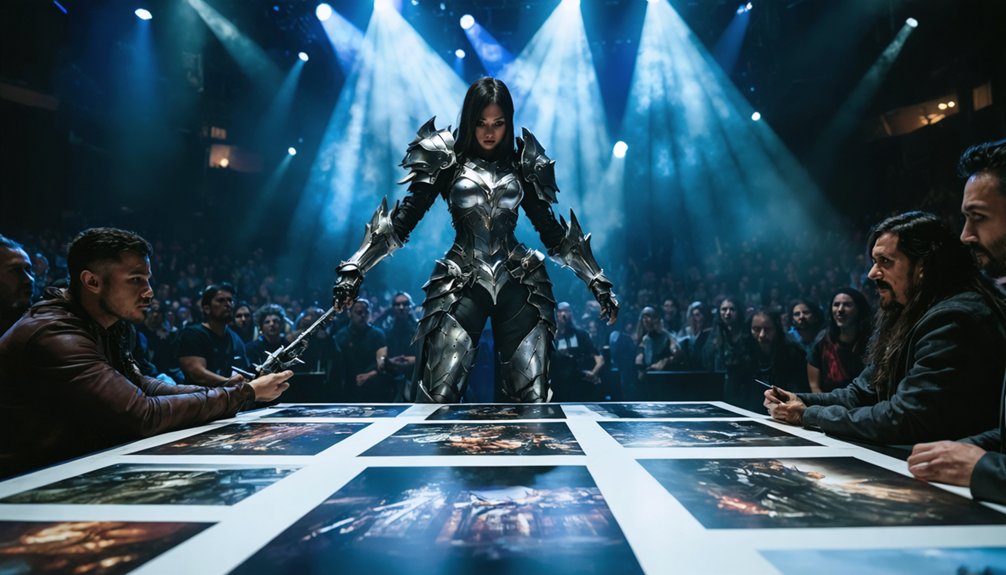
Your stage performance transforms technical craftsmanship into competitive advantage by converting static costume work into dynamic character embodiment. Judges reward performers who demonstrate authentic stage presence through deliberate movement choices—exaggerated gestures for back-row visibility, strategic positioning at 45-degree angles during dialogue, and full venue utilization that mirrors professional entertainers.
Character embodiment extends beyond appearance into behavioral consistency, maintaining immersion from stage entry through exit.
Winning performances incorporate:
- Choreographed sequences synchronized to audio cues, eliminating awkward pauses through distance calibration and extensive rehearsal
- Mobility-optimized costume designs that enable fluid combat choreography without restricting movement
- Iconic character poses adapted with natural shifts, creating visual impact through dramatic arm extensions and widened stances
- Improvisation skills for seamless error recovery, maintaining character authenticity when cues misfire or lines disappear
Creating Show-Stopping Props and Accessories
The difference between competent and championship-level cosplay often materializes in prop construction quality, where judges scrutinize structural integrity, visual accuracy, and finishing techniques that separate amateur builds from professional-grade reproductions.
You’ll achieve winning results by selecting medium-density EVA foam reinforced with threaded rods or PVC cores, creating durability without sacrificing transportability. Material cost considerations demand strategic sourcing—bulk foam purchases and reusable patterns maximize budget efficiency.
Execute precision beveling at 45-degree angles, heat-seal surfaces thoroughly, and apply 3-4 primer coats before layering metallics with strategic weathering. Implement detailed texturing using Dremel engraving tools that replicate battle-worn authenticity judges reward.
Championship props require prop storage solutions accounting for disassembly mechanisms and protective padding, ensuring your investment survives convention transport while maintaining competition-ready presentation standards throughout judging circuits.
Staying True to Source Material and Character Essence
While structural craftsmanship establishes your technical credentials, source material fidelity determines whether you’ll advance past preliminary rounds in competitive cosplay judging.
Accuracy represents 40% of your total competition score, requiring direct comparison between your costume and original artwork. Judges evaluate craftsmanship consistency through seam precision and construction cleanliness, but they’re simultaneously measuring character portrayal depth—how authentically you’ve translated design elements into wearable reality.
Your interpretation must balance exactness with innovation:
- Movement fidelity: Costume flow and behavior must mirror the character’s original design dynamics during stage performance
- Design spirit preservation: Unknown elements permit creative discretion if overall character essence remains intact
- Performance intensity: Your stage presence should demonstrate profound admiration for source material
- Visual alignment: First impression values depend on authentic character recognition by judges
Leveraging Creativity Within Established Game Universes
Perfect accuracy alone won’t secure victory when judges encounter dozens of meticulously crafted interpretations of the same character. You’ll differentiate yourself by adding personal elements while maintaining authentic character representation—gender-bending a protagonist, creating fantasy race transformations, or designing alternative timeline versions that respect source material.
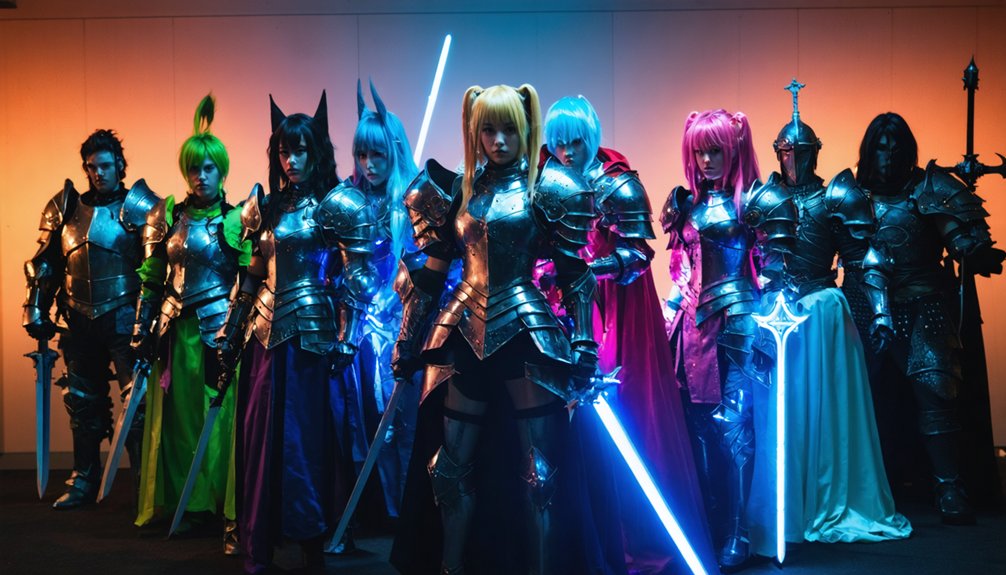
Collaborative group efforts elevate your standing through entourage cosplay, where you transform entire game scenes with environmental props and coordinated character groups.
You’re showcasing innovation when you integrate distinctive backstory elements judges haven’t seen before, carve custom linoleum stamps for unique fabric patterns, or incorporate cultural awareness into diverse character recreations.
Strategic creativity demonstrates both technical mastery and artistic vision, proving you understand the universe deeply enough to expand it authentically.
Choosing the Right Character and Game for Competition
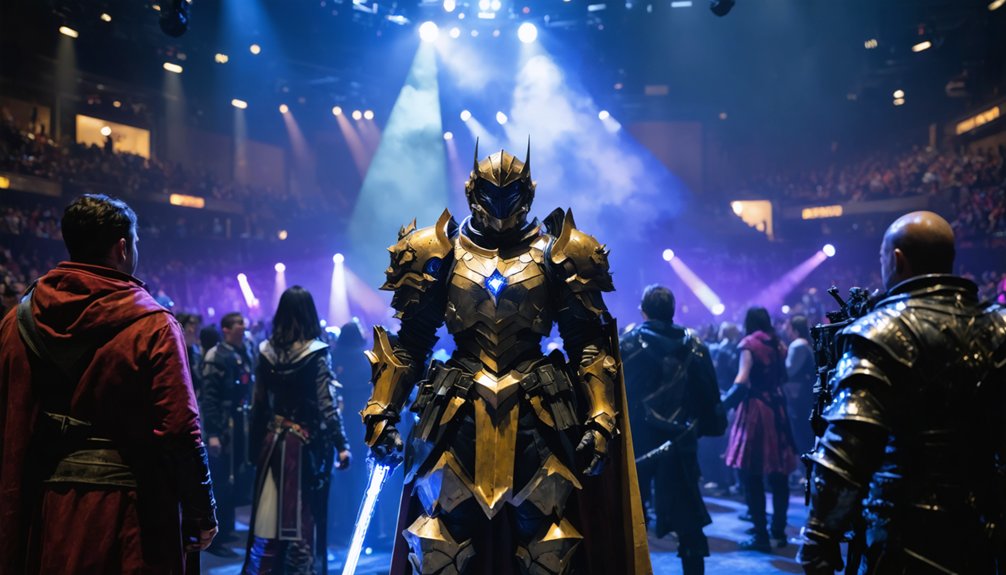
Your character selection directly influences your competition outcomes through three interconnected factors: franchise visibility, construction complexity, and audience recognition.
When you choose characters from established game universes like *The Legend of Zelda* or *Final Fantasy*, you’re accessing built-in audience familiarity while gaining clear reference materials for accurate replication.
You’ll maximize your competitive advantage by selecting characters that balance impressive technical construction opportunities with instant visual recognition—judges reward craftsmanship complexity, but audiences and preliminary rounds respond to characters they immediately identify.
Popular Franchises Draw Attention
When judges scan crowded competition halls, characters from high-visibility franchises immediately command attention through instant recognizability. You’ll gain strategic advantages selecting from properties with extensive character rosters like Genshin Impact or League of Legends, which offer diverse aesthetic directions while maintaining brand recognition.
Franchises with crossover media exposure—such as Arcane’s Netflix adaptation boosting League characters or Harley Quinn’s 758,449 hashtags spanning multiple game titles—create broader audience connections that resonate with judges.
Consider these data-driven franchise leaders:
- League of Legends holds the Guinness record with 50,265 documented cosplays
- Overwatch’s D.Va dominates with 223,046 hashtag mentions
- NieR Automata’s 2B sustains convention presence with 119,787 tags
- Tomb Raider’s Lara Croft maintains relevance across 76,839 posts since 1996
Strategic franchise selection amplifies your competitive positioning through established cultural cachet.
Costume Complexity Impresses Judges
Brand recognition opens doors, but judges award trophies based on technical execution. You’ll maximize your scoring potential when selecting characters with intricate armor, mechanical components, or layered elements that showcase advanced fabrication skills. The judging matrix allocates 40 points each for precision and material quality, with 20 points evaluating technique complexity.
Characters requiring specialized construction methods—3D printing, EVA foam sculpting, electronics integration—create opportunities to demonstrate challenging skills that elevate difficulty scores. Your design execution must include clean seams, flawless paint application, and structurally sound props meeting competition standards. Judges reward costumes utilizing multiple advanced techniques over simplified approaches.
Select characters with detailed texturing, color-blocking, and mechanical features. These technical requirements naturally align with scoring criteria prioritizing construction complexity and craftsmanship variety.
Character Recognition Matters Most
While construction mastery demonstrates technical prowess, character selection determines whether judges can properly evaluate your work. Recognition forms the foundation of all scoring categories—from accuracy assessment to stage presence evaluation. Your craftsmanship remains invisible if judges can’t identify your character, resulting in zero points for accuracy criteria. This creates an inherent bias toward popular franchises where visual design is universally recognized.
Strategic character selection maximizes competitive advantage:
- Choose iconic video game characters that judges instantly recognize, eliminating confusion during evaluation
- Select mainstream titles with established visual references that facilitate accurate comparison scoring
- Prioritize characters with distinctive features that translate clearly from audience distance during stage performance
- Avoid obscure source material that forces character reliance on verbal explanation rather than visual impact
Competition success depends on selecting characters that judges can confidently score against established criteria.
Adapting to Different Competition Formats and Requirements
You’ll encounter vastly different evaluation systems depending on whether you’re competing in a craftsmanship-focused pre-judging event or a performance-based stage presentation. Each format weighs specific criteria differently—some competitions allocate 60% of your score to stage presence while others prioritize construction techniques like foam work and wig styling during close-up material inspection.
Understanding these distinctions before you commit to a contest determines whether you should invest more hours perfecting your armor’s weathering or rehearsing your 90-second skit within the strict time limits.
Understanding Contest Judging Criteria
Competition formats vary considerably across conventions, and each assigns different weight to specific evaluation categories. Mastering costume judging rubrics means understanding that craftsmanship typically accounts for 40 points, accuracy another 40, technique 20, and performance 50 in many systems. Traversing competition scoring systems requires analyzing how judges distribute points across categories.
Key judging components you’ll encounter:
- Craftsmanship evaluation examines seam quality, assembly precision, and build complexity through pre-judging interviews
- Accuracy scoring compares your recreation directly to source material, awarding full points for identical matches
- Technique assessment prioritizes quality over quantity, valuing challenging skills like transformations
- Performance metrics measure stage presence, choreography effectiveness, and entertainment value within 60-second presentations
Strategic competitors study specific rubrics beforehand, identifying which categories offer maximum point potential for their strengths.
Video Versus Live Formats
Before submitting your application, you must identify whether the convention operates as a live stage masquerade or a craftsmanship-focused contest, since this distinction fundamentally reshapes your competitive approach. Performance-heavy formats like Anime NYC’s masquerades demand custom music preparation and choreographed execution within strict time limits—90 seconds for solos, extending to three minutes for groups of six-plus.
Conversely, craftsmanship-focused events like Awesome Con eliminate live stage performance entirely, concentrating judges’ attention on construction techniques and detail accuracy. You’ll encounter hybrid models at conventions like Naka-Kon, where runway presentation and skit components receive separate evaluation alongside craftsmanship judging.
Strategic competitors select entry types matching their technical strengths: armor fabricators thrive in Craftsmanship Only categories, while performers excel using Performance Only options that bypass craftsmanship evaluation altogether, requiring zero percent costume fabrication.
Learning From Past Winners and Championship Strategies
Championship data reveals clear patterns that separate winners from participants. You’ll notice Italy, Brazil, and Japan each secured three victories by mastering specific elements: meticulous character accuracy, theatrical performance delivery, and crafting multimedia presentations that document every construction phase. Winners like Elffi Cosplay and Calssara achieved game-extraction realism through strategic material selection and engineering. Their Biggs and Jessie portrayal demonstrated how showcasing cosplay process—from foam sculpting to weathering techniques—builds credibility with judges.
Winning strategies include:
- Combining 10-point performance scores with maximized 15-point costume ratings
- Engineering props like Hi-Rez Expo’s praised spear with documented craftsmanship
- Maintaining character consistency throughout video submissions
- Leveraging fidelity scoring through story-accurate scene recreations
You’re competing against entries from 30 countries where jury panels expect innovation alongside authenticity.
Frequently Asked Questions
How Much Does It Typically Cost to Create a Competition-Winning Cosplay?
You’ll invest $500-$2,000 in material costs for competition-grade cosplays, but skill development substantially impacts your total investment. Factor in 15+ hours weekly over four months, doubling your actual costs when valuing construction expertise that judges prioritize.
How Long Should Competitors Spend Practicing Their Performance Before Competing?
You’ll need 2-4 weeks of practice, adjusting based on your skill level progression. Implement time management strategies by scheduling daily 15-30 minute sessions for poses, walk-throughs, and pre-judging speeches to guarantee polished, competition-ready performances.
Can Beginner Cosplayers Realistically Win Major Competitions Against Experienced Participants?
You’ll struggle winning major competitions as a beginner since judges prioritize quality of materials and attention to detail that experienced cosplayers master through years of practice, advanced techniques like 3D printing, and refined performance skills.
Do Judges Prefer Newer Game Releases or Classic Characters?
Judges don’t prioritize release dates—they’ll evaluate your costume design influences and craftsmanship equally whether you’re portraying retro or modern characters. Character popularity factors matter less than accuracy, technique quality, and stage performance proficiency you demonstrate.
Should Cosplayers Enter Solo or as Teams for Better Chances?
you’ll maximize winning potential by choosing whichever format best showcases your strengths. Solo entries excel through intricate costume composition, while team entries dominate via dynamic presentation delivery and coordinated performance complexity.