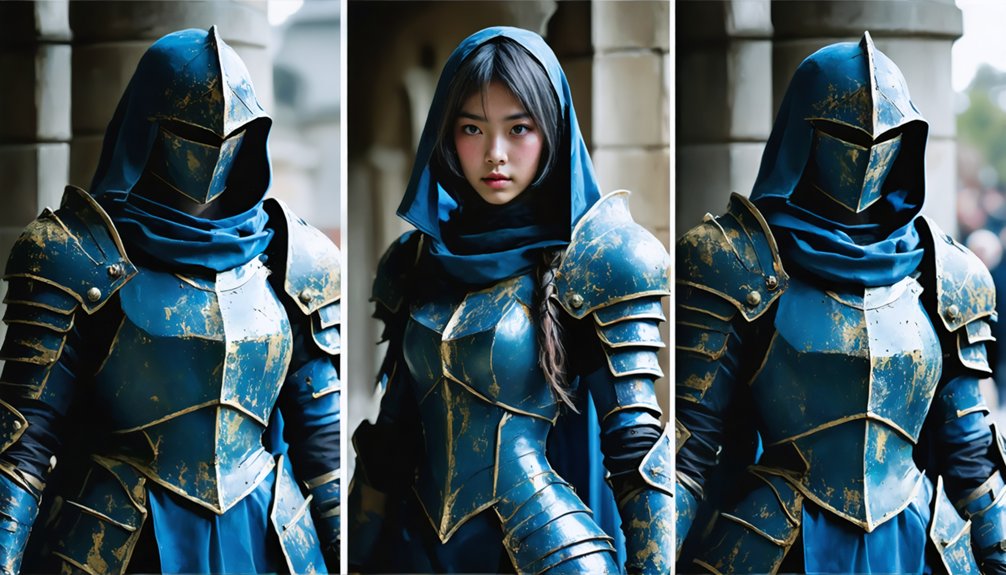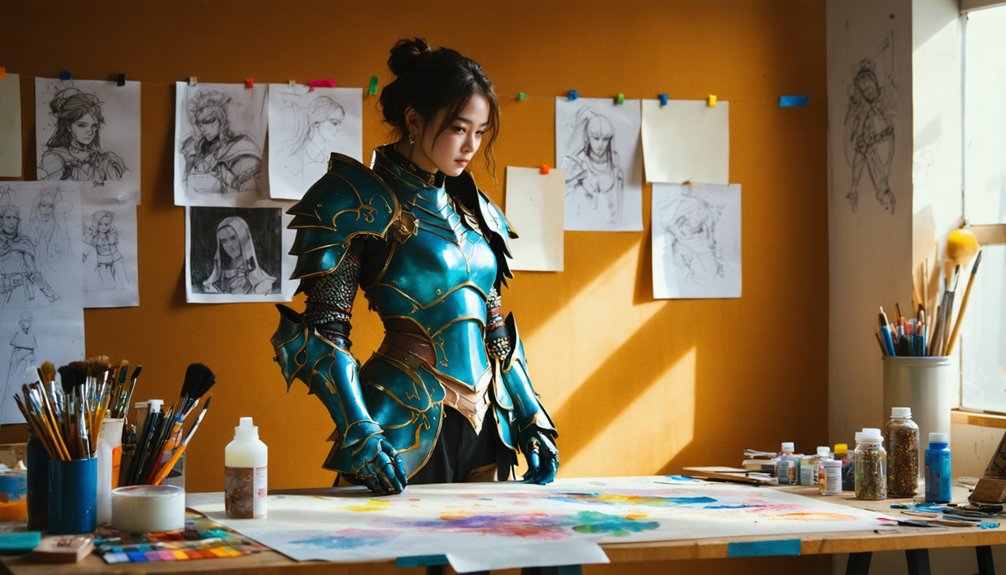
Balancing accuracy and creativity in cosplay means protecting a character’s core visual traits—color palette, silhouette, iconic accessories, and distinctive patterns—while strategically expressing your craftsmanship in secondary elements. You must first research official references thoroughly, cross-referencing multiple sources to confirm canonical details before making any interpretive decisions. Creative modifications like weathering, embellishments, and material upgrades work best when they reinforce rather than contradict the established visual language. The sections ahead break down exactly where that line falls.
Key Takeaways
- Preserve core visual traits—color palette, silhouette, and iconic accessories—to maintain character recognizability while exploring creative modifications elsewhere.
- Research official references thoroughly to distinguish essential canonical details from peripheral elements open to creative interpretation.
- Channel creativity into secondary elements like custom accessories, weathering, and embellishments without disrupting the established visual language.
- Select fabrics that match character archetypes in sheen and texture, ensuring structural integrity supports both aesthetics and wearability.
- Judges reward costumes that demonstrate technical precision and artistic flair simultaneously, so document deliberate construction choices clearly.
The Line Between Faithful Cosplay and Creative Interpretation

Although accuracy and creativity are sometimes treated as opposing forces in cosplay, they function most effectively as complementary elements within a single cohesive design. You don’t have to choose between honoring source material and expressing your own vision.
Faithful replication of color, silhouette, and character-specific details preserves recognizability, while deliberate creative interpretation adds distinction.
When selecting materials, consider how fabric texture communicates a character’s visual identity — a matte weave reads differently than a structured brocade, even at a distance.
Costume durability becomes equally critical when you’re modifying designs, since structural integrity supports both aesthetic and practical goals.
The strongest approach treats the source design as a framework rather than a restriction, allowing you to innovate purposefully without erasing the character’s core visual identity.
Research Your Character Before Making Any Creative Calls
Before you make a single creative decision, gather official reference materials—concept art, screen captures, and production photography—so your interpretations rest on documented visual evidence rather than memory or assumption.
Study your character’s personality, backstory, and narrative role, since these elements justify specific design choices and keep creative departures internally consistent.
Then isolate the signature visual traits—silhouette, color palette, recurring accessories—that define recognizability, because protecting these anchors allows you to modify secondary details without losing the character entirely.
Gather Official Reference Materials
Every creative decision in cosplay benefits from a solid research foundation, so gathering official reference materials should be your first step before touching fabric, foam, or face paint. Pull from official artwork, screen captures, concept art, and production stills to build an exhaustive visual archive of your character.
Pay close attention to character evolution across different media adaptations, since design details frequently shift between seasons, sequels, or regional releases. Cultural influences embedded in a character’s aesthetic—such as historical silhouettes, traditional textiles, or symbolic color usage—often reveal deliberate design choices you’d otherwise overlook.
Cross-reference multiple official sources rather than relying on a single image. The more thoroughly you document what’s canonical, the more confidently you can identify where strategic creative interpretation genuinely strengthens your build.
Study Personality And Backstory
Costume choices gain coherence when you understand who your character actually is, not just what they look like. Personality traits directly inform design decisions — a ruthless strategist might favor sharp silhouettes and restrained color, while a chaotic trickster invites asymmetry and bold contrast. These distinctions separate interpretive cosplay from mere replication.
Backstory insights sharpen your creative instincts further. A character shaped by war carries different visual weight than one defined by scholarly isolation. When you know their origin, motivations, and defining experiences, every material choice, accessory, and styling detail can reflect authentic narrative logic rather than surface-level imitation.
Study canonical sources — dialogue, lore entries, supplemental media — before making inventive departures. Creativity anchored in character knowledge produces work that’s both original and immediately recognizable.
Identify Signature Visual Traits
Once you’ve absorbed who your character is on the inside, shift your attention to the visual markers that make them instantly recognizable from across a convention floor. Signature traits—a distinctive silhouette, recurring color palette, iconic weapon, or specific hairstyle—form the backbone of visual consistency across your entire build.
Catalog these elements systematically using official artwork, screen captures, and concept art. Note which details appear consistently across multiple references, since recurring elements carry the most recognizability weight. A character’s collar shape or emblem placement may seem minor in isolation, but audiences register these details subconsciously.
Once you’ve mapped every core visual element, you’ll know precisely which components demand faithful replication and which peripheral details offer legitimate space for creative interpretation without compromising character recognizability.
Which Costume Details Must Stay True to the Source?
When deciding which elements of a character’s design are non-negotiable, you’ll want to focus on the details that drive immediate recognizability.
Historical accuracy and cultural significance both inform which components carry the most symbolic weight.
Prioritize these four core elements:
- Color palette – Signature hues define a character’s visual identity and shouldn’t be substituted arbitrarily.
- Silhouette – The overall shape must remain consistent with the source design for instant identification.
- Iconic accessories – Weapons, insignia, or props carry narrative meaning that anchors the costume.
- Distinctive patterns or markings – Facial marks, emblems, or textile designs communicate character-specific detail that viewers recognize immediately.
Altering these foundational components risks collapsing recognizability entirely, undermining both your creative interpretation and the character’s essential design integrity.
Where Cosplay Creativity Works Without Hurting Accuracy
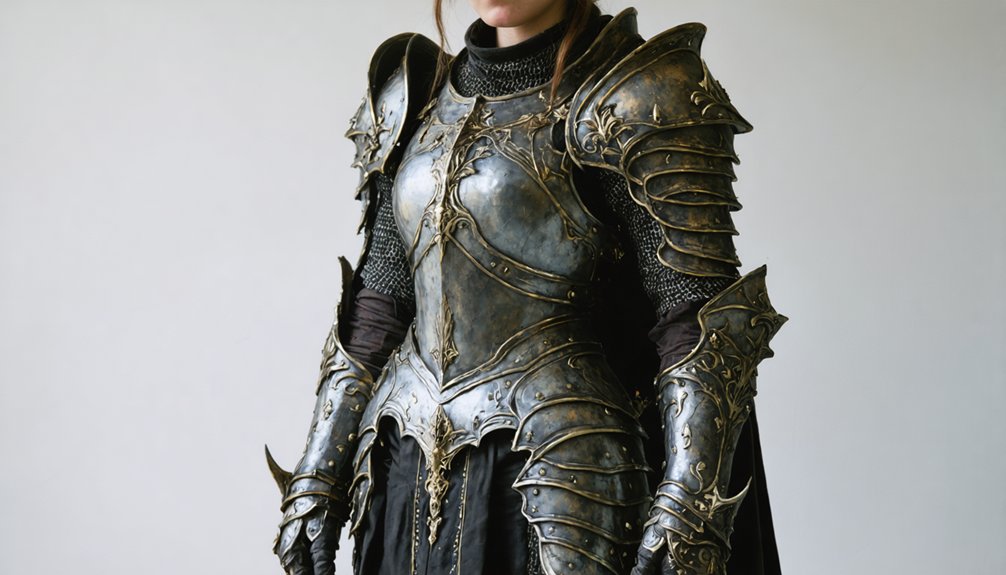
Certain elements of your costume naturally invite creative expression without compromising the character’s core identity.
Custom accessories, in particular, offer a controlled space where you can introduce original craftsmanship, personal aesthetic choices, or functional modifications while keeping recognizable design elements intact.
Small personal touches—subtle fabric embellishments, unique closures, or refined finishing details—further allow you to assert your creative voice without displacing the character’s foundational visual language.
Custom Accessory Creative Expression
Custom accessories represent one of the most effective zones for creative expression because they let you introduce personal flair without compromising the character’s core recognizability. When executed deliberately, custom accessories reinforce identity while showcasing your craftsmanship.
Apply creative expression through these targeted approaches:
- Material elevation – Substitute standard materials with premium alternatives that match the character’s aesthetic while improving durability.
- Weathering and aging – Add intentional distressing that reflects the character’s narrative history.
- Engraving or embossing – Incorporate signature motifs drawn directly from the source design.
- Functional modifications – Redesign prop accessories for improved wearability without altering their visual profile.
Each method keeps the character’s recognizable silhouette intact while giving you measurable room to demonstrate technical innovation and intentional design thinking.
Small Personal Touches Added
Small personal touches work best where they complement rather than compete with the character’s established visual language. You’ll find that signature details—color schemes, iconic props, silhouette—must remain intact for recognition to hold.
Personal flair, however, can emerge through fabric texture upgrades, subtle embroidery, or refined finishing techniques that elevate construction quality without distorting the source design.
Consider reinforcing a character’s thematic identity rather than contradicting it. If a character embodies military precision, your personal touch might appear in immaculate stitching or historically accurate hardware. That choice adds depth without visual disruption.
That way, you’re not replacing the character’s identity—you’re sharpening it. Strategic, intentional modifications signal craftsmanship and thoughtfulness, qualities competition judges and fellow enthusiasts recognize immediately.
Precision in where you deviate matters as much as the deviation itself.
Fabric Choices That Balance Cosplay Accuracy and Visual Impact
Fabric selection sits at the heart of translating a character’s visual identity into physical form, directly shaping how accurately your costume reads and how strongly it registers on a stage or convention floor. Prioritizing fabric texture and color matching guarantees your construction aligns with the source material’s visual language.
Fabric selection determines how faithfully your costume communicates character — get the textile wrong, and nothing else matters.
- Match sheen levels — matte, satin, or metallic finishes signal different character archetypes immediately.
- Prioritize color matching under multiple lighting conditions, not just natural light.
- Select fabric texture that replicates the character’s silhouette without sacrificing structural integrity.
- Substitute strategically — choose modern performance fabrics that visually approximate originals while improving durability and mobility.
Each decision compounds. A single mismatched textile can undermine an otherwise precise build, while intentional substitutions preserve accuracy without compromising wearability.
Comfort Adjustments That Don’t Sacrifice Cosplay Accuracy
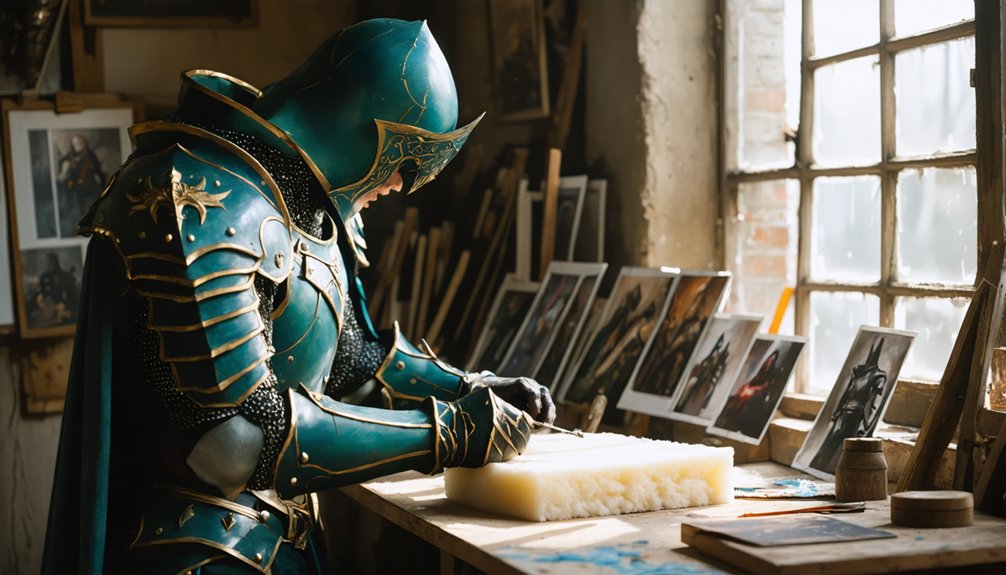
Once your fabric selections lock in the visual foundation of a build, the next challenge is making that costume livable across an entire convention day without undermining its accuracy. Comfort innovations like moisture-wicking underlayers, strategic boning replacements, and hidden elastic panels let you preserve silhouette integrity while dramatically improving endurance.
Material flexibility becomes your primary engineering tool here—stretch-woven duplicates of rigid-looking fabrics maintain screen-accurate aesthetics while accommodating natural movement. You can reinforce high-stress seams with invisible internal stitching and insert removable padding where structural pieces press against skin.
Ventilation channels built into layered armor pieces prevent overheating without altering exterior profiles. None of these adjustments require visual compromise; they require deliberate construction planning. Accuracy and wearability aren’t competing priorities—they’re parallel design problems demanding equally precise solutions.
Makeup, Wigs, and Accessories as Your Creative Outlet
While fabric and construction lock in a costume’s structural foundation, makeup, wigs, and accessories are where you exercise the sharpest creative control without destabilizing overall accuracy. These elements let you interpret a character precisely while injecting personal innovation.
Prioritize these four execution points:
- Makeup techniques: Use prosthetics, colored contacts, and high-hold setting products to replicate character-specific facial features with anatomical precision.
- Wig styling: Sculpt silhouette and shape deliberately—recognizability depends heavily on profile accuracy before color even registers.
- Accessory layering: Stack accessories intentionally so the design reads instantly at distance, preserving visual hierarchy.
- Creative expression zones: Treat custom accessories as your primary innovation space, introducing original detail without compromising core character recognizability.
Controlled creativity here strengthens, rather than undermines, your overall accuracy.
What Competition Judging Reveals About Accuracy and Creativity

Competition judging makes the accuracy-creativity balance visible in ways that personal projects don’t. When you enter a competition, judges evaluate both technical precision and artistic flair simultaneously, revealing how inseparable these qualities actually are.
Competition judging reveals what personal projects hide: technical precision and artistic flair are fundamentally inseparable qualities.
Some contests weight screen accuracy heavily, scrutinizing every seam, color match, and prop detail. Others prioritize stage presence and character embodiment, rewarding how convincingly you inhabit the role.
Most competitions recognize both dimensions, which means neglecting either puts you at a disadvantage.
Your documentation strengthens prejudging evaluations by showing deliberate construction choices rather than accidental outcomes.
Performance segments expose whether your creative interpretation communicates character identity under pressure.
Understanding what specific competitions value before you begin construction lets you make informed decisions that align your costume’s strengths with the judging criteria you’ll actually face.
Frequently Asked Questions
Can Budget Constraints Still Allow for an Accurate and Creative Cosplay?
Every cloud has a silver lining—yes, budget constraints can still yield accurate, creative cosplay. You’ll excel through strategic material sourcing and thoughtful costume personalization, substituting cost-effective fabrics while preserving visual fidelity and injecting distinctive, innovative character interpretation.
How Do I Handle Copyrighted Characters When Selling My Cosplay Creations?
When selling cosplay creations of copyrighted characters, you must avoid positioning them as licensed merchandise. Instead, frame your work as fan art, clearly distinguishing it from official products to minimize potential intellectual property infringement risks.
Is It Acceptable to Combine Elements From Multiple Characters in One Costume?
Absolutely. Imagine a Jedi-Batman character mashup — you’re blending two icons seamlessly. Cross universe cosplays let you innovate boldly while retaining each character’s signature elements, ensuring both sources remain recognizable and your creative vision stays coherent.
How Should Beginners Prioritize Accuracy Versus Creativity on Their First Build?
For your first build, prioritize accuracy to establish foundational skills, then layer in artistic expression through small details. Mastering character interpretation first guarantees recognizability while you’ll naturally develop confidence to innovate creatively as your craftsmanship advances.
Can Body Paint Replace Fabric Entirely While Maintaining Character Recognizability?
Body paint’s versatility can replace fabric, but its fabric substitution feasibility depends on character complexity. You’ll maintain recognizability through precise color accuracy, signature markings, and strategic accessory layering that preserves the character’s defining visual silhouette effectively.
References
- https://noizu.asia/about-accuracy-vs-creativity-in-cosplay/
- https://starstruckpanda.com/character-accuracy-vs-creativity-in-cosplay/
- https://starstruckpanda.com/mastering-character-accuracy-in-cosplay-crafting/
- https://noizu.asia/id/about-accuracy-vs-creativity-in-cosplay/
- https://tokyo-cosplay.com/historical-accuracy-in-cosplay-balancing-fact-and-fantasy/
- https://cos-bond.com/2020/10/30/when-to-strive-for-accuracy-cosplay-survival-guide/
- https://starstruckpanda.com/achieving-character-accuracy-in-cosplay/
- https://starstruckpanda.com/what-defines-accurate-character-details-in-cosplay/
- https://rogersenpai.com/does-cosplay-have-to-be-accurate/
- https://fancyduckie.wordpress.com/2016/05/04/costume-construction-accuracy-vs-reality/