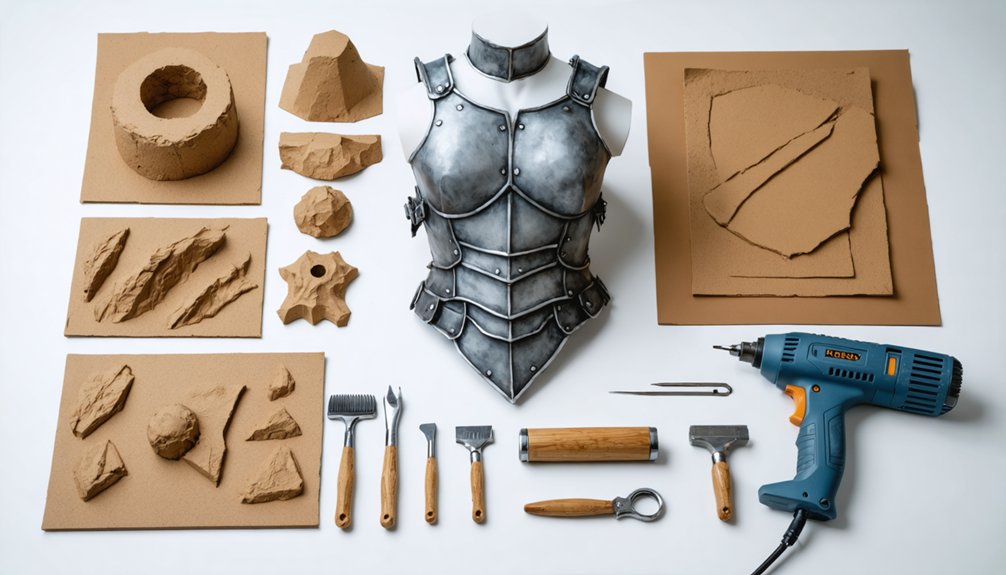
For cosplay armor, your best thermoplastic options are EVA foam, Worbla, PETG, and ABS. EVA foam is lightweight and cost-effective, making it an ideal base layer. Worbla’s Finest Art bonds directly to foam at 90°C, adding a hard, paint-ready shell. PETG delivers superior impact resistance with a smooth finish, while ABS allows acetone smoothing for faster post-processing. Matching each material to your weight, finish, and budget requirements is what separates a good build from a great one—and there’s much more to unpack.
Key Takeaways
- EVA foam is lightweight, cost-effective, and heat-shapeable, making it an ideal foundational thermoplastic for cosplay armor building.
- Worbla’s Finest Art self-bonds to foam at 90°C, creating a durable, paint-ready surface with slight flexibility to prevent cracking.
- PETG offers superior impact resistance and smooth surface finish, ideal for large, stress-prone armor pieces requiring durability.
- ABS allows acetone smoothing for refined surface finishing, making it suitable for impact-resistant shells with efficient post-processing.
- Balance weight, surface quality, and budget by layering materials strategically, prioritizing lightweight options for full-body suits.
Why Thermoplastics Outperform Resin, Fabric, and Foam Alone
Thermoplastics give you something resin, fabric, and foam alone can’t: a material that stays workable during construction and rigid once cooled, without locking you into a single irreversible step. Resin demands exact mixing ratios and cures permanently, leaving little room for correction. Fabric lacks the structural rigidity armor builds require. Foam shapes easily but degrades under surface stress without reinforcement.
Thermoplastics solve all three limitations simultaneously. You can reheat, reposition, and refine until the form is exactly right. Their surface density supports texture enhancement techniques like embossing or layering that foam alone won’t hold cleanly. They also offer strong color compatibility with primers and paints, giving you consistent, predictable finishing results.
For builders prioritizing precision and adaptability, thermoplastics are the clear functional upgrade.
Start With EVA Foam Before Adding Anything Else
Before you introduce any thermoplastic into your build, EVA foam should be your starting material. It’s cheap, lightweight, and heat-shapeable, making it the most practical foundation for armor, props, and structural base forms.
EVA foam first, always. It’s cheap, shapeable, and sets the foundation before any thermoplastic enters your build.
Foam durability holds up well under daily wear, and its low weight keeps large builds manageable.
Use 6 mm thickness as your default starting point. It balances rigidity with easy cutting and rapid assembly.
Once your foam base is solid, thermoplastic flexibility becomes your finishing advantage.
Key reasons to start with EVA foam:
- Reduces overall build cost before adding Worbla or PETG shells
- Allows fast iteration on shapes before committing to harder materials
- Acts as a lightweight substrate that preserves structure without unnecessary mass
Why Worbla’s Finest Art Is the Go-To Hard Shell Material
Once your EVA foam base is shaped and solid, Worbla’s Finest Art gives you the hard outer shell that foam alone can’t deliver. Activating at around 90°C, it becomes workable within seconds using a heat gun, then bonds directly to your foam substrate without adhesive. That self-bonding property streamlines layered construction and eliminates messy seam work.
The cured surface accepts primer and paint cleanly, making color matching across multiple armor panels straightforward and consistent. Unlike some rigidity-focused materials with limited flexibility options, Worbla’s Finest Art retains slight give after cooling, reducing cracking risk on curved wearable sections.
It’s also repositionable with reheating, letting you correct alignment before final setting. For builders prioritizing a durable, finish-ready hard shell over EVA foam, it remains the most practical choice available.
Which Worbla Variant Is Right for Your Cosplay Build?
Worbla’s Finest Art handles most builds well, but the broader Worbla product line offers variants that better match specific goals around surface finish, rigidity, flexibility, and cost. Choosing the right variant means prioritizing what your build actually demands.
- Worbla’s Black Art delivers a smoother surface, reducing prep time before painting on detailed armor pieces.
- Worbla’s Flex Art introduces foam flexibility into thermoplastic bonding, making it ideal for curved wearable panels that need movement.
- Worbla’s Mesh Art reinforces structural integrity without adding excessive weight, useful for larger rigid prop builds.
Each variant activates with standard heat tools and bonds to itself. Match the material to your build’s core requirement—whether that’s surface quality, flexibility, or structural strength—before committing to a full sheet purchase.
PETG vs ABS for 3D Printed Cosplay Parts
When you’re choosing between PETG and ABS for printed cosplay parts, PETG wins on impact resistance, making it the stronger option for large armor pieces that take regular handling stress.
ABS gives you better post-processing flexibility, since it sands more cleanly and responds well to acetone smoothing for tighter surface finishes.
Your printer setup is the deciding factor for ABS, though, because it requires an enclosed machine and controlled temperatures that PETG doesn’t demand.
Strength And Impact Resistance
For 3D printed cosplay parts, PETG outperforms ABS in impact resistance, making it the stronger choice for large armor components and props that take repeated handling or stress.
When you’re deciding between flexibility versus rigidity, PETG absorbs impact without shattering, while ABS prioritizes post-processing ease over structural resilience.
Key performance differences you should consider:
- PETG delivers superior impact resistance, reducing breakage risk on large armor panels without requiring metal reinforcement.
- ABS offers easier sanding and finishing but cracks under repeated stress if you skip metal reinforcement on critical joints.
- PETG’s chemical compatibility strengthens adhesive bonds, improving assembly durability across complex multi-part builds.
If your build demands structural reliability through convention wear and transport, PETG’s impact resistance gives you a measurable advantage over ABS.
Post-Processing And Surface Finishing
Surface finishing is where PETG and ABS split sharply regarding practical workload. PETG sands cleanly but resists acetone smoothing, so you’ll rely on filler primer and progressive grit sanding for texture enhancement. That adds steps but gives you precise control over final surface quality.
ABS accepts acetone vapor smoothing directly, collapsing layer lines quickly and reducing manual sanding time before priming.
For color matching, ABS’s smoother post-acetone surface absorbs paint more evenly, making consistent tonal reproduction easier across large armor panels. PETG requires more primer coats to achieve comparable paint adhesion uniformity.
If you’re running an enclosed printer and need fast turnaround on complex surface geometries, ABS delivers a more efficient post-processing pipeline. Choose PETG when you prioritize dimensional accuracy over finishing speed.
Printer Requirements And Setup
Choosing between PETG and ABS starts with your printer’s hardware, not the filament itself. ABS demands an enclosed build chamber to prevent warping and layer separation, making it incompatible with open-frame machines. PETG offers broader cosplay material compatibility since it prints reliably on most setups without enclosures.
Key hardware considerations:
- Enclosure: Required for ABS; optional for PETG, giving you thermoplastic flexibility across different printer configurations.
- Bed temperature: ABS needs 100–110°C; PETG runs 70–85°C, reducing energy demands and setup complexity.
- Hotend rating: Both require at least 230°C, but verify your hotend handles sustained temperatures without thermal creep.
Match your filament choice to your actual printer capabilities before committing to a build. Hardware limitations should drive your material decision first.
Where to Buy Cosplay Thermoplastics Without Overpaying
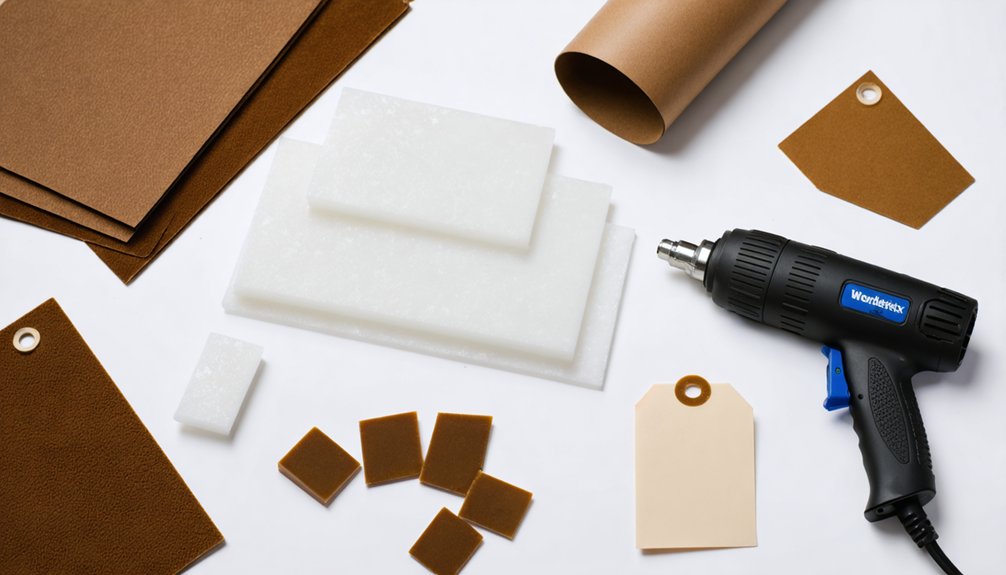
Knowing where to source your materials directly affects how far your build budget stretches.
For Worbla and specialty thermoplastics, buy directly from cosplay-focused retailers like Cosplay Supplies or TNT Cosplay Supply, where color customization options and bundled material guides justify the slight premium.
Amazon works for EVA foam sheets, but verify thickness specs before ordering.
For PETG and ABS filament, check Hatchbox, Polymaker, or MatterHackers for consistent quality at competitive pricing.
Buying in bulk reduces per-unit cost considerably on longer builds.
Local craft stores stock basic EVA foam but rarely carry thermoplastics beyond craft foam.
If your workspace uses ventilation solutions for heat-forming or printing, factor that into your material volume planning.
Always compare weight-to-cost ratios before committing to a supplier.
Which Thermoplastic Fits Your Armor Weight, Finish, and Budget
When you’re choosing a thermoplastic for armor, you’re balancing three competing demands: weight, surface quality, and cost.
EVA foam keeps your build light and cheap but won’t give you the hard, paint-ready finish that Worbla or PETG deliver.
If you’ve got an enclosed printer and finishing time, ABS or PETG can hit all three targets.
But if you’re working by hand on a budget, a Worbla-over-EVA shell usually gives you the best trade-off between durability and spend.
Armor Weight Material Trade-Offs
Every thermoplastic you consider for armor carries a different weight, finish ceiling, and price point, so matching the material to your build requirements early prevents costly mistakes.
Foam versatility makes EVA your lightest structural option, while thermoplastic compatibility determines how well your shell layer bonds and performs over it.
Use these trade-offs to guide your selection:
- EVA foam keeps total armor weight low, enabling longer wear without fatigue
- Worbla over EVA adds surface durability and finish quality without significant weight penalties
- PETG or ABS delivers rigid, impact-resistant shells but increases component weight and requires controlled fabrication conditions
Prioritize weight when you’re building full-body suits. Prioritize rigidity when structural integrity or fine surface detail outweighs portability concerns.
Surface Finish Options Compared
Surface finish is where weight trade-offs become visible in the final build. EVA foam carries natural texture variation that requires sealing before painting, while Worbla’s Finest Art delivers a harder shell with moderate surface smoothness straight off the heat gun.
If you’re layering Worbla over EVA, you’ll gain a tougher outer surface but still need sanding to eliminate pebbling. PETG printed parts offer the cleanest baseline for surface smoothness among printed options, responding well to light sanding and chemical finishing.
ABS lets you acetone-smooth printed surfaces rapidly, cutting finishing time markedly. Your finish goal determines your material stack: raw EVA suits textured or battle-worn aesthetics, while PETG and ABS printed shells suit polished, screen-accurate armor builds requiring tight surface control.
Budget-Friendly Thermoplastic Choices
Budget shapes your material stack before anything else does. Cost comparison across thermoplastics reveals EVA foam as your lowest-entry option—cheap, cuttable, and heat-shapeable without specialized tools. Material versatility matters here because one material rarely handles every build requirement alone.
Pair materials strategically based on your budget ceiling:
- EVA foam (6 mm): Lowest cost per square foot, handles armor bases, props, and wearable panels without adding significant weight.
- Worbla’s Finest Art over EVA: Mid-range cost upgrade that bonds without adhesive, adds a durable shell, and improves surface quality dramatically.
- PETG for printed components: Strong impact resistance with finish-friendly surfaces, best when you need rigid structural parts without paying ABS’s post-processing overhead.
Match your spend to your build’s structural demands first, then refine surface quality second.
Frequently Asked Questions
Can Thermoplastics Be Safely Used Directly Against Bare Skin?
Imagine wearing Worbla directly on your wrist—you’d risk skin irritation or allergic reactions. You shouldn’t apply thermoplastics bare; always layer foam or fabric underneath as a protective barrier first.
How Do You Store Unused Thermoplastic Sheets Between Cosplay Projects?
Store your unused thermoplastic sheets flat, away from heat and humidity. You’ll preserve material integrity for thermoplastic recycling later. Label remnants by type to streamline color customization techniques across future projects, keeping your innovative builds efficient and organized.
Can Thermoplastic Armor Pieces Survive Checked Baggage at Airports?
Like fragile glass in a tornado, checked baggage crushes unprepared pieces—you’ll risk thermoplastic damage potential from compression. Review airline baggage regulations, pack armor in rigid cases, and you’ll protect your builds effectively.
How Do Thermoplastics Hold up in Hot Outdoor Convention Environments?
You’ll face real heat resistance challenges outdoors—Worbla softens near 90°C, so direct sun can warp pieces. Flexibility concerns rise with EVA too. Choose PETG for rigid components; it handles thermal stress far better.
Are Thermoplastic Cosplay Builds Safe for Children to Wear?
Yes, they’re generally safe if you prioritize thermoplastic flexibility to prevent rigid stress points and manage costume weight distribution carefully, ensuring no sharp edges, excessive bulk, or heat-activated warping risks affect your child’s comfort and mobility.
References
- https://cosplaysupplies.com/collections/plastics
- https://www.reddit.com/r/costumedesign/comments/1o0d7a0/thermo_plastics_help/
- https://cosplaycurves.com/pages/cosplay-materials-guide
- https://www.minque-creative.com/en/crafting/thermoplastics/
- https://cos-bond.com/2019/06/10/thermoplastics-in-cosplay-material-guide/
- https://www.youtube.com/watch?v=Jl5b-EWXYEQ
- https://www.spoolscout.com/suggestions/best-filament-for-cosplay-props