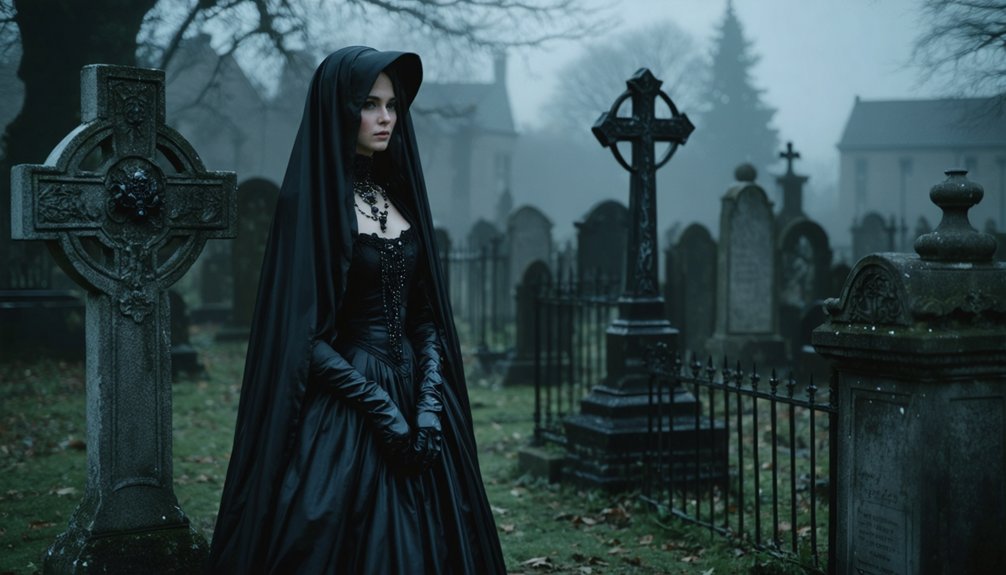
Victorian mourning attire demands strict tonal discipline, starting with matte black fabrics like crepe or bombazine that absorb light and signal deep grief. You’ll need to eliminate all reflective surfaces, swap shiny pins for black metal fasteners, and reserve jet beads strictly for second mourning. Your widow’s veil must measure three yards with precise proportional coverage. Each phase carries codified visual rules you can’t afford to misread, and what follows breaks every critical detail down systematically.
Key Takeaways
- Choose matte black fabrics like crepe or bombazine, avoiding synthetic substitutes to maintain Victorian mourning authenticity.
- Floor-length skirts, high-collared blouses, and tailored coats form the essential structural foundation of mourning attire.
- Eliminate all shiny jewelry and reflective accessories, replacing fasteners with black metal alternatives during deep mourning.
- A widow’s veil requires three yards of opaque black crape, with one-third covering the face.
- Transition to second mourning by introducing white collars, black jet beads, and muted tones like gray and lavender.
Start With Matte Black Fabrics and Zero Shine
When assembling an authentic Victorian Gothic mourning look, you’ll want to begin with the foundational principle: matte black fabrics that absorb rather than reflect light.
Victorian mourning etiquette strictly governed fabric textures, demanding crepe, bombazine, or heavy wool serge—materials chosen for their cultural significance and emotional expression of grief. These choices weren’t arbitrary; they reflected deeply embedded societal norms that transformed personal loss into public declaration.
Historical symbolism permeated every textile decision, with any luster or shine considered a profound breach of mourning protocol.
As you explore fashion evolution within this tradition, you’ll recognize that fabric selection carries intellectual weight. Selecting the correct matte materials demonstrates your understanding of this nuanced cultural language, honoring its historical integrity while innovating within its disciplined aesthetic framework.
Choose Crepe or Bombazine for Authentic Victorian Mourning
When selecting fabric for authentic Victorian mourning dress, you’ll find that crepe and bombazine stand as the two definitive materials prescribed by 19th-century mourning etiquette.
Crepe, a crimped, lightweight silk or wool textile, absorbs light rather than reflecting it, producing the requisite dull, somber surface that deep mourning demanded.
Bombazine, a twilled fabric historically woven from silk and wool, carried particular social weight in Victorian Britain, where widows relied on its dense, matte texture to signal the severity and sincerity of their grief.
Crepe Fabric Characteristics
Crepe and bombazine stand as the twin pillars of authentic Victorian deep mourning fabric, and understanding their distinct properties helps you select the right material for your ensemble.
Crepe texture features a distinctly crimped, granular surface achieved through heat and pressure treatments applied during weaving. Its characteristic crepe drape falls with controlled fluidity, creating silhouettes that convey solemnity without excess volume.
You’ll encounter varying crepe weight options, from lightweight silk crepe to heavier wool varieties suited for outer garments. Crepe variations include English, Canton, and Georgette iterations, demonstrating remarkable crepe versatility across mourning applications.
Crepe history traces back centuries before Victorian adoption formalized its grief symbolism.
Regarding crepe maintenance, you must hand-wash delicate varieties carefully, avoiding heat exposure. Crepe patterns remain deliberately plain, preserving the matte aesthetic essential to deep mourning protocol.
Bombazine Historical Significance
Bombazine carries equal weight alongside crepe in the Victorian mourning wardrobe, and its historical roots run deeper than many contemporary practitioners realize.
Tracing bombazine origins back to Renaissance-era silk weaving, you’ll find it evolved into a wool-silk or wool-cotton twill blend that dominated 19th-century mourning dress precisely because it absorbed dye without reflecting light.
Queen Victoria herself favored bombazine, cementing its cultural authority.
When examining bombazine textures, you’ll notice a fine diagonal ribbing that distinguishes it from crepe’s crimped surface, offering a subtler matte finish ideal for structured bodices and skirts.
If you’re constructing an authentic mourning ensemble, prioritize period-accurate bombazine over modern synthetic substitutes, as its weight and weave authentically communicate the gravity Victorian mourning culture demanded.
Know Exactly What Jewelry Deep Mourning Forbids
During deep mourning, you must eliminate all jewelry entirely, as Victorian convention treated adornment as a direct affront to grief’s sincerity.
You’ll replace any shiny pins with black metal alternatives, avoiding silver, gold, and gemstone pieces that carry luster or visual weight.
Dangling chains, brooches, and flashy ornaments are equally forbidden, reinforcing the period’s strict prohibition against anything that draws attention away from sorrow’s solemn expression.
Forbidden Jewelry During Mourning
Victorian deep mourning imposed a total ban on jewelry, stripping away every ornamental piece you’d typically wear. You couldn’t wear silver, gold, gemstones, or dangling chains — each violated mourning symbolism by introducing visual lightness into an ensemble built on deliberate heaviness and restraint.
Replace shiny pins immediately with black metal alternatives that complement the matte fabric textures of crape and bombazine.
Brooches, flashy ornaments, and metallic trims were equally forbidden. These restrictions weren’t arbitrary; they reinforced a codified visual language communicating grief’s severity.
Only during second mourning could you introduce black jet beads, carefully integrating minimal adornment without disrupting the ensemble’s somber integrity.
Understanding these distinctions lets you construct an historically accurate, intellectually considered mourning look that honors Victorian protocol with precision and authenticity.
Banned Accessories And Ornaments
Deep mourning’s accessory restrictions extended well beyond jewelry into every ornamental detail you might attach, pin, or drape onto your ensemble.
Within the historical context of Victorian mourning etiquette, you’d replace all shiny pins with black metal fasteners, eliminating any reflective surface that contradicted mourning symbolism. Dangling chains, decorative brooches, and gemstone ornaments carried social implications of vanity, making them culturally inappropriate during grief’s deepest phase.
You’d instead embrace fabric textures themselves as emotional expression — crape collars and matte wool trims became your only acceptable ornamentation. Understanding the cultural significance of these restrictions reveals deliberate restraint as a communicative act.
As accessory alternatives, black gloves and opaque veils fulfilled both symbolic and practical functions, satisfying mourning etiquette without compromising the ensemble’s austere, grief-honoring integrity.
Swap Shiny Pins for Black Metal Fasteners
When assembling a historically accurate deep mourning ensemble, you’ll need to replace every shiny pin and fastener with black metal alternatives, as even the smallest glint of polished silver or brass directly violated Victorian mourning etiquette.
Black metal fasteners weren’t merely decorative choices — they were obligatory components of authentic mourning attire, signaling a widow’s adherence to strict grief protocols.
Victorian conventions demanded that hooks, eyes, and dress pins carry absolutely no reflective quality. You’ll want to source oxidized iron or blackened steel fasteners when reconstructing these looks today.
Specialty costume suppliers and historical reproduction retailers offer period-accurate options. Substituting even one bright pin compromises the ensemble’s integrity, undermining the deliberate aesthetic severity that defined deep mourning’s visual language throughout the nineteenth century.
Get Your Widow’s Veil Proportions Exactly Right
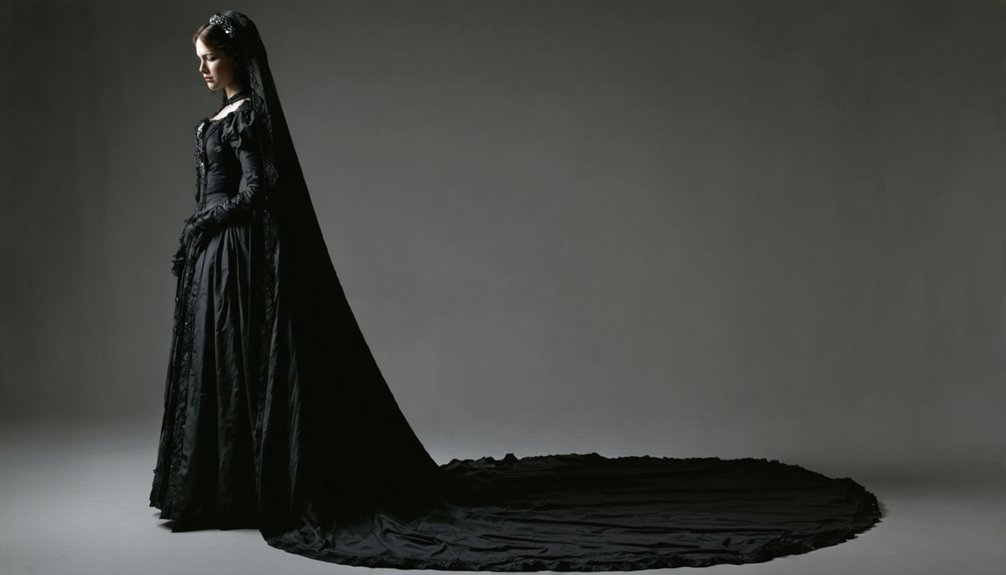
Few elements of Victorian mourning dress carried as much symbolic weight as the widow’s veil, and getting its proportions wrong immediately signals inauthenticity to anyone familiar with period conventions.
You’ll want a full three yards of opaque black crape, positioning two-thirds to fall behind you and one-third to cover your face during the deep mourning phase. This face-covering third wasn’t decorative—it actively communicated your grief’s intensity within established mourning traditions.
After six months, you’d throw the veil back, signaling your change publicly. Don’t substitute sheer fabrics; the veil’s opacity is non-negotiable in early mourning.
Measuring and cutting your widow’s veil to these precise specifications distinguishes a historically grounded look from a superficial approximation, demonstrating genuine command of Victorian funerary dress codes.
Build Your Victorian Mourning Look From These Core Garments
Your Victorian mourning ensemble begins with three foundational pieces: a floor-length black skirt in A-line or tiered construction, a high-collared blouse with lace inserts or ruffles, and a long tailored coat in wool or brocade.
You’ll want to select heavy, matte fabrics throughout, as any sheen or luster violates deep mourning protocol and marks a lapse in period-accurate authenticity.
Together, these garments establish the structural silhouette from which all remaining accessories, veils, and symbolic details properly build.
Floor-Length Black Skirts
Everything begins with the floor-length black skirt, the structural cornerstone of authentic Victorian mourning dress.
You’ll recognize its historical significance immediately — A-line and tiered cuts defined Victorian silhouettes while reinforcing mourning etiquette through deliberate fabric draping that projected grief architecturally. Mourning symbolism lived within every weighted hem and disciplined seam.
Symbolic colors carried cultural implications beyond aesthetics; black announced loss publicly, demanding social acknowledgment.
You should select heavy wool serge or matte crepe, fabrics that absorb light rather than reflect it, honoring deep mourning’s strict material codes.
Fashion evolution has broadened construction options, yet the essential discipline remains unchanged.
Innovate through silhouette layering or tiered construction while maintaining structural integrity and period authenticity, ensuring your interpretation respects both cultural implications and the garment’s foundational mourning symbolism.
High-Collared Blouses
Above the weighted hem and disciplined drape of the floor-length skirt, the high-collared blouse completes mourning dress’s upper architecture with equal symbolic precision.
You’re reconstructing Victorian silhouettes that communicated grief through structured restraint, so select blouses with stiffened collars rising close to the jaw. Lace inserts and ruffles were permitted details, provided they remained matte and subdued in tone.
Mourning etiquette dictated that deep mourning blouses carry no reflective surfaces, no sheen, and no decorative excess. Choose heavy cotton, crepe, or fine wool constructions that hold their form rigidly.
During second mourning changes, you may introduce white collars and cuffs as sanctioned relief against unbroken black.
Every fastening, seam, and surface choice communicates intentional, period-accurate devotion to the mourning dress’s historical and emotional discipline.
Long Tailored Coats
Completing the outer layer of your mourning ensemble, the long tailored coat extends the disciplined silhouette from shoulder to floor in wool or brocade constructions that signal deliberate Victorian austerity.
You’ll reinforce mourning etiquette through structured seaming, suppressed waists, and floor-grazing hemlines that define Victorian silhouettes with architectural precision.
Select matte-finished fabrics exclusively, rejecting any sheen that compromises deep mourning’s visual severity.
Prioritize these construction details:
- Fitted princess seaming that eliminates excess volume while maintaining ceremonial gravity
- Covered black buttons replacing metallic hardware to honor deep mourning fabric restrictions
- Extended sleeves reaching the wrist, sustaining modesty requirements integral to authentic Victorian mourning etiquette
These deliberate choices transform the coat from mere outerwear into a codified statement of structured grief and period-accurate sartorial discipline.
Add Crape Collars and Cuffs Without Breaking Protocol
Crape collars and cuffs serve as the definitive boundary markers between deep mourning propriety and accidental social infringement, so you’ll want to understand their precise function before incorporating them.
Crape collar history traces back to strict Victorian bereavement codes, where matte crape signaled uncompromising grief without decorative intent. During deep mourning, you’ll attach flat, unadorned crape collars and matching cuffs directly to black wool or serge gowns, avoiding any lace insertion or ruching.
Mourning attire evolution later permitted white collars and cuffs only during the second mourning phase, never during the initial phase. You’ll distinguish authentic protocol by selecting dull-finished crape exclusively, rejecting any fabric carrying sheen.
Secure collars with black metal pins, never silver clasps, maintaining compositional integrity throughout your ensemble’s construction.
Recognize When Deep Mourning Transitions to Second Mourning
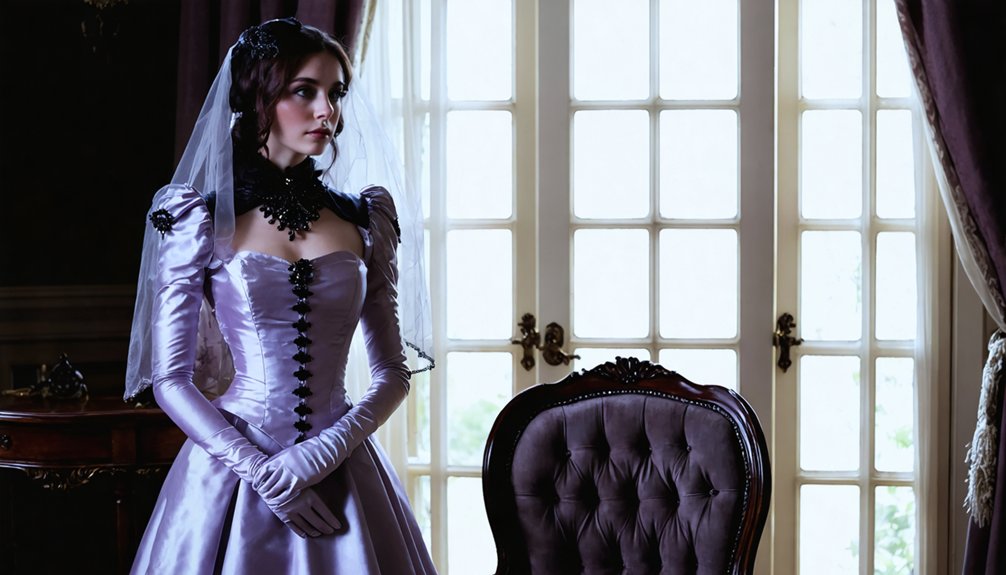
Once you’ve mastered the strict compositional rules governing crape collars and cuffs during deep mourning, you’ll need to recognize the precise social and temporal markers that signal when Victorian protocol permitted a change into second mourning.
Mourning etiquette dictated structured progression, allowing emotional expression to gradually resurface through controlled aesthetic changes.
Three alterations mark this critical shift:
- White collars and cuffs replace crape after deep mourning concludes
- Black jet beads and net veils become acceptable substitutes for opaque materials
- Gray, lavender, and light purple enter the permitted color vocabulary
You’ll notice these changes aren’t arbitrary—they reflect calculated social signaling.
Recognizing these benchmarks lets you navigate Victorian mourning’s layered protocol with scholarly precision and intentional authenticity.
Dress Second Mourning Before Advancing to Half-Mourning Colors
Before advancing to half-mourning‘s softer palette, you’ll need to dress second mourning correctly as its own distinct phase—not merely a stepping stone.
Mourning etiquette demands intentionality here: introduce white collars and cuffs to soften the stark black ensemble while retaining its structural solemnity. Replace your crape bonnet with straw or silk, and incorporate black jet beads—previously forbidden during deep mourning.
Color symbolism operates precisely in this phase; black remains dominant, but restrained trim and ruches signal measured emotional progression. Net veils replace opaque ones, lightening your silhouette without abandoning decorum.
Avoid premature introduction of gray or lavender, as those tones belong exclusively to half-mourning. Each deliberate adjustment communicates grief’s evolution with cultural literacy and sartorial precision.
Complete the Look With Jet Beads, Cameos, and Black Gloves
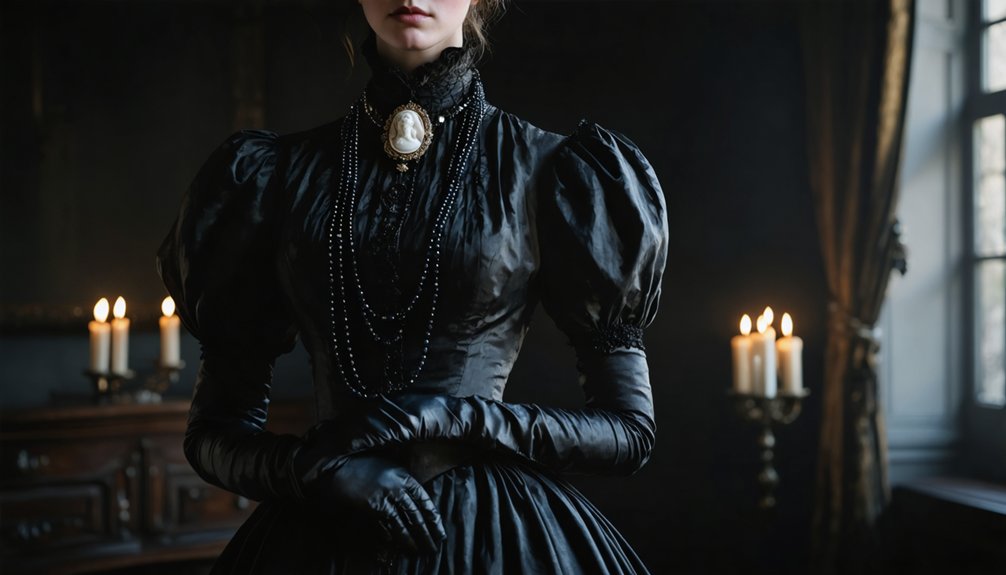
Accessories complete Victorian mourning dress with deliberate symbolic weight, and you’ll want to select each piece according to strict phase-appropriate rules.
Deep mourning prohibits all jewelry entirely, but second mourning reveals specific options you can layer strategically:
- Jet beads — wear authentic Whitby jet or black glass strands at the throat, reserving silver filigree combinations for half-mourning shifts.
- Cameo motifs — select pieces featuring crosses, mourning figures, or bat imagery mounted in blackened settings rather than gold frames.
- Black gloves — extend coverage to the wrist or elbow, choosing matte leather or cotton depending on formality.
Each accessory must reinforce the phase’s tonal discipline.
Introducing shine or color prematurely breaks the attire’s historical integrity and signals a misunderstanding of mourning’s codified visual language.
Frequently Asked Questions
Can Men Wear Victorian Mourning Attire Following the Same Strict Rules?
Yes, you can adopt masculine mourning through matte black wool suits, avoiding shine or metallic trims. You’ll incorporate historical accessories like black metal pins and jet pieces, following the same strict Victorian deep mourning protocols.
How Did Children’s Mourning Dress Differ From Adult Victorian Mourning Attire?
Cut from the same cloth, children’s mourning colors softened slightly — you’ll find they wore white or gray children’s fabrics instead of strict matte black, reflecting their innocence while still honoring Victorian mourning conventions appropriately.
Were There Specific Mourning Dress Rules for Different Social Classes?
Yes, you’d find mourning symbolism varied by class—wealthy widows strictly followed deep mourning’s matte crepe rules, while working women adapted social expectations practically, prioritizing affordable dark fabrics over expensive bombazine without sacrificing mourning’s essential somber aesthetic.
How Long Did Widows Typically Remain in Full Deep Mourning Period?
You’d endure an eternity of black—Victorian mourning customs required widows to remain in full deep mourning for two years, with grief expressions demanding matte crepe fabrics, opaque veils, and zero jewelry throughout this solemn phase.
Did Victorian Mourning Attire Rules Vary Between Different Countries or Cultures?
Yes, you’ll find that Victorian mourning attire rules varied considerably across cultures. Cultural influences shaped distinct mourning symbolism, with British customs being strictest, while French, American, and European traditions each adapted garment requirements, durations, and color interpretations differently.
References
- https://truefashionstory.com/victorian-gothic-fashion-guide-dark-elegance/
- https://www.reddit.com/r/GothFashion/comments/1ejdcdg/summer_victorian_mourningmourning_goth_tips/
- https://www.youtube.com/watch?v=zFeIIhtj-p0
- https://www.lancasterhistory.org/victorian-mourning-dress/
- https://www.youtube.com/watch?v=L45Cp4k-dR0
- https://susannaives.com/wordpress/2015/05/how-to-dress-becomingly-in-mourning-from-1885/
- https://shadowsflyaway.blog/2021/09/01/victorian-mourning-clothes/
- https://www.youtube.com/watch?v=x_nb8eAK1mY
- https://www.youtube.com/watch?v=T5w2wN301Lk
- https://omgthatdress.tumblr.com/post/633055645595205632/the-basics-of-victorian-mourning-and-identifying