Curling a synthetic wig for cosplay isn’t just about heat — it’s about control, patience, and fiber knowledge. You’ll want to confirm your wig’s heat-friendly rating, section it precisely, and keep your tools between 250°F–280°F. Techniques like foam rolling, steam-setting, and hot water curling each deliver distinct curl shapes and hold strengths. Finish with strong-hold hairspray and silicone serum to lock everything in place. The details ahead will sharpen your entire approach.
Key Takeaways
- Always verify your synthetic wig is heat-friendly before styling, keeping tools between 250°F–280°F to prevent melting or fiber damage.
- Section the wig horizontally from bottom to top, using small sections for better curl control and reduced heat stress.
- Foam rollers with steam-setting create uniform, long-lasting curls; always allow full cooling before releasing to maintain shape.
- Alternate curl directions every two sections to create natural dimension and dynamic movement ideal for cosplay styles.
- Revive flattened curls by re-wrapping sections around foam rollers, steaming briefly, and cooling completely before releasing.
Check Whether Your Synthetic Wig Is Heat-Friendly
Before reaching for a curling iron, you’ll need to confirm that your synthetic wig can actually handle heat without melting or deforming. Check the product label or manufacturer specs for heat-friendly or heat-resistant designations. Non-heat-resistant fibers break down quickly under direct tool contact, compromising both structure and color preservation.
Once you’ve confirmed heat compatibility, test a small, hidden strand at 250°F to 280°F before committing to full styling. This low-range setting protects fiber integrity while validating accessory compatibility with your chosen tools, whether that’s a curling wand, flat iron, or hot rollers.
Work only on clean, dry, and fully detangled hair. Tangled or damp fibers distribute heat unevenly, producing inconsistent curls and increasing the risk of permanent damage.
Section Your Wig Before You Start Curling
Once your wig passes the heat test, divide it into clean, horizontal sections using clips or sectioning pins before touching a single tool to it. Working in layers — bottom to top — gives you precise curl placement and prevents tangled overlap that destroys definition.
Section your wig from bottom to top — clean layers mean precise curls and zero tangled chaos.
Sectioning also supports smart color matching. If your wig has gradient tones or streaks, organized sections let you track which fibers get which curl pattern, keeping the visual design intentional and character-accurate.
From a wig maintenance standpoint, smaller sections reduce stress on individual strands, minimizing heat exposure per pass. Each section should be no wider than your curling tool’s barrel.
Tight organization now means cleaner ringlets, better volume control, and a finished silhouette that holds up through a full convention day.
Foam Rollers for Uniform Cosplay Ringlets
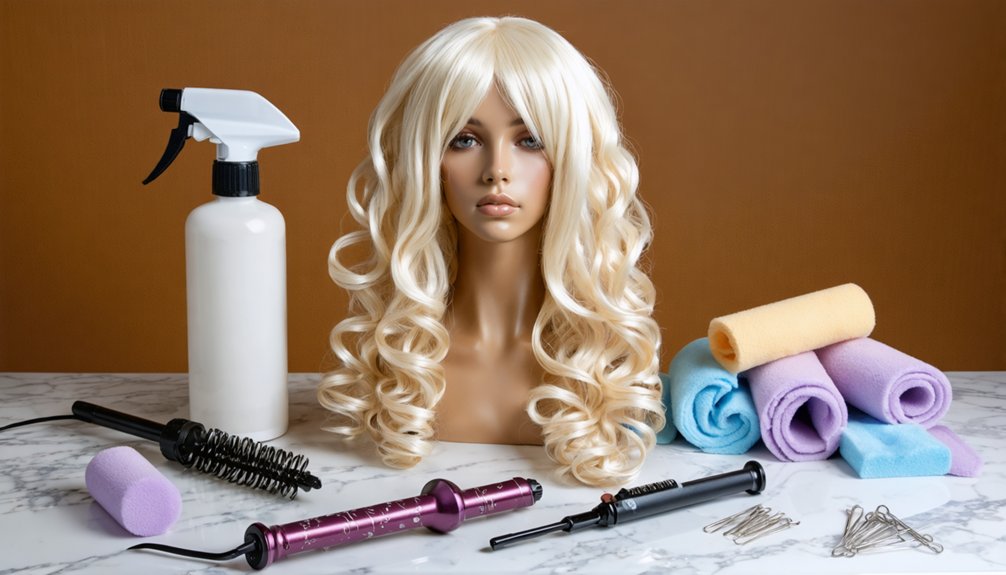
Foam rollers give you three key advantages over heat tools: uniform curl diameter, zero melt risk on delicate fibers, and hands-free setting time while you prep other wig sections. Their gentle mechanics protect fiber durability across repeated styling sessions, keeping strands resilient through convention wear and costume changes.
Section your wig into clean, equal parts before rolling. Wrap each section smoothly from tip to root, securing ends tightly to eliminate frizz.
Steam each roller thoroughly, then let the wig cool completely before release — the fiber locks its shape during hardening, not during heating.
Foam rollers also shine during color blending applications, preserving gradient transitions without heat distortion.
Once you remove the rollers, finger-separate each ringlet deliberately, then finish with strong-hold hairspray to anchor your sculpted silhouette.
Steam-Set Curls That Hold Through Convention Day
Steam reshapes synthetic fibers without the direct heat risk of a curling iron, making it one of the most reliable methods for curls that survive a full convention day.
You’ll wrap each sectioned strand tightly onto foam rollers, apply steam evenly, then let the wig cool and dry completely before releasing the set.
Once the rollers are out, lock the shape with strong-hold hairspray to keep every ringlet crisp from opening ceremony to the final cosplay contest.
Why Steam Sets Better
Among all the curling methods available to cosplayers, steam-setting stands out because it reshapes synthetic fibers without the scorching risk of direct heat contact. Steam penetrates each strand evenly, triggering molecular-level restructuring that direct irons simply can’t replicate as safely. You’re working with temperature regulation rather than against it—controlled vapor delivers consistent heat without concentration points that melt or deform fibers.
The result is superior fiber resilience. Steam-set curls flex under convention-day stress, recovering their shape instead of falling limp or frizzing. Because the fiber hardens gradually as it cools and dries on the roller, the curl memory runs deeper than surface-level heat styling.
You’ll notice the difference immediately—tighter definition, smoother texture, and a silhouette that survives hours of wear without constant touch-ups.
Roller And Steam Method
Steam-Set Curls That Hold Through Convention Day
Three supplies drive this method: foam rollers, a quality steamer, and patience during the cool-down phase. Minimal heat exposure protects fiber durability while still achieving sculpted, repeatable ringlets perfect for demanding cosplay silhouettes.
Follow these steps precisely:
- Section small — divide the wig into uniform parts for consistent curl tightness throughout.
- Roll tightly — wrap each section around foam rollers, securing ends to eliminate frizz.
- Steam evenly — pass your steamer section-by-section, saturating fibers without overexposing them.
- Cool completely — never remove rollers early; full cooling locks the curl’s shape permanently.
Once released, fingerwork separates curls cleanly. Finish with strong-hold hairspray to maintain definition through an entire convention day.
Locking In Curl Shape
Locking in curl shape separates a wig that survives one panel from one that holds through a full convention day. Once your steam-set curls cool completely, hit each section with strong-hold hairspray before touching anything. Don’t brush — use your fingers to separate ringlets gently, preserving definition without fracturing the curl pattern.
Color blending across layered sections becomes more visible once curls are locked and shaped, so confirm your silhouette matches the character design before sealing everything in place.
Wig maintenance matters here too — a well-locked curl resists humidity, friction, and costume contact far longer than an unsecured one.
Reapply hairspray lightly at the midpoint of your convention day if curls soften. A quick refresh keeps your styling precision intact without rebuilding from scratch.
Hot Water Curling for Strong Shape Memory
Hot water curling is one of the oldest tricks in the cosplay wig toolkit, and it’s still widely used because it genuinely works. It’s ideal for heat resistant fibers that need strong curl memory without direct iron contact.
Hot water curling has stood the test of time because, simply put, it delivers results every time.
- Wrap small sections tightly around foam rollers, securing ends cleanly.
- Submerge or pour hot water evenly over the rolled wig, saturating every section.
- Cool completely before removing rollers—this step directly determines curl maintenance and definition quality.
- Release carefully, separating ringlets with fingers rather than a brush.
The resulting curls hold their structure through long convention days and repeated wear. This method gives you sculpted, repeatable shapes that match demanding character designs with precision and consistency.
Curling Wand and Flat Iron Methods for Accent Curls
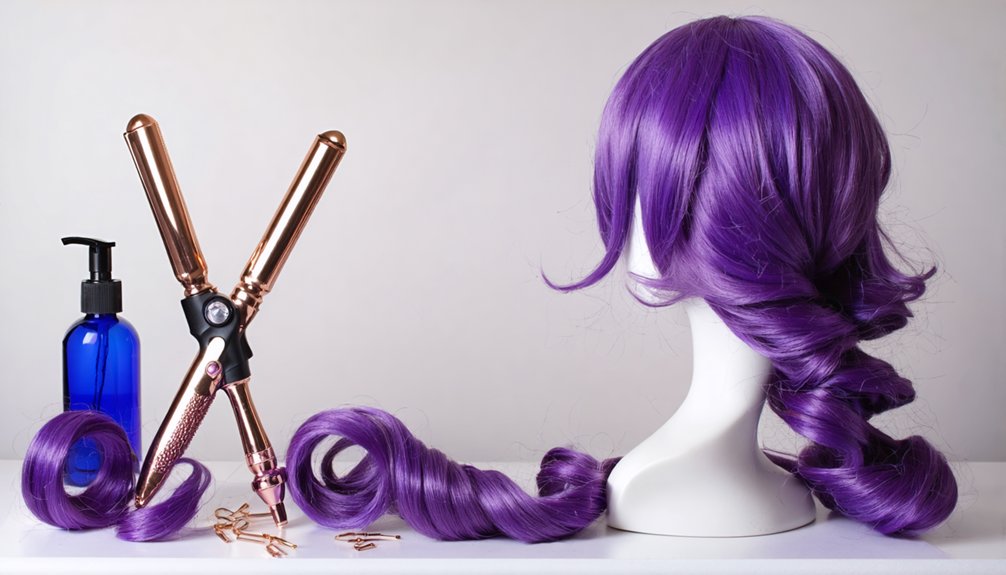
When using a curling wand or flat iron on a heat-friendly synthetic wig, you’ll want to keep your heat setting between 250°F and 280°F.
Work in small, precise sections for maximum control. Wrap each small section around the barrel briefly, then release and let it cool completely before touching it—that’s how the fiber locks into its new shape.
To avoid a uniform, artificial look, alternate your curl direction section by section. Rotate between wrapping toward and away from the face for a more dynamic, character-accurate finish.
Selecting Low Heat Settings
Curling wands and flat irons give you surgical control over accent curls, but synthetic fibers don’t forgive careless heat settings. Fiber compatibility determines everything — wrong temperatures melt strands instantly, destroying your cosplay silhouette.
Prioritize heat source safety by confirming your wig’s heat-friendly rating before touching any tool to it.
Follow these four precision rules:
- Set tools between 250°F–280°F — never exceed this range on synthetic fibers.
- Test a hidden strand first — confirm fiber compatibility before committing to full sections.
- Keep contact time under three seconds — brief exposure prevents melting while still reshaping fibers.
- Cool each curl completely before releasing — heat source safety means letting the shape lock before manipulation.
Precision here separates polished cosplay from damaged wigs.
Small Sections, Better Control
Small sections give you surgical control that wide grabs simply can’t match — especially when you’re placing accent curls around face-framing pieces or layered cosplay silhouettes. Thin subsections let you engineer curl pattern variations deliberately, alternating direction on each strand to mimic dimensional, character-accurate movement.
With a curling wand or flat iron on low heat, you’ll wrap each small section briefly, then release before heat buildup damages the fiber. Layering techniques shine here — shorter underlayers get tighter wraps while outer pieces receive looser spirals, creating intentional depth across the full silhouette. This contrast reads dramatically under convention lighting.
Work methodically from the underlayers outward, never rushing contact time. Cool each curl completely before touching the next section, and your placement stays precise throughout.
Alternating Curl Direction Naturally
Once your section sizes are locked in, the direction you curl each strand becomes the variable that separates flat, uniform results from convincing, character-accurate movement.
Alternating curl direction builds asymmetrical curls that generate natural volume without stacking identical spirals against each other.
Follow this directional rotation:
- Curl away from the face on dominant front sections to open the silhouette outward.
- Curl toward the face on secondary sections to create layered depth behind the leading strands.
- Alternate every two sections across the mid-lengths to break repetition convincingly.
- Reserve consistent direction only for character-specific accent pieces requiring sculpted uniformity.
This approach mimics how natural hair behaves under movement, giving your cosplay wig dimensional flow rather than a costume-store rigidity.
Cool Your Synthetic Wig Curls Before Touching Them
Patience is the difference between a defined ringlet and a frizzy, shapeless disappointment. When you remove a curl before the fiber hardens, you’re collapsing the structure you just built. Temperature regulation isn’t optional — it’s the mechanism that locks synthetic fibers into their new shape.
Your cooling techniques determine whether the style survives contact or unravels immediately. Leave rollers, rods, or wand-set sections completely undisturbed until they’ve dropped to room temperature. Don’t rush with a fan unless it’s cool air; warm air won’t trigger proper setting.
Once fully cooled, release each section gently using your fingers rather than a brush. That controlled separation preserves curl definition and keeps your cosplay silhouette sharp, intentional, and camera-ready.
Seal Your Curls With Strong-Hold Hairspray
Once your curls have cooled and set, strong-hold hairspray is what locks that shape against the heat, humidity, and movement that cosplay events throw at a wig.
You’ll want a spray rated for maximum hold rather than a flexible-finish formula, since synthetic fibers don’t rebond the way natural hair does and need that external structure.
Apply it section by section at a consistent distance, letting each pass dry before touching the curl so you don’t flatten the definition you just worked to create.
Why Hairspray Matters
Strong-hold hairspray is what stands between a stunning cosplay wig and a curl pattern that collapses mid-convention. Hair product formulations designed for maximum hold lock synthetic fibers into position after heat or steam styling.
You’ll get far better curl retention techniques by applying spray after full cooling, not before.
Here’s why it matters:
- Locks fiber memory — spray seals the curl’s reshaped structure against humidity and movement.
- Extends wear time — convention environments create heat and friction that break down unsupported curls.
- Preserves silhouette accuracy — character-specific shapes stay defined throughout long wearing sessions.
- Reduces mid-event touch-ups — a well-sprayed wig needs minimal correction, keeping your cosplay presentation consistent.
Apply in light, even layers and let each coat dry completely before handling.
Choosing The Right Spray
Not every hairspray delivers the hold synthetic wig fibers actually need. You want a strong-hold formula specifically designed for light, even distribution — heavy aerosols weigh down ringlets and collapse your carefully sculpted silhouette. Look for sprays labeled “maximum hold” or “freeze hold” without heavy alcohol concentrations that dry out synthetic strands over time, undermining wig preservation long-term.
For alternative styling approaches, fabric stiffeners diluted lightly in water offer a budget-conscious option that still locks curl definition effectively.
Whatever product you choose, apply it from roughly twelve inches away using short, controlled bursts. Spray after your curls cool completely — not during. This timing matters because synthetic fibers set their shape during cooling, and premature spraying interferes with that process, reducing both definition and durability.
Applying For Maximum Hold
Getting the application technique right separates a curl that lasts through a full convention day from one that droops by the second hour. After confirming fiber compatibility and avoiding heat damage during styling, locking your curls correctly seals everything in.
- Hold the can 10–12 inches away to distribute mist evenly without saturating fibers.
- Spray in thin, layered passes rather than one heavy coat to prevent stiffness and buildup.
- Let each layer dry completely before adding another for compounding hold strength.
- Target the curl’s mid-shaft and tip, not the root, to preserve volume and movement.
Once finished, don’t touch the curls immediately. Let them harden fully, then gently separate with your fingers to reveal defined, convention-ready ringlets.
Place Curls to Match Your Character’s Silhouette
Because cosplay accuracy lives in the silhouette, you’ll want to map your curl placement directly against your character’s reference art before touching the wig. Study the volume zones — where curls stack, where they fall flat, where they frame the face.
Many iconic character hairstyles carry historical hairstyle roots, borrowing structural cues from styles with deep cultural significance, like Victorian ringlets or Heian court cascades. Recognizing those influences sharpens your placement instincts.
Work section by section, mirroring the reference’s silhouette geometry. Front pieces typically define character recognition, so prioritize those.
Use tighter curls for high-volume crown areas and looser spirals for trailing lengths. Pin finished sections out of the way until the full shape emerges, then step back and compare your wig against the reference before finalizing.
Fix Flat or Frizzy Sections Without Restyling the Whole Wig
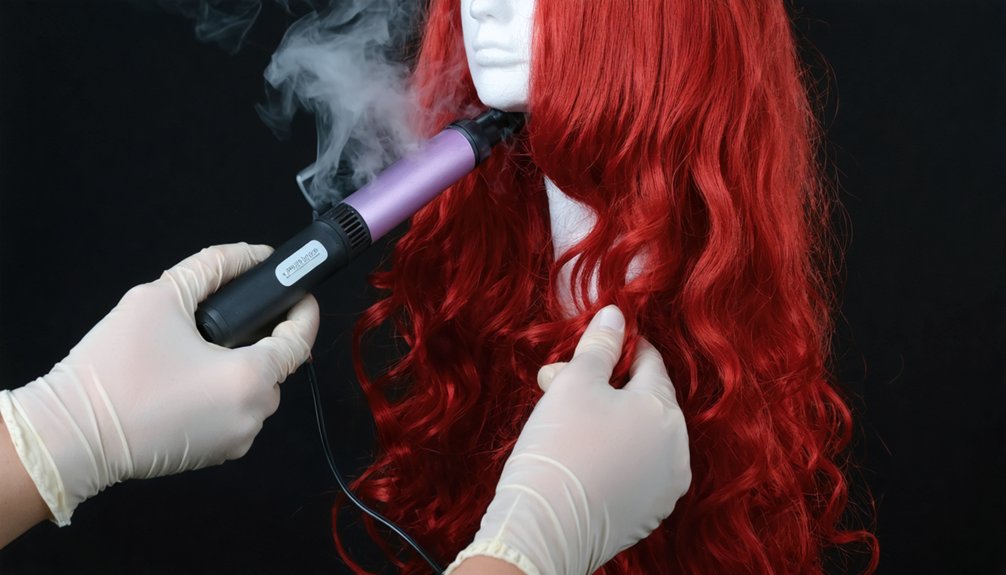
Even a well-styled wig develops trouble spots after transport or wear — a flattened crown section, a frizzy face-framing piece, a curl that lost its definition. You don’t need to restyle everything. Target only what’s broken.
- Frizz control: Smooth flyaways with a small amount of silicone serum applied fingertip-to-strand, avoiding root buildup.
- Shine enhancement: Mist a lightweight wig-safe shine spray to restore fiber vibrancy without weighing curls down.
- Revive flat curls: Re-wrap the collapsed section around a foam roller, steam briefly, then cool completely before releasing.
- Redefine curl edges: Use a low-heat curling wand on small accent sections for 3–5 seconds, then hold until cooled.
Spot corrections protect your full style investment while keeping character accuracy intact.
Frequently Asked Questions
How Do You Store a Curled Synthetic Wig Between Conventions?
Your curls could survive a thousand conventions if you nail wig storage properly. Place it on a wig head, loosely pin curls, and mist with strong-hold spray for flawless curl preservation between events.
Can You Curl a Lace Front Synthetic Wig the Same Way?
Yes, you can curl a lace front synthetic wig similarly, but protect the delicate lace hairline from direct heat. Style the synthetic fibers in small sections, working carefully away from the lace to prevent irreversible damage.
How Long Does a Steam-Set Curl Typically Last on Synthetic Fiber?
Steam-set curls on synthetic fiber can last weeks when you’ve maximized heat resistance through proper cooling. Your curl longevity depends on careful storage, minimal manipulation, and locking that sculpted shape with strong-hold hairspray after each session.
Does Wig Color Affect How Heat-Friendly the Synthetic Fibers Are?
Two wigs, same style, different shades—yet heat resistance stays tied to fiber type, not color. You’ll find fiber durability depends on manufacturing, so always test a strand regardless of your wig’s hue.
Can You Curl a Synthetic Wig While It Is on Your Head?
You shouldn’t curl a synthetic wig while wearing it—heat exposure near your scalp risks burns. For superior wig maintenance and styling versatility, style it on a wig head, ensuring precise, controlled curls every time.
References
- https://www.youtube.com/watch?v=S1ruL3_bOeY
- https://www.epiccosplay.com/blogs/styling-guide/how-to-curl-our-wig-using-steam-and-other-heat-styling-tips
- https://aliceincosplayland.com/2019/08/how-to-make-tight-curls-on-your-wig.html
- https://www.reddit.com/r/CosplayHelp/comments/1d5xx5q/how_can_i_curl_my_wig/
- https://tragee.com/Blog/can_you_put_heat_on_a_synthetic_wig_safely_and_which_temperatures_and_tools_to_use_for_styling.html
- https://www.youtube.com/watch?v=w8CCODasD44
- https://ehwap.com/Blog/can_you_put_heat_on_a_synthetic_wig_practical_heat_styling_tips_safe_temperatures_and_damage_prevention.html
- https://silkarahair.com.au/blogs/news/how-to-style-heat-resistant-synthetic-hair-safely
- https://www.youtube.com/watch?v=wAuVVk5CGoA
- https://starstruckpanda.com/quick-wig-styling-hacks-for-cosplay-events/