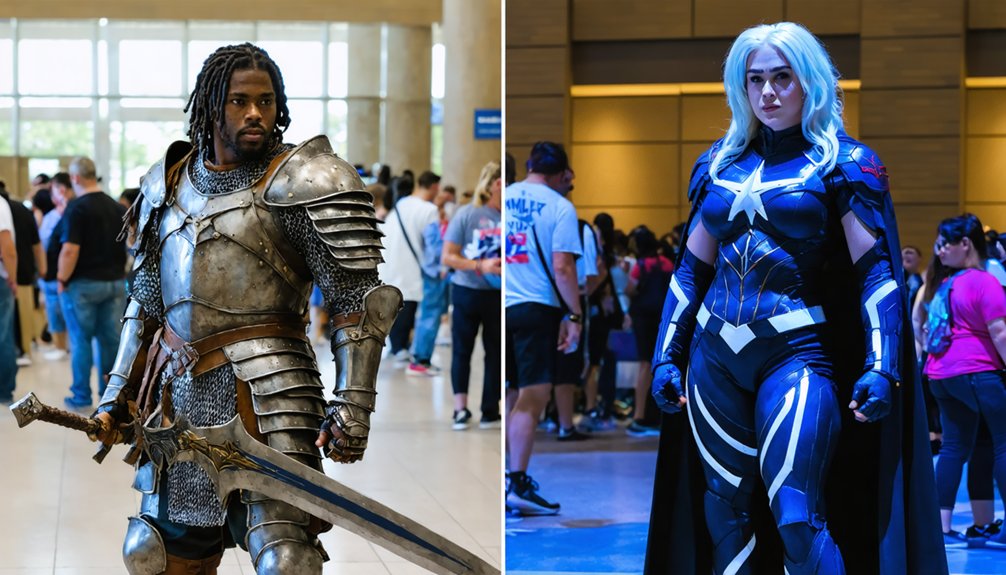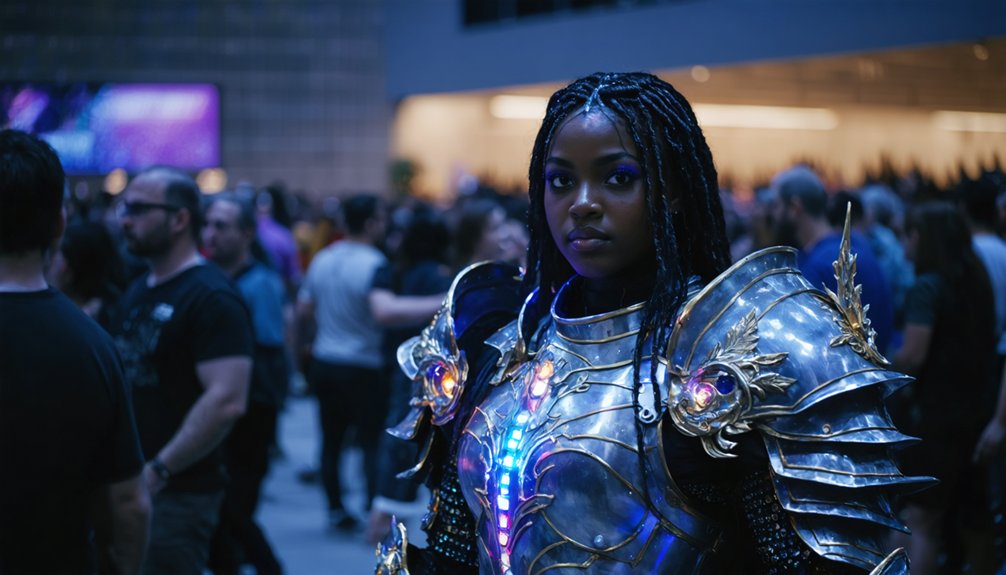
Cosplay means actively embodying a character — not just wearing a costume, but capturing their poses, mannerisms, and backstory. The word comes from Japan’s “kosupure,” coined in 1984, and it’s spread into a global phenomenon spanning anime, gaming, and Western comics. It’s open to everyone, regardless of age, body type, or background. Whether you’re a beginner or a seasoned competitor, there’s far more to this creative subculture than you might expect.
Key Takeaways
- Cosplay means actively embodying a character through costume, poses, and mannerisms, functioning as both a noun and a verb.
- The term originates from the Japanese “kosupure,” coined by Nobuyuki Takahashi in 1984 following the World Science Fiction Convention.
- Unlike Halloween costumes, cosplay requires genuine character knowledge, including backstory and mannerisms, emphasizing immersive role portrayal.
- Cosplay is inclusive, welcoming all body types, genders, and ages, with DIY costumes holding equal significance to professional ones.
- Originally a niche Japanese subculture, cosplay became a global phenomenon driven by anime, gaming, and internet cross-cultural exchange.
What Does Cosplay Actually Mean?
At its core, cosplay means more than wearing a costume. You’re actively embodying a character—adopting their poses, catchphrases, and mannerisms. This distinguishes it from Halloween dress-up, where celebration takes priority over portrayal.
The cosplay community has expanded this definition over time, embracing character evolution across anime, manga, video games, and Western comics.
You can cosplay as a noun (“a Sailor Moon cosplay”) or verb (“I cosplayed as Superman”), reflecting how deeply the practice has embedded itself into contemporary culture.
Where the Word “Cosplay” Comes From
When you trace “cosplay” back to its roots, you’ll find a Japanese term — “kosupure” (コスプレ) — that itself is a portmanteau of “costume” and “play.”
Nobuyuki Takahashi coined the term in 1984 after attending the World Science Fiction Convention in Los Angeles, where he observed fans dressing as their favorite characters.
From that single moment of naming, the word traveled globally, eventually becoming the universal shorthand for an entire cultural practice.
A Japanese Term’s Origin
The word “cosplay” is a portmanteau of “costume” and “play,” but its roots trace directly to Japan. Nobuyuki Takahashi coined the Japanese term “kosupure” (コスプレ) in 1984, capturing the activity’s essence as both costume craftsmanship and performance art.
You can’t underestimate the cultural significance of this origin. Japan’s fan community transformed cosplay from a niche activity into a global trend, expanding character variety beyond anime and manga into worldwide media franchises.
Takahashi’s linguistic innovation gave the broader world a precise term for something previously difficult to define—creative expression through embodying fictional characters.
That Japanese influence shaped how you understand cosplay today: not as simple dress-up, but as an intentional, analytical practice where accuracy, performance, and community converge meaningfully.
Nobuyuki Takahashi Coins It
Takahashi’s influence extended far beyond word creation. By framing the activity as “play,” he embedded performance and character immersion directly into its definition.
You can trace cosplay evolution—from niche convention floors to professional modeling careers and global competitions—back to that deliberate linguistic choice. The word itself shaped how participants understand their role: not merely wearing a costume, but actively inhabiting one.
The Word Travels Globally
Once Takahashi coined “cosplay” in 1984, the term didn’t stay confined to Japan’s convention circuit. Through cross-cultural exchange and the rise of online platforms, it spread rapidly across continents, absorbing cultural adaptations along the way.
You can trace its expansion through global trends in anime, gaming, and Western comics, each community reinterpreting the practice through its own historical influences.
What makes cosplay‘s global journey remarkable is how it evolved beyond imitation. Community engagement deepened as fans transformed it into a vehicle for artistic expression, pushing boundaries in craftsmanship, storytelling, and gender inclusivity.
You’ll find cosplayers worldwide who don’t just replicate characters—they reimagine them. This worldwide adoption proves the term carries far more cultural weight than its simple portmanteau origins might suggest.
How to Use “Cosplay” in a Sentence
The word’s grammatical flexibility mirrors its cultural adaptability—it shifts naturally across contexts while retaining its core meaning: embodying a character through costume and performance.
Basic, Masquerade, and Character-Specific Cosplay
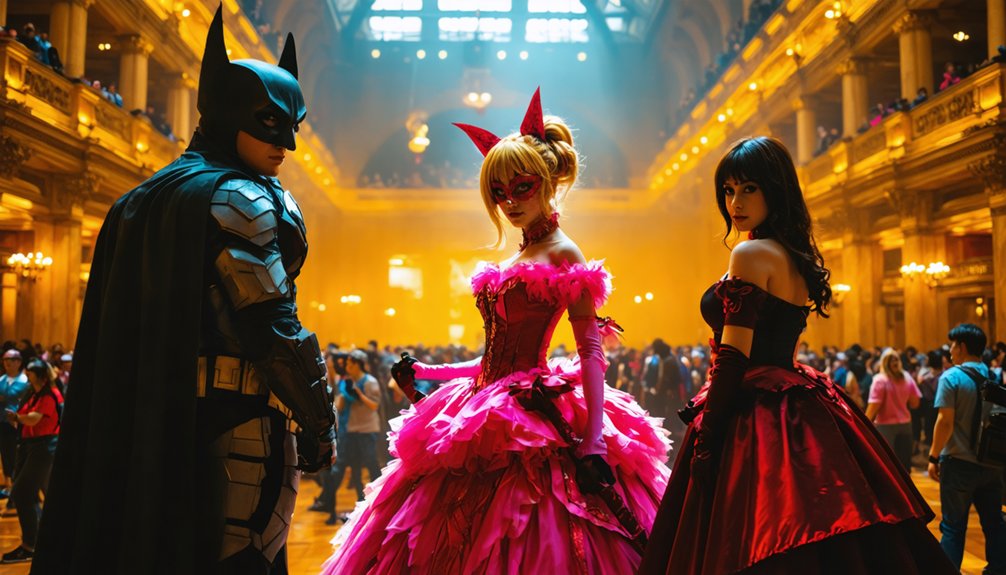
While cosplay broadly refers to costume-based character embodiment, it branches into distinct forms that differ in depth and intent.
Basic cosplay prioritizes visual representation through costume creativity, focusing on replicating a character’s appearance without demanding performance. It’s the ideal entry point for skill development, letting you refine craftsmanship before adding complexity.
At its core, basic cosplay is where craftsmanship begins—visual storytelling through costume, without the pressure of performance.
Masquerade cosplay elevates the experience by integrating performance elements—poses, dialogue, and theatrical presentation become central to your portrayal. Character accuracy matters here, distinguishing dedicated enthusiasts from casual participants.
Beyond these categories, non-character-specific costumes like maid uniforms still qualify as valid expressions within the community.
Gender inclusivity remains fundamental—you can portray any character regardless of identity. This flexibility drives community engagement, making cosplay an evolving, innovation-forward subculture rather than a rigid performance tradition.
How Cosplay Differs From Halloween and Costume Parties
When you cosplay, you’re not just wearing a costume for celebration—you’re committing to a character through immersive role portrayal.
Unlike Halloween, cosplay demands that you develop genuine expertise about your character, including their mannerisms, catchphrases, and backstory.
You don’t simply look the part; you actively perform it through poses, interactions, and in-character behavior that go far beyond surface appearance.
Character Immersion vs. Celebration
Cosplay and Halloween costumes might look similar on the surface, but they serve fundamentally different purposes. Halloween prioritizes celebration and seasonal tradition, where wearing a costume is simply part of the festivities. You don’t need to know anything about your character — you’re there to have fun.
Cosplay demands something deeper: character immersion. When you cosplay, you’re not just wearing a costume; you’re embodying a specific character‘s personality, mannerisms, and story. Role authenticity becomes your benchmark. You study catchphrases, practice poses, and engage with fellow fans from your character’s perspective.
This distinction matters because cosplay transforms passive fandom into active performance. You’re no longer just a fan wearing a costume — you’re a performer honoring the source material with precision and intentionality.
Expertise and Role Portrayal
That character immersion naturally demands a level of expertise that Halloween costumes simply don’t require. When you cosplay, you’re expected to understand your character’s backstory, mannerisms, signature poses, and iconic catchphrases.
This character expertise separates serious cosplayers from casual costume wearers. You’re not just wearing a recognizable outfit—you’re embodying a fully realized fictional identity.
At conventions, other fans will test your knowledge through interactions, photo requests, and character-specific exchanges. Role immersion means you’ll respond as the character would, maintaining consistency throughout the event.
This expertise-driven approach transforms cosplay into a performance art form. You’re simultaneously a costume designer, researcher, and actor.
That combination of technical craft and character knowledge creates something fundamentally more complex than picking a costume off a Halloween store shelf.
Performance Beyond Appearance
While Halloween rewards recognition, cosplay rewards transformation. You’re not just wearing a costume—you’re practicing performance art through complete character embodiment. This distinction redefines creative expression entirely.
True cosplay demands three performance layers:
- Role immersion — You adopt your character’s mannerisms, catchphrases, and emotional responses, making fan engagement authentic rather than superficial.
- Costume accuracy — You research construction details, materials, and proportions, treating narrative exploration as a design blueprint.
- Community connection — You interact with fellow cosplayers within shared fictional universes, building relationships through character-driven conversation.
Halloween prioritizes novelty for one night. Cosplay builds an ongoing identity.
You’re fundamentally a living, breathing extension of a story—where expertise meets artistry and performance transcends what you’re wearing.
Anyone Can Cosplay: Here’s What That Really Means
One of cosplay’s most defining principles is that it’s genuinely open to everyone — regardless of body type, gender, age, or background. This inclusive community thrives on creative expression over perfection.
Cosplay belongs to everyone — your body, your background, your rules. Creative expression always wins over perfection.
You don’t need an expensive wardrobe or professional skills — DIY costumes carry the same cultural weight as studio-crafted ones.
What matters most is your character connection and authentic fandom engagement. When you embody a character, you’re participating in a living form of performance art that bridges personal identity with shared storytelling.
Cosplay also functions as cultural exchange, allowing you to explore narratives far outside your own experience.
The standard isn’t accuracy — it’s intention. If you’re showing up with genuine enthusiasm and creative investment, you’re already doing it right.
Where Cosplayers Meet and Compete
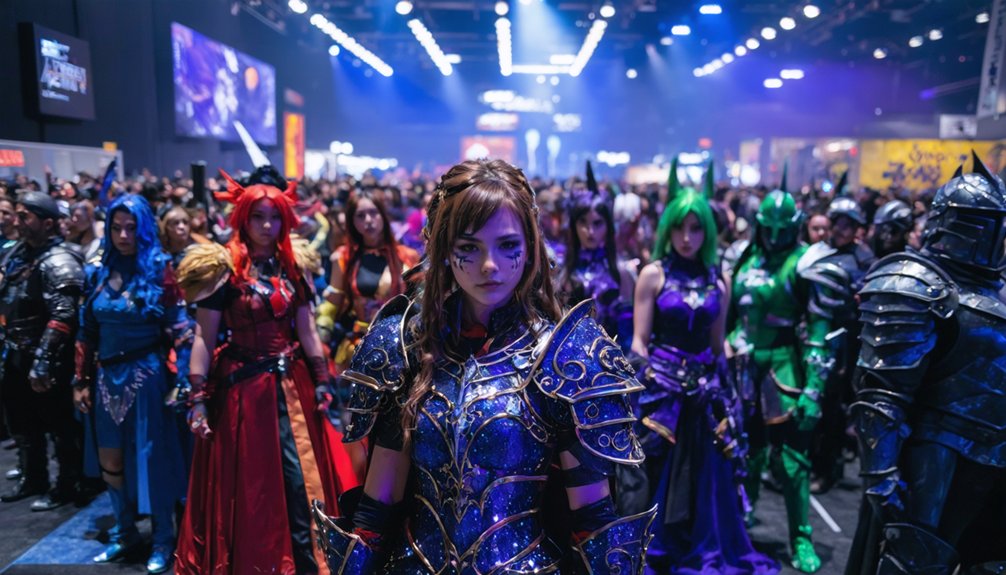
Cosplay’s open-door philosophy finds its fullest expression when practitioners actually gather — and conventions are where that energy becomes tangible.
Convention gatherings transform individual creativity into collective experience, offering community engagement that online spaces simply can’t replicate.
You’ll encounter three primary venue types:
- Major anime and pop culture expos — Large-scale fan experiences featuring showcase performances, cosplay workshops, and competition events with professional judging.
- Cosplay meetups — Smaller, intimate social interactions centered on creative collaborations and character-specific networking opportunities.
- Masquerade competitions — Structured events where you demonstrate craftsmanship and performance simultaneously.
These spaces aren’t passive.
You’re actively building relationships, refining techniques through cosplay workshops, and pushing creative boundaries alongside peers who share your investment in the craft.
Why Cosplay Became a Global Phenomenon
What began as a niche Japanese subculture in the 1980s has expanded into a worldwide creative movement, and understanding why requires examining the forces that carried it beyond its origins.
Cross-cultural influences accelerated through the internet, allowing fandom evolution to move faster than any single region could contain. You’ll find that global trends in anime, gaming, and streaming dismantled accessibility issues that once limited participation.
Character diversity gave people across backgrounds meaningful figures to portray, deepening identity exploration beyond simple costume-wearing. Creative expression merged with artistic collaboration, producing communities where craftsmanship genuinely matters.
Character diversity transformed cosplay into genuine identity exploration, where craftsmanship and artistic collaboration give every creator meaningful purpose.
Community engagement at conventions reinforced belonging, turning individual passion into collective identity. The cultural significance of cosplay ultimately rests on one undeniable truth: it transforms passive consumption into active, personal participation that resonates universally.
Frequently Asked Questions
How Much Does It Typically Cost to Create a Cosplay Costume?
Costs vary widely—you’ll spend $50–$500+ depending on complexity. Prioritize budget planning early and explore creative fabric sourcing to maximize value. Your investment reflects skill level, materials, and whether you’re crafting or commissioning the costume.
What Materials Are Most Commonly Used to Build Cosplay Props?
Like a sculptor’s dream, you’ll find foam crafting dominates prop-making. You can also use Worbla, resin, and cardboard. After shaping, prop painting brings your creations to life with vivid, character-accurate finishes.
Are There Age Restrictions for Entering Cosplay Competitions?
Age restrictions vary by event, so you’ll need to check each competition’s costume guidelines and competition rules carefully. Many conventions offer youth categories, while others welcome all ages, ensuring you can find the right competitive fit.
Can Cosplay Be Considered a Viable Full-Time Career Option?
Like a rare gem, cosplay income can sustain you fully if you’re strategic. Career sustainability demands diversifying through modeling, competitions, sponsorships, and content creation—you’ll need business acumen alongside your creative passion to thrive professionally.
What Are the Most Popular Characters Cosplayed Worldwide Each Year?
You’ll find character trends shift annually based on major releases. At global conventions, you’re seeing Spider-Man, Harley Quinn, and trending anime characters like Demon Slayer’s Tanjiro consistently dominate popularity charts, reflecting current media’s cultural impact.
References
- https://dictionary.cambridge.org/us/dictionary/english/cosplay
- https://www.dictionary.com/browse/cosplay
- https://www.merriam-webster.com/dictionary/cosplay
- https://www.britannica.com/topic/cosplay
- https://en.wikipedia.org/wiki/Cosplay
- https://www.merriam-webster.com/word-of-the-day/cosplay-2024-01-14?ICID=ref_fark
- https://libguides.lib.umt.edu/cosplay
- https://www.youtube.com/watch?v=Xw1HalEUN9U
- https://www.collinsdictionary.com/english-language-learning/cosplay
- https://theconversation.com/explainer-what-is-cosplay-20759