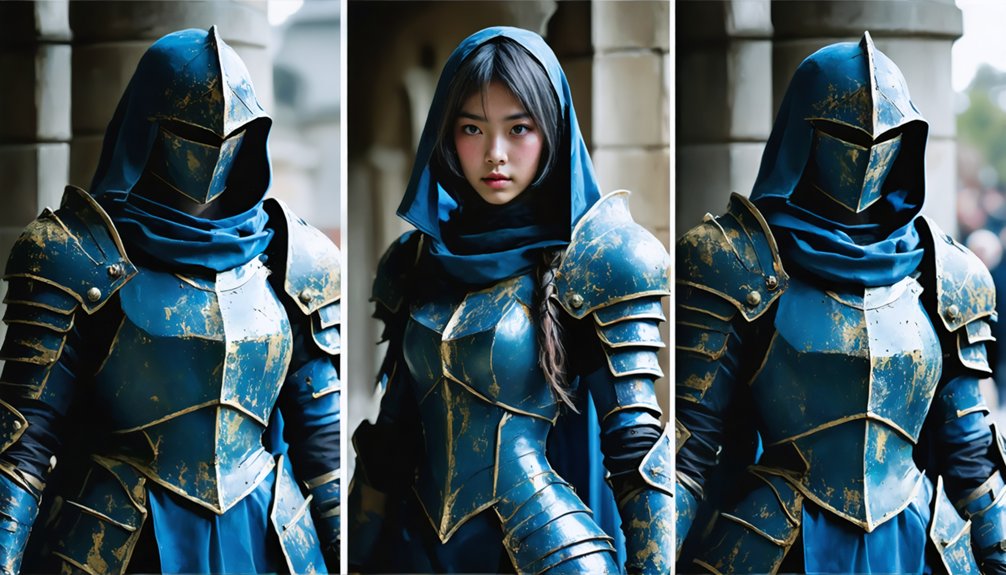
To study a character effectively for cosplay, you’ll want to build a reference library of official artwork, concept sketches, and screenshots. Immerse yourself in the source material to track movement patterns, speech cadence, and emotional responses. Analyze the character’s psychology, map their relationships, and rehearse their mannerisms until they feel instinctive. Prioritize signature props that carry immediate recognition weight. Every technique covered ahead will sharpen your portrayal from costume construction to full character embodiment.
Key Takeaways
- Build a reference library using official artwork, concept sketches, and screenshots to guide accurate costume construction and material selection.
- Engage deeply with source material to track character movement, vocal cadence, mannerisms, and emotional responses authentically.
- Study character psychology by identifying motivations, relationship dynamics, and personality evolution to inform portrayal decisions.
- Analyze posture, gestures, and facial expressions, then practice movement mimicry until character embodiment feels instinctive.
- Balance accuracy with creative interpretation by anchoring design choices in thematic elements while honoring the character’s core identity.
Build Your Character Reference Library Before Anything Else
Before constructing a single seam or sourcing a single prop, you’ll need a solid reference library as your foundation. Gather official artwork, concept sketches, and production screenshots from multiple angles to capture design evolution across different character versions.
Organize everything in a centralized digital or physical folder for efficient access throughout your build.
Don’t overlook fan art and other cosplayers’ interpretations—they reveal nuanced details and character mood that official sources sometimes obscure. When design variations exist across source material versions, deliberately select one primary reference to maintain consistency.
Cross-referencing multiple visual sources creates a thorough foundation that informs every construction decision, from fabric selection to prop fabrication.
Your reference library isn’t supplementary—it’s the technical blueprint driving every accurate, intentional choice you’ll make.
How to Use Games, Shows, and Manga as Character Study Tools
Once you’ve assembled your reference library, you need to immerse yourself directly in the source material—playing the game, watching the series, or reading the manga with deliberate analytical focus rather than passive consumption.
Track your character’s movement patterns, vocal cadence, emotional responses, and recurring behavioral tendencies across multiple scenes or chapters.
When your character appears across different media formats, cross-reference each version to identify consistent core traits versus adaptation-specific interpretations, then anchor your portrayal to those constants.
Immersive Source Material Exploration
Diving deep into a character’s source material is the most direct path to authentic portrayal. Don’t skim surface-level summaries—engage fully with the games, shows, or manga featuring your character. Immersive storytelling reveals motivations, relationships, and behavioral nuances that static images can’t communicate.
Pay attention to character symbolism embedded in design choices, color palettes, and recurring visual motifs; these elements inform both costume accuracy and performance depth.
Take notes while consuming source material, documenting specific mannerisms, speech patterns, and emotional responses. Screenshot key scenes and bookmark pivotal story moments that define your character’s core identity.
Multiple playthroughs or rewatches uncover details missed during initial viewing. This disciplined, thorough approach transforms your understanding from superficial recognition into genuine comprehension—producing a portrayal that resonates authentically with fellow enthusiasts.
Cross-Media Character Analysis
When a character appears across multiple media formats, each version offers distinct analytical value that deepens your overall understanding of their design and personality.
Games reveal interactive behavioral patterns; manga exposes raw visual storytelling and design variations absent from adaptations. Animated shows demonstrate emotional resonance through voice and movement.
Track character evolution across these platforms deliberately. Cross-media influences shape thematic motifs differently—a character’s cultural contexts shift between Japanese manga origins and Western animated interpretations.
These narrative structures inform costume and performance choices that single-source study misses entirely.
Create comparison charts documenting how each medium presents your character differently. Identify consistent core traits versus format-specific additions.
This analytical approach transforms surface-level costume recreation into authoritative character embodiment, giving your portrayal technical depth that resonates with dedicated enthusiasts across communities.
Get Inside Your Character’s Head Before You Build Anything
Before you cut a single piece of fabric or glue anything together, you need to fully understand who your character is at their core. Psychological depth drives performance authenticity, transforming costumes into immersive experiences.
Research these foundational elements first:
- Character motivations — identify what drives decisions across narrative arcs
- Emotional connections — map relationship dynamics with other characters
- Character evolution — track how personality shifts throughout the story
- Design inspirations — connect visual choices to psychological traits
- Personal interpretation — define your unique creative angle while honoring source material
Consume every available piece of source material. Watch cutscenes, read lore, analyze dialogue.
Understanding your character’s psychology before construction begins guarantees every design decision reinforces authentic portrayal rather than surface-level imitation.
Which Props and Details Make Your Character Instantly Recognizable
Once you’ve mapped your character’s psychology, that internal knowledge needs to translate into external, immediately readable visual signals. Prop significance determines whether viewers recognize your character within seconds.
Prioritize detail selection by identifying which iconic accessories carry the most character symbolism—a wizard’s staff, a hero’s shield, a villain’s signature weapon.
Study your reference materials specifically for visual cues that casual observers immediately associate with your character. These essential elements often include silhouette-defining pieces, distinctive color combinations, or recognizable features like unusual hairstyles or markings.
Prop authenticity matters considerably here. A poorly constructed signature item undermines your entire portrayal faster than any other mistake.
Invest disproportionate effort into your character’s two or three most defining props rather than distributing attention evenly across every costume component.
Mirror Their Moves: How Character Study Extends to Body Language

Translating your character’s inner psychology into physical movement requires deliberate study of how they carry themselves across source material.
Systematic movement mimicry and nuance exploration elevate character embodiment beyond costume aesthetics into authentic physical translation.
Study these expressive dynamics through focused observation:
- Posture analysis: Identify how your character holds their spine, shoulders, and weight distribution during neutral and tense moments.
- Gesture patterns: Catalog recurring hand movements and arm positioning that signal emotional subtleties.
- Facial expressions: Map microexpressions tied to specific emotional triggers throughout source material.
- Body language context: Note how posture shifts between relationship dynamics and environmental pressures.
- Movement mimicry practice: Record yourself replicating movements, then compare against reference footage for precision refinement.
Consistent rehearsal transforms studied observation into instinctive, convincing character embodiment.
Practice Techniques That Complete Your Character Study
Once you’ve studied your character’s body language, take your preparation further by rehearsing key scenes and dialogue until the performance feels instinctive rather than forced.
Run through signature exchanges, emotional beats, and pivotal moments from the source material so you can respond authentically when fans engage you at events.
Then sharpen your portrayal by seeking feedback from experienced cosplayers and community members who can identify gaps between your interpretation and the character’s established traits.
Rehearse Scenes And Dialogue
Rehearsing scenes and dialogue transforms theoretical character knowledge into authentic, embodied performance. You’ll internalize speech rhythms, emotional responses, and behavioral patterns through deliberate practice rather than passive observation.
Maximize your rehearsal sessions by focusing on these critical techniques:
- Record your dialogue delivery and analyze vocal tone, pacing, and emotional authenticity against source material.
- Practice scene improvisation using your character’s established psychology to navigate unexpected interactions at events.
- Rehearse emotionally charged moments repeatedly until responses feel instinctive rather than calculated.
- Engage fellow cosplayers as scene partners to simulate real convention dynamics.
- Study original voice actor performances frame-by-frame to capture subtle linguistic patterns and inflection choices.
Consistent rehearsal converts research into muscle memory, ensuring your character portrayal remains convincing across extended event appearances without cognitive strain.
Refine Through Community Engagement
Community engagement completes your character study by converting isolated practice into battle-tested performance. Seek community feedback from experienced cosplayers who recognize technical inconsistencies you’ve missed. Their perspective identifies gaps between your portrayal and the character’s established attributes, targeting specific mannerisms, vocal patterns, or costume accuracy issues requiring correction.
Collaborative improvement accelerates your development exponentially compared to solo refinement. Participate in panels, group photoshoots, and cosplay meetups where real-time interaction tests your character embodiment under authentic conditions.
When fellow enthusiasts challenge your interpretation, you’ll discover whether your character study has depth or only surface-level familiarity.
Document the feedback you receive systematically, prioritizing recurring critiques over isolated opinions. Implement changes methodically, then return to community settings to measure your progress against previous performance benchmarks.
How Your Character Research Should Guide Creative Costume Decisions
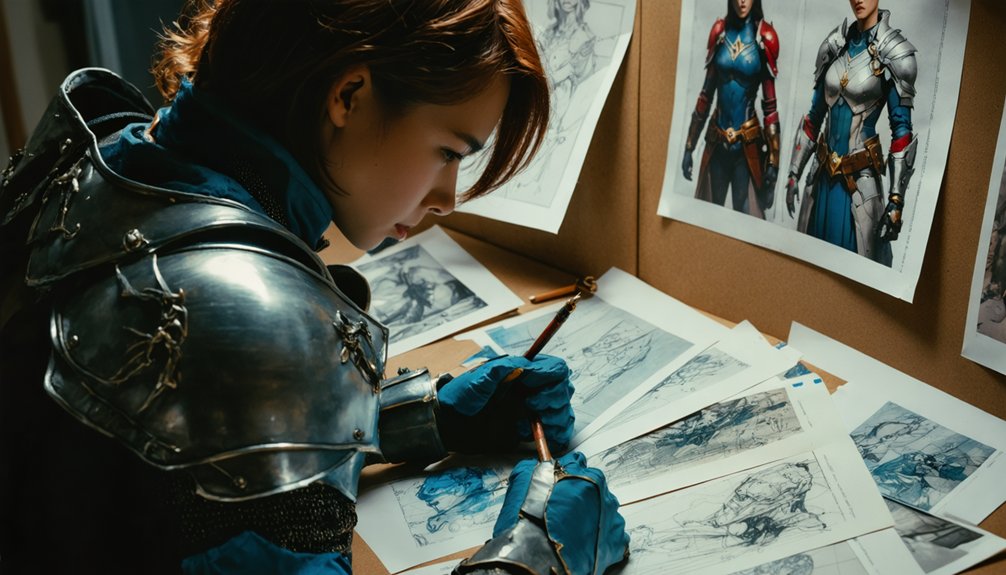
Character research isn’t just background work—it directly shapes the technical decisions you make when building your costume. Understanding your character’s personality, movement style, and narrative role transforms how you approach character design and costume functionality.
Use your research to drive these key decisions:
- Material selection: A warrior’s armor should reflect battle wear; a noble’s garment should convey refinement.
- Color accuracy: Cross-reference your primary source materials to match exact palette choices.
- Mobility requirements: Active characters demand flexible construction and unrestricted movement.
- Accessory prioritization: Signature props carry the most recognition weight—build those first.
- Detail hierarchy: Identify which elements define the character versus which are secondary.
Your research eliminates guesswork, replacing arbitrary choices with informed, intentional construction decisions that authentically honor the character’s identity.
Accuracy vs. Creative Spin: Finding Your Balance
Once your research has informed your construction decisions, you’ll face one of cosplay’s most personal questions: how closely should you follow the source material?
Neither pure accuracy nor bold reinterpretation automatically wins. Instead, anchor your design choices in the character’s thematic elements and visual symbolism, then decide where creative deviation strengthens your portrayal.
Consider cultural influences, historical context, and character evolution when exploring style variations—these factors often justify meaningful departures from canonical designs.
Cultural context and character evolution don’t just permit creative departures from canon—they often demand them.
Audience perception shifts based on how confidently you execute your interpretation. Performance nuances, emotional resonance, and consistent internal logic matter more than pixel-perfect replication.
If your creative spin honors the character’s core identity, it’ll read as intentional rather than inaccurate.
Document your reasoning. Knowing why you made each choice sharpens both your craft and your ability to articulate your vision.
Workshops and Communities That Deepen Your Character Study

Workshops and community engagement sharpen character study skills that solo research can’t fully develop. Through collaborative learning and workshop networking, you’ll accelerate your character portrayal beyond what independent study achieves.
Engage these high-impact resources:
- Acting workshops: Build character improvisation skills through structured technique instruction.
- Panel discussions: Access expert insights on screen-accurate interpretation and creative portrayal methods.
- Community feedback sessions: Receive precise critiques that identify performance gaps you’d otherwise miss.
- Cosplay group rehearsals: Practice scene work collectively, refining mannerisms through real-time response.
- Online cosplay forums: Leverage community feedback from experienced cosplayers across diverse character specializations.
Each resource compounds your technical ability differently.
Prioritize consistent participation rather than occasional attendance—character mastery develops through repeated exposure to collaborative learning environments where constructive challenges push your portrayal forward.
Frequently Asked Questions
How Do I Cosplay a Character Whose Source Material Is in Another Language?
Like a cultural bridge-builder, you’ll conquer language barriers by immersing yourself in subtitles, fan translations, and community resources. Study cultural context through visual storytelling, body language, and official artwork to authentically embody your character’s essence.
Can Children Effectively Participate in Character Study Techniques for Cosplay Purposes?
Yes, children can effectively engage in character study techniques. You’ll find child engagement thrives through simplified mannerism practice, guided character immersion activities, and age-appropriate backstory exploration, helping young cosplayers authentically embody their chosen characters with enthusiasm and creativity.
How Long Does Thorough Character Study Typically Take Before Cosplay Construction Begins?
Like roots before branches, you’ll typically spend one to four weeks immersing yourself in source material, mapping character timelines, and absorbing personality nuances before your cosplay construction meaningfully begins.
Should Character Study Techniques Differ When Cosplaying Villains Versus Heroic Characters?
Yes, you’ll need different approaches. When studying villain motivations, focus on psychological complexity and moral justifications, while heroic traits demand exploring selfless drive and relational dynamics—both require deep immersion into backstory, posture, and behavioral nuance.
How Do Cosplayers Handle Character Study for Roles With Minimal Official Source Material?
When source material’s scarce, you’ll piece together character motivation through fan communities, supplementary lore, and visual storytelling from related media. Synthesize these fragmented references into a cohesive interpretation, then craft an original backstory that authentically anchors your portrayal.
References
- https://dragonalley.shop/blog/cosplay-how-to-choose-and-interpret-a-character
- http://kiltedkatana.com/blog/2018/5/16/cosplay-tips-choosing-your-character
- https://craftysorceress.com/how-to-start-cosplaying/
- https://wigs101.com/10-tips-cosplay-beginners
- https://www.saberforum.com/index.php?topic=27637.0
- https://guides.mysapl.org/cosplay/skills
- https://texappealmag.com/crafting-a-character-the-art-passion-of-cosplay-costume-making/