To create realistic aging makeup for cosplay characters, you’ll need silicone prosthetics, liquid latex, alcohol-activated SFX pigments, and medical-grade adhesive. Start by exfoliating and priming your skin for ideal prosthetic adhesion. Stipple multiple latex layers onto high-movement zones like crow’s feet and nasolabial folds, then blend shading and highlighting for volumetric depth. Integrate root touch-up spray for gray hairline simulation. There’s a precise, methodical process behind each technique that’ll elevate your transformation greatly.
Key Takeaways
- Use silicone prosthetics for sagging jowls and eye bags, prioritizing them over liquid latex for better flexibility and breathability during wear.
- Stipple multiple thin liquid latex layers onto high-movement zones like crow’s feet and nasolabial folds, pulling skin taut for natural fold patterns.
- Apply SFX pigments using a speckling technique for age spots, blending edges seamlessly with a stippling sponge to mimic uneven pigmentation.
- Use darker pigments on sunken areas and lighter tones on protruding landmarks, blending meticulously to create realistic dimensional depth.
- Apply root touch-up spray in short bursts along temples and hairlines, then blend neck prosthetic edges for cohesive full transformation.
Gather the Right Tools and Materials for Aging Makeup
Before diving into application techniques, you’ll need to stock your kit with the right materials to pull off a convincing aged look. Precision in character portrayal starts with material selection.
Source silicone prosthetics for forehead wrinkles, sagging jowls, and eye bags, prioritizing silicone over liquid latex for superior flexibility and breathability. Stock liquid latex for stippling-based texture work on secondary zones.
For chromatic aging makeup techniques, assemble SFX pigments, alcohol-activated palettes, and powdered eyeshadows to replicate uneven pigmentation and age spots. Include dedicated darker shades for hollow contouring and lighter shades for protruding highlights.
A root touch-up spray handles gray hairline integration efficiently. Prep clean skin before any prosthetic or latex application to guarantee peak adhesion and material performance throughout wear.
Prep Your Skin Before Applying Aging Makeup
Proper skin prep across 3 critical zones—forehead, cheeks, and hands—determines whether your prosthetics and latex adhere cleanly or lift prematurely mid-wear.
Begin with targeted exfoliation techniques: use a fine-grit scrub or chemical exfoliant to eliminate dead cell buildup that compromises adhesion.
Follow immediately with controlled skin hydration—apply a lightweight, non-occlusive moisturizer, allowing full absorption before product application. Over-hydrated skin repels silicone-based adhesives, so balance is non-negotiable.
Once hydration stabilizes, cleanse each zone with isopropyl alcohol to strip residual oils and create an adhesion-ready surface. Pay particular attention to the periorbital region and nasolabial folds—high-movement areas where latex separation initiates fastest.
This systematic preparation protocol maximizes prosthetic integration, ensuring your aging transformation performs structurally through extended wear sessions.
Build Realistic Wrinkles With Latex and Prosthetics
With your skin prepped and primed, you’re ready to build convincing wrinkles using liquid latex and silicone prosthetics.
Using a sponge, stipple multiple thin layers of liquid latex onto target zones—forehead lines, crow’s feet, and nasolabial folds—allowing each layer to cure fully before applying the next to achieve pronounced, three-dimensional texture.
For high-impact areas like sagging jowls and eye bags, adhere pre-sculpted silicone prosthetics directly to the skin, as silicone’s superior flexibility and breathability outperform latex for extended cosplay wear.
Skin Prep Essentials
Achieving a seamless prosthetic or latex application starts with thorough skin prep — skip this step, and you’ll compromise adhesion, flexibility, and overall realism.
Begin by cleansing the skin with a gentle, oil-free cleanser to eliminate sebum, residual product, and environmental debris. Excess oils are the primary enemy of prosthetic adhesives, degrading bond strength across all skin types.
Next, apply a lightweight, alcohol-free toner to tighten pores and balance pH levels, optimizing your adhesive’s contact surface. For oily or combination skin types, incorporate a mattifying primer to extend makeup longevity and prevent prosthetic lift during wear.
Focus your prep on high-movement zones — forehead, cheeks, and jowl lines — where silicone and latex experience the most mechanical stress. Precision here directly determines your final application’s durability and anatomical accuracy.
Layering Latex Techniques
Two foundational materials drive realistic wrinkle construction — liquid latex and silicone prosthetics — and mastering their layered application is what separates convincing aged skin from flat, unconvincing surface painting.
For latex application techniques, you’ll stipple multiple thin coats using a compressed sponge, allowing each layer to cure before adding the next. This builds genuine topographic relief rather than painted illusion.
Target high-movement zones: crow’s feet, nasolabial grooves, and forehead furrows. For wrinkle texture tips, pull skin taut during latex application, then release it — the contraction creates organic fold patterns.
Silicone prosthetics deliver superior flexibility and breathability for jowls and eye bags. Layering both materials strategically produces dimensional, character-specific aging that withstands performance demands and close-range scrutiny.
Applying Silicone Prosthetics
Silicone prosthetics — wrinkled brows, crow’s feet appliances, sagging jowls, and eye bags — deliver structural aging that latex stippling alone can’t replicate.
For ideal silicone application, prep skin with isopropyl alcohol to eliminate oils compromising adhesion. Apply medical-grade silicone adhesive along prosthetic edges using a fine brush, pressing firmly from center outward to eliminate air pockets. Feather edges meticulously with acetone or Pros-Aide remover for seamless skin integration.
Prosthetic longevity depends on your sealing protocol. Lock edges with barrier spray before layering alcohol-activated pigments across the appliance surface.
Match undertones precisely using SFX palettes — platinum silicone accepts pigment differently than foam latex. Blend shading across forehead, jowl, and periorbital zones to unify prosthetic pieces with surrounding skin, creating convincing dimensional depth throughout your character’s aged facial structure.
Shade and Highlight for a Three-Dimensional Aging Effect
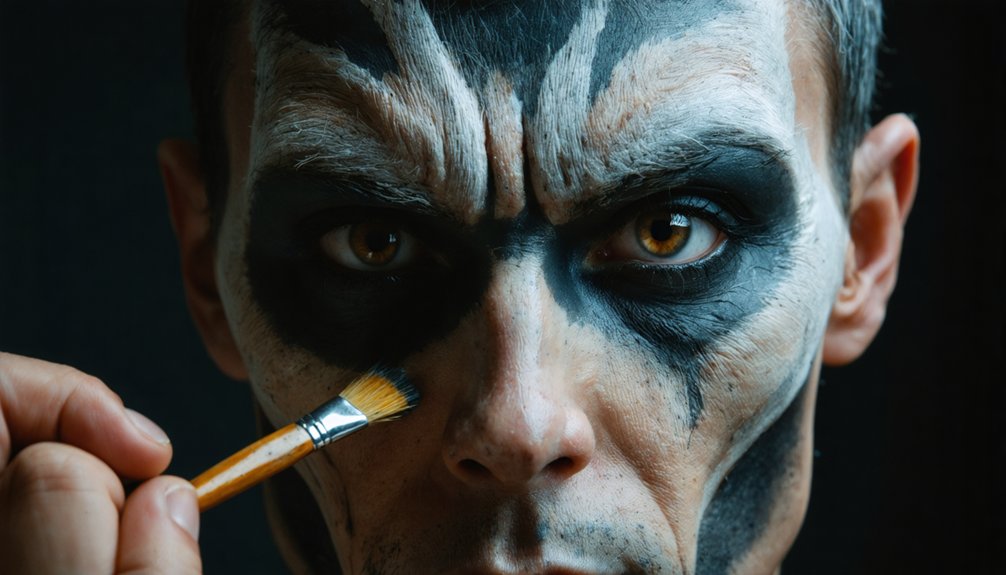
Once your prosthetics and latex layers are set, you’ll apply chiaroscuro-based shading to sculpt a convincing three-dimensional aging effect. Deploy darker pigments into sunken zones—sub-orbital hollows, temporal depressions, and mandibular ridges—to simulate volumetric recession.
Your shading tips here involve layering alcohol-activated pigments using precise stippling motions rather than broad strokes.
For highlighting techniques, apply lighter opaque tones to protruding anatomical landmarks: the zygomatic arch, supraorbital ridge, and nasolabial prominences. Position dark pigment along one wrinkle edge and a corresponding highlight on the opposing ridge to manufacture depth contrast.
For deeper complexions, introduce warm orange-toned highlights to maintain chromatic accuracy. Blend changes meticulously, eliminating harsh demarcations between shadow and highlight zones to achieve a seamlessly hollowed, age-authentic three-dimensional result.
Add Age Spots and Skin Texture to Your Aging Makeup
To mimic uneven skin pigmentation, you’ll want to apply SFX pigments strategically across high-visibility zones like the forehead, cheeks, and hands, using a chocolate-toned base to establish a naturalistic epidermal finish.
Execute the speckling technique by loading an alcohol-activated palette brush with concentrated pigment, then flicking or tapping it onto the skin’s surface to replicate the irregular dispersion of solar lentigines.
Blend your age spot colors into surrounding areas using a stippling sponge, ensuring chromatic shifts remain seamless while mud-toned fill shades reconcile any pigmentation gaps across the complexion.
Mimicking Uneven Skin Pigmentation
Age spots and uneven pigmentation are the hallmarks of realistic aging makeup, and replicating them requires a methodical layering approach with SFX pigments, face paints, and powdered eyeshadows.
Target high-visibility zones — forehead, cheekbones, and hands — where natural pigmentation clusters. Execute the speckling technique by loading your brush with a chocolate or umber shade, then flicking it across the skin’s surface for randomized distribution.
Tap individual spots with your fingertips to soften edges and integrate them into the surrounding skin texture. Avoid oversaturation; strategic sparseness reads more authentically than excessive coverage.
Fill transitional regions using mud-toned complexion-matching shades to bridge pigmentation clusters cohesively. This multi-layered chromatic approach transforms flat prosthetic surfaces into dimensionally convincing, age-accurate skin that withstands close-range scrutiny under high-intensity cosplay lighting conditions.
Speckling Technique For Spots
Speckling builds directly on your pigmentation layering work, translating clustered age spot mapping into granular, randomized skin texture. Load an alcohol-activated palette brush with your chosen chromatic concentration, then flick the bristles sharply toward targeted dermal zones—forehead, dorsal hands, malar regions. You’re distributing micro-deposits of pigment that replicate solar lentigo distribution patterns.
For speckling techniques, control your bristle tension and proximity to modulate droplet sizing. Closer applications yield concentrated micro-spots; increased distance disperses finer particulate scatter across broader surface areas. Tap activated pigment with fingertips between flicking passes to interrupt predictable patterning.
Critically, restrain your application density. Authentic aged skin texture prioritizes strategic sparsity over saturation—a few precisely placed chromatic clusters reads as biologically convincing, while oversaturation registers immediately as theatrical artifice.
Blending Age Spot Colors
Once your speckling passes have dried, you’ll blend adjacent chromatic deposits to eliminate artificially hard pigment edges while preserving their granular texture.
For age spot blending, load a clean filbert brush with minimal solvent and feather outward from each deposit’s perimeter using micro-circular strokes. This technique diffuses sharp boundaries without compromising the color texture integrity you’ve built through layering.
Work each spot individually, shifting its dominant hue into surrounding skin tones through graduated stippling pressure.
Darker chocolate deposits require a warm sienna intermediate tone bridging them to your base complexion. Lighter hypopigmented patches need cool beige shifting glazing.
You’ll achieve maximum dimensional realism by ensuring no two adjacent spots share identical chromatic values, mimicking authentic dermal pigmentation variance across forehead, cheekbones, and dorsal hand surfaces.
Finish Your Aging Makeup With Gray Hair Spray and Neck Prosthetics
The final 2 steps in completing your aging makeup transformation involve gray hair application and neck prosthetic placement.
Apply root touch-up spray strategically along your hairline, temples, and part lines to simulate natural age-related depigmentation. Use short, controlled bursts to build gradual gray density without oversaturating.
For neck prosthetic placement, clean and prime the neck’s surface before adhering your silicone piece with medical-grade adhesive.
Blend prosthetic edges seamlessly into surrounding skin using your alcohol-activated palette, matching undertones precisely. Layer shading and highlighting across the prosthetic’s surface, mirroring techniques applied to your facial work.
Both elements unify your complete character transformation — eliminating visual discontinuity between face, neck, and hair.
Together, they deliver a technically cohesive, anatomically convincing aged appearance that elevates your cosplay’s overall realism.
Frequently Asked Questions
How Long Does Aging Makeup Typically Last During a Cosplay Event?
Ironically, you’re aging faster than your makeup! Longevity factors like silicone prosthetics maximize durability through 8-12 hours under event conditions, while liquid latex degrades quicker, requiring touch-ups every 4-6 hours amid heat and activity.
Can Aging Makeup Techniques Work Effectively on All Skin Types?
Yes, aging makeup techniques work on all skin types, but you’ll need to adapt skin type considerations accordingly. Oily skin requires primer; dry skin needs moisturizing prep; darker complexions benefit from orange-highlight adjustments for ideal, innovative prosthetic adhesion.
How Do You Safely Remove Prosthetics Without Damaging Your Skin?
For safe prosthetic removal, you’ll apply medical-grade adhesive solvent along edges, gently lifting while dissolving the bond. Prioritize skin care by cleansing residual latex, then moisturizing to restore your skin’s hydration and barrier integrity post-removal.
Are There Budget-Friendly Alternatives to Professional Silicone Prosthetics?
You’ll find excellent budget alternatives in liquid latex and gelatin-based DIY solutions. Stipple latex over skin, layer gelatin prosthetics for textural depth, and utilize alcohol-activated pigments to replicate professional-grade silicone’s biomechanical realism affordably.
Can Aging Makeup Cause Allergic Reactions or Skin Irritation?
Yes, aging makeup can irritate your skin. You’ll want to conduct allergy testing on a small patch before full application. Those with elevated skin sensitivity should avoid latex-based formulations, opting instead for hypoallergenic silicone alternatives.
References
- https://www.cinemamakeup.com/blogs/essential-special-effects-techniques-for-aging-makeup/
- https://www.youtube.com/watch?v=dPQYtjbPukw
- https://www.youtube.com/watch?v=HImkOr4qAbo
- https://www.youtube.com/watch?v=a3i3U8-Uzt0
- https://abracadabranyc.com/collections/old-age-prosthetics