To create a convincing sci-fi costume, you’ll want to start with solid worldbuilding before cutting a single piece of foam. Combine 3D-printed details, foam panels, and thermoplastics for a layered structural approach. Route EL wire through pre-cut foam channels, then position LEDs at vents and seams for authentic lighting. Finish with dry-brushing, rust powders, and paint chipping to build real environmental history into the surface. There’s much more technique waiting ahead.
Key Takeaways
- 3D printing enables highly detailed costume components like visors and greebles that are difficult to achieve with traditional materials.
- Layering foam densities, dry-brushing, and rust powders transforms costume panels into convincing weathered artifacts from another world.
- Arduino or Raspberry Pi controllers enable sensor-triggered lighting sequences that respond dynamically to movement or sound.
- Combining thermoplastics molded over foam provides both structural rigidity and curved, impact-resistant panel support.
- Grounding design choices in worldbuilding—climate, culture, and technology—ensures costumes feel believable rather than purely aesthetic.
Build Your World Before You Build Your Sci-Fi Costume
Before sketching a single panel or printing a single part, define the world your costume inhabits. Ask yourself what climate your character endures, what government controls their appearance, and what technology they can access. These answers drive every design decision that follows.
Cultural influences shape what reads as fashionable, forbidden, or functional within your fictional society. Don’t ignore alien symbolism either — rank markers, sacred geometry, or faction insignias can transform a generic suit into a culturally loaded artifact.
Government structures justify restricted garments and visible status codes. Technology levels determine available materials, embedded tools, and wearable devices. When you establish these parameters first, your costume stops being a collection of cool shapes and becomes a believable extension of a living, breathing world.
Design Your Sci-Fi Costume Shape Before You Cut Anything
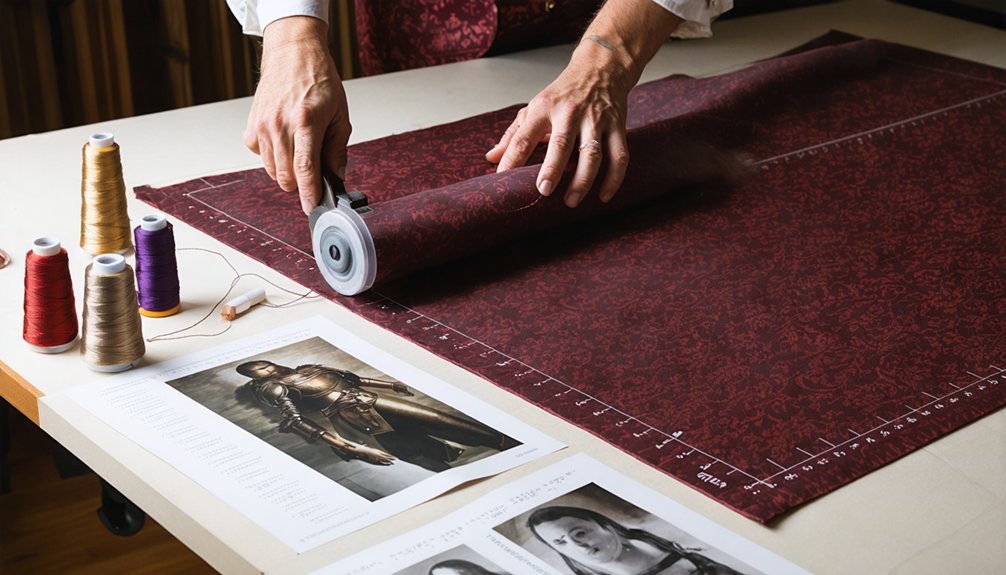
Once your world’s rules are locked in, those parameters become the skeleton of your silhouette. Before touching fabric, sketch your forms digitally or on paper, defining where hard armor panels meet flexible underlayers. Your color palette should reflect environmental logic — muted desert tones, bioluminescent deep-sea hues, or industrial grays tied directly to your setting’s climate and culture.
Use ZBrush to sculpt 3D concept shapes quickly, treating each iteration as a disposable sketch. Test proportions, cut lines, and volume relationships before committing to physical materials. Fabric manipulation techniques like pleating, bonding, and heat-shaping work best when you’ve already resolved silhouette decisions digitally.
This sequencing prevents costly material waste and forces intentional choices. Every panel placement should answer a worldbuilding question, not just a visual preference.
Use 3D Printing, Foam, and Thermoplastics Together
Each material in your build serves a distinct structural role, and mixing them strategically is what separates a convincing sci-fi costume from a craft project. 3D printing handles your high-detail components — helmet visors, greebled panels, articulated buckles — where surface precision matters most.
For assembly techniques that maximize material durability, follow this layered approach:
- Print rigid accent pieces where fine detail defines realism
- Cut foam for large body panels, flex zones, and weight-sensitive areas
- Mold thermoplastics over foam to reinforce curved structures needing impact resistance
- Bond layers using contact cement, then seal connections with flexible caulk
Each junction between materials becomes a deliberate design decision. You’re engineering wearable architecture — one where every material earns its placement through function, not convenience.
Wire In Lights and Electronics That Actually Work
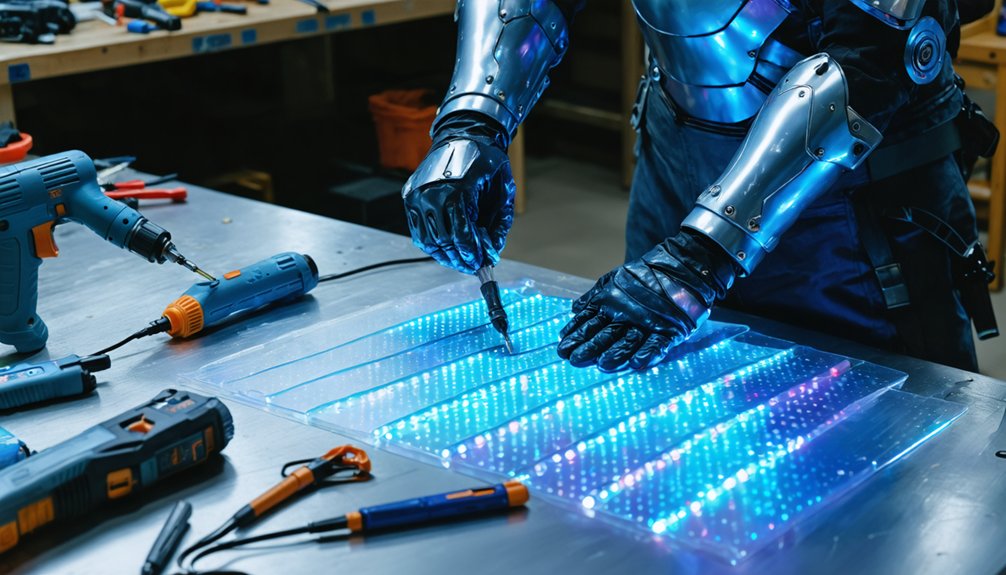
With your materials bonded and your panels locked into place, the next layer of realism comes from within — embedded lighting and responsive electronics that make your build feel like it’s actually running. Route EL wire through channel cuts in your foam before final sealing, and position LEDs at logical structural points — vents, seams, and panel edges.
Use Arduino or Raspberry Pi for sensor-triggered sequences that respond to movement or sound. Wireless integration lets you control lighting modes without breaking your costume’s surface with exposed switches.
Prioritize power management early — calculate total draw, select appropriately rated batteries, and distribute weight strategically across your rig. Enclosed helmets benefit from small cooling fans wired into the same circuit, keeping electronics and comfort working together.
Finish Your Sci-Fi Costume With Texture, Depth, and Weathering
Surface finishing is where your build stops looking like a costume and starts reading as a real object with history. Material layering and surface weathering transform clean forms into convincing artifacts from another world.
Apply these techniques strategically:
- Layer foam densities to build visual depth that mimics metal plating or woven composites beneath armor panels.
- Score and bevel edges using heat tools to simulate precision manufacturing without heavy materials.
- Paint circuit-like patterns directly onto spandex base layers, reinforcing a high-technology read across the full silhouette.
- Apply surface weathering through dry-brushing, rust powders, and controlled paint chipping to embed environmental history into every surface.
Each layer you add shifts your costume from prop toward artifact, making viewers question what world it actually came from.
Frequently Asked Questions
How Do You Safely Store a Finished Sci-Fi Costume Long-Term?
Your costume’s a priceless universe unto itself! For long-term costume preservation, you’ll want climate-controlled storage solutions—use acid-free tissue, padded hangers, and sealed containers to protect electronics, foam, and printed components from humidity damage.
Can Sci-Fi Costumes Be Adjusted to Fit Different Body Types Easily?
You can achieve body type adaptability through modular costume customization—use adjustable foam layers, stretch spandex panels, and repositionable 3D-printed components that you’ll resize digitally before printing, ensuring every structural element conforms precisely to your unique silhouette.
What Is the Average Total Cost of Building a Full Sci-Fi Costume?
Costs vary wildly—you’re looking at $200 to $2,000+ depending on materials and complexity. For cosplay conventions, investing in quality components guarantees costume durability, letting you push innovative boundaries without compromising structural integrity across multiple wearings.
How Do You Transport Large or Fragile Sci-Fi Costume Pieces Safely?
Pack your fragile costume material in foam-lined cases, using modular disassembly to simplify transportation methods. You’ll want custom crates, padded dividers, and interlocking segments that protect intricate 3D-printed armor, ensuring every innovative piece arrives convention-ready and structurally intact.
Are There Legal Restrictions on Wearing Sci-Fi Costumes in Public Spaces?
Hark — yes, legal restrictions exist. You’ll face public safety laws banning realistic weapons or full face coverings. At cosplay conventions, you’re typically protected, but always check local ordinances before donning your boldest sci-fi build publicly.
References
- https://www.thegnomonworkshop.com/workshops/sci-fi-costume-design-in-zbrush
- https://www.blauwfilms.com/research/how-to-design-costumes-for-scifi-stories
- https://www.youtube.com/watch?v=0eBF0NKOO_U
- https://www.reddit.com/r/scifi/comments/o5xufd/there_isnt_enough_focus_on_costume_design_in_sci/
- https://www.youtube.com/watch?v=_bk11YKe3mE
- https://starstruckpanda.com/sci-fi-cosplay-outfit-fabrication-methods/
- https://gizmodo.com/playing-with-science-and-technology-for-fantastic-costu-1585619571
- https://www.youtube.com/watch?v=N0xyb48dcAU
- https://scifiction.com/the-art-of-sci-fi-cosplay-how-fans-are-pushing-creative-boundaries-at-conventions/