Mastering villain cosplay transformations starts with researching your character’s backstory, ideology, and quirks to build authentic presence. You’ll choose psychologically charged colors like crimson or poison green, then layer bold accents for visual tension. Precision costume details, dramatic makeup, and deliberate movement combine to project dominance. You’ll train your voice for unpredictable cadence and practice chilling eye contact. Every element works together, and the seven steps ahead reveal the full transformation.
Key Takeaways
- Research your villain’s backstory, ideology, and quirks thoroughly to authentically externalize their personality through costume and performance.
- Choose a dominant base color covering 60% of the costume, layering bold accents to psychologically communicate threat and malevolence.
- Apply dark, layered eye makeup with sharp edges and seal with setting spray for a lasting, sinister definition.
- Practice deep, resonant vocal tones with deliberate pauses, varied cadence, and unpredictable pitch shifts to embody the villain’s presence.
- Combine consistent posture, minimal gestures, and sustained eye contact to project dominance, psychological tension, and controlled authority.
Research Your Villain’s Backstory First
Before slipping into a villain’s skin, you’ll need to excavate their history with the precision of a forensic investigator. Analyze historical influences that shaped your character’s worldview, identifying the pivotal trauma, ideology, or power structure that fractured their moral compass.
Map your villain against established villain archetypes — the nihilist, the revolutionary, the megalomaniac — then locate where your specific character deviates. That deviation is your treasure trove.
Catalog their signature quirks, speech cadences, and behavioral triggers. Understand what they fear, crave, and despise. These psychological coordinates transform surface-level cosplay into an embodied performance.
Cross-reference comic runs, cinematic adaptations, and original source material to build a thorough character dossier. The more precisely you understand their internal logic, the more authentically you’ll externalize their menace.
Pick Costume Colors That Scream Villain
Your costume’s color palette is the first visual signal that tells the world you mean business, so start by anchoring your look with a dominant base color like black, deep crimson, or poison green that instantly reads as threatening.
Layer in bold accent colors — electric purple, blood orange, or acid yellow — to amplify your villain’s personality and add visual tension to the overall design.
Push the look further by engineering sharp contrast between your base and accents, forcing the eye to move across your costume with an unsettling energy that commands attention in any room.
Choosing Your Base Color
When building a villain costume, the base color you choose sets the entire psychological tone of your character. Color psychology isn’t decorative—it’s strategic. Your base color becomes the visual foundation that communicates your villain’s core motivation before you’ve spoken a single word.
Consider these foundational color symbolism principles:
- Black signals dominance, mystery, and absolute authority
- Deep crimson channels aggression, obsession, and dangerous passion
- Dark purple embodies corruption, arcane power, and twisted ambition
Select one dominant base that covers roughly 60% of your costume’s visual surface. This creates immediate psychological impact. Everything else—highlights, accents, textures—builds upon this chromatic foundation.
Your audience processes costume symbolism instinctively, so choose a base color that makes your villain’s darkest intentions unmistakably clear.
Adding Bold Accent Colors
Once your base color anchors the costume’s psychological foundation, bold accent colors become your villain’s visual punctuation—sharp, deliberate, and impossible to ignore. Color psychology dictates that secondary hues communicate specific emotional triggers—crimson signals aggression, electric yellow suggests instability, and venomous green implies corruption.
You’ll want to select one highlight color and one accent color that clash intentionally with your base, creating visual tension that mirrors your character’s inner chaos. Costume symbolism deepens when these colors appear strategically—lining weapon edges, framing facial features, or tracing silhouette boundaries.
Place accent colors where light naturally hits: collar edges, shoulder armor, or emblem outlines. This calculated placement doesn’t just catch eyes—it weaponizes your appearance, transforming fabric and paint into psychological warfare that commands every room you enter.
Creating Visual Color Contrast
Mastering accent placement sets the stage, but the full power of your villain’s palette emerges when those individual color choices work together as a unified system of visual contrast.
Color psychology drives audience perception instantly—your combinations should trigger unease, dominance, or dread before you speak a word.
Build contrast deliberately using these principles:
- Value contrast: Pair deep shadows with sharp highlights to create visual tension that reads menacing under stage or event lighting.
- Complementary opposition: Position opposing hues against each other to intensify both colors simultaneously through costume symbolism.
- Saturation imbalance: Anchor muted base tones against one explosively vivid accent to direct the eye toward your most threatening design element.
Your villain’s visual identity isn’t accidental—it’s engineered opposition that communicates malevolence through calculated, intentional contrast.
Build a Villain Costume With Standout Details
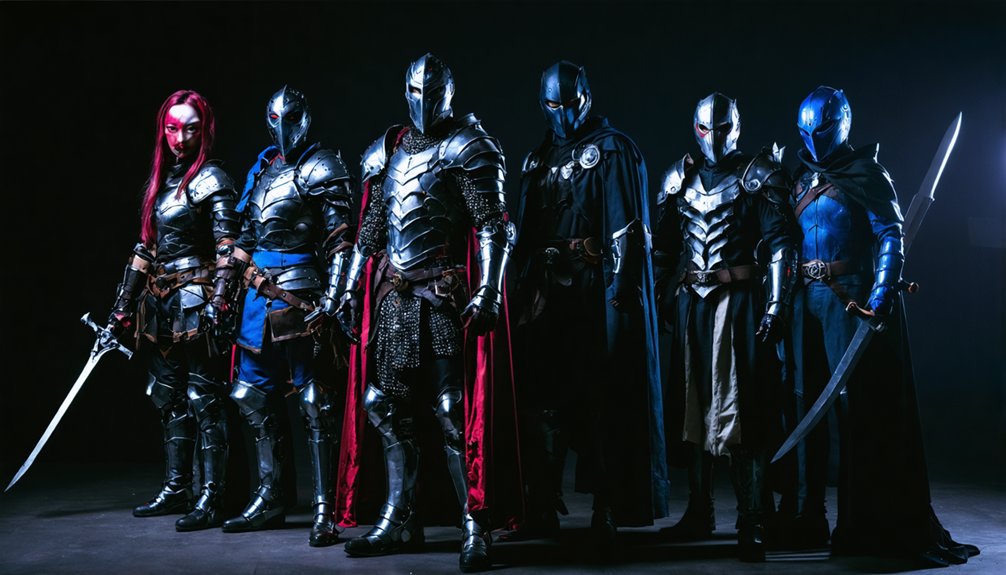
Building a villain costume that turns heads starts with selecting a bold color palette—choose a dominant base color, a contrasting highlight, and a sharp accent color that work together to create a visually striking silhouette.
Every iconic villain begins with color—bold, deliberate, and impossible to ignore.
Before cutting a single piece of fabric, develop detailed character sketches to map out proportions, textures, and structural elements like armor plating, asymmetrical cuts, or dramatic silhouettes.
Next, integrate intentional costume accessories—ornate jewelry, spiked pauldrons, dramatic capes, or distinctive headpieces—that reinforce your villain’s identity rather than simply decorating it.
Every detail should serve a narrative purpose.
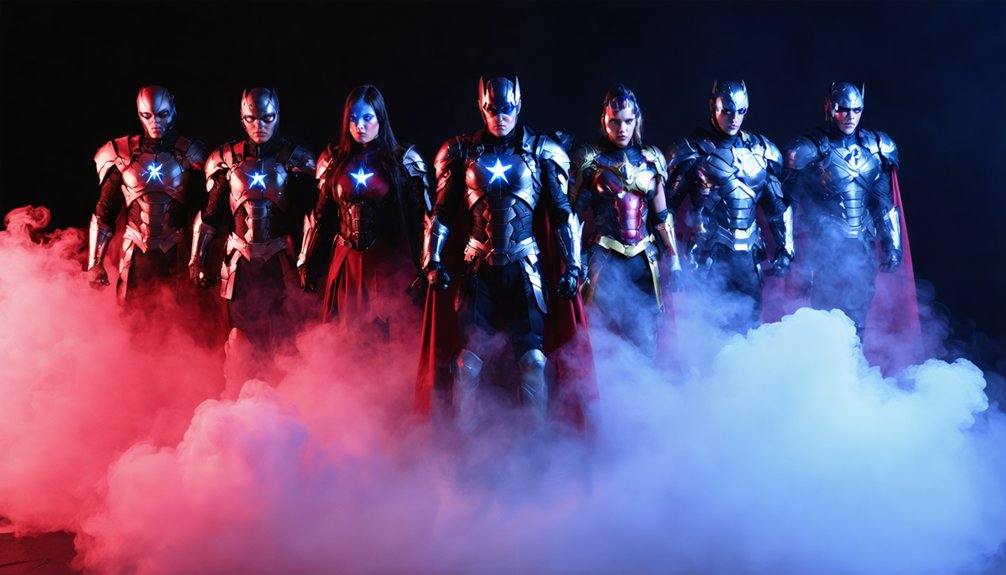
Design a signature emblem or logo and position it consistently across your costume for cohesive visual branding.
Precision in construction separates a forgettable costume from an unforgettable transformation that commands every room you enter.
Master Dramatic Villain Makeup
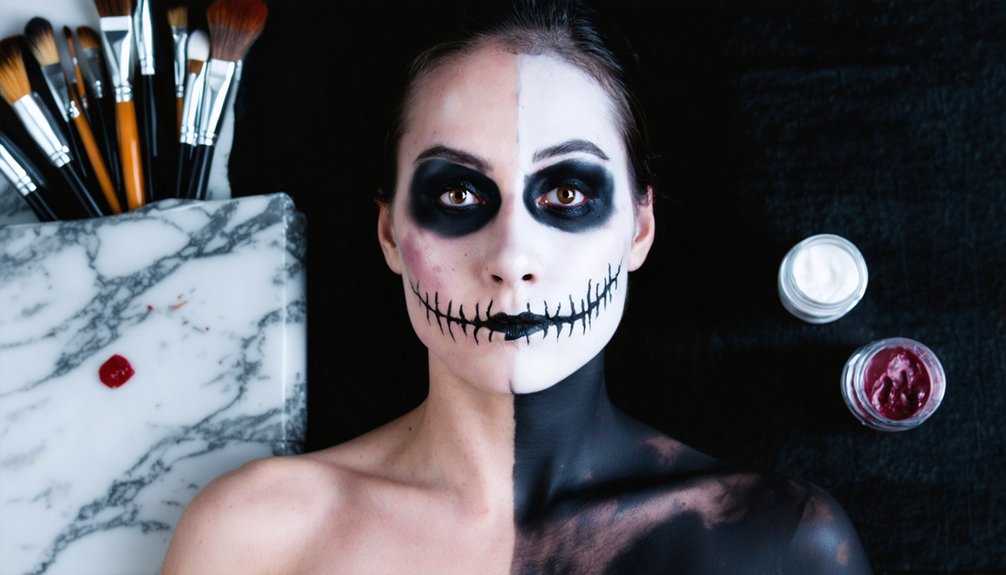
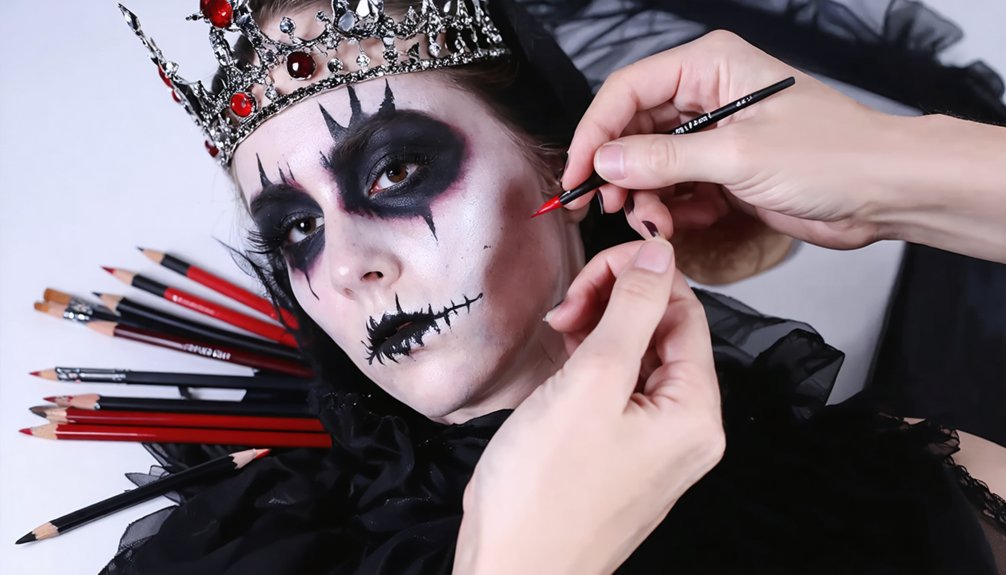
To master dramatic villain makeup, you’ll want to start with a primer that blurs imperfections. Then layer a full-coverage concealer to create a flawless, ominous canvas before setting everything with translucent powder.
Bold, dark colors like deep purples, blacks, and blood reds are your weapons for crafting a sinister appearance. Apply them with precision and intentionality to highlight the most threatening features of your character.
Your eye makeup is the centerpiece of the villain’s look. Use a light shade under the brow, blend it into a darker lid shade, and sharpen the edges to create depth and a chillingly expressive gaze.
Bold Color Application Techniques
Bold colors are the backbone of dramatic villain makeup, and knowing how to apply them effectively separates an amateur look from a truly menacing transformation. Leverage color psychology to choose shades that amplify your character’s menace—deep crimsons signal danger, blacks convey dominance, and purples suggest dark mysticism.
- Layer eyeshadow in bold hues using a flat shader brush, packing pigment directly onto the lid before blending edges strategically.
- Echo costume symbolism by mirroring your character’s signature palette across facial features for visual cohesion.
- Use a damp beauty sponge to intensify pigmentation, making colors appear more saturated and theatrical under event lighting.
Seal every bold application with a translucent setting spray to prevent fallout and maintain sharp, striking definition throughout your entire performance.
Sinister Eye Makeup Mastery
Once you’ve locked in your bold color foundation, the eyes become your most powerful storytelling instrument—capable of projecting menace, madness, or cold calculation before you speak a single word.
Start by applying a light shade beneath your brow bone, then blend a deeper lid color downward to construct shadowy silhouettes that hollow and intensify your gaze.
Layer dark liner along both waterlines—upper and lower—to shrink the visible iris and create haunting expressions that unsettle anyone who meets your stare.
Smudge liner outward at the corners for a predatory sharpness.
Use a fine brush to define the crease with deep matte shadow, eliminating softness entirely.
Seal everything with translucent powder so dramatic lines hold through hours of performance without fading or creasing.
Move and Carry Yourself Like a Villain
Carrying yourself like a villain starts with your stance — stand tall, pull your shoulders back, and lean slightly forward to radiate dominance and quiet menace. Martial posture isn’t just aesthetic; it signals calculated authority. Every movement should feel deliberate, never rushed.
Stealth movement — slow, fluid shifts between positions — amplifies psychological tension in any room.
Refine your physicality with these core techniques:
- Arms: Keep them relaxed yet coiled, suggesting restrained power rather than idle stillness.
- Eye contact: Lock your gaze intentionally, holding it a beat longer than comfortable to establish control.
- Gestures: Make them minimal but precise — a single raised finger commands more presence than frantic movement.
Your body tells your villain’s story before you speak a single word.
Nail Your Villain’s Voice and Speech Patterns
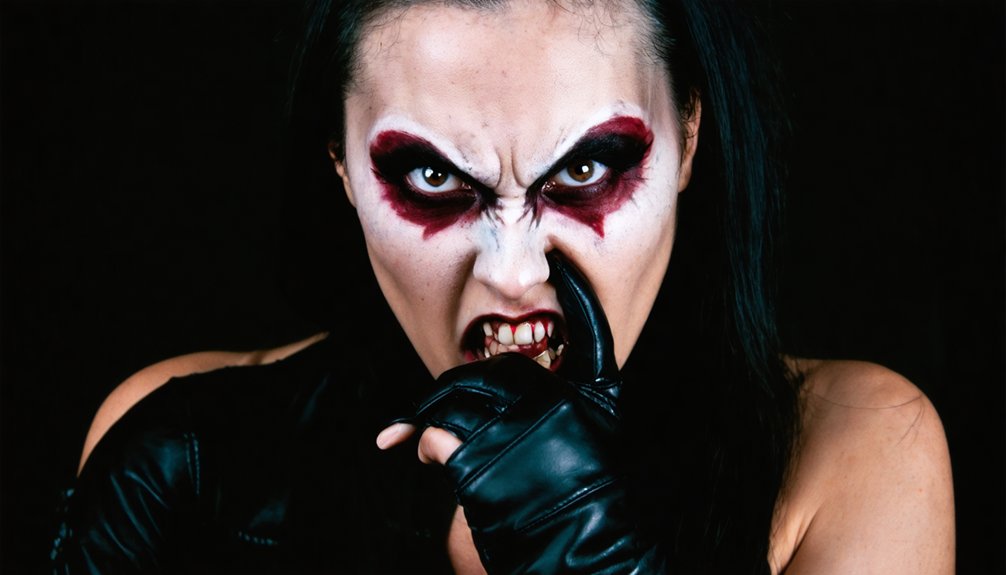
Your villain’s voice is a weapon — wield it with the same intentionality you bring to every calculated gesture. Start by identifying your chest register — say “whoa” at your deepest pitch and feel those vibrations anchoring your power.
Practice shifting between two distinct registers: a slow, commanding baritone that hints at shadowy alliances forged in darkness, and a sharp, unpredictable pitch that exposes hidden motives beneath a charismatic facade. This vocal duality creates psychological tension your audience will feel instinctively.
Rehearse your character’s signature lines daily, emphasizing deliberate pauses for menace and controlled breath for authority. Vary your cadence — drag certain syllables, clip others sharply.
A truly mastered villain voice doesn’t just speak; it manipulates, seduces, and unsettles simultaneously, making every word land with calculated precision.
Own the Room With Villain Poses and Eye Contact
When you step into a room as your villain, every pose and glance becomes a deliberate instrument of psychological control. Your body communicates shadowy alliances and hidden motives before you speak a single word.
Master these foundational techniques:
- Lock eyes deliberately — sustain a chilling stare for three seconds, then glance away dismissively to establish dominance
- Command space physically — stand with shoulders squared, slight forward lean, arms purposefully relaxed yet tension-ready
- Deploy micro-expressions — practice a slow, calculated smile that hints at hidden motives without revealing your full agenda
Study your villain’s iconic poses frame-by-frame from source material. Mirror their spatial ownership instinctively. Your stare shouldn’t feel aggressive — it should feel *inevitable*, like someone who’s already calculated every outcome in the room.
Frequently Asked Questions
How Do I Stay in Character During Long Cosplay Events?
Stay immersed by practicing your villain’s voice acting consistently, responding to interactions in character. You’ll maintain intensity by revitalizing your makeup techniques mid-event, reinforcing your transformation visually and mentally, keeping your sinister persona authentically alive throughout.
What Materials Are Best for Making Villain Costumes Durable?
For durable villain costumes, you’ll want EVA foam for armor construction and Worbla thermoplastics for rigid pieces. Your fabric choices should prioritize stretch velvet, faux leather, and ripstop nylon—they’ll withstand long events while maintaining that menacing aesthetic.
How Do I Comfortably Wear a Villain Costume in Hot Weather?
You’d think heavy costumes doom hot-weather wear—they don’t! Choose breathable fabrics like moisture-wicking mesh and opt for lightweight accessories instead of bulky props. Strategic ventilation panels keep you cool while maintaining your villain’s sinister, commanding presence.
Can Beginners Successfully Pull off Complex Villain Transformations?
Yes, you can absolutely pull off complex villain makeup and costume accessories as a beginner! Start by researching your character’s backstory, mastering bold makeup techniques, and selecting statement accessories that’ll authentically capture your villain’s sinister essence.
How Do I Photograph My Villain Cosplay for the Best Results?
85% of viral cosplay photos use dramatic lighting! You’ll elevate your villain shots by mastering lighting techniques like low-angle shadows and backlighting. Combine these with menacing pose strategies—leaning forward, arms extended—to capture truly sinister, publication-worthy images.
References
- https://starstruckpanda.com/villain-cosplay-transformation-tutorials/
- https://halloweencostumedirectory.com/superhero-villain-costume-makeup-tutorials/
- https://starstruckpanda.com/cosplay-as-your-favorite-anime-villain/
- https://www.wikihow.com/Act-Evil
- https://www.youtube.com/watch?v=fpVpr7v5ewc
- https://eyecandys.com/blogs/news/building-a-character-for-cosplay
- https://www.costumerealm.com/two-face-costume/