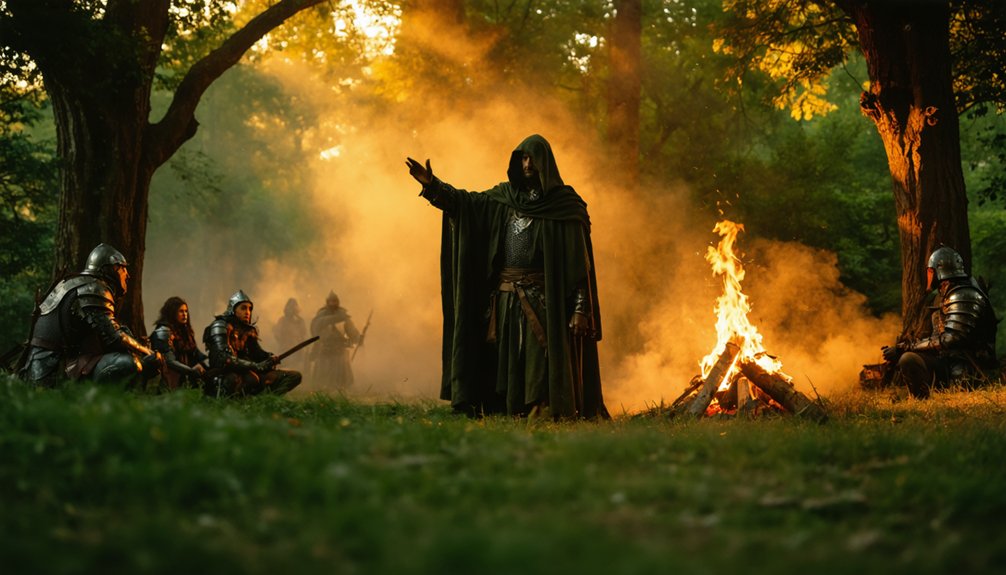
Start by understanding your game’s archetype hierarchy—some systems require foundational classes before specialized roles become available. Match your combat instincts to frontline, midrange, or support roles, considering physical capabilities like armor endurance. Research race restrictions since they’ll limit class options and skill costs. Evaluate multi-classing early to avoid prerequisite gaps that waste skill points. Balance specialization’s accelerated progression against versatility’s tactical breadth. Your character’s effectiveness depends on aligning mechanical requirements with your playstyle preferences, and the following insights will help you navigate these significant trade-offs.
Key Takeaways
- Match your combat role to natural instincts—frontline warriors offer sustained damage while casters deliver rapid spell volleys from distance.
- Verify race-class compatibility early, as racial choice creates mechanical trade-offs through skill cost adjustments and availability restrictions.
- Map desired abilities to prerequisite chains before your first event to avoid costly progression mistakes and resource allocation errors.
- Balance specialization depth against multi-class versatility by weighing exclusive capabilities versus expanded party roles and adaptive responses.
- Align archetype narrative purpose with LARP story framework, considering faction dynamics and hierarchical requirements for specialized roles.
Understand Your LARP System’s Archetype Structure
Examine how archetypes interact hierarchically. Does your game require a foundational Denizen archetype before accessing specialized roles? Can you combine multiple archetypes for versatility? Investigate the archetype narrative purpose within your LARP’s story framework.
Some systems emphasize Golden Triangle conflict dynamics, while others prioritize faction-based away teams or role functions that serve other players. Acknowledging these structural elements guarantees your character choice aligns with both mechanical systems and collaborative storytelling opportunities, maximizing your gameplay impact.
Match Your Playstyle to Combat Roles
Once you’ve grasped your LARP’s archetype framework, identify which combat role aligns with your natural instincts on the battlefield. Combat role placement determines whether you’ll anchor lines as a prof-driven fighter, exploit weaknesses as a crit-driven rogue, or command forces as a paladin.
Your battlefield instincts reveal your true role—anchor the line, exploit vulnerabilities, or command allies through strategic dominance.
Frontline damage patterns vary tremendously—warriors deliver sustained crushing power through 2-handed weapons and iron grip, while casters project rapid spell volleys from protected positions.
Assess your preferred engagement distance and tempo. Do you thrive maintaining defensive formations with shields, or striking opportunistically from stealth? Consider your physical capabilities too—heavy armor demands endurance, while light armor assassination requires agility and timing precision.
Match secondary functions to your interests: siege support for warriors, dungeon exploration for rogues, or battlefield enhancement for warlocks. This alignment guarantees sustainable enjoyment across campaigns.
Consider Race Restrictions and Special Class Options
Most LARP systems tie class availability directly to racial choice, creating mechanical trade-offs you’ll need to evaluate before committing to your character. Systems like Interphaze and LAIRE implement race based skill adjustments that increase costs or restrict certain abilities—Dark Elves, for example, face significant limitations balanced against their advantages.
You’ll also encounter phys rep requirements: non-human races typically demand makeup, prosthetics, or vocal modifications to differentiate yourself clearly from humans.
Humans offer maximum flexibility, accessing any class without penalties—a strategic advantage when dual-classing options exist. Meanwhile, specialized races like Alliance LARP’s Sarrs or Wylderkyn provide unique roleplay opportunities with distinctive physical presentations. Balance your desired mechanical benefits against costuming effort and in-game prejudices.
Hybrid races expand possibilities while inheriting parent traits, creating nuanced character-building opportunities that reward creative combinations.
Evaluate Multi-Classing Opportunities Early
You’ll need to check if your character meets the minimum ability score of 13 in both your current and desired class’s primary abilities before committing to a multiclass path.
Planning your stat distribution early guarantees you won’t face prerequisite roadblocks when you’re ready to branch into a second class for combat versatility.
Consider whether your character concept benefits more from specialized single-class progression or the tactical flexibility that multiclassing provides, as splitting levels means delaying access to your most powerful class features.
Identify Prerequisite Skill Gaps
Every LARP system builds character progression through prerequisite chains, and identifying these gaps before your first event saves you from costly character-build mistakes. You’ll need to evaluate background needs and identify training gaps by mapping your desired abilities backward to their foundational requirements.
Critical prerequisite checkpoints:
- Skill chains – Advanced combat skills like Head-Butt require Hamstring and level 6, creating 120+ CP investment paths
- Category progression – You must purchase Minor grade skills before accessing Moderate or Major tiers within each category
- Racial advantages – First advantage comes free; subsequent superhuman abilities cost 50 CP each at 50-point increments
- Class-specific requirements – Advanced classes demand specific point pools, organization membership, or racial prerequisites
- Phys-rep limitations – Scout effectiveness depends on throwable knife availability
Balance Combat Versatility Now
Multiclassing transforms your character’s tactical options by blending abilities from different classes, but timing this decision shapes your entire progression arc. Front-loaded options like Fighter’s Action Surge or Warlock’s invocations provide immediate payoffs after just two levels, while stat allocation compromises demand careful planning—you’ll need minimum 13s in multiple abilities, creating MAD challenges that limit optimization potential.
Evaluate synergies before committing. A Fighter dip grants martial proficiencies and survivability without steep prerequisites, while caster combinations face resource management constraints through delayed spell access despite advancing slot progression. Calculate whether secondary features justify postponing your primary class’s capstone abilities.
Strategic dips enhance survivability and action economy, but prioritize concepts that reflect your character’s narrative journey rather than chasing theoretical maximization.
Choose Between Specialized and Versatile Builds
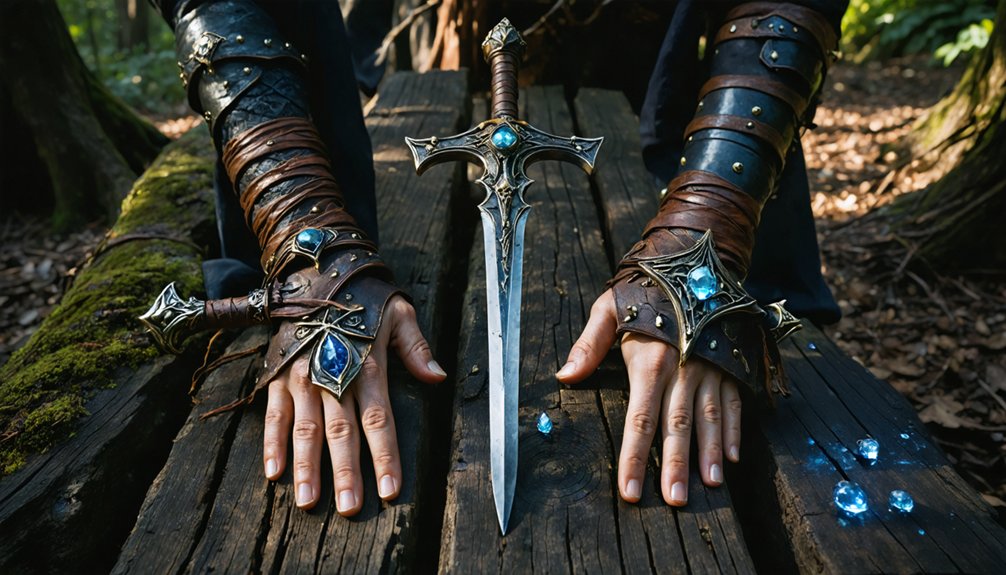
You’ll face a fundamental choice between deep specialization and versatile multi-classing that shapes your entire LARP experience. Specialized builds like pure Fighters or combat-focused Rogues deliver maximum effectiveness in their niche through profession bonuses and concentrated skill investments.
Versatile builds sacrifice raw power for tactical flexibility, allowing you to adapt to varied challenges by mixing paths like Warrior-Rogue or Fighter-Mage combinations.
Deep Specialization Benefits
Consider these concrete benefits:
- Accelerated progression: Class skills cost 1xp versus 2xp for cross-class abilities, reaching expert tiers faster
- Negated hybrid penalties: Pure combat or crafting focus eliminates proficiency dilution from spreading thin
- Exclusive capabilities: Alchemist 3 or Enchanter 3 produce advanced items unavailable to generalists
- Enhanced gear progression: Warrior-class weapon mastery and armor proficiencies maximize equipment effectiveness
- Economic dominance: Specialized professions control critical supply chains for high-demand magical components
Deep investment outperforms surface-level dabbling mechanically.
Multi-Class Flexibility Advantages
While pure specialization offers undeniable mechanical advantages, versatile builds present their own compelling case. You’ll gain expanded party roles by combining abilities from multiple skill spheres—Warrior’s Path, Rogue’s Path, Path of Healers, and Path of Wizards—creating fighter-mage archetypes that transcend traditional boundaries. This flexibility reduces your dependency on others while enabling adaptive responses to unexpected encounters.
Multi-classing demands strategic resource allocation and accepting weaker specialized capabilities in exchange for tactical breadth. You’ll develop skills organically through NPC training and questing, crafting unique identities through personalized combinations. Diverse adventurer combinations emerge when you balance versatile characters alongside specialists, promoting party composition innovation. Your character evolves coherently through background-driven progression rather than rigid mechanical constraints, supporting creative problem-solving through unconventional ability synergies unavailable to single-class builds.
Factor in Non-Combat Skills and Utility Functions
Beyond swinging swords and casting offensive spells, your character’s non-combat capabilities often determine their true value to a LARP community. Profession skill specialization transforms you into an essential resource, while craftable utility items extend your impact beyond combat encounters.
The most memorable LARP characters aren’t always the strongest fighters—they’re the irreplaceable craftsmen, healers, and diplomats their communities depend upon.
Strategic non-combat selections include:
- Healing and Support: Mend, Restore Limb, and Physick skills provide battlefield sustainability without offensive requirements
- Crafting Proficiency: Blacksmith and Alchemist archetypes create armor repairs and potions through tiered progression systems
- Roleplay Depth: Bargaining, Plant Identification, and Diplomacy enable immersive scenarios tied to merchant, apothecary, or noble archetypes
- Universal Accessibility: First Aid costs only 1 point across all classes, offering immediate utility
- Strategic Combinations: Expert and Skilled archetypes excel through Alchemy, Enchanting, and trade-focused skill trees
Research Skill Point Costs Across Different Occupations

You’ll need to compare how different classes abbreviate their skill costs—mercenaries pay 65 CP for blacksmithing while mages pay 110 CP for the same skill. Calculate your total build cost by tracking which occupation offers the most efficient path to your desired abilities, remembering that dual classes average their costs and round down.
This analysis guarantees you’re maximizing your starting 20-100 CP allocation without overpaying for essential skills.
Compare Occupation Abbreviation Systems
Across the spectrum of LARP systems, occupation classes distribute skill points through vastly different mathematical frameworks. Understanding comparative role nomenclature differences helps you optimize character builds across multiple games. Legacy terminology persistence means banker stats in Alliance might translate differently than merchant classes in Nordic freeforms.
When comparing occupation abbreviation systems, you’ll encounter:
- Core rules separation allows standardized stat blocks across settings, reducing learning curves
- DBMS-style relational attributes organize skills under parent occupations for clearer progression paths
- Financial instrument parallels create market-like dynamics where occupation choices affect resource availability
- Proprietary code variations between games require translation of equivalent skills
- Truth-command integrity mechanisms guarantee balanced gameplay despite terminology differences
This systematic approach prevents min-maxing while encouraging innovative character concepts.
Calculate Build Cost Efficiency
Mastering occupation abbreviations prepares you to analyze the mathematical core of character building: skill point economics. Build cost optimization requires comparing CP expenditures across class structures—warriors accessing blacksmithing at 65 CP versus mages at 110 CP demonstrates dramatic efficiency disparities.
Calculate threshold impacts meticulously: your first 57 Life points cost 1 CP each, but subsequent blocks escalate to 2 CP and 3 CP per point, fundamentally altering cost efficient skill allocation strategies.
Cross-training penalties double skill point costs while delaying tier access, making single-class specialization mathematically superior initially. Dual-class characters average CP costs between base classes, potentially enabling optimized hybrid builds.
Track occupational progressions carefully—level 3 skills universally cost 30 CP, scaling predictably to 120 CP at level 12. Compare production skill investments against Craftsman’s economic output: 1 silver per 2 builds often outperforms specialized crafting when factoring 10-gold workshop fees.
Draw Character Inspiration From Familiar Fantasy Sources
When building your LARP character, familiar fantasy sources provide a tested foundation for class mechanics and role definition. Drawing from established material helps you craft viable builds while maintaining narrative coherence.
Character concept inspirations to explore:
- Classic RPGs like Dungeons & Dragons offer proven archetypes—thieves, paladins, and fighter-mage hybrids that balance combat effectiveness with versatility
- Fantasy literature provides cultural role archetypes that players instantly recognize, reducing learning curves during collaborative gameplay
- Video games like Grim Dawn demonstrate how classless systems evolve into specialized masteries through organic progression
- Mythology and cultural tropes (Adam and Eve, rom-com dynamics) create familiar pitfalls and character relationships that enhance immersion
- Tarot symbolism and workshop templates (Jester, Idealist, Grey) offer structured frameworks for developing unique interpretations within established class boundaries
Prioritize Character Background Over Rigid Class Labels

While familiar archetypes provide mechanical frameworks, your character’s background shapes how you’ll actually experience the game. Modern LARP systems recognize this by separating class mechanics from thematic backgrounds.
You’ll gain background flexibility when classes define only your abilities—warrior, healer, priest, wizard—while your chosen background establishes whether you’re a Paladin, Ranger, or Monk. This approach eliminates restrictive theme-locking and enables class customization across concepts.
After selecting your race and mechanical class, build your background by detailing birthplace, religion, family, and core motivations. You can justify unconventional combinations like assassin-medic through thoughtful storytelling. Connect your character to the world through relationships, mysteries, and personal goals.
Keep backgrounds concise—two pages maximum—and avoid exhaustive tragic backstories. This separation enhances replayability while maintaining mechanical balance across diverse character concepts.
Plan for Character Progression and Advanced Class Prerequisites
Understanding skill point economics shapes your long-term LARP experience more than any single character choice. Strategic skill progression planning requires analyzing tier prerequisites and cross-training costs before committing to advanced class access strategies.
Critical progression considerations:
- Calculate breakeven points – Cross-training doubles costs and halves advancement speed, making early specialization more efficient for reaching Tier 3 trainer status
- Map prerequisite chains – You’ll need at least one skill per tier before ascending, so identify bottlenecks in your desired path
- Budget EP allocation – Career-specific expertise points grant access to specialist skills beyond standard progression
- Time cross-training strategically – Access Tier 1 alternatives at Tier 2, but weigh opportunity costs against primary path advancement
- Secure guild positioning early – Higher-tier members lead guilds, creating mechanical advantages for focused progression
Frequently Asked Questions
How Do I Handle Character Death and Resurrection Mechanics in Different LARPS?
You’ll navigate death through each LARP’s unique respawning policies—some offer limited resurrections, others shift you to ghost roles. Balance your character backstory customization with mechanics that maintain continued engagement, whether through soul-play scenarios or risk-based revival systems.
What Costume and Prop Requirements Are Mandatory for My Chosen Class?
Building your character’s visual identity is like assembling armor—layer by layer. You’ll need base garments plus class-specific outerwear. Costume design considerations include role-signaling details, while your prop procurement process must balance durability with game rules and weather adaptability.
Can I Change My Character Class Mid-Campaign if Unsatisfied?
When considering mid-campaign class changes, you’ll need to check your specific LARP’s ruleset—some systems offer flexibility while others don’t. We recommend requesting system flexibility from organizers if you’re unsatisfied with your current class choice.
How Do Different LARP Systems Handle Magic Components and Spell Casting?
Magic’s resource dance varies: you’ll handle ritual components (gestures, verbal formulas, physical items) with effect durations spanning instant strikes to sustained enchantments. Systems balance spontaneity against preparation through energy tracking, attribute caps, and consumable crystals ensuring fair play.
What Are Typical Experience Point Requirements Between Character Levels?
Experience point progression varies by your character’s total points—you’ll earn 6-12 XP monthly depending on sheet size. Character advancement milestones occur every tier, requiring minimum skill investments before gaining access to higher abilities, ensuring balanced progression across all playstyles.