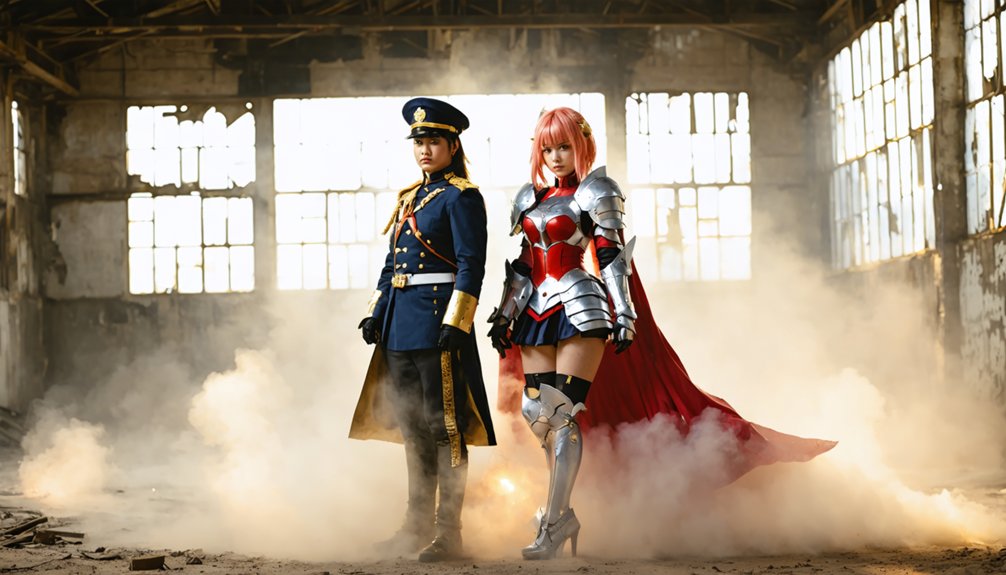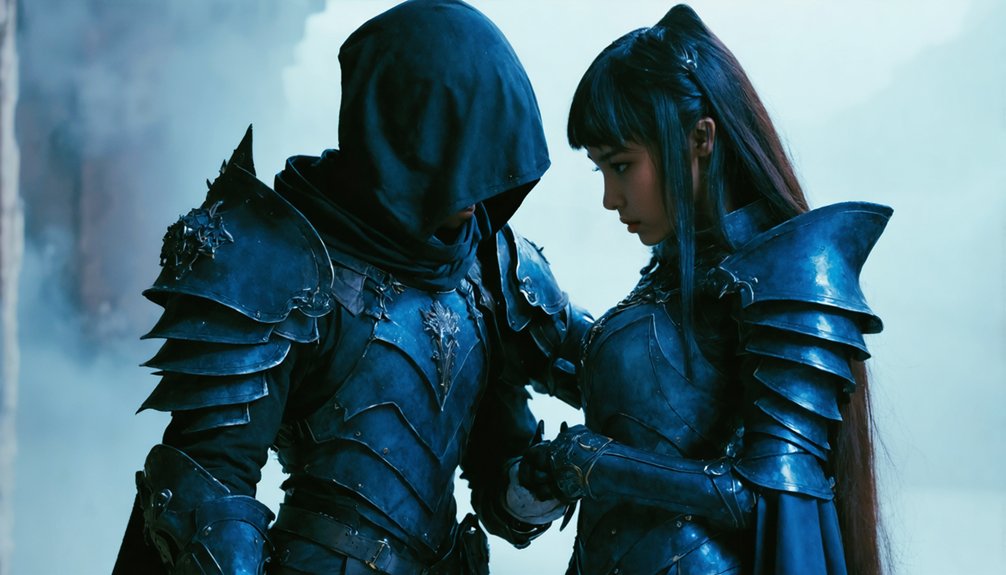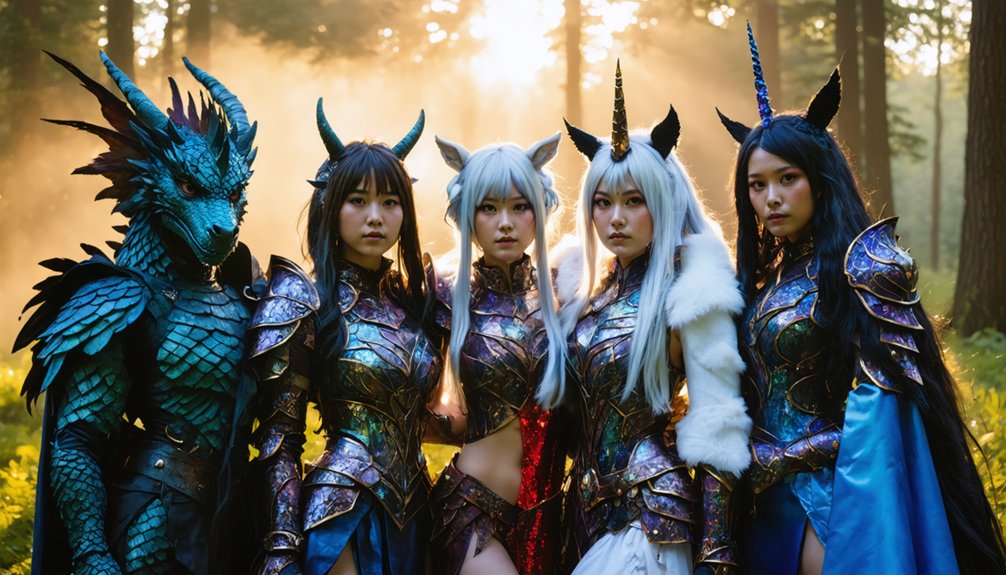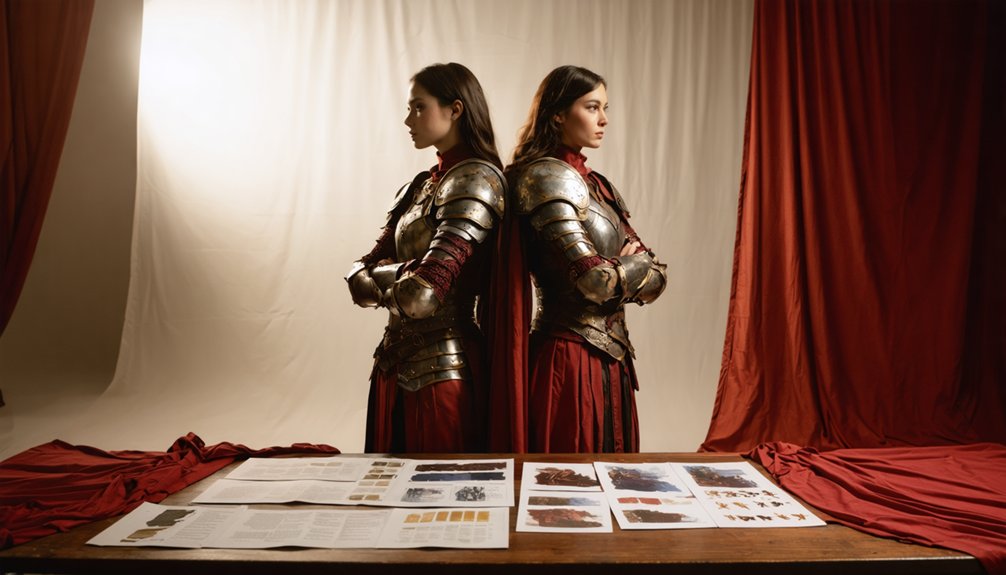
Coordinating couple cosplays successfully starts with picking a fandom you both genuinely love and choosing characters with complementary color palettes and balanced visual weight. Assess your crafting skills honestly, set a shared budget, and build a timeline at least six weeks out. Practice your poses in full costume, pack an emergency repair kit, and communicate clearly throughout the process. Every detail covered here will help you pull it off flawlessly.
Key Takeaways
- Choose characters with complementary color palettes and equal visual weight to ensure a balanced, cohesive appearance.
- Honestly assess both partners’ skill levels and align costume complexity to prevent frustration during construction.
- Establish a clear budget early, listing all components with realistic cost estimates tracked in a shared spreadsheet.
- Set deadlines six weeks before the event, breaking the project into research, sourcing, construction, and finishing phases.
- Pack a shared emergency kit with safety pins, tape, and thread, designating roles for efficient costume repairs.
Pick a Fandom That Works for Couple Cosplay
Not every fandom lends itself equally well to couple cosplay, so choosing the right one sets the foundation for the entire project.
Start by evaluating fandom compatibility — does the source material offer strong character dynamics and story relevance between two figures? Fandoms with iconic pairings give you built-in audience appeal, making your costumes instantly recognizable.
Strong character dynamics and iconic pairings create instant audience recognition, making fandom compatibility the ultimate foundation for couple cosplay.
Prioritize shared interests so both partners stay genuinely invested throughout the process.
Consider costume diversity within your chosen genre; genre variety matters because some fandoms offer flexible design options while others don’t. Fantasy, sci-fi, anime, and gaming each present distinct opportunities.
Select a fandom where both characters carry equal visual weight, ensuring neither costume overshadows the other and your pairing feels intentional and cohesive.
Match Skill Levels Before You Choose Your Characters
Before choosing your characters, take an honest inventory of each partner’s crafting skills—consider sewing, prop-making, and painting separately.
Once you’ve identified your individual strengths and weaknesses, select characters whose costumes reflect complementary complexity levels, so neither partner feels overwhelmed or underutilized.
For example, one partner can tackle an intricate armored build while the other handles a simpler but visually cohesive counterpart costume.
Assess Individual Crafting Abilities
Choosing characters that match both partners’ skill levels prevents frustration and unfinished costumes. Conduct honest skill assessments before committing to any design, since mismatched crafting techniques create imbalanced results.
Consider these four evaluation points:
- Sewing proficiency — determine whether each partner can construct garments independently or needs pattern guidance.
- Prop-building experience — identify comfort levels with materials like foam, resin, or thermoplastics.
- Painting and detailing skills — assess airbrush, weathering, or fine-detail painting capabilities honestly.
- Time availability — factor realistic build schedules alongside each person’s skill speed.
Once you’ve mapped both partners’ strengths, select characters whose complexity aligns with those findings. You’ll produce cleaner results, maintain momentum throughout the build process, and arrive at the event genuinely proud of what you’ve created together.
Choose Complementary Complexity Levels
Complementary complexity means pairing costumes where both partners’ builds demand roughly equal effort and technical challenge, even if the characters themselves look nothing alike.
You’re not aiming for identical difficulty—you’re aiming for costume balance, where neither partner feels overwhelmed or underutilized.
Start by rating each costume’s requirements: armor fabrication, wig styling, prop construction, and detail painting all carry different skill demands.
If one partner’s build scores considerably higher, adjust your character selections until design harmony emerges naturally across both costumes.
Mismatched complexity creates frustration, uneven results, and collaborative tension.
Instead, select characters whose technical demands align with each person’s actual current skill level—not aspirational ability.
That alignment produces cohesive results and keeps the construction process genuinely enjoyable for both of you.
Choose Characters Who Look Good Together
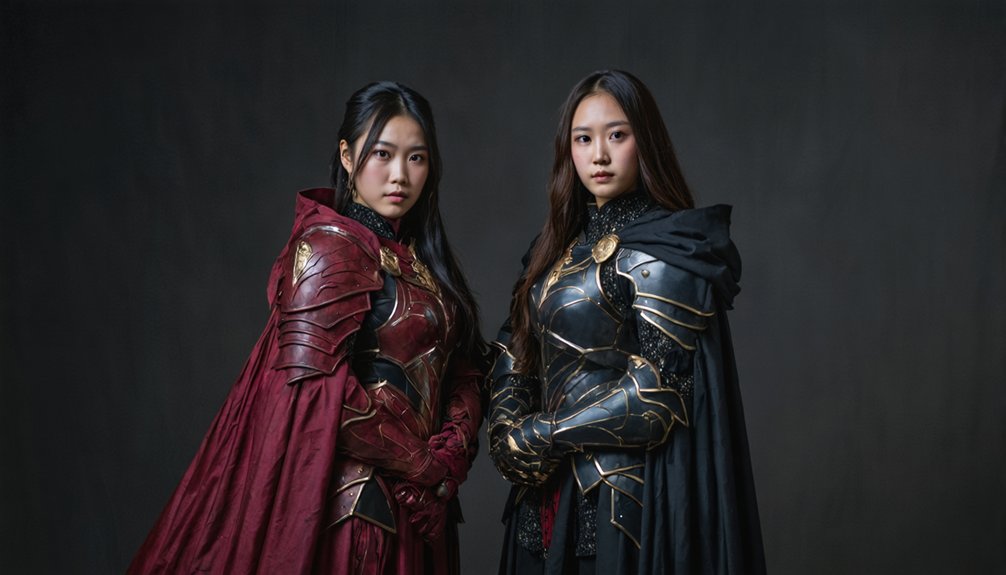
Once you’ve matched skill levels, it’s time to think about how your characters look side by side.
Choose pairs whose color palettes complement each other—like characters who share a dominant hue or whose contrasting colors create visual balance.
You’ll also want to align your overall aesthetics, pairing characters who share a similar style, whether that’s sleek and futuristic, dark and gothic, or bright and whimsical.
Complementary Color Palettes
Consider these four strategies:
- Choose analogous palettes — select characters sharing adjacent hues on the color wheel for a cohesive, unified look.
- Leverage complementary contrasts — pair characters with opposing colors (blue/orange, purple/yellow) to create dynamic visual tension.
- Match saturation levels — keep both costumes equally bold or muted to avoid one overpowering the other.
- Align neutral tones — coordinate blacks, whites, or metallics across both costumes to anchor the overall aesthetic.
Matching Visual Aesthetics
Beyond color alone, the overall visual aesthetic of your characters needs to feel intentional and balanced. You’ll want to reflect on silhouette, design complexity, and era when selecting your pairing.
If one costume features heavy armor and intricate detailing, pair it with something equally bold rather than a minimalist design that’ll visually disappear beside it.
Character synergy matters here—your chosen characters should share a visual language, whether that’s sleek futurism, dark fantasy, or retro-stylized designs. Aesthetic harmony doesn’t require identical styles, but both costumes should feel like they belong in the same visual universe.
Evaluate reference images side by side before committing. Ask yourself whether these two characters would look cohesive in a photograph.
Your goal is a pairing that reads as deliberate, not accidental.
Coordinate Your Couple Cosplay Colors Without Matching Too Closely
Color coordination can make or break a couple cosplay, so it’s worth thinking beyond simply wearing identical hues. Achieving color harmony and outfit balance requires intentional contrast paired with visual cohesion.
Consider these four strategic approaches:
- Use analogous colors — choose hues sitting adjacent on the color wheel for subtle visual connection.
- Apply the 60-30-10 rule — distribute dominant, secondary, and accent colors deliberately across both costumes.
- Mirror accent pieces — share one repeated color through smaller details like gloves, trim, or accessories.
- Contrast value, not hue — pair a light and dark version of the same color family for dynamic visual tension without monotony.
These techniques create cohesion while keeping each costume distinctly individual.
Plan Your Couple Cosplay Budget Before You Buy Anything
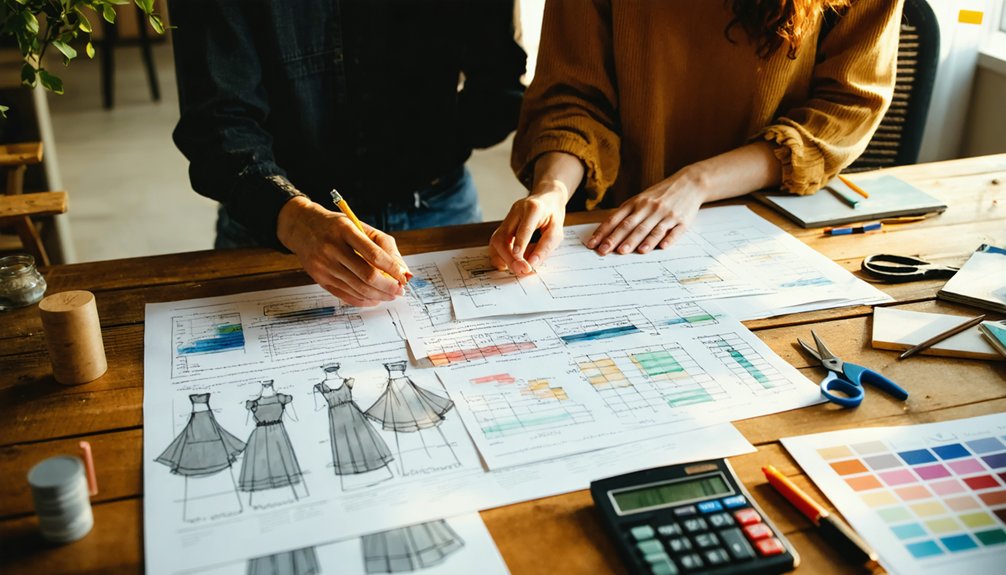
Before you spend a single dollar on fabric, foam, or accessories, you’ll want a clear budget that accounts for both costumes together.
List every component each costume requires, then assign realistic cost estimates before purchasing anything.
Work within your budget constraints by identifying which elements demand the most visual impact. A poorly crafted centerpiece prop undermines an otherwise solid build, so allocate funds strategically.
Define your costume priorities early. If one character wears an elaborate armored suit while the other wears simpler clothing, shift resources accordingly rather than splitting funds equally.
Track spending in a shared spreadsheet so both partners stay aligned throughout the build process. Catching overspending early keeps your final looks polished without financial stress derailing your creative momentum.
Find Fabrics and Props That Look Like They Belong Together
When both costumes share the same fabric textures, color palette, and prop finishes, they read as a cohesive pair rather than two separate builds standing next to each other.
Strategic prop sourcing and material matching elevate your duo from coordinated to intentional.
Apply these four coordination techniques:
- Match sheen levels — pair matte fabrics with matte props and glossy materials with glossy finishes across both costumes.
- Source props from the same supplier — consistent manufacturing processes produce unified finish tones.
- Swatch together before buying — compare fabric textures side-by-side under event lighting conditions.
- Unify metallic accents — choose either gold or silver hardware consistently across both builds.
Build a Couple Cosplay Timeline So Nothing Gets Left to the Last Minute
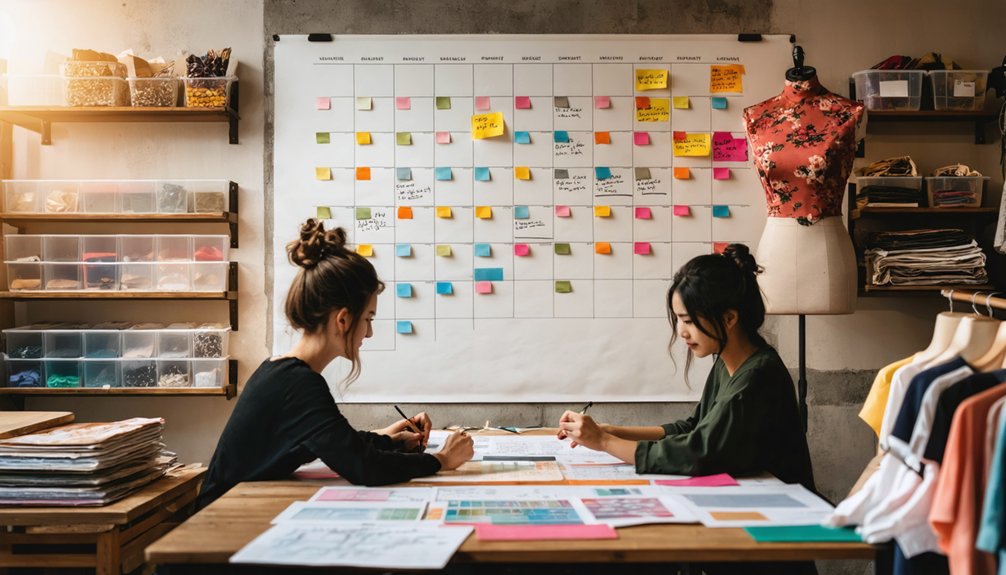
Matching fabrics and props across two builds takes time you simply won’t have if you’re scrambling the week before an event.
Set costume deadlines at least six weeks out, breaking the project into phases: research, sourcing, construction, and finishing.
Build crafting schedules that account for both partners’ availability, not just your own.
Align your calendars weekly to track progress and flag bottlenecks early.
Strong communication strategies prevent one person from falling behind while the other finishes ahead of schedule.
If a material arrives late or a technique fails, build in timeline adjustments rather than panicking.
Buffer days aren’t optional — they’re essential.
A shared project management tool or even a simple checklist keeps both builds moving forward at the same pace.
Practice Couple Cosplay Poses Before You Hit the Convention Floor
Posing together as a couple cosplay duo takes more practice than most people expect, so don’t wait until a photographer is standing in front of you to figure it out. Deliberate pose practice before the event transforms awkward moments into polished photo opportunities.
- Mirror your characters’ iconic stances from source material screenshots.
- Rehearse dynamic interaction poses that tell a visual story between your characters.
- Practice shifting smoothly between three to five signature poses quickly.
- Film your practice sessions to identify awkward angles or unnatural positioning.
Run through poses in your full costumes, including props and footwear, since comfort levels change dramatically when you’re fully dressed.
Knowing your strongest angles ahead of time lets you maximize every photo opportunity on the convention floor.
Handle Costume Malfunctions as a Team
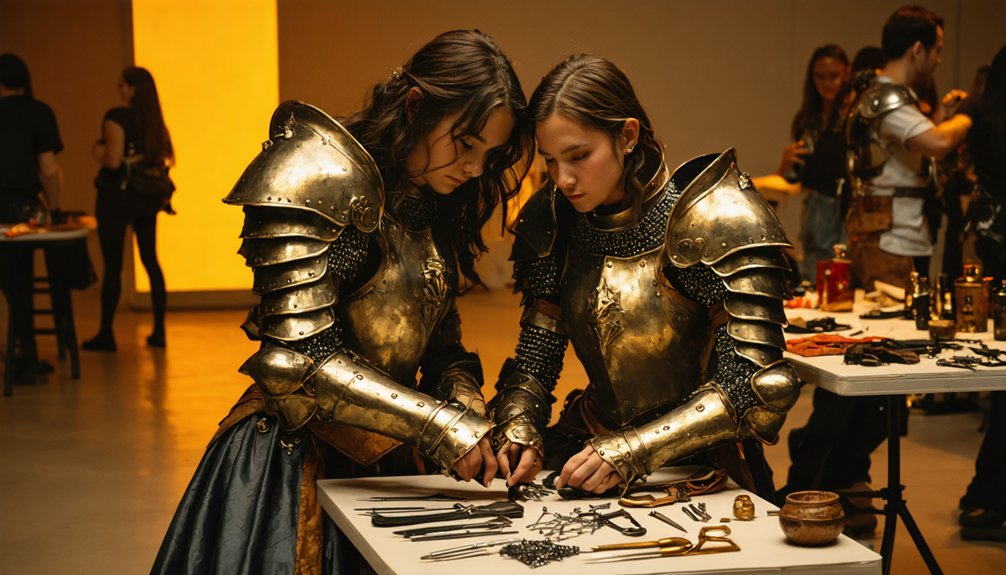
All that pose practice pays off until a snap, tear, or wardrobe failure derails your momentum mid-convention. That’s why building emergency kits into your couple cosplay plan is non-negotiable.
Pack a shared kit containing safety pins, double-sided tape, a needle and thread, hot glue sticks, and a small battery-powered glue gun. Split carrying responsibilities so neither partner’s bag becomes too heavy.
Your teamwork strategies should include designating specific roles during a malfunction—one partner shields the other from the crowd while the second executes repairs.
Establish a quick communication signal before the event so you can discreetly alert each other to issues without breaking character unnecessarily. Treating malfunctions as a coordinated problem rather than an individual crisis keeps your presentation polished and your energy focused.
Frequently Asked Questions
Can Couples Cosplay Characters From Different Fandoms Together?
Yes, you can! Don’t worry about mismatched universes — fandom fusion works when you prioritize character compatibility. Choose complementary aesthetics or themes, and you’ll create an innovative, cohesive couple cosplay that bridges different fandoms beautifully.
What if Partners Disagree on Which Characters to Choose?
When you’re facing disagreements, prioritize character compromise by listing each partner’s top picks, then identify overlapping aesthetics or theme alignment. You’ll discover creative crossover options that satisfy both visions, turning conflict into an innovative, uniquely personalized cosplay collaboration.
Should Couples Always Cosplay Romantic Characters From the Same Series?
You don’t have to limit yourselves to romantic dynamics from the same series. Explore character compatibility across different fandoms—you’ll often find creative pairings that spark more innovation and better reflect both your unique personalities and shared interests.
How Do We Pick Characters When We Have No Shared Fandoms?
Think of it as building a bridge—focus on character compatibility rather than shared fandoms. You’ll find iconic duos across different universes through fandom exploration. Pick contrasting archetypes like hero and villain that visually complement each other naturally.
Is It Okay to Gender-Swap Characters for Couple Cosplay Purposes?
Gender-swapping embraces creative freedom within gender bending guidelines. You’ll find it enhances character compatibility when coordinating couple cosplays. Focus on recognizable design elements so your audience instantly connects your innovative interpretations to the original characters.
References
- https://www.anthelia-counseling.com/cosplay-couples-coordinating-your-costumes-for-group-cosplay/
- https://unwinnable.com/2024/06/27/couple-bonding-through-cosplay-guide/
- https://www.youtube.com/watch?v=5-KWqfDhVS4
- https://www.xnyhealth.com/blog/cosplay-for-couples-deepen-your-connection-by-collaboration/
- https://getblys.com.au/blog/couples-costume-coordination/
- https://cosplay.com/archive/thread/8oxp1p/thoughts-on-cosplay-partner-etiquette
- https://www.lemon8-app.com/experience/good-couple-cosplay-ideas?region=us
- https://www.goodnovel.com/qa/fil/saan-malalaman-kung-ano-ang-tugma-para-sa-cosplay-couple
- https://www.magicwardrobes.com/blog/unlock-the-magic-of-twoperson-cosplay-couple-ideas-b-170.html
- https://rickyshalloween.com/halloween-couple-costumes/