Celebrity film cosplay isn’t just about great costumes—it’s a multi-million dollar engineering process you need to understand fully. Studios deploy 50 to 100 specialists, spend up to $10 million on fabrication, and coordinate costume, lighting, camera, and makeup departments with precision. Senior designers charge $150 to $300 hourly, and iterative fittings consume 60 hours per costume. Every texture, silhouette, and lighting angle is deliberately engineered. The deeper you explore these behind-the-scenes systems, the more the illusion reveals itself.
Key Takeaways
- Major studio costume budgets range from $15M to $300M, with 50–100 specialists ensuring character authenticity across 6–12 month timelines.
- Senior costume designers charge $150–$300 hourly, spending 40–60 hours per costume on iterative fittings for screen-accurate results.
- Visual bibles govern material choices, color palettes, and continuity photography to maintain character consistency across entire productions.
- Key lights at 45-degree angles and overhead rigs replicate cinematic lighting, essential for capturing authentic cosplay texture and depth.
- Modular components, template-driven patterns, and digital texture overlays serve as production shortcuts that reduce fabrication time without sacrificing realism.
How Celebrity Film Cosplay Actually Gets Made
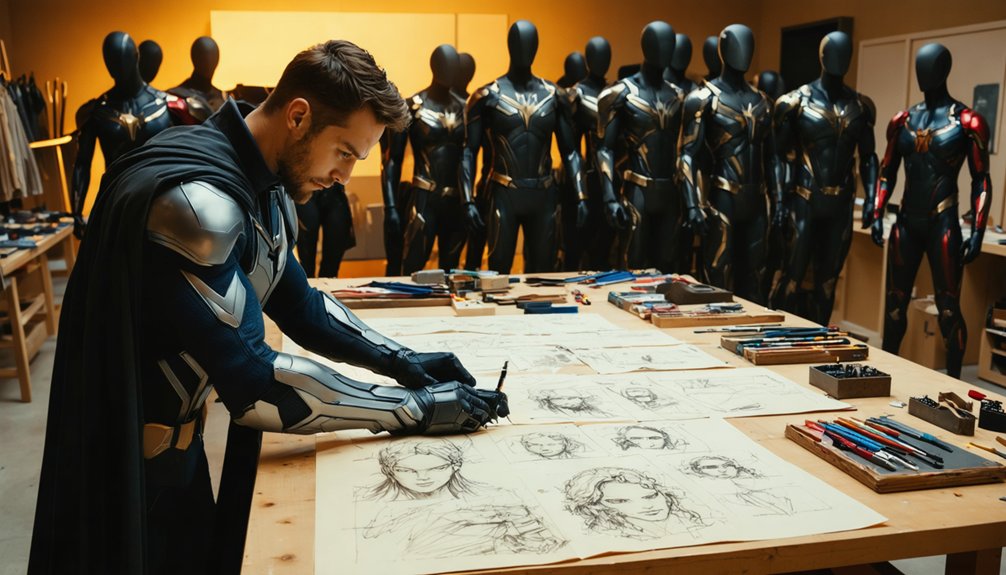
When you pull back the curtain on celebrity film cosplay, the scale of production is staggering. Major studios budget up to $300 million for costume innovation, deploying 50 to 100 specialists focused on character authenticity.
You’re looking at design collaboration that merges artistic inspiration with precise fabric selection. Departments spend 6 months to a year perfecting thematic elements, tackling production challenges through rigorous behind the scenes dynamics.
Design collaboration fuses artistic inspiration with fabric precision, spending months perfecting thematic elements through rigorous production dynamics.
Premier designers address visual aesthetics by integrating creative storytelling into every construction decision. Fabric selection isn’t arbitrary—it’s a calculated choice that reinforces character psychology and narrative context.
Your understanding of this process reveals that landmark productions allocate $5 million to $10 million specifically for research and fabrication, transforming conceptual sketches into technically sophisticated, narratively powerful costume systems.
The Real Cost of Celebrity Film Cosplay Costumes
When you break down the costume budget for a major film production, you’re looking at anywhere from $15 million to $300 million allocated specifically for the costume department.
You’ll find that fabric and material costs consume a significant portion of that budget, with specialized fabrication research alone running $5 million to $10 million on landmark productions.
Designer labor expenses add another substantial layer, as premier costume designers can spend up to a year crafting a single character’s outfit, supported by teams of 50 to 100 staff members.
Costume Budget Breakdown
Behind every iconic film costume lies a staggering financial investment that’d surprise most cosplayers. Major studios allocate $15M–$300M toward costume innovation, demanding precise budget allocation across departments.
Key breakdown elements you should understand:
- Design collaboration connects 50–100 specialists driving fabrication techniques and character authenticity.
- Material sourcing consumes significant portions of the $5M–$10M research budget.
- Production timelines span 6–12 months, shaping creative processes from concept to completion.
- Research methodologies inform every technical decision, ensuring screen-accurate results.
- Team dynamics determine how efficiently departments execute complex builds.
You’re working within a system where every dollar directly impacts the final costume’s integrity.
Understanding these financial structures helps you appreciate why professional fabrication techniques remain difficult to replicate independently, yet serve as invaluable benchmarks for your own cosplay ambitions.
Fabric And Material Costs
Fabric and material costs represent one of the most notable line items within that $5M–$10M research and fabrication budget, and understanding what drives those numbers sharpens your own sourcing decisions.
Studios prioritize fabric sourcing from specialized global suppliers, where material durability directly impacts shooting schedules. You’ll find that texture selection and color matching demand iterative sampling, adding weeks and real dollars to timelines.
Budget allocation shifts dramatically when production teams pursue fabric innovation—custom-engineered textiles, reactive dyes, and performance-grade composites command premium pricing.
Supplier negotiation becomes your strongest cost efficiency lever; bulk commitments and long-term vendor relationships reduce per-yard costs notably.
Track every material decision against your overall budget, and you’ll identify where substitutions maintain visual integrity without sacrificing production quality.
Designer Labor Expenses
Designer labor expenses consume the largest share of that $5M–$10M fabrication budget, so you’ll want to understand exactly where those hours accumulate. Teams of 50–100 specialists split labor allocation across distinct production phases, demanding precise designer efficiency at every stage.
- Pattern drafting and technical specification development
- Hand-stitching structural underlayers requiring master-level artisans
- Iterative fittings consuming 40–60 hours per costume
- Embellishment application demanding microscopic precision work
- Final quality-control inspections logged per individual component
Each phase compounds hourly costs exponentially. Senior costume designers command $150–$300 hourly rates, while specialized fabricators average $75–$150.
You’re fundamentally funding a concentrated creative workforce operating simultaneously across multiple costume builds, where misallocated labor hours directly compromise deadline integrity and finished product quality.
What Top Costume Designers Do on a Film Set
When you watch a finished film, top costume designers have already spent 6 months to a year building every character’s visual identity from scratch. They drive costume innovation by researching cultural influences and maintaining historical accuracy across every design iteration.
You’ll find them collaborating directly with directors, cinematographers, and actors through active design collaboration sessions that sharpen character authenticity at every stage.
They handle material sourcing personally, evaluating fabrics for both visual storytelling impact and on-set durability.
Tech integration enters their workflow through 3D modeling and digital fitting tools that accelerate precision. Actor involvement remains critical—designers observe movement patterns and comfort needs to refine silhouettes.
Every decision ultimately shapes audience perception, ensuring each costume communicates character psychology before a single line of dialogue is spoken.
How Production Design Drives Every Cosplay Detail
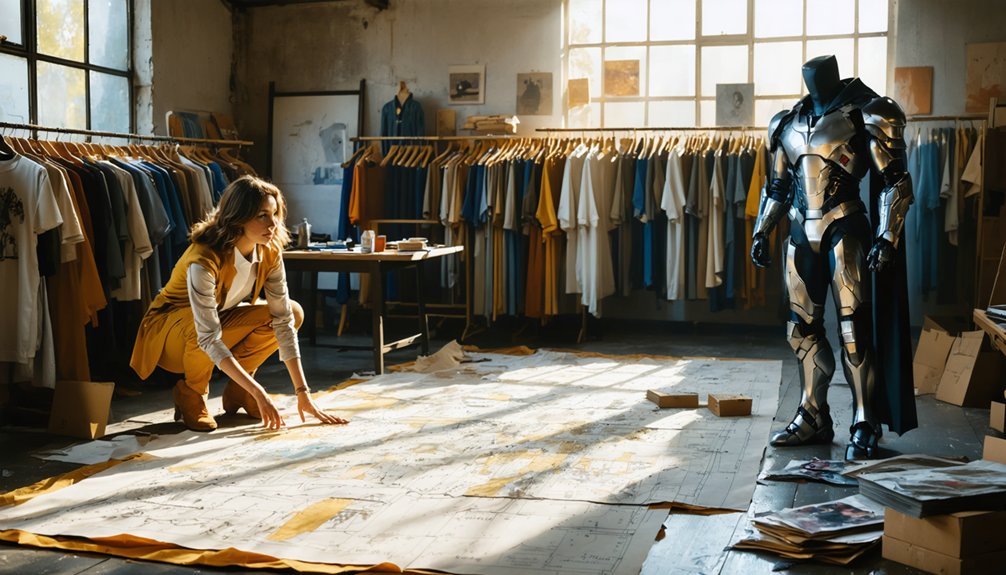
When you study production design, you’ll see how every cosplay detail—from fabric texture to color palette—stems from a unified visual blueprint that the entire creative team follows.
You’re not just wearing a costume; you’re embodying a precisely engineered character system where design choices drive authenticity across every frame.
Working collaboratively with designers, fabricators, and directors, you’ll find that visual consistency isn’t accidental—it’s a technical discipline built into every production decision.
Design Shapes Cosplay Details
Production design drives every cosplay detail you see on screen, from the curve of a villain’s shoulder armor to the weathered stitching on a hero’s jacket.
Designers collaborate across departments to guarantee character authenticity through every material innovations choice and color palettes decision.
Key design elements shaping cosplay accuracy include:
- Conceptual sketches translating abstract ideas into precise costume blueprints
- Historical inspirations and cultural influences grounding characters in tangible realities
- Silhouette variations distinguishing characters across complex ensemble casts
- Design aesthetics balancing visual storytelling with functional wearability
- Material innovations pushing fabrication beyond conventional textile boundaries
You’ll notice these decisions aren’t accidental.
Each element reflects deliberate cross-departmental collaboration, where production designers, costume supervisors, and fabricators align every visual choice to serve the character’s narrative truth precisely.
Production Drives Creative Authenticity
Every costume detail you see on screen emerges from a production design framework that’s far more systematic than most cosplayers realize.
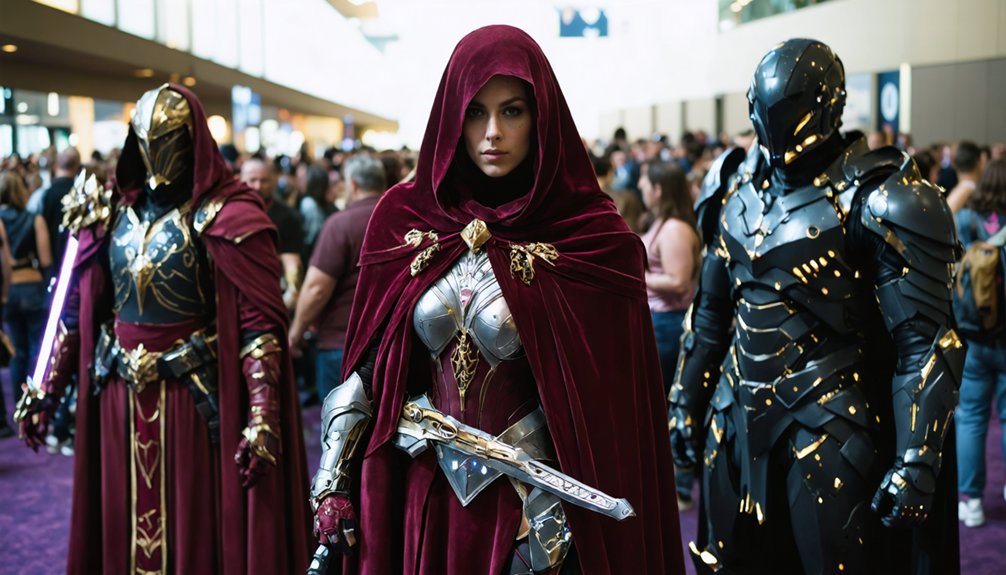
Studios coordinate creative collaboration across departments—costume, lighting, camera, and set design—ensuring every texture, color, and silhouette reads authentically on camera.
You’re looking at authenticity challenges that demand precise material testing under specific lighting conditions before filming begins.
Costume designers work directly alongside cinematographers, confirming that fabric sheen, color saturation, and structural integrity translate correctly through the lens.
When you’re replicating these looks, understanding this interdisciplinary process changes your approach entirely.
You’ll recognize that screen-accurate cosplay isn’t just about sourcing similar materials—it’s about understanding how production teams engineered each visual element to perform under controlled, technical filming environments.
Crafting Visual Character Consistency
Character consistency across a film production isn’t accidental—costume departments coordinate directly with production designers to establish a visual bible that governs every material choice, color palette, and silhouette decision from pre-production through final shot.
You’ll find that character alignment depends on rigorous cross-departmental collaboration, ensuring visual cohesion holds frame after frame.
Key coordination protocols include:
- Color script mapping ties costume palettes to cinematography lighting plans
- Material testing validates fabric behavior under specific camera formats
- Character evolution tracking documents costume changes across timeline arcs
- Reference libraries standardize approved textures, trims, and hardware finishes
- Continuity photography creates shot-specific costume benchmarks for every scene
These systems eliminate visual drift, keeping your character’s design language precise, intentional, and narratively coherent throughout production.
Celebrity Film Cosplay Fabrication Techniques That Work
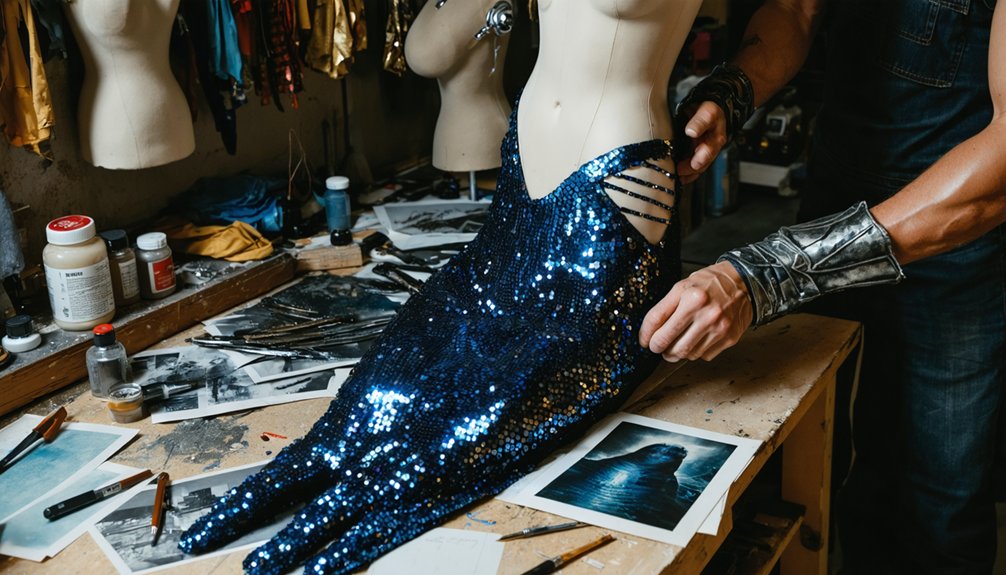
When you’re fabricating celebrity film-quality cosplay, the techniques behind the finished product matter as much as the materials themselves. Successful fabrication techniques demand precise design collaboration between pattern makers, sculptors, and textile specialists working in synchronized team dynamics.
Your creative processes should begin with material sourcing from industry-grade suppliers, prioritizing durability alongside visual accuracy. Character authenticity depends on referencing original production breakdowns, not just surface-level aesthetics.
Source materials from industry-grade suppliers, balancing durability with visual accuracy for true character authenticity.
Technical challenges emerge constantly—from thermoplastic molding inconsistencies to fabric dye bleeding under specific lighting conditions. Addressing these requires adaptive problem-solving built into your workflow from day one.
Costume innovation happens when you treat every constraint as a design opportunity. Document each fabrication decision, share findings across your team, and continuously refine your methodology to achieve genuinely professional results.
What a Film Glam Squad Does Before Cameras Roll
Before cameras roll, a film glam squad executes a tightly coordinated series of preparation steps that directly determine how well a look holds up under production conditions.
You’re watching makeup techniques, costume materials, and design collaboration converge into a single workflow driven by character authenticity and visual storytelling precision.
Here’s what the team carries out before you hear “action”:
- Tests makeup longevity under production lighting to address filming logistics early
- Coordinates fabric sourcing with costume leads to align material behavior with movement demands
- Runs fit checks that feed directly into the creative process and team dynamics
- Identifies production challenges through pre-shoot walkthroughs
- Documents every product and technique layer to guarantee consistent reproducibility across shooting days
Each step protects the integrity of the final visual output.
How Makeup Artists Hold Up Through 12-Hour Film Days
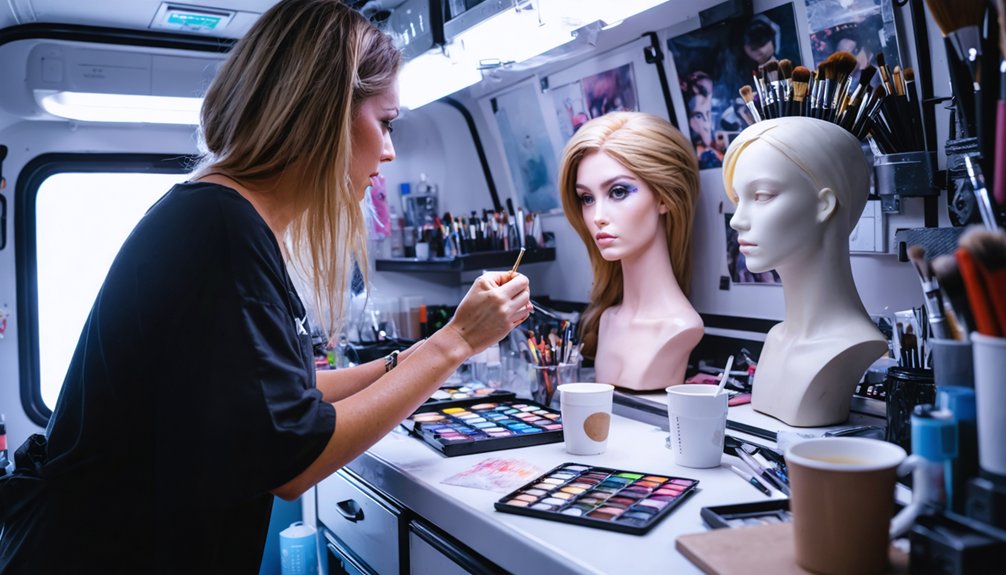
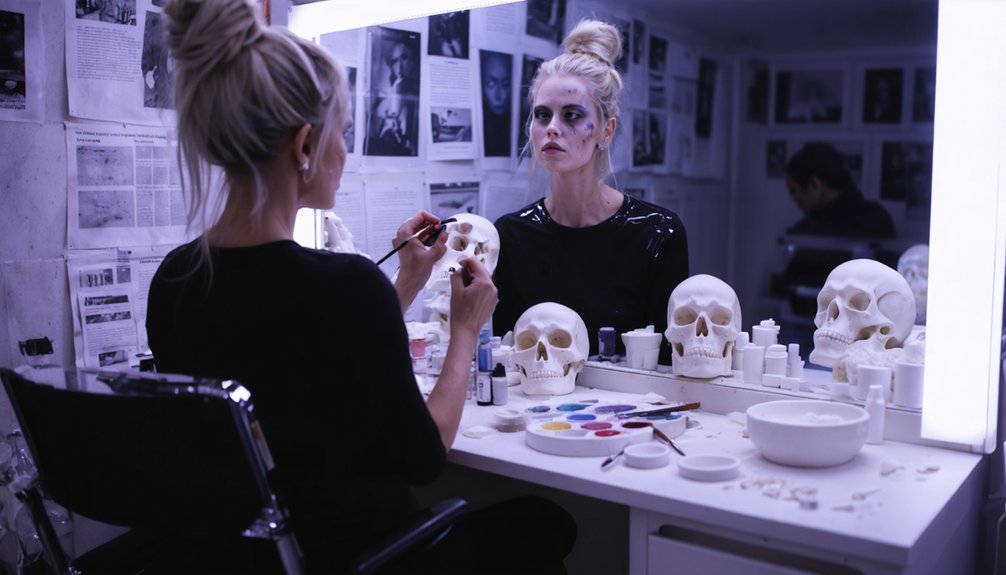
Sustaining a makeup look through a 12-hour film day demands layered prep work that begins well before the first shot. You’re working with primer applications that lock pigment against sweat, heat, and repeated takes.
Makeup longevity depends on your product sequencing—setting sprays, translucent powders, and skin-prep serums aren’t optional; they’re structural. You coordinate with lighting teams to identify where coverage breaks down fastest under high-intensity rigs.
Filming endurance means you’re touching up between every scene shift, reading the actor’s skin in real time, and adjusting for humidity shifts on location.
Your kit stays organized by priority—what degrades first gets restocked most frequently. Every application decision you make directly protects continuity, ensuring each frame matches the last without visible inconsistency.
The Lighting and Camera Rigs Behind Film Cosplay Shoots
When you’re shooting film cosplay, you’ll want to position your key lights at 45-degree angles to sculpt costume textures and eliminate harsh shadows that flatten intricate design details.
You can further enhance depth by mounting secondary rigs overhead to simulate cinematic top-lighting, replicating the controlled studio environments that major productions use.
Pairing these setups with camera angles positioned slightly below eye level lets you capture the full scope of costume fabrication while maintaining the dramatic framing audiences recognize from blockbuster films.
Lighting Rig Setup Techniques
Lighting rigs for film cosplay shoots demand careful planning, with cinematographers and gaffers collaborating to layer multiple light sources that sculpt costume textures and character aesthetics.
You’ll find that lighting efficiency and rig stabilization are critical priorities throughout setup.
Key techniques your team should implement:
- Mount LED panels on motorized rigs for dynamic angle adjustments during shooting
- Use diffusion fabrics to soften harsh light and preserve costume material detail
- Deploy counterweights on overhead rigs to guarantee rig stabilization across extended shoots
- Integrate DMX control systems to coordinate multiple fixtures simultaneously, maximizing lighting efficiency
- Position practical bounce cards strategically to fill shadow zones on intricate costume surfaces
These collaborative methods guarantee your lighting infrastructure delivers precise, repeatable results across every cosplay filming session.
Camera Angle Positioning Methods
Once your lighting rigs are locked and stabilized, camera angle positioning becomes the next layer of precision your team needs to coordinate.
You’ll want to establish hero angles first, identifying the sightlines that best complement your cosplay subject’s costume silhouette and facial prosthetics. Your camera angle techniques should account for lens distortion at wider focal lengths, particularly when capturing full-body armor builds.
Collaborate with your director of photography to map framing strategies that balance environmental context with character detail. Low-angle placements amplify presence, while eye-level setups maintain authenticity.
You’re also adjusting for lighting spill, ensuring your rigs don’t create unwanted shadows across intricate costume textures. Lock each position in your shot list before filming begins, keeping your entire crew aligned and execution precise.
The Production Shortcuts Most Film Cosplay Teams Use
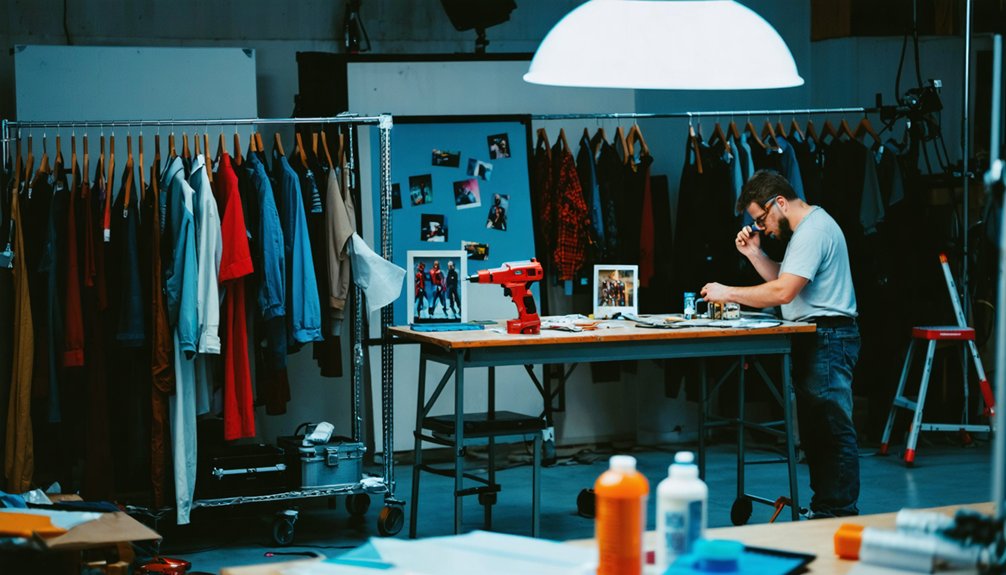
Behind every polished film cosplay production lies a toolkit of proven shortcuts that teams rely on to stay on schedule and under budget.
Behind every stunning cosplay production is a carefully curated toolkit keeping teams on schedule and under budget.
You’ll find that costume shortcuts and production efficiency aren’t about cutting corners—they’re about working smarter with your resources.
Here are the most widely used shortcuts:
- Modular costume components that swap between characters quickly
- Pre-rigged lighting setups recycled across multiple scenes
- Digital texture overlays replacing hand-painted costume details
- Standardized makeup base layers applied universally before character-specific work begins
- Template-driven fabrication patterns reducing custom construction time considerably
When you implement these strategies, your team maintains quality while compressing timelines.
Studios consistently leverage these methods to reallocate budget toward high-impact visual moments that audiences actually notice on screen.
What Makes Celebrity Film Cosplay Look Real on Screen
What separates convincing celebrity film cosplay from amateur imitation comes down to layered realism—the deliberate combination of texture, light interaction, and scale accuracy that fools the camera.
You’re working with materials that respond authentically to lighting rigs, not just look good under natural light.
Character authenticity demands you match screen-accurate proportions, weathering patterns, and surface finishes.
Productions invest heavily in photographic references, breaking down every costume component frame by frame.
Costume evolution also plays a critical role.
You’ll notice how costumes shift across a film’s timeline—strategic distressing, color grading adjustments, and fabrication layering all contribute to believability.
Makeup departments coordinate directly with costume teams, ensuring skin tones and material palettes align cohesively on camera.
Precision collaboration between departments is what ultimately sells the illusion.
Frequently Asked Questions
How Do Celebrity Cosplay Teams Handle Unexpected Costume Malfunctions During Filming?
When costume malfunctions strike, you’ve got dedicated repair specialists executing emergency solutions instantly. They’re using industrial adhesives, backup pieces, and rapid stitching techniques, ensuring costume repairs don’t disrupt your collaborative filming schedule, keeping innovation and production momentum intact.
What Psychological Preparation Do Celebrities Undergo Before Major Cosplay Transformations?
Before embodying Thanos, Josh Brolin underwent identity exploration sessions with psychologists. You’d build emotional resilience through character immersion workshops, collaborative mindfulness exercises, and method-acting techniques, mentally separating your personal identity from the transformative cosplay role you’re assuming.
How Do Film Cosplay Departments Manage Sustainability and Costume Recycling After Production?
You’ll find film cosplay departments actively repurpose costume materials through eco-friendly practices, collaborating with green initiatives to donate, upcycle, or archive pieces, ensuring innovative sustainability strategies minimize waste while preserving production culture for future creative endeavors.
What Union Regulations Govern Celebrity Film Cosplay Department Working Conditions?
You’ll find that union contracts under IATSE govern your department’s working conditions, enforcing safety standards around hours, equipment handling, and fair wages, ensuring collaborative teams innovate efficiently while protecting every crew member’s rights throughout production.
How Do Cosplay Teams Coordinate Between International Productions With Different Cultural Standards?
Like bridges spanning oceans, you’ll navigate international cosplay productions by deploying cultural sensitivity frameworks and advanced communication tools, actively syncing teams across borders, aligning diverse standards, and you’re collaborating through real-time digital platforms to guarantee cohesive, culturally respectful creative execution.
References
- https://www.youtube.com/watch?v=NkwbVjnFzE4
- https://www.youtube.com/watch?v=Ms5F6R_Hx2I
- https://www.ranker.com/list/action-movie-costume-details/raelyn-giansanti
- https://www.huffingtonpost.co.uk/entry/the-masked-singer-behind-the-scenes-secrets-facts_uk_61dc2bcce4b0d637aea46b03
- https://www.youtube.com/watch?v=n6GeSsmMlTM
- https://www.youtube.com/watch?v=jKFU41zgvf0
- https://celebritykingdom.com/behind-the-scenes-stories-from-celebrity-movies/
- https://www.youtube.com/watch?v=12xiyK9sGBk
- https://www.youtube.com/watch?v=RSHyxk0W_TQ
- https://brightside.me/articles/15-pics-that-reveal-the-behind-the-scenes-secrets-of-our-favorite-movies-and-tv-shows-811276/