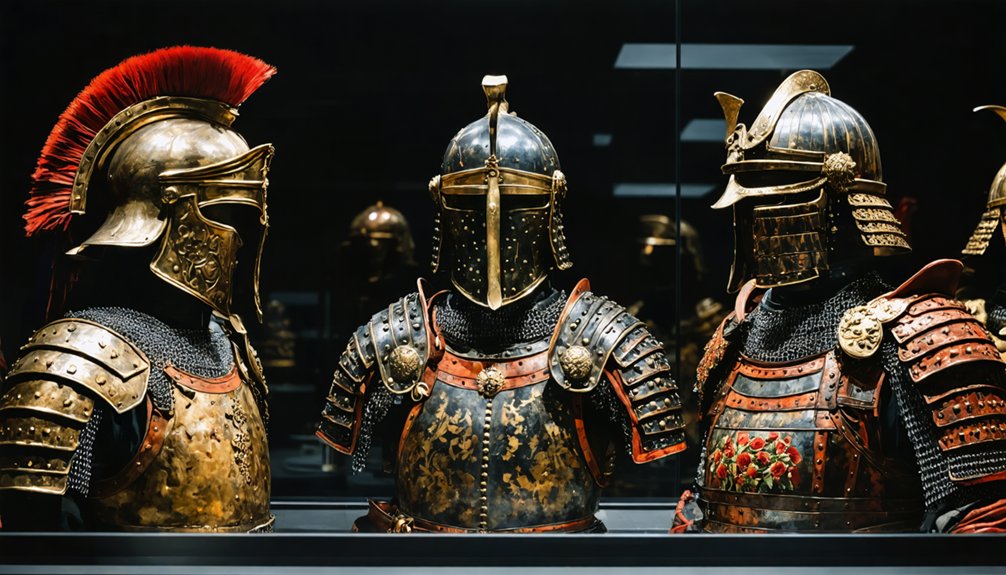
When exploring armor replicas across historical eras, you’ll encounter consistent metallurgical benchmarks that define authenticity. Greek bronze plates maintain 2.5mm thickness, matching 13th-century medieval steel standards, while classical cuirasses and 14th-century plate armor both reach 3.3mm. Roman and knight helmet replicas share a 1.8mm specification. Quality indicators like hand-riveted joints and period-appropriate hammer marks separate authentic pieces from cheap imitations. There’s considerably more to uncover about what makes these replicas historically credible.
Key Takeaways
- Greek phalanx replicas feature 2.5mm bronze plates, while classical bronze cuirasses reach 3.3mm thickness for historical accuracy.
- Medieval 13th-century plate armor maintains 2.5mm steel, advancing to 3.3mm thickness by the 14th century.
- Renaissance smiths achieved 3.3mm thick steel by the 15th century, reflecting greater craftsmanship precision.
- Quality replicas feature hand-riveted connections, period-appropriate hammer marks, and historically accurate steel or bronze materials.
- Black light testing verifies material authenticity by detecting modern synthetic fibers in armor replicas.
Bronze and Iron Armor Replicas From Ancient Greece and Rome
Bronze and iron armor replicas from ancient Greece and Rome offer collectors a tangible connection to classical warfare, capturing the metallurgical sophistication of civilizations that shaped Western military history.
When you examine Greek armor, you’ll notice 2.5mm bronze plates reflecting rigorous craftsmanship standards tied directly to phalanx combat techniques.
Roman shields demonstrate design evolution shaped by warfare impact across expanding territories.
Material authenticity matters considerably—bronze cuirass replicas feature 3.3mm thick construction, ensuring historical accuracy that serious collectors demand.
You’ll want to prioritize replica maintenance, as bronze oxidation can compromise cultural significance and structural integrity over time.
Understanding each piece’s contextual origins lets you appreciate how metallurgical innovations transformed battlefield strategy, connecting you intellectually to civilizations whose military ingenuity fundamentally redefined organized warfare.
Chain Mail and Plate Armor Replicas From the Medieval Period
Medieval armor replicas represent a fascinating evolution in protective technology, bridging the gap between ancient scale construction and Renaissance sophistication.
When you examine chain mail replicas, you’ll notice thousands of interlocking rings engineered for remarkable flexibility, demonstrating how medieval craftsmen prioritized movement alongside protection.
Plate armor replicas reveal an equally compelling technological trajectory. You’re looking at 2.5mm thick steel construction in 13th century models, while 14th century designs advanced to 3.3mm thick plates, reflecting metalworking innovations driven by evolving battlefield demands.
Plate armor thickness evolved from 2.5mm to 3.3mm within a single century, mirroring warfare’s relentless demands on medieval metallurgy.
Knight helmet replicas consistently feature 1.8mm thick iron or steel, maintaining structural integrity without compromising mobility.
These replicas aren’t merely decorative artifacts; they’re analytical windows into how warfare conditions systematically transformed defensive engineering throughout the medieval period.
Why Renaissance Armor Replicas Look More Refined Than Earlier Designs
Renaissance armor replicas exhibit a marked refinement over their medieval counterparts, and understanding why requires examining both metallurgical advancement and shifting aesthetic priorities.
By the 15th century, smiths had mastered forging 3.3mm thick steel with greater precision, enabling flowing contours that deflect blows more efficiently than flat medieval plates.
You’ll notice Renaissance craftsmanship introduced subtle ridges, fluting, and articulated joints that distribute impact forces while simultaneously achieving sophisticated armor aesthetics.
This dual function—structural integrity alongside visual elegance—distinguishes Renaissance designs fundamentally.
Where 13th century plate armor replicas show 2.5mm thick utilitarian construction, Renaissance equivalents incorporate decorative etching and symmetrical proportions reflecting humanist ideals.
When you examine these replicas closely, you’re observing a convergence of engineering innovation and artistic ambition that medieval armorers simply hadn’t yet achieved.
How Historical Metalworking Techniques Influence Armor Replica Construction Today
When you examine ancient metalworking techniques, you’ll recognize how early craftsmen’s use of copper and bronze scales directly shaped the foundational principles of replica construction.
You can trace medieval forging methods—particularly the 1300s advancements in producing larger steel sheets—through the precise 2.5mm to 3.3mm thickness standards that modern replica makers maintain today.
Understanding these historical benchmarks equips you to critically evaluate how contemporary construction techniques either honor or deviate from their metallurgical origins.
Ancient Metalworking Techniques Explored
Ancient metalworking techniques laid the groundwork for how armor replicas are constructed today, bridging millennia of craftsmanship with modern manufacturing precision.
You’ll find that ancient metallurgy directly informs contemporary replica construction, where bronze casting methods pioneered in early civilizations still echo in modern foundry practices.
Craftsmen who mastered iron smelting transformed armor design from primitive bone-and-wood constructions into sophisticated, overlapping metal scales.
Today’s replica manufacturers analyze these ancestral processes to reproduce historically accurate pieces with remarkable fidelity.
Mining advancements enabled copper and bronze scale production, while improved iron smelting eventually yielded larger, articulated steel sheets by the 1300s.
Understanding these foundational techniques allows you to appreciate how innovation isn’t solely modern—it’s deeply rooted in ancient metallurgical experimentation that continues shaping armor replica craftsmanship today.
Medieval Forging Methods Analyzed
Medieval forging methods built directly upon ancient metallurgical foundations, refining earlier scale-and-laminate construction into sophisticated plate armor systems that today’s replica craftsmen continue studying and reproducing.
You’ll find that medieval craftsmanship techniques centered on improved furnace temperatures and controlled carbon introduction, enabling smiths to forge larger, more uniform steel sheets.
Plate armor replicas reflect this advancement, showing 2.5mm thick steel in 13th century models and 3.3mm thick construction in 14th century designs.
Traditional forging practices from this period introduced articulated joint systems, allowing greater mobility without sacrificing protection.
When you examine authentic medieval reproductions, you’re witnessing direct applications of these historically documented methods.
The 1300s metalworking improvements that produced larger steel sheets remain foundational knowledge driving contemporary replica construction standards today.
Modern Replica Construction Techniques
Modern replica construction techniques draw directly from historical metalworking foundations, translating centuries-old smithing principles into today’s precision manufacturing standards.
You’ll find that modern materials and refined crafting techniques enable unprecedented accuracy in reproducing historically significant armor pieces.
Key construction benchmarks include:
- 2.5mm steel plates replicating 13th-century plate armor specifications
- 1.8mm iron or steel matching medieval knight helmet thickness standards
- 3.3mm bronze construction mirroring classical cuirass structural integrity
- Black light verification detecting synthetic fibers that distinguish replicas from originals
These parameters aren’t arbitrary—they’re derived from documented historical analysis.
When you examine reputable dealers’ offerings, you’ll notice their crafting techniques consistently align with period-accurate thickness standards.
Modern materials like high-carbon steel now allow smiths to achieve historical tolerances while incorporating contemporary metallurgical advancements.
Steel and Bronze Thickness Standards in Historically Accurate Armor Replicas
When examining historically accurate armor replicas, you’ll find that steel and bronze thickness standards vary meaningfully across periods and armor types. These specifications carry profound historical significance, directly influencing armor functionality and combat effectiveness across eras.
Greek phalanx replicas feature 2.5mm bronze plates, while classical bronze cuirasses reach 3.3mm construction. Roman legionary helmets incorporate 1.8mm iron or steel, balancing protection with mobility.
Medieval progression mirrors this precision: 13th-century plate armor maintains 2.5mm steel, advancing to 3.3mm thickness by the 14th century. Renaissance models sustain this 3.3mm standard in 15th-century knight armor, while jousting replicas return to 1.8mm construction.
You’ll want to verify these specifications through reputable dealers who prioritize metallurgical accuracy, ensuring your replica authentically reflects its period’s engineering innovations.
Construction Details That Separate Quality Armor Replicas From Cheap Imitations

Beyond thickness specifications, construction quality markers distinguish authentic replicas from mass-produced imitations. When you’re evaluating replica authenticity, examine these critical quality assessment indicators:
- Joint construction: Quality replicas feature hand-riveted connections, not spot-welded shortcuts.
- Surface finishing: Authentic pieces show period-appropriate hammer marks or polishing consistent with historical metalworking techniques.
- Material composition: Reputable dealers provide 2.5mm–3.3mm thick historically accurate steel or bronze, not lightweight alloy substitutes.
- Hardware integrity: Buckles, straps, and fasteners should match era-specific designs using appropriate metals.
You’ll immediately notice cheap imitations through uniform machine-stamped surfaces, inconsistent thickness, and anachronistic hardware.
Black light tests additionally reveal modern synthetic fibers that glow, exposing inauthentic materials.
Applying these analytical criteria sharpens your ability to confidently distinguish museum-grade craftsmanship from commercially inferior reproductions.
What Black Light Tests Reveal About Modern Armor Replica Materials
Black light testing offers one of the most reliable diagnostic methods for exposing inauthentic materials in armor replicas. When you subject a replica to ultraviolet illumination, modern fibers embedded within the construction fluoresce distinctly, immediately betraying anachronistic manufacturing shortcuts.
Authentic historical materials—iron, bronze, and tempered steel—absorb ultraviolet light rather than reflecting it, producing no luminescent response.
You’ll find that thickness variations matter here too. Whether examining 1.8mm, 2.5mm, or 3.3mm constructions, black light penetrates surface treatments and patinas, revealing synthetic reinforcements that visual inspection misses entirely.
This diagnostic precision allows collectors and researchers to distinguish genuinely constructed replicas from deceptive imitations efficiently. Incorporating black light verification into your acquisition protocol guarantees that every piece meets rigorous material authenticity standards before entering your collection.
Where to Buy Historically Accurate Armor Replicas From Reputable Dealers
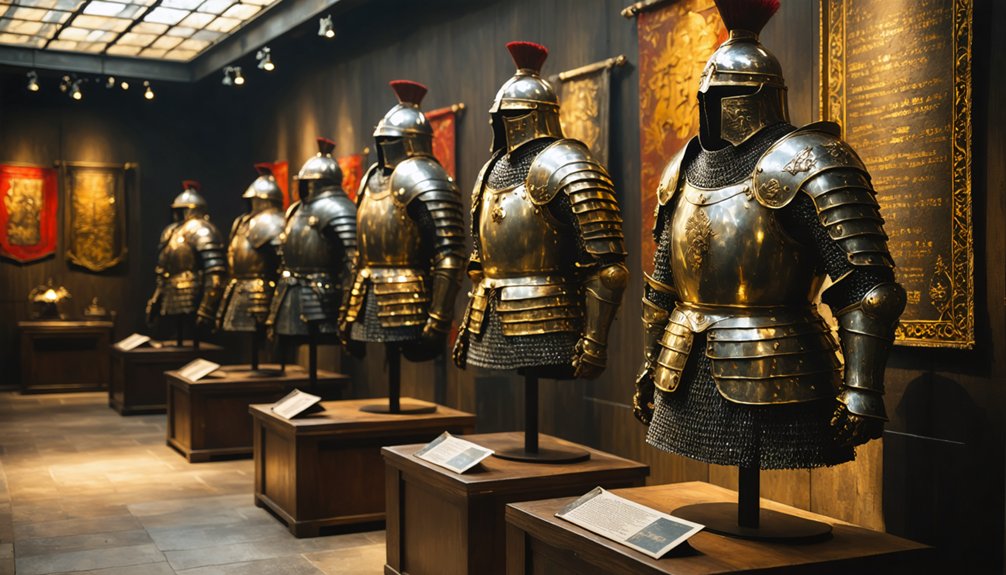
When seeking historically accurate armor replicas, you’ll find that reputable dealers maintain strict adherence to documented thickness specifications, such as 2.5mm steel for medieval plate armor or 3.3mm bronze for classical cuirasses.
You should verify a dealer’s credibility by confirming their replicas align with period-specific construction standards and pass established authentication tests, including black light examination for synthetic materials.
Trusted sources, including specialized historical armories and academically vetted suppliers, offer documented provenance and precision craftsmanship that distinguish authentic replicas from inferior reproductions.
Reputable Dealers Offer Replicas
Sourcing historically accurate armor replicas requires identifying reputable dealers who prioritize material authenticity and construction precision.
You’ll find that replica craftsmanship varies considerably across vendors, making historical authenticity a critical evaluation criterion.
Consider these key dealer attributes:
- Material specification transparency: Dealers document precise thickness measurements, such as 2.5mm or 3.3mm steel construction.
- Era-accurate metallurgy: Vendors replicate period-appropriate materials, from bronze scales to articulated steel plates.
- Verification protocols: Reputable dealers support black light testing to distinguish authentic materials from synthetic fibers.
- Construction documentation: Detailed provenance records validate manufacturing techniques against historical standards.
When you’re evaluating vendors, cross-reference their specifications against documented historical parameters.
Prioritizing dealers who maintain rigorous construction standards guarantees your acquisition reflects genuine scholarly and material integrity.
Historically Accurate Armor Sources
Apply black light verification techniques when evaluating physical samples, as modern synthetic fibers fluoresce distinctly under ultraviolet exposure.
Dealers who welcome rigorous scrutiny—rather than deflecting technical inquiries—signal credible operational standards, ultimately ensuring your acquisition reflects genuine historical precision and scholarly integrity.
Verified Replica Purchase Locations
Identifying verified purchase locations demands the same analytical rigor you’d apply to evaluating the replicas themselves. Reputable dealers don’t merely sell products—they substantiate replica authenticity through documented material specifications and historical sourcing.
Prioritize dealers who demonstrate transparency across these critical benchmarks:
- Material disclosure: Confirmed armor material thickness, such as 2.5mm or 3.3mm steel, matching documented historical standards.
- Provenance documentation: Written records linking replicas to specific historical periods and manufacturing techniques.
- Third-party verification: Independent assessments validating construction accuracy against archaeological references.
- Return policies: Structured guarantees reflecting confidence in their replicas’ historical integrity.
Cross-referencing dealer credentials against museum catalogs and academic publications strengthens your acquisition strategy.
Dealers who voluntarily provide metallurgical specifications signal credible operational standards, distinguishing themselves within an increasingly competitive, innovation-driven replica marketplace.
Frequently Asked Questions
How Did Ancient Warriors Maintain and Repair Their Armor During Campaigns?
During campaigns, you’d employ essential armor maintenance through field repair techniques, using warrior resources like portable tools. Campaign strategies included patching rivets, re-lacing leather, and hammering dents—keeping your armor combat-ready with minimal resources available.
Were Armor Replicas Ever Used as Diplomatic Gifts Between Historical Kingdoms?
Like bridges spanning cultures, armor replicas carried profound diplomatic significance between kingdoms. You’ll find they embodied cultural symbolism, strengthening alliances and showcasing metalworking mastery, transforming mere objects into powerful ambassadors of political goodwill and mutual respect.
How Long Does It Typically Take to Hand-Craft a Full Armor Replica?
You’ll typically invest 200–500 hours hand-crafting a full armor replica, depending on complexity. Mastering crafting techniques and sourcing historical materials like 2.5mm steel demand precision, analytical rigor, and innovative dedication to authentically reproduce each era’s distinctive construction methods.
Can Armor Replicas Be Legally Worn in Public Historical Reenactment Events?
You’re stepping from modern streets into ancient battlefields—you can wear armor replicas at public events, but you’ll need to navigate legal restrictions, as local ordinances often regulate weapons and protective gear differently.
What Museums Offer the Best Original Armor Pieces for Replica Reference?
You’ll find exceptional armor conservation and historical authenticity references at the Metropolitan Museum, Wallace Collection, and Vienna’s Kunsthistorisches Museum. These institutions offer unparalleled original pieces, actively inspiring innovative replica craftsmanship through scholarly, precisely documented collections.
References
- https://museumreplicas.com
- https://warfarehistorynetwork.com/article/military-replicas-vs-originals/
- https://www.historicalreproductions.com
- https://www.medievalcollectibles.com/product-category/armour/
- https://steel-mastery.com/full-armour
- https://indianchainmailarmour.com/index.php/product-category/historical-medieval-reproduction/
- https://museumreplicas.com/blog/the-evolution-of-armor-from-ancient-warriors-to-renaissance-knights/
- https://www.arms-n-armor.com
- https://www.medieval-shop.co.uk/content/187-historical-armor
- https://www.youtube.com/watch?v=kBSy4erfQEE