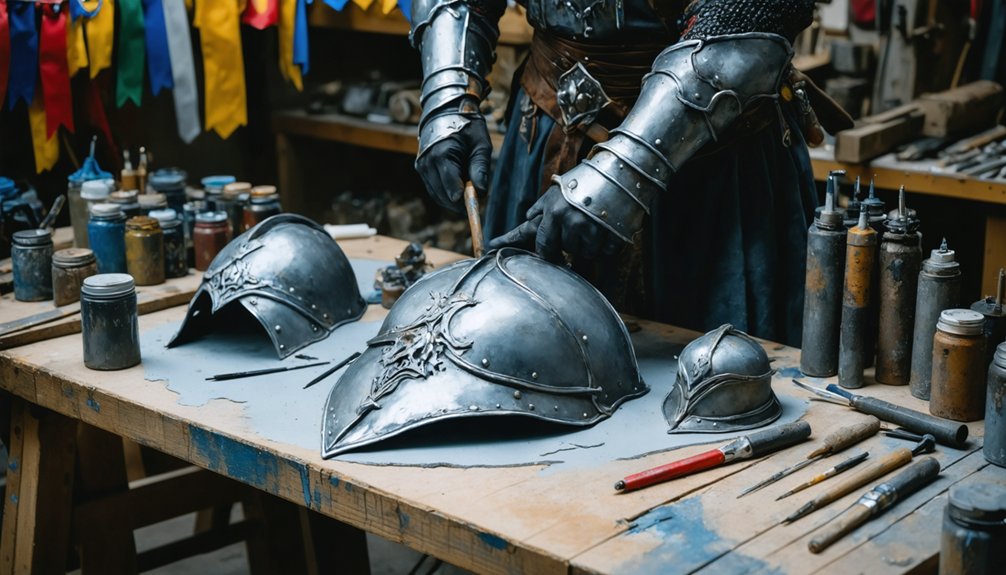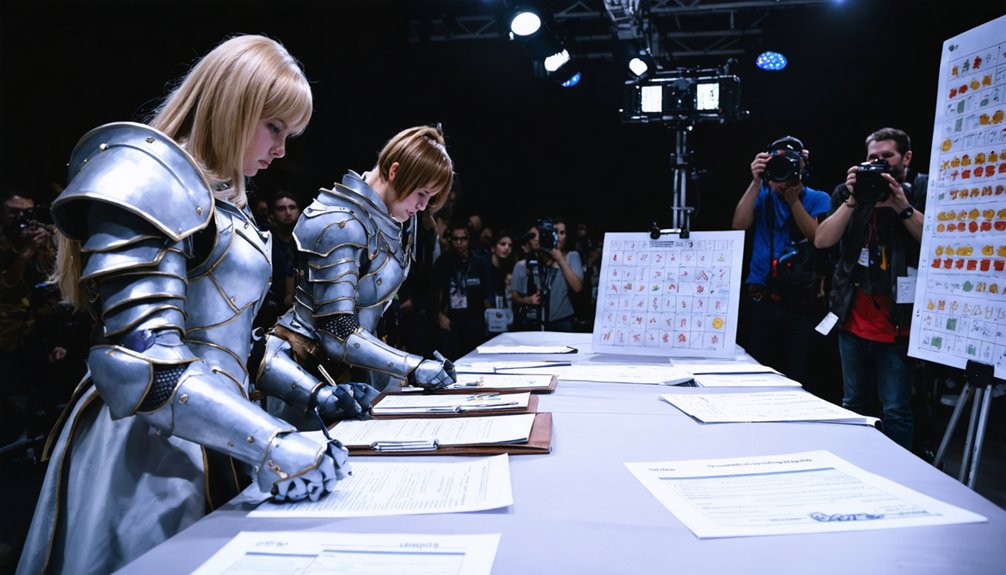
To win a cosplay skit contest, you’ll need to master seven key areas: understanding scoring rules, calculating your handmade percentage accurately, finishing your costume to a judge-ready standard, building a compelling progress book, structuring a clear and timed skit, commanding the stage with exaggerated expressions, and rehearsing your pre-judging walkthrough aloud. Each element directly impacts your score in ways most competitors underestimate—and every detail covered below can sharpen your competitive edge considerably.
Key Takeaways
- Structure your skit with a clear three-beat format: setup, escalation, and payoff to maintain narrative flow and audience engagement.
- Exaggerate facial expressions and emotions on stage, since theatricality appears subtle from a distance beyond the third row.
- Stay within time limits strictly, as exceeding them triggers immediate point deductions that can cost you the competition.
- Slow down deliberately when showcasing impressive costume details so judges can fully assess your craftsmanship without missing key elements.
- Document every construction phase in a progress book, referencing specific pages during judging to demonstrate intentionality and technical mastery.
Which Cosplay Contest Rules Actually Affect Your Score
Before you start hot-gluing foam or drafting patterns, you need to understand which contest rules directly tie to your final score. Scoring criteria vary by event, but handmade percentage requirements—typically 70–80%—directly eliminate non-compliant entries.
Exceed your skit’s time limit, and you’ll face immediate point deductions, regardless of quality.
Go over your allotted skit time, and points vanish instantly—no exceptions made for exceptional work.
Pre-judging slots run 2–5 minutes, so your contestant strategies must prioritize efficient, sequential presentation over exhaustive storytelling. Judges evaluate judging nuances like seam finishing, internal lining, and armor priming—details most competitors overlook until it’s too late.
Your presentation tips should address both the judging table and the stage simultaneously. Understand eligibility criteria before building, not after.
Rules aren’t bureaucratic obstacles—they’re the actual framework determining whether your craftsmanship translates into competitive points.
How to Calculate Your Handmade Percentage Before You Enter
Before you register, count every costume piece and assign it either a handmade or bought status. Then divide your handmade pieces by the total to get your percentage.
Most contests require 70–80% handmade construction, so if you’re relying heavily on commissioned armor or store-bought accessories, you’ll likely fall short of eligibility.
Audit your build honestly, because judges who spot a discrepancy between your documentation and your actual construction can disqualify you outright.
Counting Handmade Versus Bought
Most cosplay contests require that 70–80% of your costume be handmade, so you need to calculate that percentage accurately before you submit your entry.
Begin your handmade evaluation by listing every component separately, then assign each a percentage of the total costume’s value or construction effort. Bought item impact compounds quickly—one purchased armor set can collapse your craftsmanship balance instantly.
Prioritize originality importance by replacing store-bought pieces with handcrafted alternatives wherever possible, turning each substitution into a skill showcase.
During pre-judging, technique demonstration on constructed pieces sharpens judge perception in your favor.
Don’t estimate loosely; accuracy verification protects you from disqualification. Cross-reference your component list against contest rules, confirm your percentage meets the threshold, then enter with documented confidence that every handmade element genuinely reflects your technical investment.
Meeting Minimum Percentage Requirements
Calculating your handmade percentage accurately turns component listing into a concrete eligibility verdict. Divide your handmade components by total components, then multiply by 100. Most contests require 70–80% handmade verification before you’re cleared to compete.
Percentage tracking demands honesty—judges recognize purchased pieces immediately. If your calculation falls short, modify or replace bought elements before submitting your entry. Strengthen weak areas through skill demonstration: replace store-bought accessories with fabricated alternatives that also showcase technical ability.
Contest compliance isn’t purely administrative; it’s strategic. Every handmade addition simultaneously improves your eligibility score and your craftsmanship score.
Document each component’s construction status in your progress book, assigning clear handmade or purchased designations. That transparency protects you during pre-judging and eliminates disqualification risks entirely.
Make Your Cosplay Costume Stage-Ready From the Start
When designing your cosplay for competition, you must plan stage-friendly elements from the start — hems that clear the floor, silhouettes that read from the back of the hall, and armor proportions that photograph well under harsh lighting.
Finish every seam, hem, and raw edge as if judges will inspect each inch up close, because they will, and unfinished interiors signal careless construction regardless of how polished the exterior looks.
Fill gaps between armor plates with faux chain mail or appropriate texture rather than leaving voids, since those spaces reveal the difference between a costume built for display and one built to win.
Plan Stage-Friendly Design
Designing your cosplay with the stage in mind from the very beginning saves you from costly last-minute alterations and performance mishaps.
Prioritize stage visibility by selecting bold colors and sharp silhouettes that read clearly from the back row. Build costume durability into every seam and closure, since performance movement stress-tests construction far beyond static display.
Guarantee character authenticity remains intact while adapting design elements that could restrict movement or create hazards. Integrate prop integration early, mapping out exactly how you’ll carry, deploy, or store props during skit pacing shifts.
Audience engagement depends on uninterrupted performance flow, meaning tripping hazards, loose components, or malfunctioning attachments destroy momentum instantly.
Design hems slightly shorter for stage clearance, reinforce high-movement zones, and test every wearable element through full rehearsal before competition day.
Finish All Costume Edges
Finishing every raw edge, seam, and hem transforms your cosplay from a rushed build into a competition-worthy garment that survives both pre-judging inspection and stage performance.
Judges physically examine interiors, so you’ll want seamless construction methods applied consistently throughout. Serge or bind every seam allowance, line all garments, and apply edge finishing techniques like Hong Kong seams or bias tape to eliminate fraying.
For foam armor, sand away textured backing, prime surfaces properly, and fill plate gaps with faux chain mail or matching fabric.
Iron all seams flat before assembly since puckered construction signals careless workmanship instantly. You’re not just building a surface illusion — you’re engineering a garment that holds under scrutiny.
Every finished edge signals intentional craftsmanship, communicating technical competence that separates serious competitors from casual entrants.
Fill Armor Plate Gaps
Gaps between armor plates expose the costume’s structural skeleton, instantly communicating unfinished construction to judges conducting close-range pre-judging inspection. Filling gaps with faux chain mail, weathered fabric, or layered foam finishes transforms structural weaknesses into deliberate design cohesion.
These crafting techniques demonstrate technical intentionality rather than oversight.
Select armor textures that reinforce character fidelity—a warrior’s plating demands battle-worn underlayers, while futuristic armor suits integrated mesh panels. You’re communicating design literacy when materials align with the character’s world-building logic. This visual appeal translates effectively from pre-judging tables to stage lighting during performance.
Apply foam finishes to exposed backing before installing gap-filling materials, eliminating any raw texture visible between plates.
Consistent material treatment throughout reinforces your construction narrative, strengthening the performance tips judges evaluate: technical precision, finish quality, and deliberate creative execution.
How to Build a Cosplay Contest Progress Book Judges Respect

When you walk into pre-judging, your progress book speaks before you do. Strong progress documentation signals serious craftsmanship emphasis and immediately satisfies judging criteria before you explain a single stitch.
Organize your book sequentially from head to toe, capturing every construction phase with clear photos. Label techniques explicitly—don’t assume judges recognize your methods. Highlight where originality matters by showcasing unconventional problem-solving or self-taught skills.
Structure your progress book head to toe, labeling every technique explicitly so judges never have to guess your methods.
Your presentation techniques should complement the book’s visual appeal, not repeat it. Reference specific pages while narrating construction decisions, demonstrating confident time management during your limited pre-judging window.
Avoid vague captions. Write precise descriptions explaining *why* you made each structural choice. Judges reward builders who document intentionality, not just outcomes.
Your book should prove mastery, not merely participation.
How to Write a Cosplay Contest Skit Without Losing the Audience
Your progress book earns points before you speak a word, but once you step on stage, documentation no longer carries you—your skit does.
Prioritize theme clarity immediately; judges and audiences shouldn’t decode your concept mid-performance.
Build narrative flow through a tight three-beat structure: setup, escalation, payoff.
Pacing techniques matter enormously—rushed delivery kills humor timing, while dragging moments destroy audience connection.
Maintain character consistency throughout; breaking character signals poor preparation.
Maximize visual impact by staging movement that reads from the back row.
Engineer interactive moments sparingly—they create energy without derailing structure.
Skit engagement depends on universal relatability, not niche lore knowledge.
Exaggerate emotion conveyance deliberately; subtlety disappears past the third row.
Every second on stage must serve your story purposefully.
Stage Expressions and Timing Tricks That Judges Notice
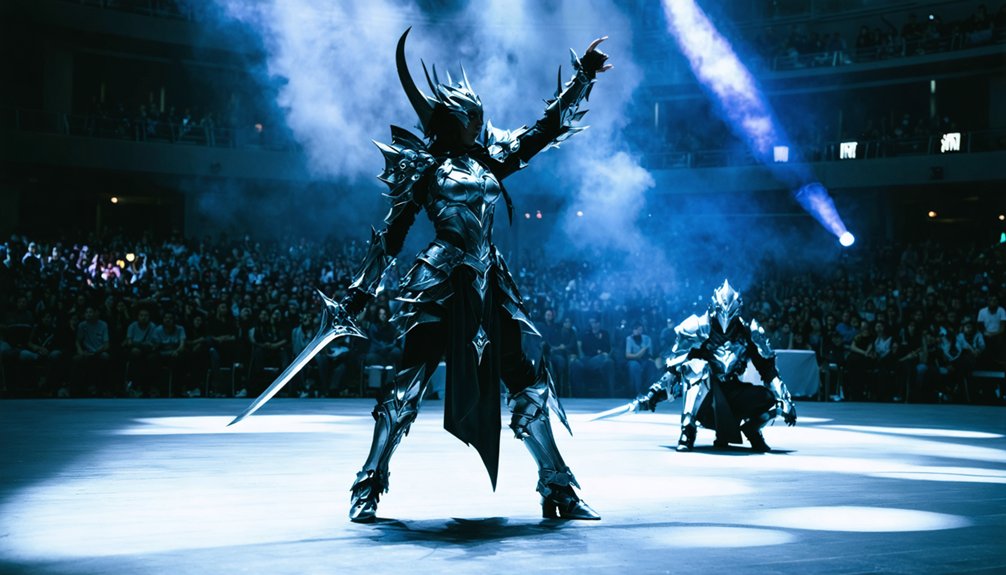
Judges clock expressions and timing instinctively, even before they consciously evaluate your performance. Your stage presence lives or dies in micro-moments: a held pause, a sharp glance, a deliberate beat before movement.
Exaggerate every facial expression greatly — what feels theatrical backstage reads as subtle from row twenty. Timing techniques like strategic freezes after a punchline or dramatic reveal let judges absorb your craftsmanship while amplifying audience engagement simultaneously.
Practice hitting specific marks at precise moments within your skit’s structure. Count beats mentally during rehearsal until shifts feel automatic.
Never rush through impressive costume details; slow down intentionally when showcasing complex construction. Overrunning your time slot triggers point deductions, so ruthlessly edit anything that doesn’t serve both visual impact and narrative momentum.
Practice Your Cosplay Pre-Judging Walkthrough Out Loud
Pre-judging slots typically run just two to five minutes, so every word you speak must earn its place. Rehearse your walkthrough techniques aloud with a timer running and a friend playing judge.
These presentation tips sharpen your instincts: describe construction sequentially from head to toe, deploy timing strategies by allocating roughly 30 seconds per major component, and build confidence boosters through repetition until shifts feel automatic.
Practice engaging storytelling by framing each technique as a deliberate creative decision rather than a simple description. Anticipate judge questions about materials, structural support, and finish quality — question anticipation eliminates hesitation under pressure.
Frame every technique as a deliberate creative decision — question anticipation eliminates hesitation when judges push back.
Use visual aids like your progress book strategically, opening it to pre-marked pages. This preparation creates genuine audience connection and signals serious, competition-level craftsmanship immediately.
Frequently Asked Questions
Can You Enter the Same Cosplay in Multiple Contests Simultaneously?
Like a ship sailing multiple seas, you can enter the same cosplay in multiple contests, but you must review each event’s contest rules carefully, as some prohibit prior-winning entries, protecting costume originality.
Should You Notify Judges if Your Costume Breaks During Pre-Judging?
Yes, you should notify judges immediately if your costume breaks during pre-judging. Proactive judge communication demonstrates professionalism, and quick costume repairs showcase your technical adaptability—two traits that innovative cosplayers leverage to maintain credibility and preserve their overall competition standing.
How Early Should You Arrive Before Cosplay Contest Registration Closes?
Arrive at least 60-90 minutes early to implement a solid arrival strategy. You’ll secure pre-judging slots, review registration tips, organize documentation, and troubleshoot costume issues before deadlines close—maximizing your competitive edge considerably.
Do Judges Penalize Costumes Representing Controversial or Mature-Rated Characters?
Judges don’t typically penalize character representation from mature-rated sources, but you must guarantee costume appropriateness aligns with venue policies. Focus your craftsmanship and skit execution on technical excellence, as those factors drive winning scores more decisively.
Can Group Cosplay Entries Share a Single Progress Book Together?
Yes, you can share a single progress book for group entries, but make sure it covers each member’s contributions separately. Effective progress book sharing strengthens group dynamics by clearly documenting individual techniques, construction steps, and skills for every costume piece thoroughly.
References
- https://whatsernamescosplay.wordpress.com/2022/06/28/tips-tricks-competitive-cosplay/
- https://www.youtube.com/watch?v=5XCVpcu30rU
- https://dorothythicket.com/2016/07/17/how-to-win-costume-contests/