To build a screen-accurate Captain America cosplay, you’ll need a four-way stretch spandex base, craft foam or vinyl armor panels, and EVA foam for raised graphics like the chest star. Match red boots and gloves precisely, then add a helmeted “A,” utility belt, and shoulder straps. For the shield, cut concentric EVA foam rings and finish with automotive-grade paints. Weathering techniques tie everything together, and there’s much more to uncover ahead.
Key Takeaways
- Use blue spandex or four-way stretch fabric for the base suit, adding red and white stripes and a white chest star.
- Select EVA foam or craft foam for armor overlays, as both materials are lightweight, shapeable, and durable.
- Build the shield from EVA foam, cutting concentric rings to 24–30 inches diameter and painting with automotive-grade colors.
- Apply weathering using airbrushed gray or black on edges, seams, and joints to achieve a realistic battle-worn look.
- Finish with a matte clear coat to protect painted surfaces and maintain a natural, camera-ready appearance.
Suit Up: Every Piece a Captain America Cosplay Needs
Building an accurate Captain America cosplay starts with understanding its core components: a blue spandex or four-way stretch jumpsuit as the base, red and white abdominal stripes, a white chest star, red boots, red gloves, and finishing hardware like a helmet with an encircled “A,” a utility belt, and shoulder straps.
Each element serves a purpose beyond aesthetics. Your character inspiration should drive material choices — spandex allows the mobility needed for iconic poses like the forward shield extension or the side-armed guard.
Every material choice should serve your character — spandex isn’t just comfortable, it’s built for the poses that define the role.
Red boots and gloves require precise color matching, often demanding custom dye or paint. Shoulder straps anchor chest graphics structurally, preventing emblem shift during dynamic movement.
Treat every component as a functional system, not decoration, and your build will achieve both visual accuracy and performance reliability.
Choose the Right Captain America Suit Fabrics and Armor Materials
Once you’ve identified every component your build requires, fabric and material selection becomes the decision that determines whether your suit moves, holds shape, and reads accurately on camera.
For suit durability and armor flexibility, prioritize these materials:
- Spandex or four-way stretch fabric — your undersuit foundation that absorbs movement without tearing during dynamic shield poses.
- Craft foam or vinyl panels — heat-shapeable armor overlays that bond cleanly to stretch bases while maintaining rigid visual structure.
- EVA foam for raised graphics — lightweight, carvable, and thermally responsive, letting you sculpt dimension into chest emblems and scale details.
Weathering with airbrushed gray or black along seams and edges transforms clean materials into battle-tested surfaces.
Each material choice compounds into a cohesive, camera-ready result that performs under convention conditions.
Build the Chest Star and Stripe Graphics Step by Step
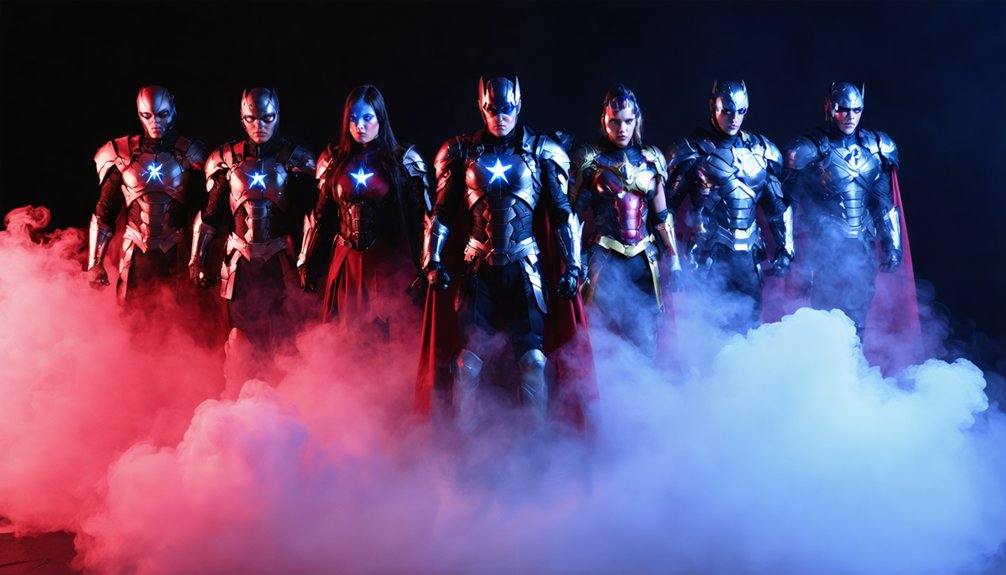
Three elements define the chest graphics on a Captain America suit: the central star, the parallel outline ring, and the red-and-white abdominal stripes.
Cut your chest star from felt, canvas, or vinyl, then back it with a slightly larger fabric panel to add dimension. Trace a parallel outline approximately 1 cm from the star’s edge to make the emblem pop against the blue field.
Pin paper-templated upper chest panels over the star before final stitching to guarantee precise alignment.
For stripe patterns, cut uniform red and white fabric strips, then sew or glue them horizontally along your abdomen. Use hook-and-loop tape during fitting to adjust placement iteratively before permanently stitching everything down.
Finish edges with airbrushed gray weathering for a battle-worn, screen-accurate result.
Make a Captain America Shield From EVA Foam
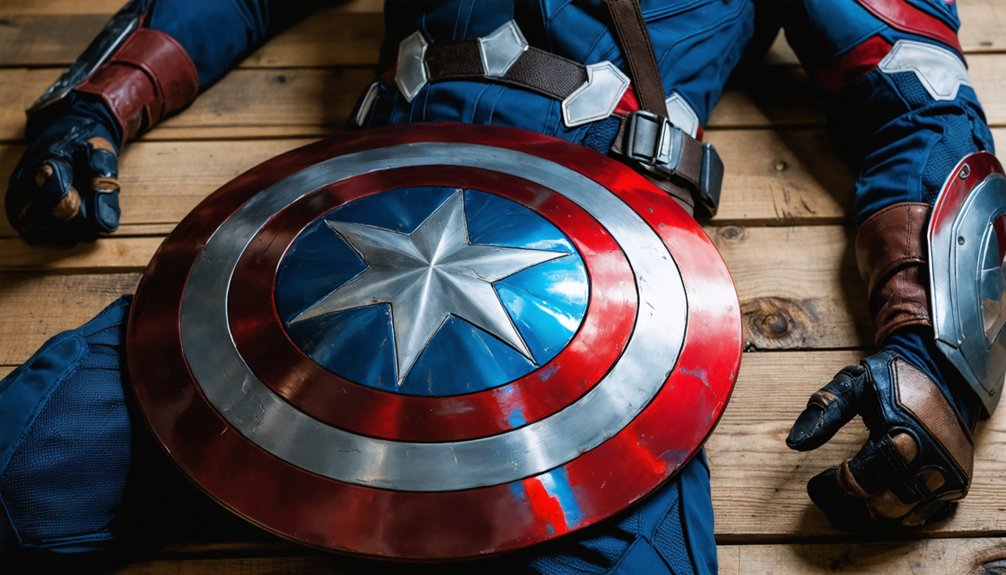
EVA foam is your best material choice for a Captain America shield replica because it’s lightweight, easy to cut, and responds well to heat shaping.
For accurate shield dimensions, target 24–30 inches in diameter. Use a nail-and-blade PVC compass for precise foam cutting of concentric rings.
Follow these critical build steps:
- Score and cut your concentric ring lines cleanly, then apply even heat to curve the foam over your knee for that authentic movie profile.
- Paint in sequence — metallic silver base first, then mask and spray red, blue, and white rings using automotive-grade paint.
- Bolt leather straps to the back securely so dynamic poses never compromise structural integrity.
Finish with clear-coat layers to lock in vibrant, battle-ready color.
Paint and Weather Your Captain America Costume for a Battle-Worn Finish
Weathering transforms a clean cosplay build into a battle-hardened costume that feels genuinely lived-in. The key tool you’ll need is an airbrush loaded with thinned black or gray paint.
Focus your paint application on edges, seams, joints, and high-wear zones like the elbows, knees, and shoulder straps. These areas accumulate the most fictional battlefield damage, so concentrating pigment there sells the illusion effectively.
Edges, seams, and joints tell the story—concentrate your pigment where fictional wear would naturally accumulate.
Use feathered, low-pressure passes rather than direct saturation—you’re building gradual shadow, not painting solid coverage. Weathering techniques work best when layered; apply one translucent coat, let it cure, then evaluate before adding more.
Protect finished areas with a matte clear coat to lock pigment without introducing unwanted sheen. Your final result should read as earned wear, not manufactured grime.
Frequently Asked Questions
How Do I Safely Transport My Captain America Shield to Conventions?
Wrap your shield in bubble wrap, securing it in a rigid case. For foam shield materials, you’ll avoid warping; for acrylic, you’ll prevent cracking. Both transportation methods guarantee your prop arrives convention-ready and undamaged.
Can Children Wear a Captain America Costume Comfortably and Safely?
Over 60% of cosplayers start young! You can dress children comfortably using soft spandex costume materials that stretch freely. Explore kid-specific sizing options, ensuring snug fits without restricting movement, keeping safety and authenticity perfectly balanced.
How Do I Clean and Store My Captain America Costume After Events?
Hand-wash your spandex base in cold water for proper fabric care, air-dry flat, and store folded loosely in a breathable garment bag. Consistent costume maintenance prevents fiber breakdown, color fading, and emblem adhesive failure between events.
Are There Budget-Friendly Alternatives to Buying an Official Captain America Costume?
Imagine a builder crafting a screen-accurate suit for under $40. You can create a DIY costume using thrift store options—grab a blue jumpsuit, add craft foam panels, and paint red-white stripes yourself.
How Do I Keep My Captain America Helmet Secure During Active Movement?
Secure your helmet using interior foam padding and chin straps for reliable helmet retention. You’ll want to test multiple movement strategies—like sudden turns and crouching—ensuring snug fit without restricting visibility or comfort during dynamic cosplay action.
References
- https://www.cosercos.com/blog/Captain-America-Cosplay-A-Heroic-Transformation-Guide/
- https://www.youtube.com/watch?v=SxUYDgdJgnM
- https://www.youtube.com/watch?v=m74wbAVq9xs
- https://www.upuply.com/blog/captain-america-cosplay
- https://www.youtube.com/watch?v=XcNgxFAASDk
- https://www.crazecosplay.com/blogs/questions/how-to-cosplay-captain-america
- https://www.usajacket.com/blog/captain-america-costume/
- https://costumewall.com/dress-like-wwii-captain-america/
- https://www.crazecosplay.com/blogs/questions/how-to-make-captain-america-cosplay
- https://www.instructables.com/Captain-America-Shield-3/