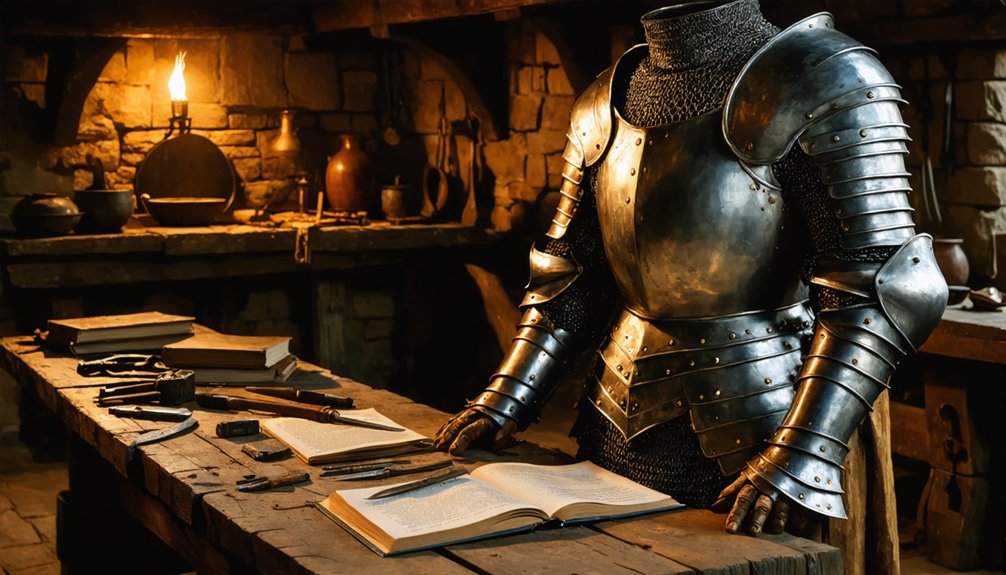
Choosing an authentic medieval knight armor replica requires you to balance historical accuracy, functional safety, and personal fit before you spend a single dollar. You’ll want to match the armor to its intended use, whether that’s LARP, reenactment, or display. Scrutinize construction methods, materials, and manufacturer documentation carefully. Always verify safety features and test your full range of motion while accounting for gambeson bulk. The five essential tips ahead will sharpen your selection process considerably.
Key Takeaways
- Define your intended use—LARP, reenactment, display, or collecting—to avoid costly mismatches when selecting authentic medieval knight armor replicas.
- Evaluate historical accuracy by examining period-correct construction methods, verified materials, and manufacturer documentation referencing credible historical sources.
- Check safety features, including helmet visibility, emergency removal protocols, edge smoothness, and overall mobility during dynamic movements.
- Ensure proper fit by recording exact body dimensions, accounting for gambeson bulk, and testing full range of motion.
- Prioritize high-grade steel, inspect weld quality and ring density, and maintain armor with rust-inhibiting oil for lasting durability.
Match Your Knight Armor Replica to Its Intended Use
Before selecting a medieval knight armor replica, you’ll need to define its intended use, as this single factor shapes every subsequent decision. Each application demands distinct specifications that directly influence material selection, construction standards, and design priorities.
LARP considerations center on safety, comfort, and visual impact, requiring lightweight materials that don’t compromise mobility during dynamic events.
Reenactment demands stricter historical accuracy alongside reinforced structural integrity for combat simulation.
Display costumes prioritize aesthetic impression over functional performance.
Collector preferences diverge greatly, emphasizing rarity, artisanal craftsmanship, and provenance documentation rather than wearability.
A piece’s authenticity and historical significance drive its value within serious collections.
Identifying your purpose eliminates costly mismatches, ensuring your selected replica precisely meets its operational requirements.
Spot the Hallmarks of Historical Accuracy in Armor Design
Once you’ve defined your armor’s purpose, evaluating historical accuracy becomes your next critical filter.
Authentic replicas distinguish themselves through precise design authenticity—period-correct construction methods, historically verified materials, and regionally accurate stylistic details.
Authentic replicas demand period-correct construction, historically verified materials, and regionally precise stylistic details that separate genuine craftsmanship from imitation.
Examine specific helmet styles critically. A well-crafted great helm, bascinet, or barbute reflects documented historical craftsmanship, featuring proportions and metalwork consistent with surviving museum specimens.
Breastplates should incorporate articulated joints and period-appropriate engravings rather than purely decorative fabrications.
Gauntlets demand particular scrutiny—they must balance documented protective configurations with functional weapon-handling geometry.
Scrutinize manufacturer documentation for referenced historical sources, metallurgical specifications, and construction transparency.
Prioritize makers who demonstrate scholarly engagement with primary historical sources.
Authentic replicas aren’t merely aesthetic objects; they’re tangible connections to documented technological and cultural heritage, deepening your understanding of medieval martial traditions.
Check These Safety Features Before Wearing Your Armor
Safety verification transforms armor from decoration into functional protective equipment. Before donning your suit, systematically evaluate each component against established safety benchmarks.
Prioritize helmet visibility by confirming that eye holes provide adequate peripheral vision and unobstructed sightlines. Compromised visibility creates genuine hazards during movement or combat scenarios.
Next, establish a reliable emergency removal protocol. You’ll need to quickly shed your armor if an accident occurs, so practice releasing buckles and straps under pressure. Designate someone to assist during complex removal sequences.
Additionally, inspect all edges for sharp protrusions and apply appropriate padding where metal contacts skin.
Test your complete suit’s mobility by walking, sitting, and executing dynamic movements. Only armor that passes these rigorous safety checks deserves deployment beyond display purposes.
Get the Right Fit, Including Room for Your Gambeson
Proper fit determines whether your armor enhances or hinders your performance, making precise measurement non-negotiable. Consult each manufacturer’s size charts and record your exact body dimensions before purchasing.
Gambeson sizing directly impacts your overall armor fit, as this padded undergarment adds considerable bulk beneath your steel pieces. You’ll need to account for that additional volume when selecting your breastplate, pauldrons, and other components.
Once you’ve assembled your suit, armor adjustments become essential for optimizing performance. Work systematically through each buckle and strap, securing pieces firmly without restricting circulation or mobility.
Test your range of motion by walking, sitting, and simulating combat movements. If any component pinches, gaps, or shifts during movement, recalibrate the corresponding straps immediately. A precisely fitted suit translates directly into superior comfort and battlefield effectiveness.
Choose Materials That Make Your Knight Armor Replica Last
Material selection determines the longevity and authenticity of your knight armor replica, so you’ll want to prioritize high-grade steel over cheaper alternatives like thin sheet metal or foam composites.
Conduct a thorough durability assessment by examining steel thickness, weld quality, and surface hardening treatments before purchasing. High-carbon steel withstands repeated use, resists deformation, and maintains structural integrity across extended wear periods.
Chainmail components deserve equal scrutiny—inspect ring density and wire gauge to confirm reliable gap coverage at vulnerable joints.
For maintenance tips, apply rust-inhibiting oil regularly, store pieces in climate-controlled environments, and inspect buckles and rivets after each use.
Custom-fabricated armor using precision-forged steel offers superior longevity compared to mass-produced alternatives, making it the strategically sound investment for serious collectors and reenactors pursuing uncompromising historical authenticity.
Frequently Asked Questions
What Is the Correct Layering Sequence for Putting on Knight Armor?
Begin with greaves and thigh armor, then layer your gambeson, chainmail hauberk, breastplate, and backplate. Mastering these layering techniques guarantees ideal armor fit, finishing with your helmet for complete, historically precise protection.
How Do I Properly Store and Maintain My Medieval Armor Replica?
While armor battles time’s decay, you’ll preserve it through diligent armor cleaning techniques—oiling steel, removing moisture promptly—and innovative protective storage solutions like climate-controlled cases, ensuring your replica’s craftsmanship endures beautifully against corrosion and deterioration.
Which Medieval Armor Styles Are Most Popular Among Collectors Today?
You’ll find the great helm, bascinet, and barbute dominate armor collecting today. These styles excel in historical accuracy, showcasing innovative craftsmanship through articulated breastplates and detailed engravings that consistently captivate serious collectors seeking authentic medieval representations.
How Much Does a High-Quality Authentic Medieval Knight Armor Replica Cost?
Coincidentally, your budget mirrors your ambitions: high-quality authentic replicas cost $1,000–$10,000+, depending on historical accuracy and replica materials. You’ll invest more for custom high-grade steel, but you’re securing unmatched craftsmanship and durability.
Can Knight Armor Replicas Be Customized to Reflect Specific Historical Periods?
You can absolutely customize knight armor replicas for specific historical periods. Prioritize historical accuracy by selecting period-appropriate designs, materials, and engravings. Explore customization options like articulated joints or era-specific motifs to authentically represent your chosen medieval epoch.
References
- https://www.morphsuits.com/blog/knight-costume/
- https://www.battlemerchant.com/en/blog/finding-the-right-medieval-armour-a-guide-for-beginners
- https://www.medievalcollectibles.com/blog/life-in-medieval-times/how-to-layer-and-wear-your-steel-armor/
- https://www.youtube.com/watch?v=kBSy4erfQEE
- https://www.instructables.com/DIY-Knight-Armor-Costume-From-a-Floormat-and-Hot-G/
- https://artizanshub.com/blogs/armors/custom-made-medieval-armor-perfect-fit-design-guide
- https://www.youtube.com/watch?v=RcOtbv_HGkk