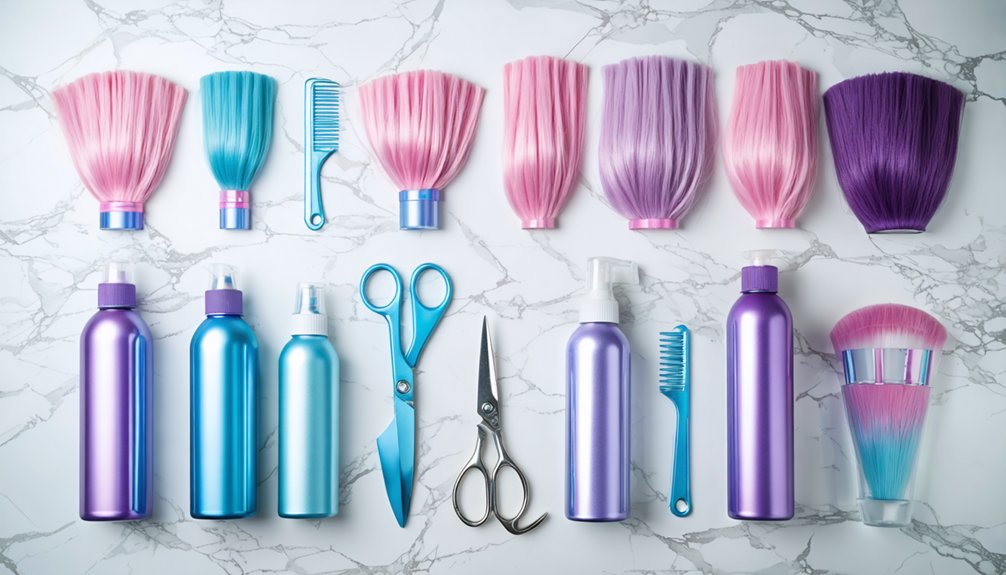
To style twin tails and pigtails for cosplay, start with clean, dry hair or a prepped wig and create a precise center part using a tail comb. Section each side symmetrically, secure with texture-matched elastics, and wrap small strands around the base to hide the band. Add hairspray for hold, then finish with ribbons or bows for character accuracy. There’s plenty more technique ahead to perfect your look.
Key Takeaways
- Start with clean, dry hair, apply texturizing spray, and create a precise center part for symmetrical, even sections.
- Choose placement deliberately: high for energy, mid for balance, or low for elegance, based on character design.
- Secure tails with texture-matched elastic bands, then wrap small hair strands around the base to conceal them.
- Backcomb tail bases for volume, pancake braids outward, and finish with light hairspray to maintain shape and movement.
- Add ribbons, bows, and accessories using double knots or hot glue to ensure they stay secure during wear.
How to Prep Your Hair or Wig for Twin Tails
Whether you’re working with your natural hair or a synthetic wig, proper prep determines how clean, symmetrical, and long-lasting your twin tails will look. Start with clean, dry hair — buildup kills grip and distorts sectioning precision. Apply a volumizing mousse or dry texturizing spray before blow-drying to build foundational hold.
For fine hair, a light texturizing spray adds structure that hair accessories can anchor into cleanly. Thicker hair typically holds shape without extra product.
Always detangle thoroughly before dividing sections, since unresolved knots create uneven divisions. Pull a precise center part using a tail comb — symmetry here directly impacts the finished silhouette.
Smart hair care at this stage isn’t optional; it’s the technical foundation that makes every subsequent styling decision cleaner and more controlled.
How to Choose Placement for High, Mid, or Low Twin Tails
Once your sections are cleanly divided and prepped, placement determines the entire personality of your twin tails.
Once sections are divided, placement isn’t just positioning—it defines everything your twin tails communicate about the character.
High placement sits above the ears, projecting energy and youthful intensity—ideal for characters with bold silhouettes. It also opens up accessory placement near the crown, where bows or statement clips catch the most visual attention.
Mid placement lands at ear level, offering structural balance that pairs naturally with color coordination across layered or ombré wigs. It’s the most versatile option for detailed braiding styles.
Low placement sits near the nape, communicating restraint and elegance. It suits understated characters and keeps accessory placement minimal and refined.
Each height shifts your character’s visual weight differently, so match placement deliberately to the character’s design rather than defaulting to habit.
How to Style Pigtails and Twin Tails Step by Step
Start by creating a clean center part using a tail comb.
Then divide your hair into two equal sections before clipping each side out of the way while you work.
Secure each section with a snag-free elastic at your chosen placement point, wrapping a small strand of hair around the base to conceal the band and give the tail a polished, finished appearance.
Once both tails are locked in, check symmetry in a mirror and apply a light mist of hairspray to hold the shape without stiffening the movement.
Sectioning And Parting Hair
Sectioning your hair cleanly determines how balanced and intentional your twin tails or pigtails will look once they’re styled. A precise center part locks in symmetry and complements your hair color by creating even light distribution across both sides.
- Draw your part using a tail comb from forehead to nape in one controlled motion.
- Clip each section separately to prevent cross-contamination between halves while you work.
- Check symmetry visually by comparing section width at crown, mid-shaft, and nape before securing.
- Plan accessory placement now, before tying — this prevents repositioning that disrupts volume or shifts your part.
Zigzag parting adds dimension and reduces harsh visible lines, making your overall construction feel deliberate rather than mechanical.
Securing And Finishing Tails
Securing your tails correctly determines whether your finished style holds its shape through an entire convention day or slowly migrates out of position. Choose elastics that match your hair texture — silicone-coated bands grip synthetic fiber better than standard cotton ties, which tend to slip.
Color matching your elastic to the wig fiber makes exposed bands nearly invisible from any angle. Wrap a small strand around each base to conceal attachment points entirely.
After securing, gently pancake braided sections outward to maximize volume and visual weight. Set everything with a light hairspray pass, holding the can roughly twelve inches away to avoid stiffening the fiber.
Face-framing pieces pulled forward soften the overall silhouette, while ribbons or bows positioned directly over the band deliver clean, convention-ready finishing detail.
How to Add Volume and Shape to Your Twin Tails
Once you’ve got your twin tails secured, volume and shape are what transform a flat, lifeless style into something that actually reads on stage or in photos. Hair texture plays a critical role here—fine fibers need teasing support, while thicker strands hold shape naturally.
- Backcomb the base of each tail to lift and lock volume before smoothing the outer layer.
- Pancake your braids by gently pulling the edges outward, creating dramatic width.
- Curl tails away from your face to build a fuller, dynamic silhouette.
- Strategically position accessories—accessory placement near the crown draws the eye upward, amplifying height and intentionality.
Finish with a light hairspray pass to lock everything without killing movement.
How to Build Fuller Twintail Wigs With Extra Wefts
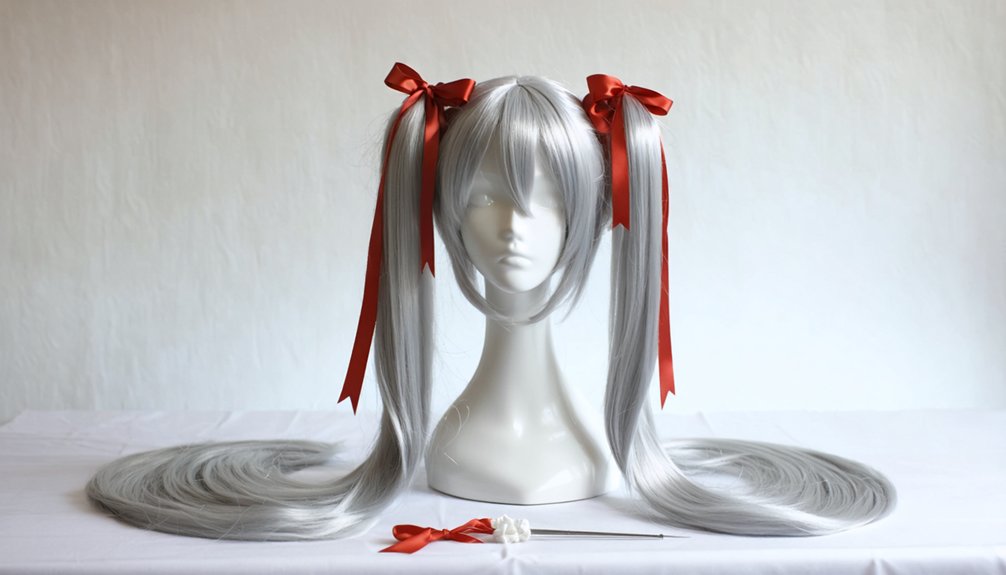
If your twintail wig looks flat or sparse, sewing or gluing extra wefts directly into the cap builds the density that styling alone can’t achieve.
Focus weft placement along the crown and sides where thinning is most visible, layering each strip close to the previous one for seamless coverage.
Once you’ve added the wefts, wrap small sections of hair around each ponytail base to conceal attachment points and create a clean, natural-looking finish.
Adding Wefts For Fullness
When a twintail wig lacks the density your character demands, adding wefts is the most reliable fix. Matching the hair color precisely before purchasing wefts prevents visible inconsistencies that break immersion. Gather your styling tools — a tail comb, wig clips, fabric glue or needle and thread — before starting.
- Identify thin zones by parting the wig under bright light and marking sparse areas with clips.
- Cut wefts to size, slightly shorter than each section to prevent edge exposure.
- Sew or glue wefts horizontally across marked zones, working bottom to top for natural layering.
- Press each weft flat using a rat-tail comb to integrate fibers seamlessly into surrounding strands.
You’ll transform a flat, lifeless wig into something that genuinely commands attention.
Concealing Weft Attachment Points
Adding wefts solves density problems, but exposed attachment points can unravel the illusion just as quickly as thin hair did. Use a criss-cross stitching pattern across the wig’s back panel to anchor wefts while distributing tension evenly. Zigzag parting disrupts visible track lines and introduces dimension that straight rows can’t achieve.
Color blending becomes critical here — mismatched weft tones catch light differently and expose seams immediately. Match your weft fiber tone precisely before securing anything permanently.
At the ponytail base, wrap a small hair section around the elastic to mask the attachment entirely. Strategic accessory placement — bows, ribbons, or layered clips — redirects attention from vulnerable junction points while reinforcing the cosplay aesthetic. Overlay pieces across the crown seal any remaining transparency.
How to Cover Wig Tracks So They’re Completely Invisible
Visible wig tracks can instantly break the illusion of a seamless cosplay, but a few targeted techniques will make them disappear entirely. Matching your hair color precisely to the wig ensures layered cover pieces blend without contrast betrayal.
- Zigzag your part — irregular parting scatters light unpredictably, dissolving harsh track lines into natural-looking dimension.
- Wrap hair around ponytail bases — this conceals elastic attachment points while creating a polished, intentional finish.
- Layer curtain pieces over exposed back sections — strategic accessory placement doubles as both coverage and cosplay-accurate embellishment.
- Apply criss-cross weft patterns — crossing tracks against each other eliminates gaps where scalp-colored backing shows through.
Finish with light hairspray to lock every concealment layer permanently in place.
Ribbons, Bows, and Clips for a Cosplay-Ready Finish

Ribbons, bows, and clips do more than decorate — they anchor your cosplay’s accuracy while solving structural problems like exposed tracks and asymmetrical tails. Strategic accessory placement directly over weft lines conceals seams without additional sewing.
Match your ribbon or bow to your wig’s hair color for seamless integration rather than obvious ornamentation. Wide satin ribbons wrapped around each ponytail base simultaneously hide elastic bands and reinforce symmetry between both tails.
Snap clips positioned at the crown can lock face-framing pieces in place while covering any crown transparency. For high-energy characters, layered bows add dimensional volume without altering the tail’s silhouette.
Prioritize secure attachment methods — hot glue on clip backs or double-knotted ribbon ties — so accessories stay fixed through movement-heavy convention environments.
Frequently Asked Questions
Can Twin Tails Work With Very Short Hair That Won’t Reach?
Even short strands can sprout twin tails! You’ll use hair accessories like mini clips and creative styling techniques—backcombing, texturizing spray, and small elastics—to coax stubborn short hair into playful, secure twin tail shapes.
How Do You Keep Twin Tails Symmetrical Throughout a Long Convention Day?
Use strong elastics and light hairspray to lock symmetry in place. Carry a tail comb for quick readjustments—these essential hair accessories and proactive styling tips guarantee your twin tails stay perfectly balanced throughout every convention hour.
What Hair Types Struggle Most With Holding the Twin Tail Shape?
Fine, silky hair texture battles twin tail retention most aggressively — you’ll lose hair volume fast without texture spray. Conversely, over-conditioned thick hair can collapse under its own weight, demanding strategic backcombing to maintain structural integrity.
Can You Sleep in Twin Tails Without Ruining the Style Completely?
Coincidentally, you *can* sleep in twin tails! Swap elastics for scrunchies as hair accessory ideas, and apply light hairspray as styling product tips to preserve shape. You’ll wake with surprisingly intact volume.
How Do You Fix a Twin Tail That Keeps Drooping or Falling Sideways?
Backcomb the base for lift, then secure tightly with strong elastics. You’ll want to layer styling products like firm-hold hairspray, and reinforce drooping tails using strategic hair accessories such as bobby pins or hidden clips.
References
- https://www.reddit.com/r/CosplayHelp/comments/1ibbw99/is_there_any_way_i_could_style_this_wig_in_twin/
- https://www.youtube.com/watch?v=whu84Tt9oUU
- https://cosplayerjourney.com/posts/wig-pigtails-tutorial
- https://www.youtube.com/watch?v=Bw8FCU0rDa0
- https://blondefilter.net/short-twintails
- https://danbooru.donmai.us/posts?tags=twintails
- https://www.lemon8-app.com/experience/braided-pigtails?region=us