When choosing a sheath for a replica medieval weapon, you’ll need to match it to your blade’s length, tip geometry, and hilt configuration while selecting materials suited to your intended purpose. Leather suits display and reenactment; wood-core construction ensures precise fit and retention; metal offers impact protection. Interior fit matters more than exterior finish—consistent draw resistance and snug blade seating are non-negotiable. Authenticity requires period-appropriate construction, avoiding modern hardware. Everything you need to evaluate is covered ahead.
Key Takeaways
- Define your sheath’s purpose—display, reenactment, or transport—as this determines material, design, retention features, and required durability.
- Prioritize interior fit over exterior appearance, ensuring precise internal dimensions match blade length, shape, tip geometry, and hilt configuration.
- Choose materials appropriately: leather suits decorative use, wood-core constructions ensure shape retention, and metal scabbards offer superior impact protection.
- Maintain historical authenticity by using period-appropriate construction, avoiding modern hardware, and referencing actual artifacts for embellishments and suspension styles.
- Support longevity through regular blade cleaning, leather conditioning, and proper dry horizontal storage separated from the blade.
Choosing a Medieval Sword Sheath: Purpose Shapes Every Decision
Whether you’re equipping a replica for display, reenactment, or transport, the sheath’s purpose determines every material and design choice that follows. Display replicas benefit from decorative embellishments—leather tooling, metal accents, and period engravings—that prioritize visual authenticity over structural demands.
The sheath’s purpose drives every design choice—display demands authenticity, while function demands durability.
Reenactment and practice applications require stronger retention, reliable blade protection, and construction that withstands repeated handling. Transport-focused sheaths must prevent blade movement, resist slipping, and secure the sword against impact.
Modern manufacturing enables purpose-built solutions across all three categories, offering precision-fitted cores, consistent stitching, and material combinations that earlier craftsmen couldn’t access. Identify your primary use case before selecting any sheath.
A choice optimized for exhibition will underperform in active carry, and a functional carry sheath may lack the finish a display context demands.
Leather, Wood, and Metal Scabbard Materials Compared
Each scabbard material brings a distinct set of trade-offs that directly affect how your replica performs, lasts, and looks. Leather offers flexibility, quieter carry, and a classic finish that accepts decorative embellishments like tooling or metal accents with ease. It’s the most versatile option across display and functional builds.
Wood-core construction adds structural integrity, making it the preferred choice for medieval-style scabbards that need shape retention without sacrificing authenticity. You’ll often find it wrapped in cloth and leather for added stability.
Metal scabbards deliver superior impact protection but increase weight and demand corrosion maintenance. Modern manufacturing techniques have improved synthetic alternatives, though they still lag behind in durability and period accuracy.
Match your material choice to your replica’s specific performance requirements before committing.
How Core Construction Determines Fit, Finish, and Durability
The core construction of a scabbard determines everything downstream—fit, finish, structural longevity, and how well the blade seats during draw and re-sheathing. Without core stability, even high-quality outer materials will shift, compress, or warp under repeated use.
A wooden core provides the rigid foundation that holds blade tolerances tight and prevents internal movement that damages edges over time.
Material layering compounds this advantage. Wrapping a shaped wood core in linen or cloth before applying leather distributes stress across multiple layers, reducing surface cracking and improving overall resilience.
Each layer contributes specific properties—structural rigidity, impact absorption, and surface durability—that no single material achieves alone.
When you commission or select a scabbard, evaluate the core first. Surface finish is cosmetic; core construction is functional, and function determines longevity.
Matching a Sword Sheath to Your Blade’s Length, Shape, and Hilt
Matching a sheath to your blade requires more than measuring overall length—blade shape, tip geometry, and hilt configuration all determine whether a scabbard fits cleanly or fails under use.
Spatulated or rolled tips demand custom interior shaping; standard scabbards won’t accommodate them without internal blade movement.
Your hilt’s cross-guard width and grip profile must align with the scabbard throat to allow a controlled draw without binding.
Color matching between blade furniture and scabbard finish reinforces visual cohesion, particularly when decorative accents like metal chapes or embossed leather panels are part of the design.
Prioritize snug retention along the full blade length, not just at the throat.
A precisely fitted sheath protects the edge, reduces internal wear, and performs reliably under active handling or extended carry.
What Makes a Medieval Replica Scabbard Historically Accurate?
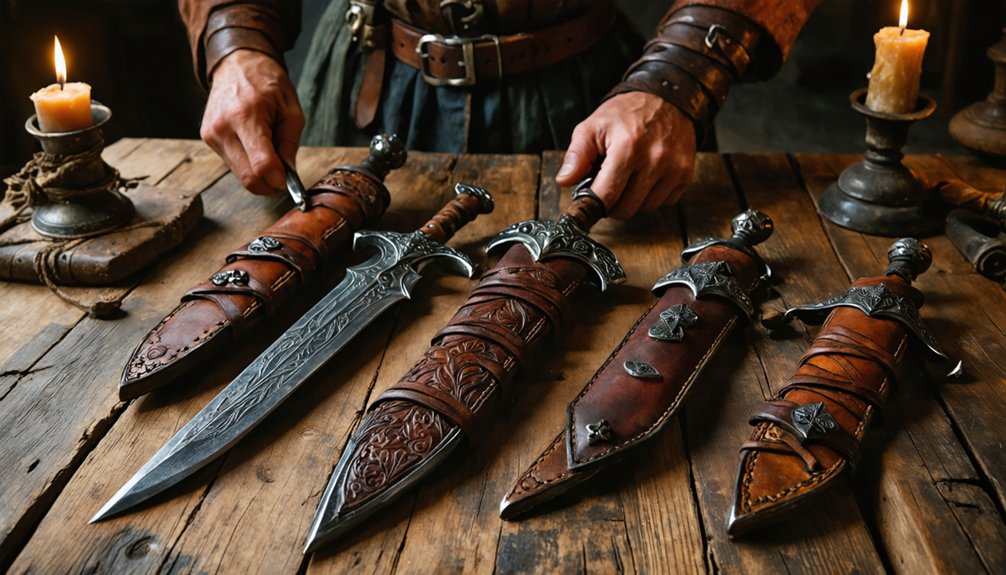
Historical accuracy in a replica scabbard starts with period-appropriate construction methods and materials—wood-core foundations wrapped in cloth, then leather, with seams placed at the back to reflect documented medieval practice.
Period-correct scabbard construction begins with a wood core, cloth wrap, and leather—seams at the back, as history dictates.
You’ll want to verify that the blade shape, tip profile, and hilt fittings align with known period examples rather than generalized approximations.
Authentic replicas prioritize surface finish, suspension style, and proportional fit over decorative shortcuts.
When evaluating ornamental embellishments like metal chape fittings or tooled leather detailing, confirm they reference actual historical artifacts rather than stylized interpretations driven by modern manufacturing convenience.
Stainless steel hardware, uneven textures, or visible weld marks immediately signal modern production compromises.
You’re building a historically grounded piece, so cross-reference your scabbard’s construction against documented medieval examples to maintain credible authenticity throughout.
Retention Systems, Belt Loops, and Draw Resistance to Evaluate
When evaluating a replica scabbard’s strap fastening system, you should check that buckles, ties, or snap closures hold the sword securely during movement without requiring excessive force to release.
You’ll want to test draw resistance by pulling the blade steadily — it should slide free with controlled effort, neither so loose that the sword slips out unintentionally nor so tight that a clean draw becomes difficult.
Balancing these two factors guarantees the sheath functions reliably for reenactment, cosplay, or display carry without compromising safety or authenticity.
Evaluating Strap Fastening Systems
Evaluating a sheath’s strap fastening system directly affects how safely and reliably you can carry a replica medieval sword. Modern manufacturing has improved strap hardware markedly, letting you choose systems that balance security with period-appropriate aesthetics.
Even decorative embellishments on buckles and clasps should meet functional load requirements.
Assess these strap fastening criteria before committing:
- Buckle strength: Metal hardware outperforms plastic under repeated stress and lateral movement.
- Adjustability: Straps should accommodate varied belt widths and carry angles without slipping.
- Attachment points: Reinforced stitching or riveted connections resist tearing during active wear or transport.
- Quick-release capability: Some systems allow fast detachment without compromising retention during normal carry.
Prioritize fastening systems that hold the sword firmly while allowing a controlled, consistent draw every time.
Balancing Draw Resistance Effectively
Balancing draw resistance effectively means finding the point where your sheath holds the blade securely without fighting you during retrieval. Too much friction causes dangerous fumbling; too little allows unintended release. Modern manufacturing has refined interior lining tolerances, letting you select sheaths with measurable grip consistency across repeated draws.
Test resistance by drawing slowly and noting where drag concentrates — typically near the throat. A well-fitted sheath distributes contact evenly along the blade rather than gripping at one pressure point.
Avoid sheaths where decorative embellishments compromise throat geometry, as added metalwork can create uneven contact zones that alter resistance unpredictably. Prioritize interior fit over exterior finish.
Your draw should feel controlled, repeatable, and smooth — qualities that depend entirely on dimensional precision, not surface aesthetics.
Cleaning and Storage Habits That Protect Your Blade and Scabbard
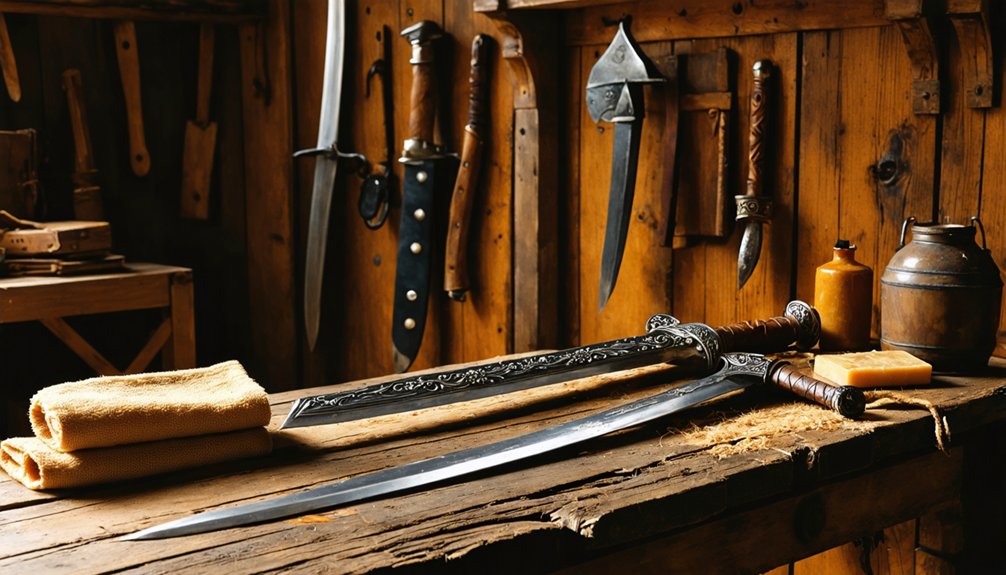
Proper cleaning and storage habits directly determine how long your blade and scabbard remain functional and presentable. Regular blade polishing prevents oxidation on carbon steel, while consistent sheath coloration maintenance preserves leather integrity and visual accuracy.
Follow these targeted practices:
- Wipe your blade after every handling session using a lightly oiled cloth to prevent moisture-induced corrosion
- Condition leather sheaths with appropriate oils or waxes to maintain flexibility and prevent cracking
- Store your sword horizontally in a dry environment, avoiding humidity that degrades wooden cores and leather linings
- Keep blade and scabbard separated during long-term storage to prevent trapped moisture from accelerating surface damage
These habits protect your investment and preserve functional and aesthetic value across extended use cycles.
Frequently Asked Questions
Can a Single Sheath Fit Multiple Sword Types Interchangeably?
You can’t rely on interchangeable sheath compatibility across sword types. Sheath fitting standards demand precise matches in blade length, thickness, and tip shape, so you’ll need a dedicated sheath for each distinct sword design.
How Much Does a Quality Custom Medieval Scabbard Typically Cost?
Like forging the sword itself, quality custom medieval scabbards aren’t cheap—you’ll typically invest $150–$500+, depending on materials, craftsmanship, and complexity. Pairing medieval armor aesthetics with expert sword forging-level construction commands premium pricing for authentic results.
Are There Legal Restrictions on Carrying Replica Swords in Public?
Yes, legal restrictions on public carrying vary by location. You’ll need to check local laws, as many jurisdictions prohibit carrying replica swords publicly, regardless of intent. Always verify regional regulations before transporting your replica outside private property.
Which Historical Periods Produced the Most Ornate Scabbard Designs?
Over 60% of surviving medieval artifacts feature decorative embellishments from the Renaissance and Viking eras. You’ll find the most ornate craftsmanship in these periods, where scabbards showcased intricate metalwork, engravings, and elaborate leather tooling reflecting cultural prestige.
Can Beginners Make Their Own Medieval Scabbard at Home?
Yes, you can craft your own medieval scabbard at home. Start with smart material selection—wood core and leather—then study historical craftsmanship techniques like back-seam stitching to build a functional, authentic-looking result efficiently.
References
- https://swordsswords.com/blog/a-guide-to-buying-medieval-swords/
- https://www.youtube.com/watch?v=pi031sjHTOw
- https://battlingblades.com/blogs/news/how-to-select-the-best-replica-medieval-weapon-to-display-or-use-for-cosplay
- https://www.reddit.com/r/wma/comments/acjhjc/going_to_have_a_sheath_made_for_a_longsword/
- https://www.medieval-shop.co.uk/faq/faqs/what-is-a-sheath-or-scabbard
- https://www.medieval-shop.co.uk/93-sword-sheaths