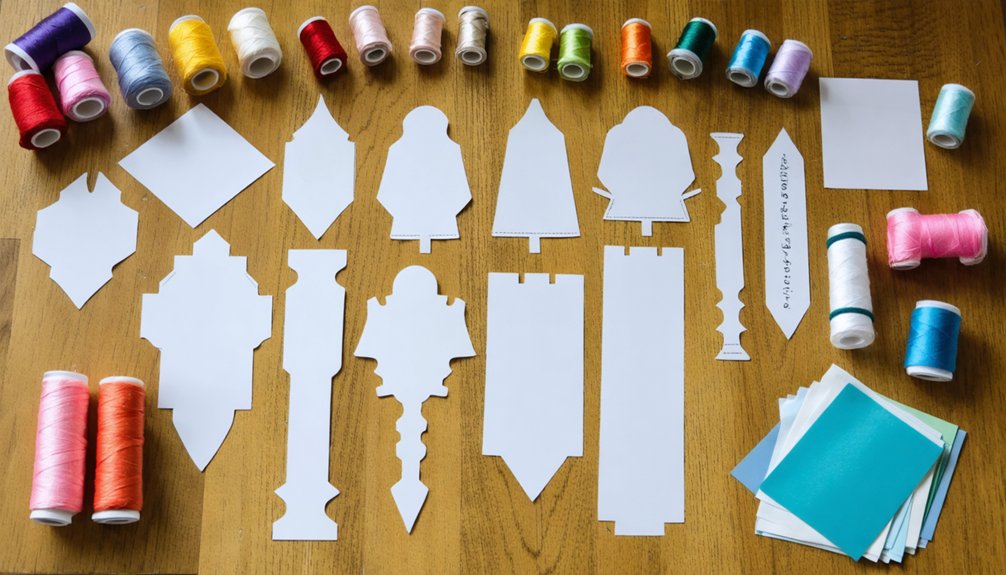
You can find video game cosplay sewing patterns on Etsy, Simplicity.com, Freesewing.org, and McCall’s dedicated cosplay lines. Etsy PDF patterns run $15–$20 and include construction notes, while Simplicity offers licensed character designs, often discounted to $1.99 at JoAnn. Free options like Freesewing.org draft patterns to your exact measurements. Match your pattern source to your costume’s complexity—armor pieces need different resources than base garments. There’s a lot more strategy involved in getting this right.
Key Takeaways
- Etsy offers the largest selection of cosplay PDF patterns, with full character designs priced at $15–$20 or $3 per individual piece.
- Simplicity.com carries officially licensed character patterns, frequently discounted to $1.99 during JoAnn sales.
- Freesewing.org generates free, measurement-based patterns ideal for base garments beneath armor or accessories.
- Combining free base patterns with individual paid pieces balances budget while maximizing costume accuracy and customization.
- Test all modified patterns using muslin mockups before cutting final fabric to catch fit issues early.
Where to Find Video Game Cosplay Sewing Patterns
Finding video game cosplay sewing patterns is easier than it might seem, with several reliable sources available across different price points. Etsy hosts the largest collection of dedicated cosplay PDF patterns, typically priced at $15–$20 for full character designs or $3 per individual piece.
Finding video game cosplay sewing patterns is surprisingly accessible, with Etsy offering the largest dedicated collection at reasonable prices.
For free options, Freesewing.org drafts custom patterns to your exact measurements, while DRCOS Patterns offers machine-translated Japanese cosplay resources.
If historical accuracy matters for your character’s design, Simplicity.com carries licensed and period-adjacent patterns worth exploring. JoAnn stores run $1.99 in-store sales on Simplicity, McCall, and Butterick patterns regularly.
Once you’ve secured your pattern, prioritize fabric selection early, as the right material directly impacts how accurately you’ll replicate your character’s on-screen appearance.
Best Sites for Licensed Video Game Character Sewing Patterns
When hunting for licensed video game character sewing patterns, 3 platforms stand out as your most reliable starting points. Simplicity.com carries officially licensed character designs, giving you verified accuracy for costume accessory crafting. Some patterns include serial numbers tied to specific franchises, making character identification straightforward.
JoAnn stores run $1.99 in-store sales on Simplicity, McCall, and Butterick patterns, dramatically cutting your budget.
Etsy delivers the largest dedicated cosplay pattern collection, with full PDF designs for popular characters priced at $15–$20. Individual pieces average $3 each, letting you build complex costumes incrementally.
McCalls’ dedicated cosplay line and Yaya Han’s recognized pattern series are both available through Etsy resellers.
Apply fabric selection tips early — each licensed pattern specifies recommended materials, streamlining your purchasing decisions before construction begins.
Free vs. Paid Video Game Cosplay Patterns: Which Should You Choose?
Choosing between free and paid patterns comes down to your project’s complexity and your drafting experience. Free resources like Freesewing.org draft directly to your measurements, making them ideal for base garments requiring precise fit.
However, they rarely address color coordination across multiple costume components or accessory integration for character-specific details like armor attachments or weapon holsters.
Paid patterns on Etsy, typically $15–$20 for full PDFs, often include construction notes covering accessory integration points and color coordination guides referencing specific fabric types.
If you’re building a complex video game costume with layered components, that investment saves significant drafting time. For simpler builds, combining free base patterns with individual $3 Etsy pieces lets you assemble exactly what you need without overspending.
Essential Tools You Need Before Drafting or Cutting Anything
Before you sketch a single line or cut a single piece, you’ll need a measuring tape to capture accurate body measurements and chalk to transfer your pattern shapes onto fabric.
Stock your workspace with scissors, pencils, markers, and pins to handle both drafting and assembly tasks efficiently. These measuring and marking supplies work alongside your drafting and cutting tools—rulers, posterboard, and sewable tracing paper—to form the core toolkit that keeps your pattern work precise and organized.
Measuring And Marking Supplies
Getting your measurements and markings right is the foundation of any successful cosplay build, so you’ll need a few key supplies before you touch any fabric or paper.
These four tools are non-negotiable:
- Measuring tape – Take precise body measurements before any fabric selection or pattern drafting begins.
- Chalk – Mark seam allowances, cut lines, and construction details directly onto your fabric.
- Pencils and markers – Transfer pattern shapes onto kraft paper or posterboard with accuracy.
- Pins – Secure pattern pieces during layout to prevent shifting along grain lines.
Each tool serves a distinct function in your workflow. Skipping any one of them introduces measurement errors that compound through every subsequent construction step, compromising your final fit.
Drafting And Cutting Tools
Once your measuring and marking supplies are in order, drafting and cutting tools take over as the next layer of your toolkit. You’ll need French curves, straight rulers, and L-squares to draft accurate pattern shapes for complex video game silhouettes. Kraft paper or posterboard serves as your drafting surface before fabric manipulation begins.
For cutting, invest in sharp fabric shears, rotary cutters, and a self-healing mat. Each tool handles different material weights you’ll encounter across costume components. Notch cutters help transfer alignment marks cleanly between pattern pieces.
Before committing to final cuts, verify your sewing machine settings match your chosen fabric type. Incorrect tension or stitch length distorts seams and compromises fit. Precise cutting and calibrated settings together determine whether your finished costume holds its intended structure.
How to Match a Pattern to Your Character’s Costume Complexity
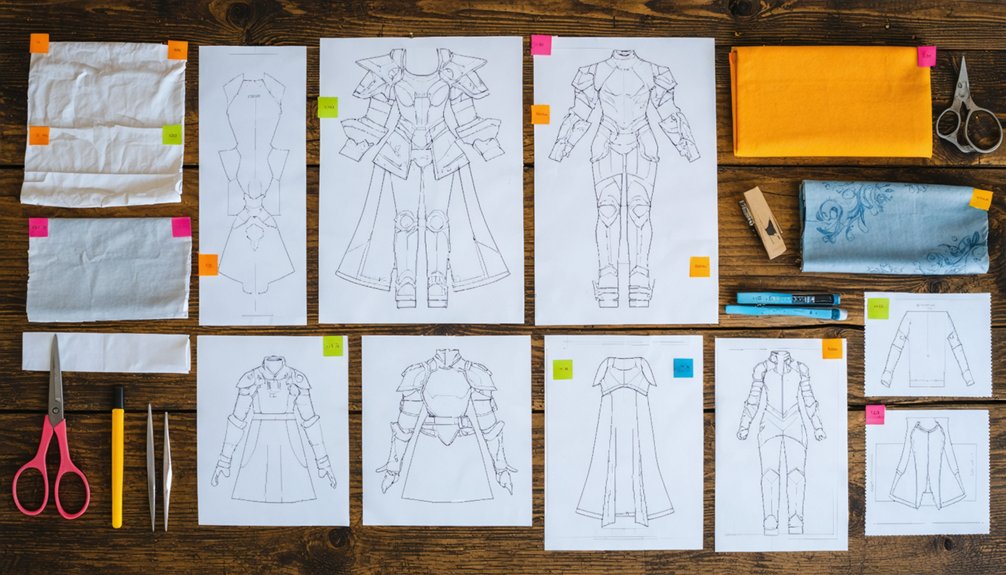
Before selecting or drafting a pattern, you’ll need to assess your character’s costume by breaking it down into its individual components—armor pieces, underlayers, accessories, and structural elements.
Once you’ve cataloged the complexity, match each component to a pattern source that fits its difficulty level: simple tunics work well with Simplicity or McCall patterns, while intricate armored builds may require dedicated cosplay PDFs from Etsy or piece-by-piece drafting from scratch.
Scale your project realistically by tackling lower-complexity garments first, then building toward more technically demanding components as your skills and pattern library develop.
Assess Costume Detail Levels
Matching a sewing pattern to your character’s costume complexity starts with an honest breakdown of the costume’s individual components. Catalog every element before purchasing or drafting anything.
- Count distinct pieces — armor panels, underlayers, accessories, and props each require separate pattern components.
- Evaluate fabric texture requirements — structured EVA foam builds differ significantly from flowing draped garments.
- Audit color accuracy demands — multi-toned costumes require precise dye-matching or strategic fabric sourcing.
- Rate construction difficulty — score each piece from basic (straight seams) to advanced (curved boning channels, articulated joints).
Cross-reference your skill level against this component inventory. A costume scoring high across all four categories signals you’ll need modular patterns or professional-grade drafting tools like Freesewing.org to customize fits accurately.
Match Patterns To Complexity
With your costume’s complexity mapped out, pairing the right pattern to each component becomes a straightforward matching exercise.
Simple silhouettes — tunics, capes, basic trousers — align well with Simplicity or McCall licensed patterns, especially when JoAnn’s $1.99 sales make them accessible.
For mid-tier pattern complexity, Etsy’s full PDF designs at $15–$20 cover structured armor overlays and fitted bodices efficiently.
When crafting intricacies escalate — articulated armor, asymmetrical cuts, character-specific tailoring — draft custom pieces using kraft paper, rulers, and muslin mockups to test fit before committing to final fabric.
Freesewing.org and Lekala handle measurement-specific drafting for technical components without significant cost.
Match each costume piece individually rather than forcing one pattern source to cover everything.
Precision at this stage prevents costly rework later.
Scale Difficulty Appropriately
Scaling difficulty appropriately means honestly evaluating your current skill level before selecting any pattern source. Match your chosen pattern’s complexity to your demonstrated abilities, not your aspirations.
Follow this progression framework:
- Beginner – Select Simplicity or McCall licensed patterns with minimal costume accessories and straightforward fabric selection, such as cotton broadcloth.
- Intermediate – Draft modifications using kraft paper mockups, incorporating structured panels and two-to-three costume accessories.
- Advanced – Source Etsy PDF patterns ($15–$20) requiring complex fabric selection, including stretch knits or thermoplastics.
- Expert – Draft original patterns from measurements using Freesewing.org, integrating fully engineered costume accessories with precise grain-line control.
Each tier builds transferable skills. Attempting expert-level construction prematurely produces poor results and wastes materials. Advance systematically.
Modify an Existing Pattern to Fit Your Video Game Character
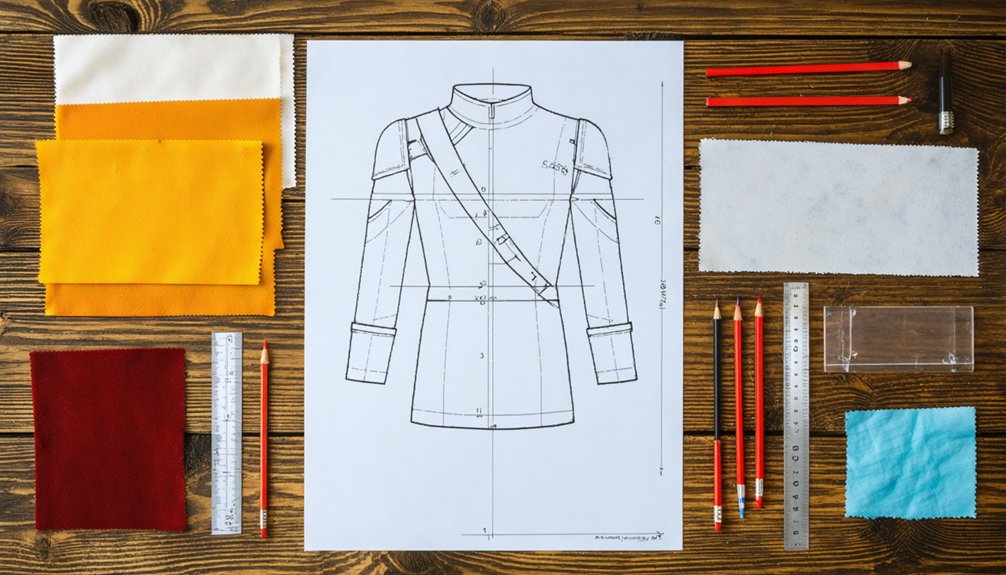
Once you’ve found a base pattern that closely resembles your character’s silhouette, you’ll need to modify it to match the costume’s specific design elements. Start by sketching the character’s unique features directly onto your kraft paper pattern, noting where standard pieces diverge from the design.
Trace the original pattern, then redraw seam lines to accommodate armor panels, asymmetrical cuts, or fabric embellishments like decorative trim and appliqués. Many video game costumes draw on historical influences, so cross-reference period construction techniques when adapting collar shapes, sleeve structures, or bodice lines.
Create a muslin mockup before cutting final fabric. Test every modification on the mockup, mark corrections with chalk, and transfer changes back to your paper pattern. Accurate seam allowances must be recalculated whenever you redraw any piece.
Draft a Video Game Cosplay Pattern From Scratch
Drafting a cosplay pattern from scratch gives you complete control over every seam line and silhouette, making it the best approach when no commercial pattern closely matches your character. Begin with kraft paper or posterboard, then follow these steps:
- Take precise body measurements using a measuring tape before sketching any shapes.
- Draft pattern pieces with rulers, marking each piece clearly to maintain pattern symmetry across mirrored components.
- Cut a muslin mockup to test fit before committing to final fabric selection.
- Transfer refined pieces to sewable tracing paper, adding seam allowances along every edge.
Tools like Freesewing.org can accelerate measurement-based drafting digitally. Whether you work by hand or algorithmically, accurate grain line notation and clearly labeled pieces prevent costly construction errors during final assembly.
Use Mockups to Test Fit Before Cutting Your Final Fabric
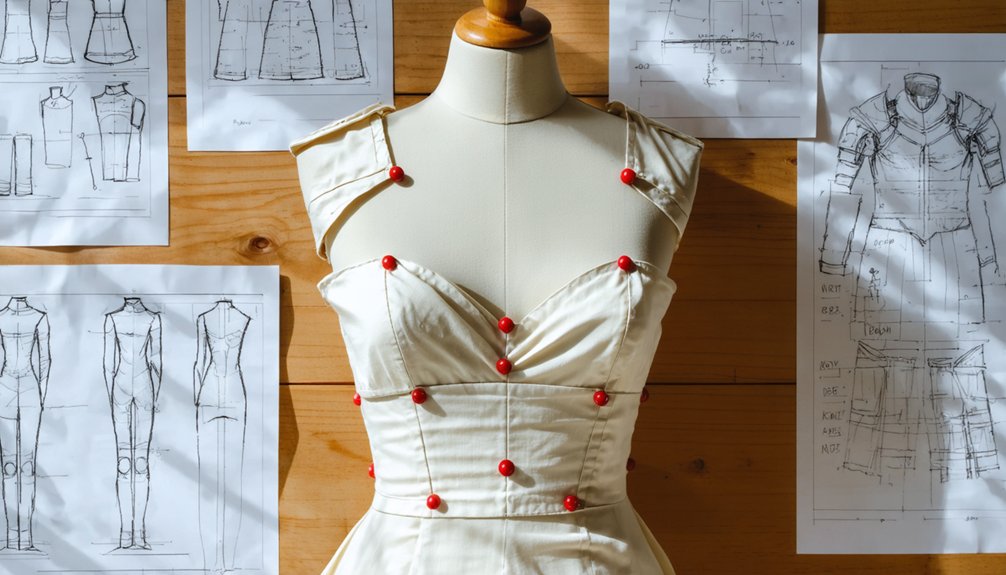
Before cutting into your final fabric, test every drafted pattern piece in muslin or scrap fabric to catch fit issues early. Pin your mockup together, wear it, and mark adjustments directly on the material with chalk. Transfer every correction back to your paper pattern before proceeding.
Mockup testing is especially critical for complex video game armor-adjacent silhouettes, where unusual seam placements can distort fit unpredictably. Evaluate ease, proportion, and movement range before committing to fabric selection, since certain materials behave differently under stress than muslin does.
Once your mockup confirms accurate fit, finalize all pattern pieces and label each one clearly with piece names, grain lines, and cut quantities. Organize them for pattern storage in labeled envelopes or flat folders, protecting them for future costume builds.
Assemble Your Video Game Cosplay for a Clean, Polished Finish
With your tested pattern pieces confirmed and labeled, lay each fabric component out on a flat surface and align every grain line precisely before pinning. Mark wrong sides with chalk to maintain orientation throughout assembly.
Prioritize color matching across seams so panels flow seamlessly on your finished costume.
Follow this assembly sequence:
- Sew primary structural seams first, pressing each allowance flat before advancing.
- Attach secondary panels and fabric embellishments only after base construction is complete.
- Install functional closures—buttonholes, zippers, or hooks—with precise edge measurements.
- Top-stitch exposed seams and waistbands on all four sides for a polished finish.
Work methodically through each numbered step without skipping stages.
Clean construction now prevents visible errors that undermine your video game character’s screen-accurate silhouette.
Frequently Asked Questions
Can I Sell Cosplay Costumes I Make Using Licensed Sewing Patterns?
Can you profit freely? You can’t—licensing considerations restrict commercial sales. Selling costumes made from licensed patterns risks copyright infringement. Check each pattern’s terms; most permit personal use only, prohibiting resale without explicit manufacturer authorization.
How Do I Scale a Pattern up or Down for a Child’s Size?
Scale your pattern by measuring a child’s body, then apply proportional pattern alteration to each piece. You’ll adjust seam lines precisely, create a muslin mockup, and match fabric selection to the resized template before cutting final pieces.
What Fabrics Work Best for Replicating Video Game Character Armor Textures?
Like sculpted steel meeting light, EVA foam transforms fabric textures into convincing armor replication. You’ll achieve best results layering craft foam with thermoplastics, then applying metallic spandex or faux leather over structured bases for authentic video game character detail.
How Do I Handle Patterns for Non-Human Video Game Characters With Unusual Proportions?
Draft your base pattern using standard measurements, then apply proportion adjustments for alien anatomy by scaling limbs and torso sections independently. You’ll use muslin mockups to test exaggerated shapes before committing to final fabric cuts.
Are Video Game Cosplay Patterns Suitable for Complete Sewing Beginners?
Some beginner friendly patterns exist, but you’ll need basic skills first. Start with Simplicity’s licensed designs, then apply pattern alteration techniques gradually. You’re better off practicing on simple garments before tackling complex video game character builds.
References
- https://www.youtube.com/watch?v=caGwoCFwxIk
- https://www.youtube.com/watch?v=CvtV3pMFZTg
- https://www.reddit.com/r/sewing/comments/18ezx57/drafting_cosplay_patterns/
- https://www.joann.com/video-game-characters/222482638P753.html