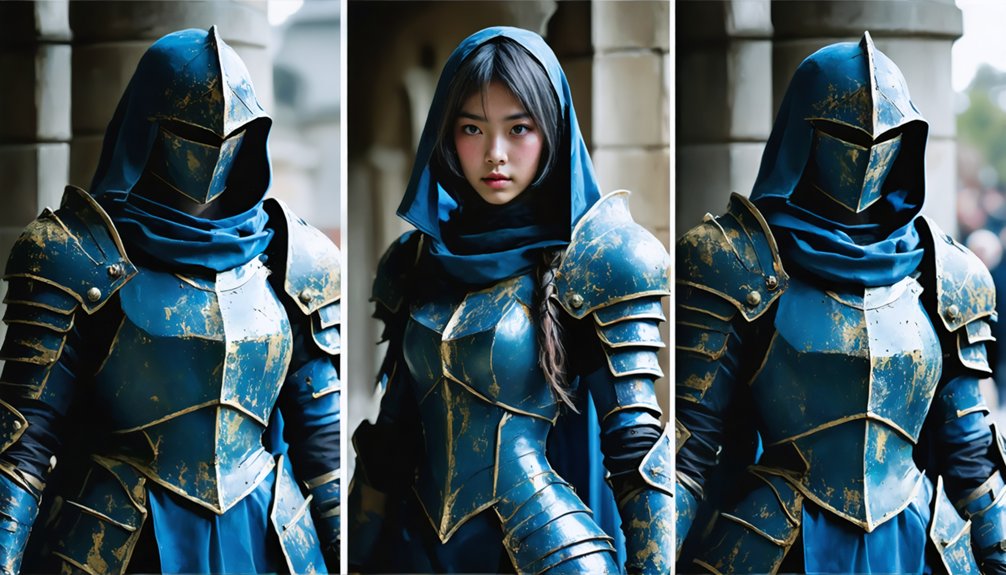
Authentic character portrayal starts with thorough research into your character’s personality, mannerisms, speech patterns, and visual references. You’ll need to rehearse body language and key poses until they’re instinctive, practice matching micro-expressions to emotional states, and deliver dialogue with accurate tone and pacing. Test your costume’s mobility and structural integrity before the event, and seek critiques from experienced cosplayers to refine behavioral accuracy. Every technique covered below will sharpen your portrayal considerably.
Key Takeaways
- Research your character’s personality, mannerisms, speech patterns, and emotional range thoroughly using official artwork and canon source material.
- Rehearse key poses and facial expressions repeatedly until body language becomes natural and instinctive during the event.
- Practice voice modulation, catchphrases, and dialogue delivery to mirror the character’s tone, pacing, and emotional range accurately.
- Test full costume mobility at home by simulating sitting, walking, posing, and navigating crowds before the event.
- Seek critiques from experienced cosplayers and compare recorded rehearsal footage against reference material for continuous refinement.
Research Your Character’s Personality, Mannerisms, and Visual References First
Before building a single piece of your costume, research your character’s personality, motivations, and emotional range thoroughly. Understanding character backstory gives your portrayal structural integrity beyond surface-level aesthetics.
Before stitching a single seam, know your character’s soul—research transforms costumes into genuine, living portrayals.
Review official artwork, screenshots, and key scenes across all available media to capture consistent visual details.
Track recurring mannerisms, speech patterns, and signature gestures that distinguish your character from others. When canon designs vary across adaptations, compare multiple references before committing to construction decisions. This cross-referencing reduces accidental visual errors and strengthens overall accuracy.
Emotional depth emerges when you identify defining quirks, posture cues, and facial expressions rooted in the character’s psychology. Authenticity isn’t achieved through costume alone—it requires behavioral precision grounded in deliberate research.
Start there, and every subsequent construction and performance decision becomes more intentional and technically sound.
Match Your Cosplay Costume to the Character’s Visual Identity
Once you’ve locked in your character research, your next task is translating that knowledge into a costume that mirrors the source material’s color palette, fabric texture, and overall visual weight. Match your fabrics as closely as possible to the character’s on-screen appearance, since the wrong sheen, drape, or tone breaks visual credibility fast.
You’ll also need to treat props and accessories as structural elements of the costume, not afterthoughts. Placing them accurately is essential to preserve the character’s iconic silhouette and screen-accurate identity.
Fabric and Color Accuracy
When selecting fabrics for your cosplay, matching the character’s color palette and texture language is just as critical as the cut and construction. Poor color matching immediately breaks visual accuracy, even when construction is flawless. Use color-matching tools or pull direct hex codes from official artwork to identify precise shades before purchasing materials.
Fabric texture carries equal weight. A character rendered in matte armor shouldn’t translate into shiny spandex, and silken robes shouldn’t become stiff canvas. Study source references closely to determine whether surfaces read as structured, flowing, worn, or pristine.
Test swatches under event lighting conditions, since colors shift dramatically under convention fluorescents versus natural light. Prioritizing both fabric texture and color matching early prevents costly rebuilds and strengthens your costume’s overall visual fidelity.
Props and Accessory Placement
Fabric and color accuracy lock in your costume’s surface identity, but props and accessory placement complete the visual argument. Incorrect prop scaling or misplaced accessories immediately breaks screen accuracy, regardless of fabric quality.
Prioritize these prop integration principles:
- Scale to canon — Match prop dimensions to official reference art, not personal preference or material convenience.
- Anchor accessories precisely — Study screenshots to confirm exact placement on the body, costume layer, or silhouette zone.
- Reinforce structural stability — Secure props so they withstand repeated posing, movement, and extended wear without shifting.
- Preserve finish quality — Match surface texture, sheen, and weathering to source material so props read as cohesive costume elements, not afterthoughts.
Accurate accessory placement transforms a recognizable costume into a convincing character statement.
Approach Cultural Costume Designs With Research, Not Assumptions
Cultural costume designs carry layered meaning that surface-level observation won’t capture, so you’ll need to research the symbolism, historical context, and community significance behind every visual element before construction begins.
Cultural sensitivity isn’t optional—it’s a foundational requirement for accurate portrayal. Engage directly with communities connected to the character’s cultural origins, and cross-reference academic sources alongside fan documentation to build a complete picture.
Stereotype avoidance requires active effort. Identify which design elements hold ceremonial weight, which are decorative, and which have been historically misrepresented in media. That distinction shapes construction decisions and performance choices equally.
Consult experienced cosplayers who’ve navigated similar cultural territory, and treat their feedback as technical data rather than opinion. Precision here protects both the character’s integrity and the culture it draws from.
Rehearse Body Language and Posture Until It Feels Natural
Body language separates a recognizable costume from a convincing portrayal, so you’ll need to rehearse posture, stance, and movement until they become automatic rather than deliberate. Pull directly from source scenes and practice until physicality stops requiring conscious effort.
- Mirror key poses from official artwork until your muscle memory locks in accurate positioning.
- Train emotional expression by matching the character’s micro-expressions to specific narrative moments, not generic moods.
- Maintain gesture consistency across photos, conversations, and event movement to prevent character breaks.
- Record rehearsal sessions and compare footage against reference material to identify drift in posture or timing.
Precision in physical performance transforms costume accuracy into full character embodiment, making every interaction feel intentional and sourced rather than improvised.
Practice Facial Expressions That Match Your Cosplay Character’s Mood
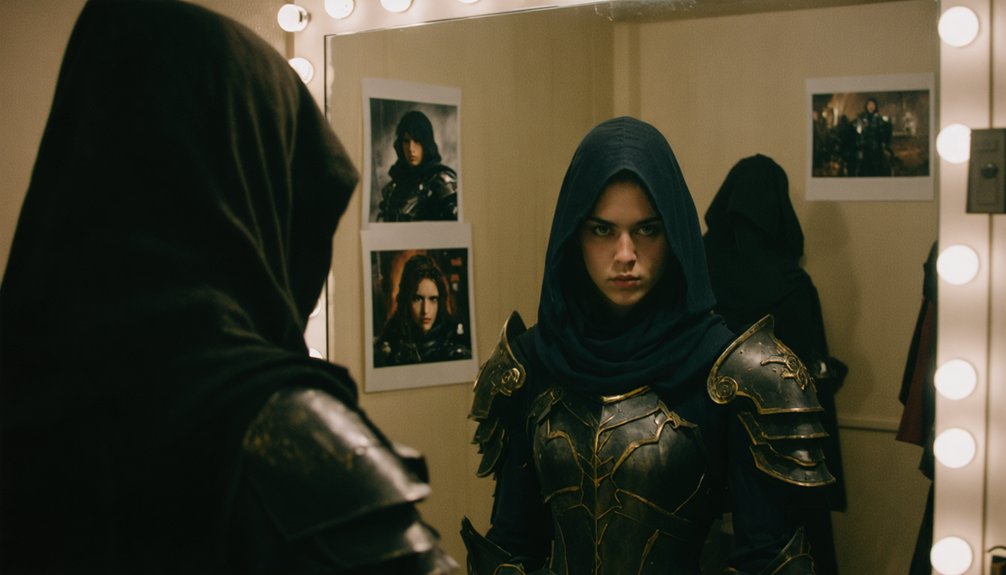
Facial expressions complete the physical performance by anchoring your portrayal in the character’s emotional logic rather than your own default reactions.
Apply emotion recognition techniques by cataloging the specific emotional states your character cycles through across key scenes. Note brow position, mouth tension, and eye intensity for each state.
Then train facial muscle control through mirror repetition until those configurations feel instinctive rather than performed.
Study reference screenshots frame by frame to isolate micro-expressions that define the character’s signature mood shifts.
Practice shifting between expressions as the character would, not as you naturally would.
During event interactions, maintain expression consistency even when you’re speaking casually.
Your face communicates character identity continuously, so deliberate muscular precision separates a convincing portrayal from a costume that simply looks the part.
Deliver Voice, Dialogue, and Catchphrases in the Character’s Style
Voice carries character identity as directly as costume silhouette, so you’ll want to match your delivery to the character’s documented speech patterns before stepping into any public interaction.
Voice modulation and catchphrase delivery are technical skills requiring deliberate rehearsal.
- Study source material for tone, pacing, and vocabulary patterns specific to your character.
- Practice voice modulation by adjusting pitch, rhythm, and intensity to mirror canon emotional ranges accurately.
- Rehearse catchphrase delivery until timing, emphasis, and inflection feel instinctive rather than performed.
- Adapt interactions contextually, responding to fans using the character’s documented temperament and relational dynamics.
Avoid adopting accents or vocal affectations unless they’re canonically established—inaccurate choices undermine authenticity.
Consistent, researched vocal performance transforms your portrayal from visual costume into a fully inhabited character presence.
Test Mobility and Endurance Before Wearing Your Cosplay to an Event
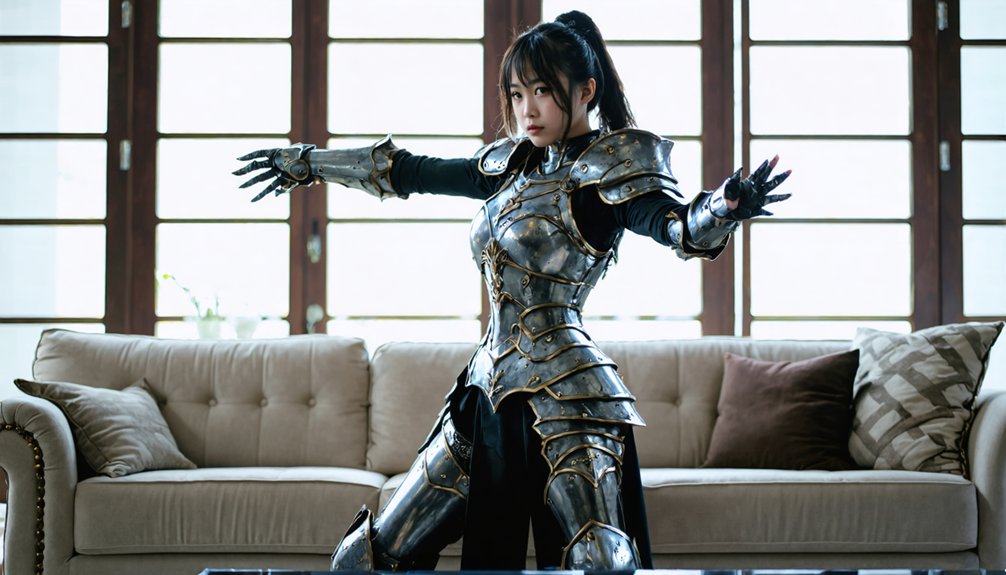
Before attending any event, wear your complete costume at home and run through your full range of motion, including sitting, walking, crouching, and posing, to catch mobility restrictions early.
Test wig stability, prop balance, and armor attachment points under realistic movement conditions rather than assuming they’ll hold during extended wear.
Plan your endurance strategy in advance by scheduling hydration breaks, identifying costume-safe rest positions, and packing emergency repair supplies to sustain performance quality throughout the event.
Pre-Event Mobility Testing
Testing your costume across three movement categories—walking, sitting, and posing—before event day reveals fit issues that static fittings miss. Fabric selection directly impacts costume durability under repeated stress, so rehearse in the complete build to expose weak points early.
- Walk continuously for 15 minutes to identify drag, hem failure, or joint restriction.
- Sit and rise repeatedly to test seam tension and armor panel alignment under compression.
- Execute your five core poses fully to confirm prop stability and wig security during dynamic positioning.
- Simulate crowded navigation by moving through tight spaces to assess silhouette clearance and accessory snag points.
Document every restriction you find and reconstruct problem areas before the event.
Endurance And Comfort Planning
Makeup techniques should be tested for longevity under heat, sweat, and physical activity—not just appearance. Set products with appropriate sealers and identify which formulas degrade fastest.
Build a touch-up kit targeting those specific failure points. Plan scheduled breaks into your event timeline to preserve both physical performance and costume integrity.
Endurance isn’t optional—it’s infrastructure for consistent, high-quality character portrayal throughout the entire event.
Ask Experienced Cosplayers to Help You Spot What You’re Missing
Even the most detail-oriented cosplayers develop blind spots, so getting outside perspective from experienced cosplayers can surface gaps you’d never catch on your own. Their trained eye catches inconsistencies in character development, emotional depth, and physical execution that self-review misses.
- Request posture critiques during full-costume rehearsals to identify stance drift from canon references.
- Share video footage of your movement and poses so reviewers can assess behavioral accuracy frame by frame.
- Ask specifically about emotional depth—whether your expressions and gestures reflect the character’s psychological core.
- Cross-reference feedback from multiple experienced cosplayers to separate subjective preference from genuine accuracy gaps.
Treat every critique as technical data. Targeted external feedback accelerates refinement faster than isolated self-assessment ever will.
Frequently Asked Questions
How Do You Stay in Character When Something Unexpected Happens at Events?
Ironically, chaos is your best stage. Filter surprises through your character’s mindset to maintain emotional consistency. You’ll turn disruptions into audience engagement gold by responding with the temperament, instincts, and reactions your character would authentically express.
Can You Cosplay a Character Whose Gender Differs From Your Own?
You can absolutely pursue gender bending cosplay by adapting silhouettes, tailoring, and styling to fit your physique. Cross gender interpretation lets you honor a character’s core identity while innovating the visual presentation authentically.
How Do You Handle Fans Who Challenge Your Character Interpretation Publicly?
When facing public criticism during fan interaction, stay grounded in your research. You’ve studied the character deeply, so acknowledge differing views respectfully, cite your source references confidently, and redirect conversation toward shared enthusiasm for the character.
Is It Acceptable to Combine Elements From Multiple Versions of One Character?
Like a director’s cut blending the best takes, you can absolutely combine elements from multiple versions. Prioritize costume accuracy and character consistency by cross-referencing sources, ensuring your hybrid design still communicates a coherent, recognizable identity.
How Do You Manage Character Immersion During Necessary Out-Of-Character Breaks?
Step away deliberately, use breaks for costume maintenance, and practice emotional boundary setting so you’re re-entering character with intention. You’ll preserve immersion quality by mentally “switching on” through a signature pose or breath before re-engaging.
References
- https://www.reddit.com/r/cosplayers/comments/1re6x05/question_for_cosplayers_about_character/
- https://starstruckpanda.com/creating-authentic-character-portrayals-in-cosplay/
- https://starstruckpanda.com/engaging-audience-with-character-portrayal-in-cosplay/
- https://www.jay-japan.com/blogs/otaku-spot/cosplay-like-a-pro-7-expert-tricks-for-authentic-anime-character-portrayal
- https://springventuresllc.com/mastering-character-portrayal-a-guide-to-immersive-cosplay/
- https://starstruckpanda.com/creating-authentic-character-details-for-cosplay-success/