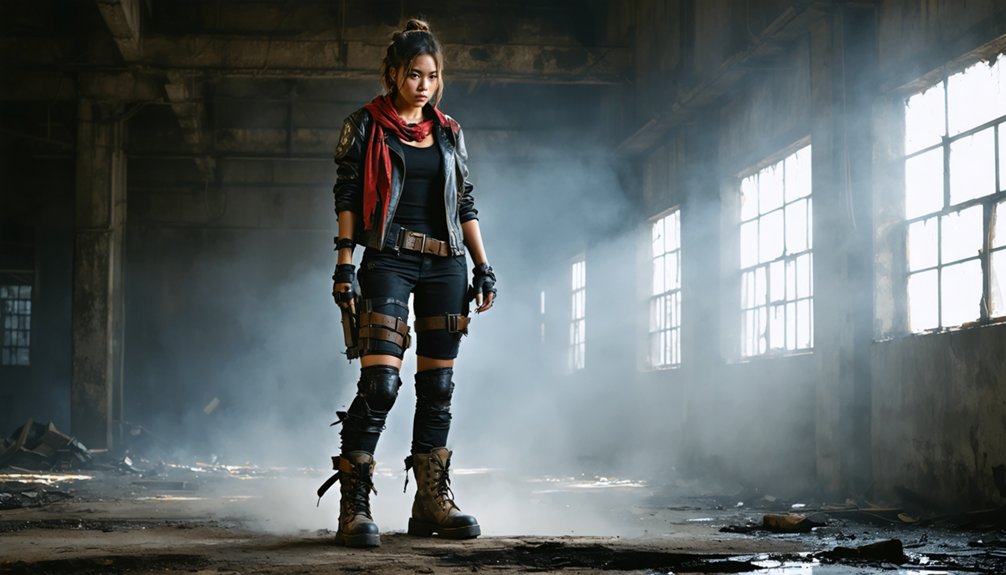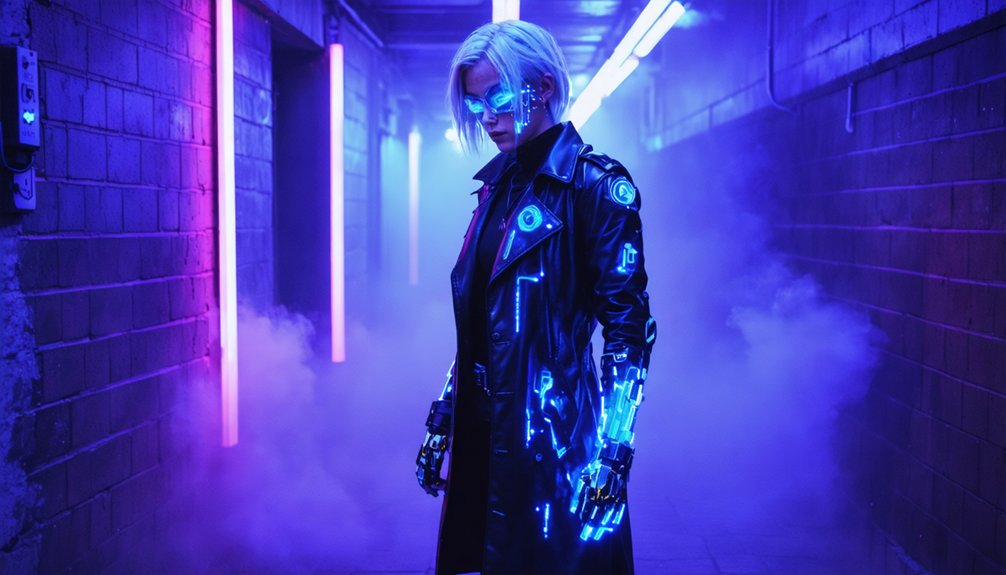
For futuristic cyberpunk cosplay, you’ll find the strongest inspiration in characters like Johnny Silverhand, Adam Jensen, and Quorra, each built around a distinct material language of matte black bodysuits, wired lighting rigs, and sculpted augmentations. Alita demands dimensional metalwork and prosthetic construction, while Quorra rewards precision with electroluminescent geometry. Whether you’re building from scratch or combining commercial pieces with custom upgrades, your material choices define everything — and there’s far more technical depth ahead to help you nail it.
Key Takeaways
- Johnny Silverhand and Adam Jensen are top cyberpunk cosplay choices, offering rebellious rock-mercenary and sleek augmented silhouette aesthetics respectively.
- Alita and Quorra are standout options, combining mechanical prosthetics, black latex bodysuits, and glowing electroluminescent circuit lines.
- Building from scratch offers full creative control, while combining commercial base pieces with custom elements balances efficiency and personalization.
- Black latex, sculpted metals, fiber optics, and LED lighting are essential materials for achieving authentic cyberpunk visual impact.
- Budget-friendly cosplay is achievable using thrift store finds, electrical tape, salvaged components, and UV-reactive fabrics from platforms like Etsy.
Best Video Game Characters for Cyberpunk Cosplay
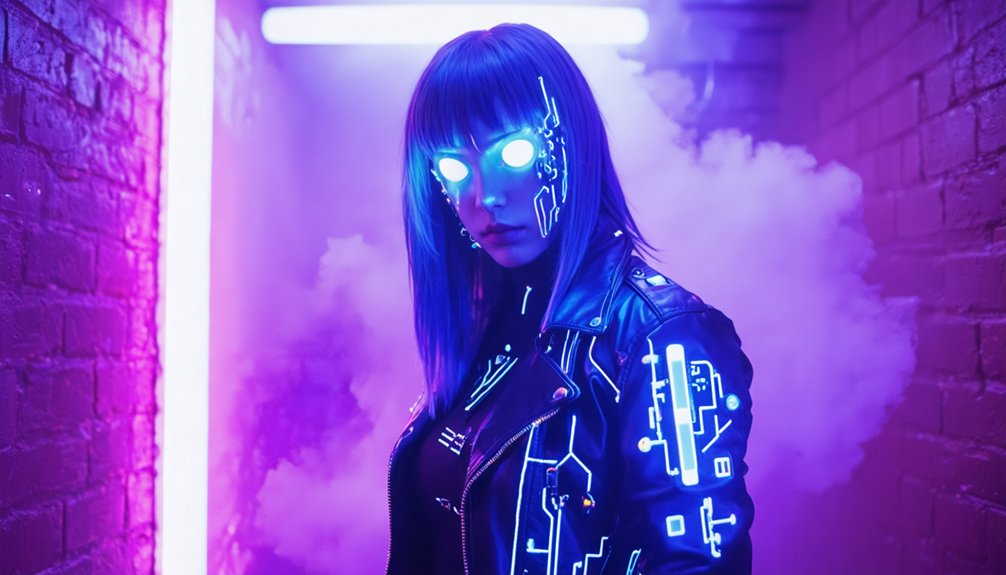
Video games offer some of the most meticulously designed cyberpunk characters available for cosplay inspiration, with franchises like Cyberpunk 2077 and Deus Ex establishing visual benchmarks that blend tactical styling with high-tech aesthetics.
Johnny Silverhand’s rebellious rock-mercenary look contrasts sharply with V customization options, letting you tailor futuristic fashion to your personal vision.
Adam Jensen’s sleek augmented silhouette delivers mechanical precision, while Lucy outfit elements combine bodysuit and jacket construction beautifully.
Beyond gaming, Alita prosthetics introduce dimensional metalwork, Quorra lines offer minimalist glowing geometry, and SHODAN creativity enables fiber optic and LED experimentation.
Ana Shrike provides an underutilized alternative with aggressive cyberpunk detailing. Each character gives you a structured design framework, letting you build technically ambitious costumes without sacrificing authentic futuristic character integrity.
Top Anime and Film Characters Worth Cosplaying
If you’re ready to pull inspiration from anime and film, you’ll find that Alita from *Battle Angel Alita* delivers a technically demanding build centered on metal prosthetics and black latex construction, with source material available from both the original manga and the 2019 film adaptation.
Quorra from *Tron: Legacy* challenges you to master electroluminescent wire and LED integration, replicating her minimalist black suit’s signature glowing circuit lines with precision.
For maximum creative latitude, SHODAN from *System Shock* invites you to engineer a wearable installation using fiber optics, fragmented visor elements, and programmable lighting arrays that capture her fractured, machine-god aesthetic.
Alita Battle Angel Cosplay
Alita from *Battle Angel Alita* gives you two distinct design directions to work with — the manga version or the live-action film adaptation — and both translate beautifully into cyberpunk cosplay.
Alita’s design centers on a striking contrast between her organic face and fully mechanical body, making prosthetic construction your primary technical challenge. You’ll want to source black latex fabrics for her bodysuit foundation, then layer sculpted metal prosthetic components over the arms and torso.
Alita’s aesthetics demand precision — rough, unfinished metalwork reads authentically dystopian, while polished surfaces shift the tone toward cinematic polish.
Choose your version deliberately, then commit to the material language it requires. Either interpretation rewards cosplayers who prioritize dimensional fabrication and structural detail over surface-level costume assembly.
Quorra From Tron Legacy
Quorra’s suit from *Tron: Legacy* strips cyberpunk cosplay down to its most architectural form — a matte black bodysuit defined almost entirely by its glowing circuit lines rather than surface texture or mechanical detail.
When you’re building from Quorra design elements, precision matters more than ornamentation. You’ll map electroluminescent wire or flexible LED strips along geometric pathways across the torso, arms, and legs, keeping every line clean and intentional.
The silhouette stays tight and uncluttered, so material quality becomes non-negotiable — opt for matte spandex or scuba fabric to absorb light rather than reflect it.
Quorra costume inspiration rewards minimalist discipline; the power comes entirely from contrast between deep black and cold luminescence, making technical execution your single most important creative tool.
SHODAN System Shock Design
Executing SHODAN concepts authentically means layering AI aesthetics through deliberate material choices:
- Fiber optic threading woven through pale fabric mimics corrupted data streams across her form.
- Fragmented face paneling using rigid geometric pieces suggests a shattered digital consciousness reconstructing itself.
- LED matrix grids mapped onto bodysuit sections replicate circuit-board logic made physical.
Every construction decision should reflect instability and dominance simultaneously.
She radiates cold intelligence through visual noise, not polish — embrace asymmetry, glitch-inspired distortion, and monochromatic contrasts to deliver a genuinely unsettling, technically ambitious build.
The Core Traits Every Cyberpunk Costume Needs
Whether you’re cosplaying an established character or building an original concept, every convincing cyberpunk costume shares a distinct set of visual and material signatures. Your character silhouette should communicate tension between human form and machine integration — sharp angular lines, structured shoulders, and form-fitting layers achieve this effectively.
Every convincing cyberpunk costume communicates tension between human form and machine integration through sharp lines and structured silhouettes.
Black latex, matte vinyl, and tactical fabrics establish your foundational palette.
From there, futuristic accessories escalate authenticity considerably. Incorporate fiber optic threading, embedded LEDs, or segmented mechanical prosthetics to signal technological immersion. Glowing accent lines reference the digital infrastructure underlying cyberpunk’s dystopian world-building.
Functionality matters too — layered armor panels, utility harnesses, and circuit-printed textiles reinforce tactical credibility.
Every material choice should suggest a world where biological and technological systems have permanently merged.
Build or Buy? Cyberpunk Cosplay Construction Options

When building your cyberpunk costume from scratch, you’ll gain full creative control over every mechanical augmentation, LED integration, and fabric choice. However, you’ll need technical skills in sewing, electronics, and prop fabrication to execute it properly.
Alternatively, purchasing commercial base pieces — bodysuits, jackets, and pre-made armor components — lets you fast-track construction while still leaving room for personalized modifications that sharpen the overall aesthetic.
Your best approach often combines both methods, buying foundational garments and then upgrading them with custom-crafted prosthetics, fiber optic accents, and tactical detailing that transforms a generic outfit into a precisely realized cyberpunk character.
DIY Construction Techniques
Deciding between building your cyberpunk costume from scratch or buying pre-made pieces shapes every construction decision that follows.
DIY techniques give you precision control over every seam, circuit, and surface finish. Your material choices directly determine authenticity and durability.
Core DIY construction approaches include:
- Latex fabrication – Cut and heat-bond black latex panels into fitted bodysuits, creating that signature second-skin silhouette.
- LED and fiber optic integration – Solder micro-controllers into jacket linings, routing fiber optic strands through seams for programmable glow effects.
- Mechanical augmentation crafting – Sculpt Worbla or thermoplastic into prosthetic limb covers, then layer metallic paint finishes for dimensional realism.
Each technique demands technical investment but delivers results that pre-made costumes simply can’t replicate.
You’re engineering wearable technology, not just assembling fabric.
Commercial Costume Sourcing
Not every cosplayer has access to a soldering iron, thermoplastic sheets, or the hours required to hand-bond latex panels—and that’s where commercial costume sourcing earns its place in your build strategy.
Tracking commercial costume trends reveals a growing marketplace offering pre-constructed bodysuits, modular armor pieces, and LED-integrated jackets calibrated specifically for cyberpunk aesthetics.
When sourcing materials commercially, prioritize vendors supplying UV-reactive fabrics, pre-wired fiber optic panels, and adjustable mechanical augmentation components that integrate cleanly with custom additions.
Platforms like Etsy, AliExpress, and specialized cosplay retailers stock Lucy’s jacket silhouette, Adam Jensen-inspired tactical coats, and Alita-style latex frameworks.
Purchasing foundational pieces strategically reduces construction time while preserving bandwidth for technical modifications—letting you focus creative energy on electronics integration, weathering details, and personalized augmentation work.
Black Latex, Metals, and Lighting: Your Cyberpunk Materials Guide
Building an authentic cyberpunk costume starts with mastering three core material categories: black latex, metals, and lighting. Strategic material sourcing determines whether your build reads as genuinely futuristic or falls flat. Each category serves a distinct structural purpose:
- Black latex establishes your base layer, creating that signature sleek, skin-tight silhouette essential to cyberpunk aesthetics.
- Metals introduce dimensional augmentation elements, transforming flat costume surfaces into tactile, mechanically complex assemblies.
- Lighting techniques using fiber optics and LED strips inject dynamic luminosity, animating your costume with technological authenticity.
Combine these three elements deliberately. Layer latex beneath metal prosthetics, then thread fiber optics through augmentation joints for maximum visual impact.
Your lighting techniques should highlight structural details rather than overwhelm them, keeping the overall design sharp and intentional.
How to Wire LEDs and Fiber Optics Into Any Cyberpunk Build
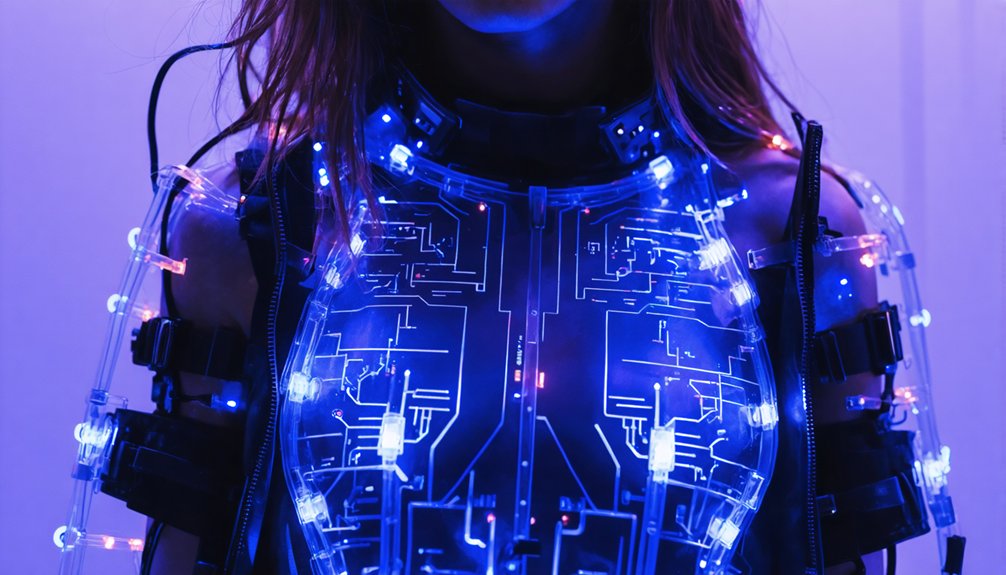
Wiring LEDs and fiber optics into your cyberpunk build transforms static costume pieces into living, breathing technological displays — but only if you approach the integration systematically.
Start your LED integration by mapping power routes before cutting fabric — identify battery placement, calculate voltage requirements, and plan concealed wiring channels. Use thin, flexible conductive thread for seam-embedded circuits, keeping connections soldered and heat-shrink wrapped against movement stress.
Plan before you cut — map every power route, battery position, and wiring channel first to save your build.
For fiber optic techniques, bundle strands through drilled acrylic panels or layered fabric, terminating each cluster at a single LED source to maximize luminosity efficiency.
Controller boards like Arduino Nano let you program pulse sequences, creating organic breathing effects rather than static glow.
Always test complete circuits before final assembly — troubleshooting live costumes destroys seams and wastes hours.
Lights, Augmentations, and Color Palettes That Define the Look
Once you’ve mapped your wiring and locked in your power systems, the visual language of your costume comes down to three interdependent elements: lights, augmentations, and color.
Each element reinforces the others through deliberate design decisions:
- Lighting techniques: Use cold whites and electric blues for neural implant glows; amber and red tones signal damaged or rogue tech.
- Augmentation effects: Layer rigid resin pieces over fabric to simulate subdermal hardware, then run fiber optics through seams for bioluminescent depth.
- Color palettes: Anchor everything in matte black, then introduce chromatic accents—neon cyan, magenta, or sickly green—to direct the eye toward your tech details.
These three systems work symbiotically. Neglect one, and your build reads as incomplete rather than intentionally dystopian.
How to Design an Original Cyberpunk Cosplay Character
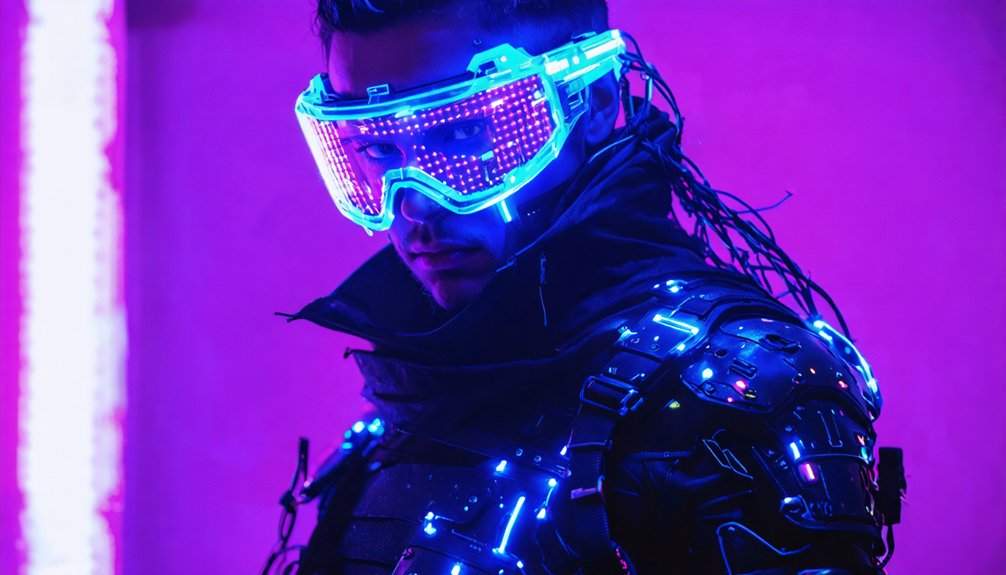
Designing an original cyberpunk character gives you something no licensed cosplay can—complete creative ownership over every aesthetic decision, from silhouette to circuitry.
Start with a character backstory that informs every material choice. Is your character a corporate mercenary, a rogue netrunner, or a street-level augmentation technician? That context drives your design inspiration organically.
Build your foundation using black latex or tactical fabrics, then layer mechanical augmentations that reflect your character’s function.
Integrate LED strips or fiber optics along seams and prosthetic edges to establish technological authenticity. Combine dystopian silhouettes with precise, purposeful details—avoid decorating without narrative reason.
Every component should communicate who your character is within their fictional world. Original design lets you fuse tactical, futuristic, and mechanical elements into something distinctly, unmistakably yours.
Budget Tips for an Authentic Cyberpunk Cosplay
Pulling off an authentic cyberpunk cosplay doesn’t require a corporate budget—it requires strategic sourcing and smart material substitution. Thrift store finds transform ordinary jackets into tactical masterpieces with minimal investment.
Authentic cyberpunk cosplay demands resourcefulness, not a corporate budget—thrift stores are your most powerful tactical weapon.
You’ll discover budget friendly materials hiding in unexpected places:
- Electrical tape and metallic spray paint replicate glowing circuit patterns on black fabric foundations
- Salvaged electronics components—circuit boards, wiring, and LED strips—create convincing mechanical augmentation details
- Secondhand leather and vinyl jackets provide authentic texture that expensive specialty retailers can’t outperform
Layer these elements deliberately. Sand hardware pieces for weathered texture, integrate salvaged fiber optics through existing seams, and weaponize hot glue for structural prosthetic construction.
Your cyberpunk aesthetic emerges from resourceful technical execution, not premium spending.
Frequently Asked Questions
Which Cyberpunk Cosplay Conventions Are Most Welcoming to Original Character Designs?
You’ll find Dragon Con and PAX events most welcoming to original character inspiration, celebrating unique cyberpunk design elements. They’re ideal for showcasing your innovative, technically crafted costumes that blend futuristic aesthetics with personalized mechanical augmentations and creative lighting.
How Do I Safely Wear Black Latex Costumes for Extended Convention Hours?
You’ll maximize comfort by applying silicone-based lubricant for latex care, wearing moisture-wicking underlayers, scheduling regular ventilation breaks, and staying hydrated. These comfort tips guarantee you’re performing confidently throughout extended convention hours without overheating.
Can Cyberpunk Cosplay Costumes Be Adapted for Outdoor Festival Environments?
You can absolutely adapt cyberpunk cosplay for outdoor festivals! Swap delicate latex for festival-friendly materials like weatherproof vinyl, then integrate weather-resistant accessories — think sealed LED components and reinforced mechanical augmentations — balancing futuristic aesthetics against practical environmental durability.
What Photography Techniques Best Capture LED Lighting Effects in Cyberpunk Costumes?
Shoot in manual mode, reducing ambient light to let LED lighting dominate. Use slow shutter speeds for effect enhancement, capturing costume details with precision. These photography tips transform your cyberpunk look into a stunning, innovative visual masterpiece.
Are There Cyberpunk Cosplay Communities or Groups Available for Beginners to Join?
You’ll find thriving cyberpunk cosplay communities on Reddit, Discord, and Facebook, offering costume resources, tutorials, and community events where you can connect with experienced builders who’ll guide your futuristic creative journey.
References
- https://www.creativecosplays.com/post/top-10-cyberpunk-cosplay-ideas-for-futuristic-looks
- https://devilwalking.com/collections/cyberpunk-clothing-and-outfits
- https://www.etsy.com/market/futuristic_cyberpunk_outfit